Deadline Island — Samplerman

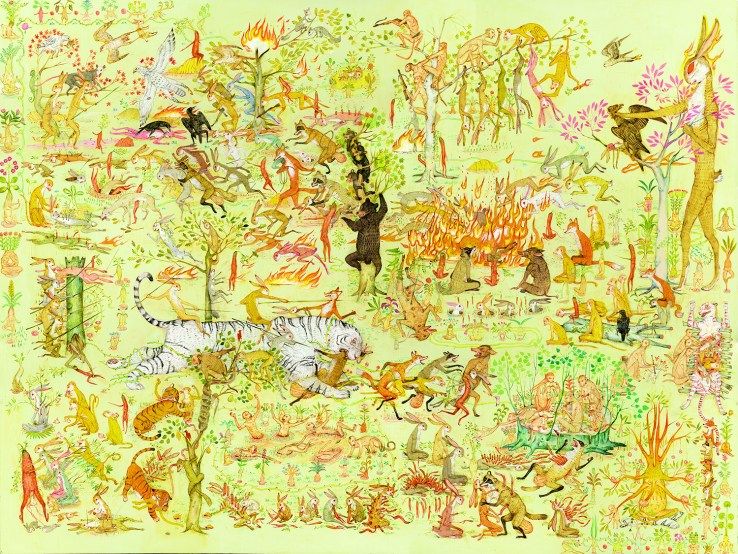
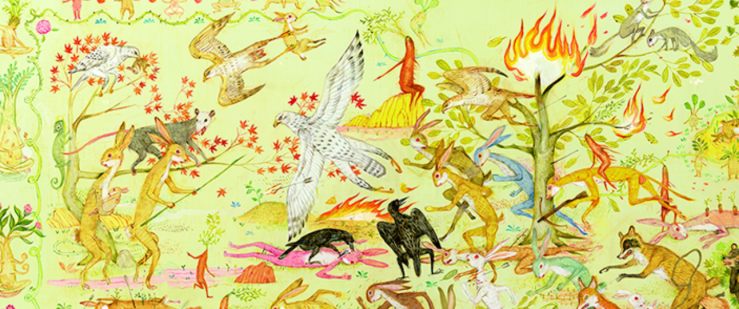
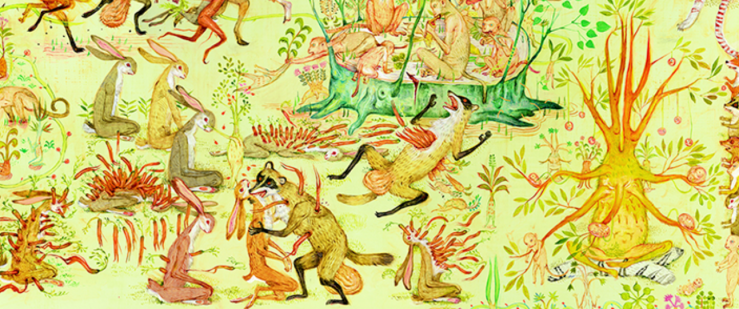
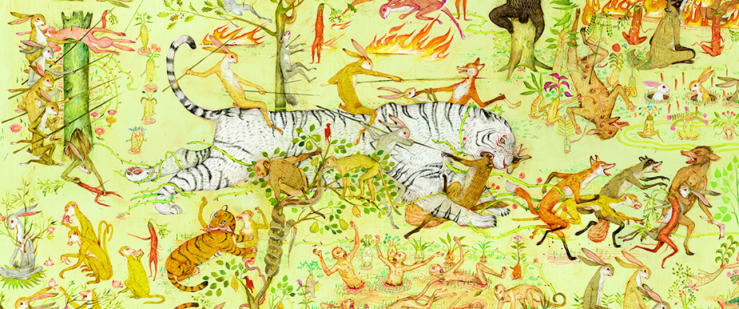
Deadline Island, 2019 by Samplerman (Yvan Guillo)

Rabbits — Mu Pan

Rabbits, 2020 by Mu Pan (b. 1976)

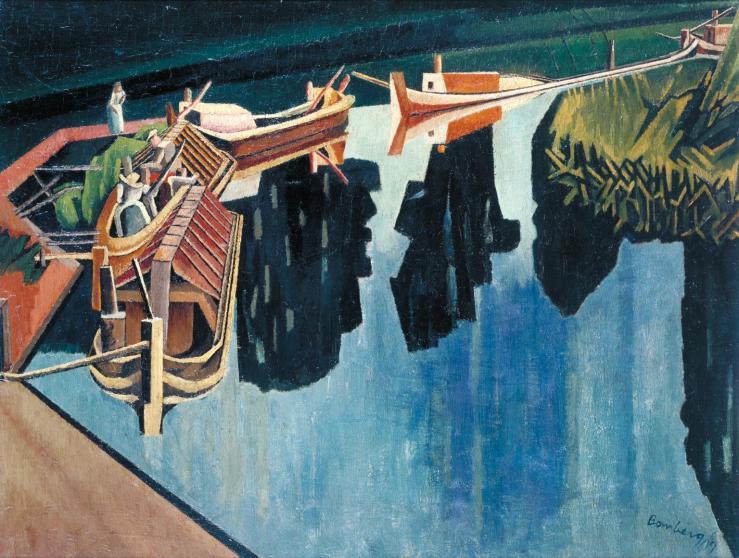
Barges — David Bomberg

Barges 1919, by David Bomberg (1890-1957)

“The Tale of the Two Hunchbacks” | An excerpt from Fernanda Melchor’s novel Hurricane Season

And Norma nodded and apologized and washed her blood-soaked knickers in secret so that her mother wouldn’t throw her out, so that she wouldn’t discover that her worst fear had come true, until finally one day Norma realized she’d been wrong all that time: the Sunday seven wasn’t the blood that stained her underwear but what happened to your body when that blood stopped flowing. Because one day, on her way home from school, Norma found a little paperback book with a ripped cover and Fairy Tales for Children of All Ages written across it, and on opening it at random the first thing she saw was a black-and-white illustration of a little hunchback crying terrified while a coven of witches with bat wings stabbed the hunch on his back, and the illustration was so strange that, ignoring the time and the ominous rain clouds, ignoring the dishes waiting to be washed and her siblings who needed feeding before their mother got home from the factory, Norma sat down at the bus stop to read the whole story, because at home there was never time to read anything, and even if there were she wouldn’t be to, with her siblings’ racket, the blare of the TV and her mother’s constant yelling, not to mention Pepe’s fooling around or the piles of homework that awaited her each night after washing the pots, which she herself had used at noon before leaving for school; and so she pulled the hood of her coat over her head and folded her legs under her skirt and she read the whole story from start to finish, the tale of the two hunchbacks, that’s what the fairy tale was called, and it was about a hunchback who lost his way one evening in the woods close to his home, dark and sinister woods where witches were said to meet to do their evil deeds, and that was why the little fellow was so frightened to find himself lost there, unable to find his way home, wandering blindly as night fell, until suddenly he spied a fire in the distance, and thinking it might be a campfire he ran towards it, convinced that he’d been saved. So imagine his surprise when he arrived at the clearing with the gigantic fire only to realize it was a Witches’ Sabbath: a coven of horrifying witches with bat wings and claws instead of hands, all dancing around the blazing fire in the most macabre fashion while they sang: Monday and Tuesday and Wednesday, three; Monday and Tuesday and Wednesday, three; Monday and Tuesday and Wednesday, three, and they were cackling their terrible witchy cackles and howling up at the full moon, and the hunchback, who, still unseen, had taken cover behind an enormous rock not far from the fire, listened to that cyclic chant and, unable to explain how, unable to explain the overwhelming urge that came over him, took a deep breath as the witches sang their next Monday and Tuesday and Wednesday, three, jumped onto the rock and shouted at the top of his lungs: Thursday and Friday and Saturday, six! His cry resounded with surprising force in that clearing, and on hearing him the witches froze where they were, petrified around the fire that was casting horrible shadows on their beastly faces. And seconds later they were all running around, hovering between the trees, shrieking and hollering that they had to find the human who’d said that, and the poor hunchback, once again crouched behind the rock, trembled at the thought of the fate awaiting him, but when at last the witches found him they didn’t hurt him as he’d imagined, nor did they turn him into a frog or a worm, or much less eat him. Instead, they took the man and cast spells to conjure enormous magical knives, which they used to cut off his hunch, all without spilling a drop of blood or hurting him at all, because the witches were pleased that the little fellow had improved their song, which, truth be told, they were beginning to find a little boring, and when the hunchback saw that he no longer had a hump, that his back was completely flat and that he didn’t have to walk hunched over, he was happy, enormously happy and contented, and as well as curing his hump the witches also gave him a pot of gold and thanked him for having improved their song, and before resuming their Witches’ Sabbath they showed him the way out of that enchanted part of the woods, and the little man ran all the way home and straight to his neighbor, who was also a hunchback, to show him his back and the riches he’d received from the witches, and his neighbor, who was a mean, jealous man, believed that he deserved those gifts more, because he was more important and more intelligent and those witches must be real fools to go around giving away gold just like that, and by the following Friday the jealous hunchback had convinced himself that he should copy his neighbor, and as night fell he entered the woods in search of that coven of cretinous hags and he walked for hours in the darkness until he, too, lost his way, and just as he was about to collapse against a tree and cry out in fear and desperation he glimpsed, in the distance, in the thickest, gloomiest part of the woods, a fire surrounded by witches dancing and singing: Monday and Tuesday and Wednesday, three; Thursday and Friday and Saturday, six; Monday and Tuesday and Wednesday, three; Thursday and Friday and Saturday, six, and with that the jealous neighbor scurried towards them and hid behind the same enormous rock, and at the next round of Monday and Tuesday and Wednesday, three; Thursday and Friday and Saturday, six, the vile little man – who, despite believing himself more intelligent than his neighbor, was not the smartest of fellows – opened his mouth, took the deepest breath he could, cupped his hands around his lips and shouted: SUNDAY SEVEN! with all his might. And when the witches heard him they froze on the spot, petrified in the middle of their dance, and that dimwit of a hunchback emerged from his hiding place and opened his arms to reveal himself, thinking they’d all flock to him to fix his hunchback and hand him a pot of gold even bigger than the one they’d given his neighbor, but instead he saw that the witches were furious, clawing at their chests and yanking out great clumps of flesh with their own nails, scratching their cheeks and pulling the flowing hair that crowned their horrific heads, roaring like wild beasts and screaming: Who’s the fool who said Sunday? Who’s the wretch who ruined our song? And then they caught sight of the mean little man and zoomed towards him, and with hexes and jinxes they conjured the hump they’d removed from the first man and put it on him, and as a punishment for his imprudence and greedthey placed it on his front, and instead of a pot of gold they pulled out a pot of warts that hopped out of the container and immediately stuck to the body of that despicable man, who was left with no choice but to return to the town like that, with two humps instead of one and warts all over his face and body, and all for having come out with his Sunday seven, the book explained – and in the final illustration of the story the jealous neighbor appeared with those two humps, one deforming his back and the other making him look pregnant, and that was the moment Norma finally understood how silly she’d been to think that the fateful Sunday seven was the blood that stained her knickers each month, because clearly what it referred to was what happened when that blood stopped flowing; what happened to her mother after a spell of going out at night in her flesh-colored tights and her high heels, when from one day to the next her belly would start to swell, reaching grotesque proportions before finally expelling a new child, a new sibling for Norma, a new mistake that generated a new set of problems for her mother, but, above all, for Norma: sleepless nights, crushing tiredness, reeking nappies, mountains of sicky clothes, and crying, unbroken, ceaseless crying. Yet…


From Fernanda Melchor’s novel Hurricane Season. English translation by Sophie Hughes. From New Directions (US)  and Fitzcarraldo Editions (UK) .

Jean-Patrick Manchette’s The N’Gustro Affair (Book acquired 11 Aug. 2021)

Jean-Patrick Manchette’s The N’Gustro Affair is forthcoming from NYRB in a translation by Donald Nicholson-Smith. NYRB’s blurb:

Mean, arrogant, naive, sadistic on occasion, the young Henri Butron records his life story on tape just before death catches up with him: a death passed off as a suicide by his killers, French secret service agents who need to hush up their role—and Butron’s—in the kidnapping, torture, and murder of a prominent opposition leader from a third-world African nation in the throes of a postcolonial civil war.

The N’Gustro Affair is a thinly veiled retelling of the 1965 abduction and killing of Mehdi Ben Barka, a radical opponent of King Hassan II of Morocco. But this is merely the backdrop to Jean-Patrick Manchette’s first-person portrait (with shades of Jim Thompson’s The Killer Inside Me) of a man who lacks the insight to see himself for what he is: a wannabe nihilist too weak to be even a full-bore fascist.

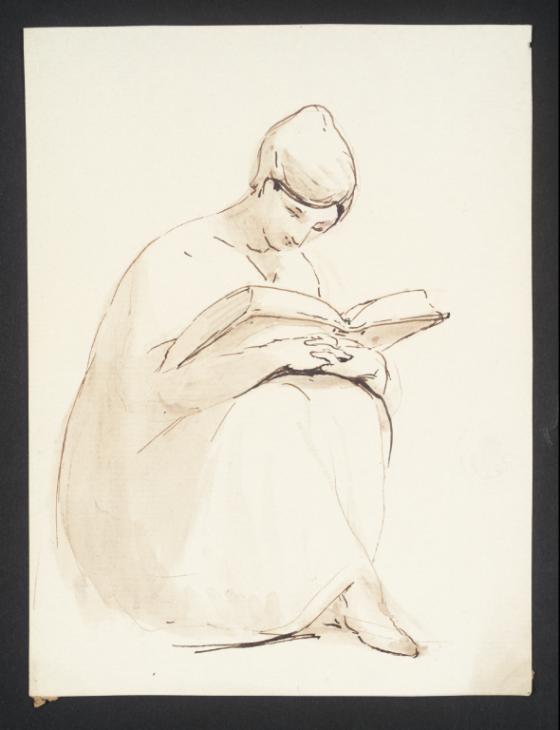
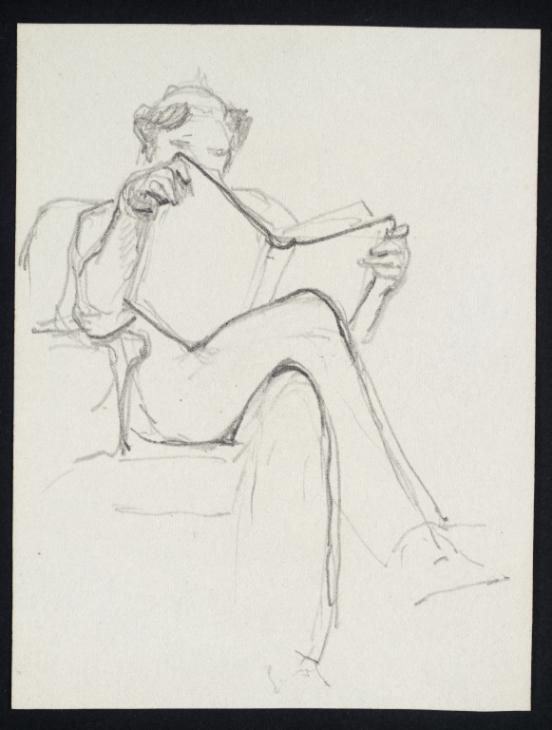
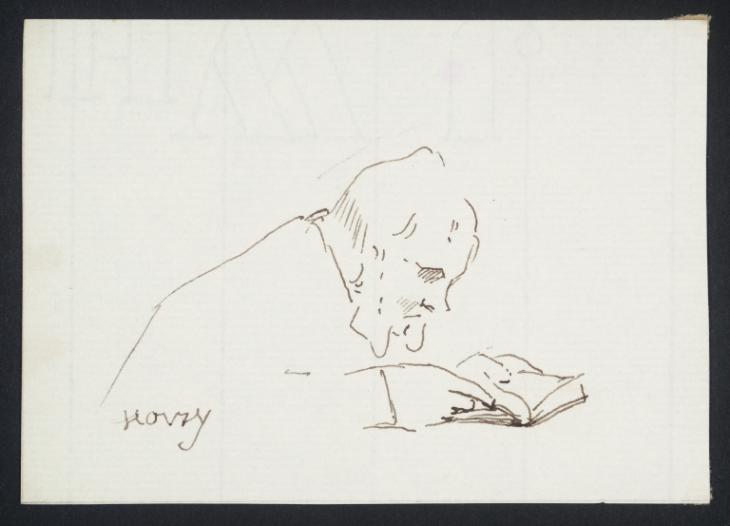
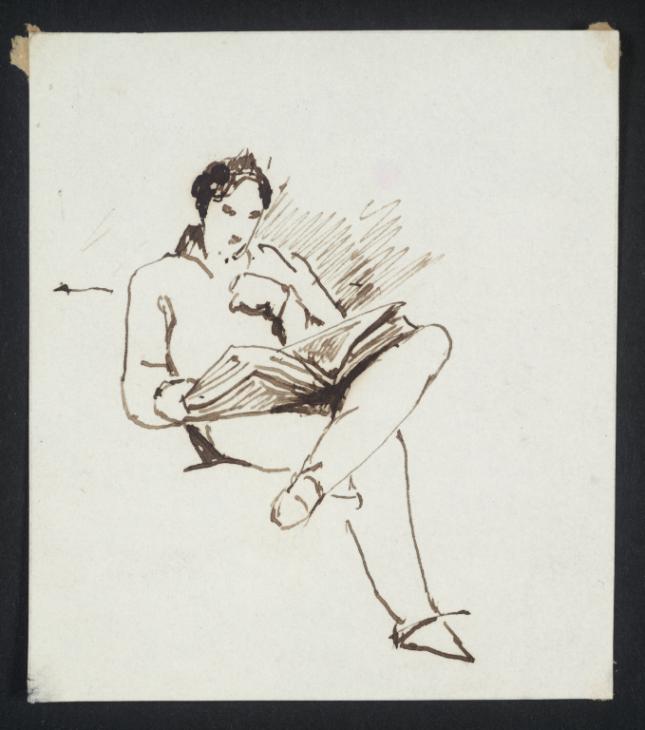
Seven sketches of people reading by George Jones


Untitled, undated sketches of readers by George Jones (1786–1869)

Abe/Melchor/Schwartz (Books acquired, 13 Aug. 2021)

Got some books today.

Last month I wrote a little bit about slowly converting hundreds of my grandmother’s books into store credit. I still have a closet full of boxed books. In the post I linked to above, I wrote about picking up Kobo Abe’s Secret Rendezvous, which I still haven’t read, which didn’t stop me from picking up two more today.

I ordered a copy of his most famous novel, The Woman in the Dunes (translation by E. Dale Saunders), on the recommendation of the bookseller who rang up Secret Rendezvous for me. (We chatted about Ballard and a few other writers and I recommended Martin Bax’s overlooked novel The Hospital Ship.) I picked it up today. The Vintage International edition I got includes wonderful illustrations by Machi Abe, like the one below (unfortunately the art director did not choose to adapt one for the cover):

I also got Beasts Head for Home (translation by Richard F. Calichman), an earlier less-celebrated novel.

I’d been wanting to read Fernanda Melchor’s Hurricane Season (translation by Sophie Hughes), so I ordered it as well. It’s been compared to both 2666 and Faulkner, so I have high expectations. (Flicking through it recalls Krasznahorkai or Sebald or Bernhard—big long paragraphless chunks.)

I also picked up Francie Schwartz’s memoir Body Count, somewhat at random, based on the title and the spine. It was shelved incorrectly (or maybe correctly?) in “General Fiction.” I opened it to see that it was a first edition, 1972, dedicated to Norman Mailer. Unless I’m wrong, it’s one of only two editions, the other being a British hardback copy. Flicking through it, the chapter titles, the mostly-written-in dialogue prose, and the general themes of sex drugs rocknroll interested me enough to look it up while I was in the store. The first google hit was for an Amazon listing pricing the book at over a thousand dollars, so I left with it. The main attraction for this book seems to be a brief affair Schwartz had with Paul McCartney. I read through some of those bits, and they seem juicy enough I guess.

I’ll read either the Melchor or Abe’s The Woman in the Dunes next. (I finished Carol Emshwiller’s novel Mister Boots this morning and loved it. Not sure if I’ll ever get my shit together enough to write a real review again though. Peace.)


Salomé — Paul Iribe

Salomé, 1916 by Paul Iribe (1883–1935)

Off to the Pub — Walter Richard Sickert


Off to the Pub, 1911 by Walter Richard Sickert (1860-1942)

Aleksandar Tišma’s Kapo (Book acquired, 10 Aug. 2021)

Aleksandar Tišma’s Kapo is forthcoming from NYRB in translation by Richard Williams. NYRB’s blurb:

The Book of BlamThe Use of ManKapo: In these three unsparing novels the Yugoslav author Aleksandar Tišma anatomized the plight of those who survived the Second World War and the death camps, only to live on in a death-haunted world. Blam simply lucked out—and can hardly face himself in the mirror. By contrast, the teenage friends in The Use of Man are condemned to live on and on while enduring every affliction. Kapo is about Lamian, who made it through Auschwitz by serving his German masters, knowing that at any moment and for any reason his “special status” might be revoked.

But the war is over now. Auschwitz is in the past. Lamian has settled down in the Bosnian town of Banja Luka, where he has a respectable job as a superintendent in the railyard. Everything is normal enough. Then one day in the paper he comes on the name of Helena Lifka, a woman—like him a Yugoslav and a Jew—he raped in the camp. Not long after he sees her, aged and ungainly, Lamian is flooded with guilt and terror.

Kapo, like Tišma’s other great novels, is not simply a document or an act of witness. Tišma’s terrible gift is to see with an artist’s dispassionate clarity how fear, violence, guilt, and desire—whether for life, love, or simple understanding—are inextricably knotted together in the human breast.

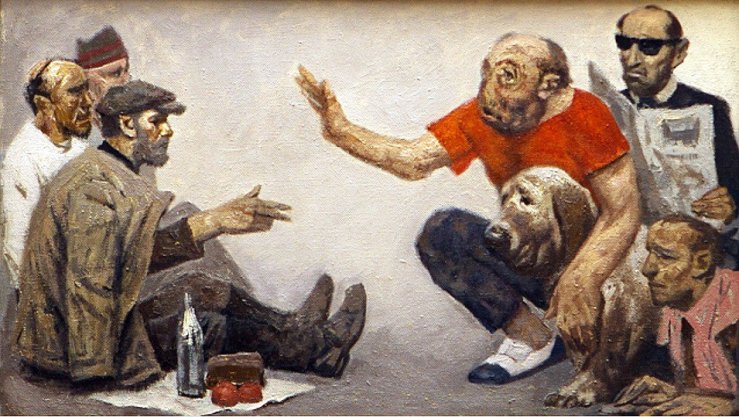
Peasants Arguing with Mutants — Gely Korzhev

Peasants Arguing with Mutants, 1992 by Gely Korzhev (1925-2012)

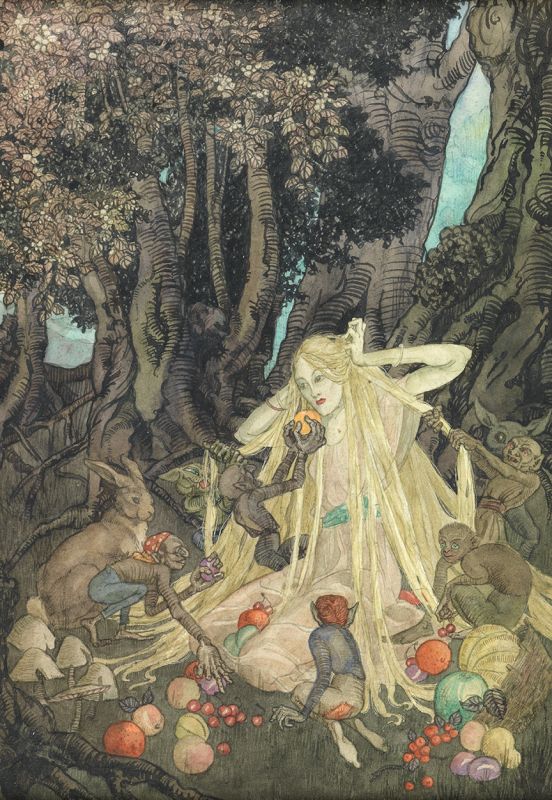
Goblin Market — Primrose Harley

Goblin Market, by Primrose Harley (1908-1978)


“Goblin Market”

by

Christina Rossetti


Morning and evening
Maids heard the goblins cry:
“Come buy our orchard fruits,
Come buy, come buy:
Apples and quinces,
Lemons and oranges,
Plump unpeck’d cherries,
Melons and raspberries,
Bloom-down-cheek’d peaches,
Swart-headed mulberries,
Wild free-born cranberries,
Crab-apples, dewberries,
Pine-apples, blackberries,
Apricots, strawberries;—
All ripe together
In summer weather,—
Morns that pass by,
Fair eves that fly;
Come buy, come buy:
Our grapes fresh from the vine,
Pomegranates full and fine,
Dates and sharp bullaces,
Rare pears and greengages,
Damsons and bilberries,
Taste them and try:
Currants and gooseberries,
Bright-fire-like barberries,
Figs to fill your mouth,
Citrons from the South,
Sweet to tongue and sound to eye;
Come buy, come buy.”

Continue reading “Goblin Market — Primrose Harley”

Odalisque Feeding a Faun — Dorothy Webster Hawksley

Odalisque Feeding a Faun, 1920s by Dorothy Webster Hawksley (1884-1970)

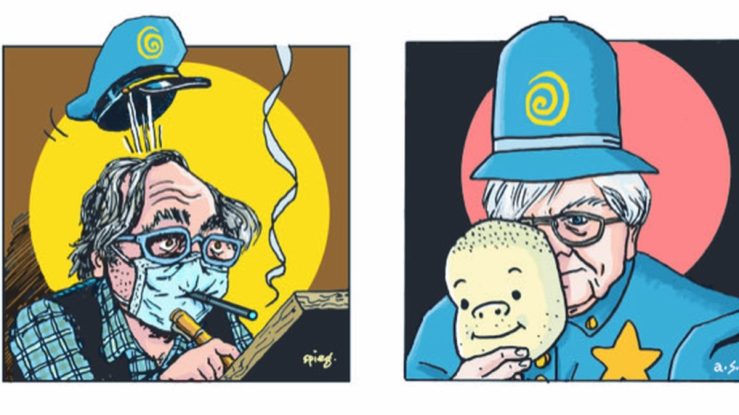
“I learned my realism from Kafka” | Art Spiegelman and Robert Coover have a conversation at The Believer

There’s a nice conversation between Art Spiegelman and Robert Coover at The BelieverThe pair have collaborated on an illustrated “novelette” called Street Cop. 

Their discussion begins with Street Cop but expands much further, touching on postmodernism, realism (“Our Zeitgeist has left us mostly with shards of media as our reality,” says Spiegelman; “When people ask me, I say that I learned my realism from Kafka,” replies Coover”), time and space, the desire for happy endings, and more. But like I said, it begins with Street Cop:

ART SPIEGELMAN: So first: why a street cop?

ROBERT COOVER:Well, I wrote Street Cop in 2019. It emerged, like everything I write, from anxieties about the present. I had written about private eyes, but the dumb street cop was something new. I liked the idea of a guy who would be technologically inept. It’s about a bumbler who began his career as a crook and drug dealer, before accidentally becoming a cop who stumbles his way through a techno-city where the landscape changes daily thanks to 3D printing—blurring past, present and future. His job is to convict suspects rather than solve crimes, but all he wants, really, is to return to the old part of town, a seamy noir-like zone where his urges, and their many flaws, are permissible.

AS:When I first read and signed on to illustrate your story early in 2020’s quarantine, I was grateful to dive into a Dystopia Next Door and escape the one that surrounded us even in the bucolic bunker in the woods we’d retreated to from NYC. Choking on an overdose of toxic news, and compulsively “doom-scrolling”—I really love that phrase—I found the Covid-free air of Street Cop breathable because at least it didn’t have the twin viruses of the Covid pandemic and Trump directly confronting me. Still, the very first picture I drew had Covids in it—it was inevitable that they found their way into the prescient present of the story.

Read the rest of the conversation here.

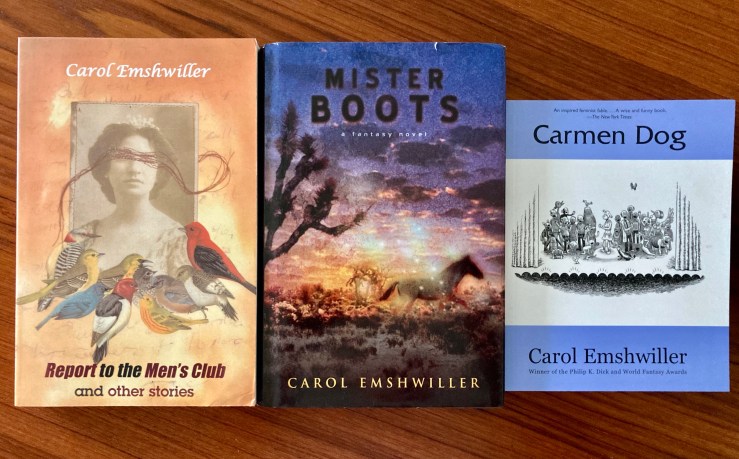
Three by Carol Emshwiller (Books acquired, sometime last week)

Small Beer Press had a warehouse sale last month, so I ordered two by the late avant-garde sci-fi writer Carol Emshwiller. I ordered Carmen Dog, which is what I take to be her most lauded novel, based on this blurb from Ursula Le Guin:

Carol is the most unappreciated great writer we’ve got. Carmen Dog ought to be a classic in the colleges by now . . . It’s so funny, and it’s so keen.

The pub’s blurb:

The debut title in our Peapod Classics line, Carol Emshwiller’s genre-jumping debut novel is a dangerous, sharp-eyed look at men, women, and the world we live in.

Everything is changing: women are turning into animals, and animals are turning into women. Pooch, a golden setter, is turning into a beautiful woman–although she still has some of her canine traits: she just can’t shuck that loyalty thing–and her former owner has turned into a snapping turtle. When the turtle tries to take a bite of her own baby, Pooch snatches the baby and runs. Meanwhile, there’s a dangerous wolverine on the loose, men are desperately trying to figure out what’s going on, and Pooch discovers what she really wants: to sing Carmen.

I also ordered a story collection, Report to the Men’s Club. Small Beer’s blurb:

 What if the world ended on your birthday — and no one came? What if your grandmother was a superhero? What if the orphan you were raising was a top-secret weapon, looked like Godzilla, and loved singing nursery rhymes? What if poet laureates fought to the death, in stadiums?

A day or two before they showed up, I found a copy of Emshwiller’s 2005 novel Mister Boots in the YA section of my local bookshop. I launched into it and I don’t think it necessarily reads as YA-as-genre, but it’s the kind of weird shit I would’ve loved to get a hold of as a sixteen year old. Blurb:

Bobby Lassiter has some important secrets—but it’s not as if anyone’s paying attention. It’s the middle of the Depression, and while Bobby’s mother and older sister knit all day to make money, Bobby explores the California desert around their home. That’s how Bobby finds Boots. He’s under their one half-dead tree, halfdead himself. Right away he’s a secret, too—a secret to be fed and clothed and taken care of, and even more of a secret because of what he can do. Sometimes Boots is a man. Sometimes he’s (really, truly) a horse. He and Bobby both know something about magic—and those who read this book will,

Le Guin also blurbs this book.

I hate to admit that I had never heard of Emshwiller until last month. In a strange moment of synchronicity, Joachim Boaz, who blogs at Science Fiction and Other Suspect ruminations, reviewed a bunch of older Emshwiller stories this July. On twitter, he described Emshwiller as “an author who should be a feminist science fiction icon.” I’m excited to read more.

Summer’s Almost Gone — William Trowbridge

“Summer’s Almost Gone”
by
William Trowbridge

The squirrels are spreading the rumor: no more monkey business.
The Dow Jones hops up, then down, then back up, trying for attention,
           up against dog days.
The Capitol dome rattles like a witch doctor’s gourd. “More Republicans,”
           warn the talking drums.
The networks labor underground to stockpile T, A, and blood capsules
           for Sweeps Week, when all hell won’t be enough to save some.
Pedestrians slip into light coats of pollen and mold spores.
The Enquirer reports the sighting of Satan’s image over Chicago during
           the heat emergency. His words were, “For the hottest deals in town,
           see Sal at Mutto’s Chevrolet on East Wacker.”
The old elms shrug: “You think this is hot: we could tell you about hot.”
Walmart and Kmart burgeon into crooked towers of back-to-school
           candy. They’re heaven-bound, via the moon. Greeters offer
           themselves to the lowest common denominator. There’s a Blue-
           Light on moon caps.
Representatives from Tire City have announced they intend a hostile
           takeover and cleansing of their former territory, now known as
           Carpet City. Furniture City will not intervene.
The NFL’s negotiating for rights to the Baptist Church.
The carnies have packed up the Tilt-A-Whirl and Ferris wheel, leaving us
           up to our ass in free parking.
Everyone under 30 dreams of shoplifting some Air Jordans for school.
Everyone over 30 dreams of going to prison for shoplifting.
The hypochondriacs wake up noticing little dark spots in front of their
           eyes, think they could be in the middle of something serious.
“Winterize now,” say the prime-time commercials. “Spend, spend, spend!”
           cry the cicadas and katydids over the scorched, moonlit lawns.

David Berman’s Nashville Mix

From The Minus Times #29, as republished in The Minus Times Collected. 

I made as much of the mix I could—D.C.3’s second record The Good Hex isn’t streaming or even on YouTube. Here is David Berman’s “Nashville Mix” mixtape: