Gob’s Grief — Chris Adrian

It’s the greatest open secret, that death will take everyone, that every person is as transient as a shadow. Embracing this knowledge…was how sane people managed their grief.

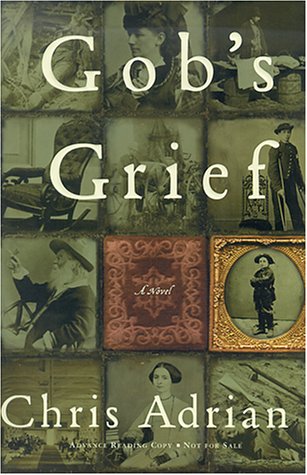
In his debut novel Gob’s Grief, Chris Adrian explores the turbulent political, cultural, and social reforms of the immediate post-Civil War era through the lens of personal loss–specifically, the loss of dead brothers. Gob Woodhull, fictional son of agitating feminist Victoria Woodhull, suffers from intense grief and guilt after not running away to war with his twin brother Tomo, who dies at Chickamauga. Deciding that he must perform the impossible, Gob sacrifices his pinkie finger (and much more!) to a sinister, cave-dwelling magical being called the Urfeist, who takes young Gob on as an apprentice. Under the Urfeist’s tutelage, Gob begins designing and building a Frankenstein machine that will bring both his brother and all of the dead back to earth. Gob describes his machine and its purpose:

Don’t you understand? What’s grief if not a profound complaint? It’s what the engine will do; it will complain. It will grieve with mechanical efficiency and mechanical strength. It will grieve for my brother and for your brother and for all the six hundred thousand dead of the war. It will grieve for all the dead of history, and all the dead of the future. Man’s grief does nothing to bring them back, but just as man’s hands cannot move mountains, but man’s machines can, our machine will grieve away the boundaries between this world and the next.

The Urfeist agrees with Gob’s strange logic, explaining just what’s in it for the dead:

Unhappiness is the lot of the spirits. They are denied bodily delight, but they are creatures of desire. Desire is all that’s left to them. They want to live again! They want to be with you, all you desolate millions. How will you live without them? How will they continue without you? What sort of heaven can there be when brothers are apart?

Aiding Gob, often against their better judgment, are Walt Whitman (yes, that Walt Whitman), Will Fie, and Maci Truffant; both Will and Maci have also lost brothers in the Civil War, and these fraternal ghosts literally haunt them. Whitman too has lost a brother, but the poet more keenly misses Hank, a young man who Whitman becomes very attached to while volunteering at a hospital. Although Hank dies, his voice remains in Whitman’s head. Walt, Will, and Maci all make unique contributions to Gob’s bizarre machine. Maci serves as an engineer, Will as a visionary builder, and Walt, “the Kosmos,” serves as the battery that powers the strange, mansion-sized contraption. Added to the mix is Pickie Beecher, an unearthly little kid birthed during an early trial run of the machine.

The novel is divided into three distinct sections, each focusing on the different perspectives of Walt, Will, and Maci, and the most interesting moments of the narrative are when the events overlap, revealing the differences between these characters (the first section, focusing on Walt Whitman, is easily my favorite; it even made me go back and reread portions of Leaves of Grass). Adrian also employs interchapters focusing on young Tomo running away to the war and the Urfeist’s education of Gob. At times, this structure is fascinating, but it often gets in the way of characterization and detail: at nearly 400 pages, Gob’s Grief is a fairly long book, but it feels like it should be much longer. Adrian is fascinated with the cultural, economic, and social upheavals that preceded the Gilded Age, but much of the fine tuning seems edited away in favor of repeated descriptions of, uh, grief (at a certain point, I wanted to yell, “Okay–I get it! He’s mourning! He’s sad! Move on”). I also found the elements of magical realism, particularly the backstory of the Urfeist, to be underdeveloped, often overshadowed by a concern for the tropes of historical fiction.

Still, in Gob’s Grief, Adrian conveys a marvelous aplomb rare in debut novels, a promise he lives up to in his fantastic follow-up The Children’s Hospital (Pickie Beecher shows up again in that novel, and its main protagonist, Jemma Claflin, is a descendant of Woodhull). In all likelihood, Adrian will continue to perfect his craft. And while we’re waiting for his next great novel, we can read A Better Angel, a collection of short stories set to drop this August.

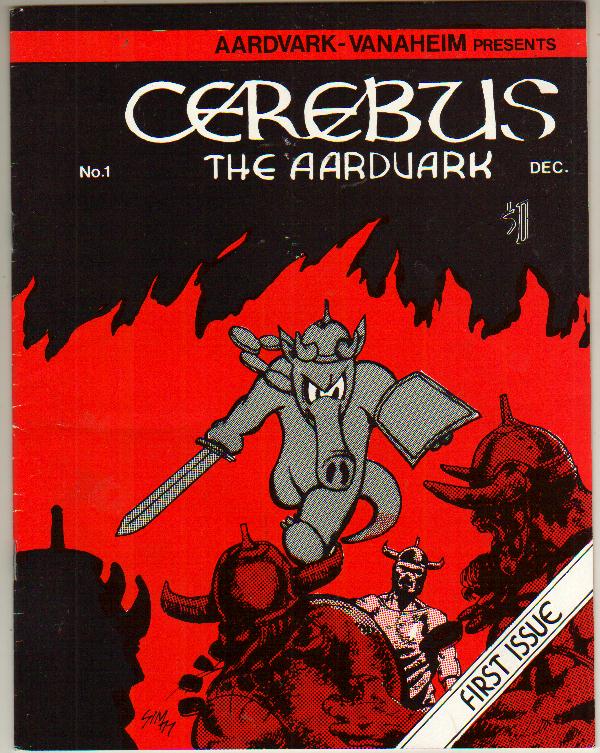
Cerebus — Dave Sim

Quick disclaimer:

What follows is a review of the first Cerebus graphic novel, not a review of the series as a whole. I initially contemplated such a feat, but handling Dave Sim’s (and Gerhard’s) 300-issue-long magnum opus in one post would result in either a really, really long post or a really, really inadequate handling of such fine (and troubled) material. Instead, I’ll review the series chronologically, covering one volume a month.

I suppose, also, that a quick primer or introduction may be necessary, so here goes–

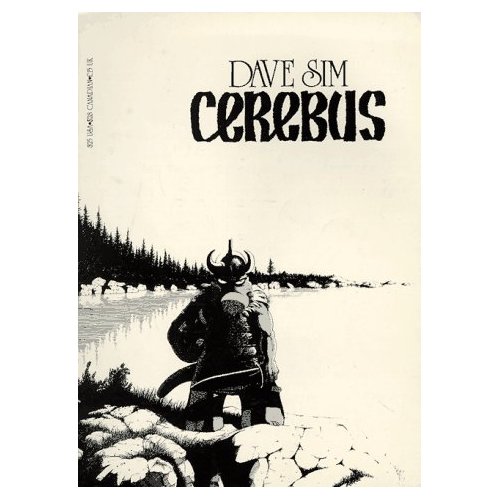
Cerebus is a 300 issue black and white comic book, conceived, written, and drawn by Dave Sim (with stunning background art by Gerhard in issues 66-300). Sim published the book himself via his Aardvark-Vanaheim imprint. The book follows the adventures (and non-adventures) of Cerebus the Aardvark, a surly barbarian who, as one of only three existing aardvarks in Estarcion, has a sort of catalytic power to influence major world events. It’s satire, it’s drama, it’s action, it’s art. The series contemplates politics, religion, literature, economics, and just about everything else under the sun. Only this is really not an adequate summary at all, so I’ll stop here, and get to the actual review. You can google “Cerebus” and “Dave Sim,” of course, and read all about Sim’s rise and fall (it gets spectacularly crazy, folks!); or, you can just wait until we get to the Reads book to learn all about Dave Sim, misogynist. But I’ve digressed before I’ve even begun. (The Cerebus Wikipedia page is pretty good; and this 2004 AV Club interview is also insightful).
Let’s start the review with yet another non-start: another disclaimer:

If you’re at all interested in Cerebus, Cerebus, the first graphic novel in the series, collecting issues
1-25, is not the place to start. If you really are interested in Sim’s work, start with the next collection, High Society. It’s much funnier, tighter, and Sim comes into his own as a draftsman by these issues (although there’s no denying that the art only gets better and better as the story progresses). Sim claims that he knew more or less from the beginning that Cerebus would have a scope of 300 issues (taking 27 years to complete), but the first 15 or so issues don’t really reveal anything that promising. Very early Cerebus is a silly funny animal Conan-Red Sophia parody. However, with issue 20, “Mind Games”–a comic Sim composed in interlocking images that when reconstituted created a new image (all right, that’s not a great description)–the book starts to get really interesting. By this point, Sim has already introduced my favorite character, Lord Julius, the anarchic Groucho Marx parody who wreaks havoc throughout the series; Sim further stirs things up by injecting the matriarchialist Cirinists into the chaos. The emerging Cirinists’ political/martial power becomes the conflict that will dominate the first half of the Cerebus series, and the larger issue of female power can rightly be named the Sim’s thematic obsession throughout the entire comic’s run. Before these themes come into their own, issues 1-17 or so of the book are stock fantasy tropes poked at with a stoner’s sense of humor. Like I said before, Cerebus–volume 1 of Cerebus–will be most enjoyed by those who’ve already had a taste of the good stuff–High Society and Church & State. Good stuff. More to come.

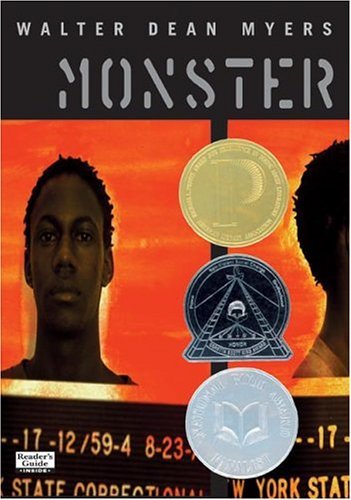
Monster–Walter Dean Myers

In Walter Dean Myer’s Monster, sixteen year-old Steve Harmon is on trial for felony murder in New York City. He participated in a robbery that went bad when the store owner was killed with his own gun. Only Steve wasn’t in the store at the time of the robbery/murder–he was playing the role of the lookout. In fact, he didn’t even send a signal of any kind, he just walked out of the store. Before he wound up in jail, Steve attended Stuyvesant High School, where he excelled in his film class. Steve, a sensitive kid from a stable home, despises the violence and cruelty of jail and feels utterly alienated from the reality of his trial. To avoid the intensity of his situation, he writes a diary where he records his feeling. These handwritten passages introspectively contextualize the rest of the narrative, which is composed of Steve’s screenplay of the events of the trial.

Walter Dean Myers (Scorpions, Fallen Angels) is one of the founding writers of the YA movement that emerged in the early seventies (other writers include S.E. Hinton, Robert Cormier, and Judy Blume), and Monster is written to appeal to high school kids. Although Myers always has his teen audience in mind, he never talks down to them, and even though Monster features a discussion of some “edgy” content (uh…prison rape) it’s always purposeful to the narrative and never lurid or used for the sake of crude shock value. I’ve used this novel in my 10th grade classroom for a few years now and it’s always a big hit (this year we’re reading it in conjunction with Antigone and a viewing of Lumet’s 12 Angry Men). The students generally love it–they get to read the parts in Steve’s film–and it provides a fantastic platform to discuss a number of relevant issues, including justice, prejudice, guilt and innocence, and how we perceive (and sometimes dehumanize) others. At the heart of the novel is Steve’s inward battle to see himself as human and resist the gaze of the prosecutor, jury, and judge, as well as his attempt to escape the way that jail will shape his personality. This psychological/ethical/perceptual dilemma dominates the novel and Myers is content to let moments of irresolution stand in place of easy, platitudinous answers or dogmatic moralizing. This is a great novel for the classroom, but I think adult readers would also enjoy it. Highly recommended.

The Biblioklept Interview: Mathias Freese

Mathias Freese, author of Down to a Sunless Sea and The i Tetralogy, was kind enough to answer a few questions for us. This interview took place over the course of several emails.

Biblioklept: Have you ever stolen a book? If so, could you tell us a little bit about that?

Mathias Freese: No, I’ve never stolen a book.

B: Have you ever borrowed a book without returning it–purposefully or not?

MF: The amount of guilt for both of these questions, as a young boy, would be too much to bear; and then obsessing about it enters the picture and I’d end up in central casting auditioning for a role in The Possessed.

B: What are you currently reading?

MF: Dan Wakefield’s, New York in the Fifties. Living in Arizona, a geriatric Disneyland, I remember well Brooklyn – Brighton Beach, Manhattan Beach, and Coney Island. I grew up in the Fifties and Wakefield evokes the literary times very well – Ginsburg, Kerouac, Mailer – as well as the cultural sensibilities of the time. I was too young for all this but reading about it evokes Greenwich Village, egg creams, and a great bialy.

B: What are you writing right now?

MF: I am editing a novel, my first, written more than two decades ago. Sojourner is a philosophical tale dealing with the emigration of a young Chinese farmer to the Mountain of Gold (California) as it was called.

B: Sojourner sounds interesting. Is it research-based historical fiction? (Perhaps you hate to classify what you write into a specific genre, of course). Tell us more.

MF: Sojourner began as a 30 page short story in the years 1969 to 1972; I was working on a federal project dealing with racial-ethnic relations in the town of Freeport, on Long Island, NY. I had met a Chinese-American librarian who had written on the emigration to Gum Shan, Mountain of Gold. I researched only details that would be useful for verisimilitude, such as Gum Shan, and began a short story about the subject. The book ultimately reflects my own philosophical needs and emotional cravings for meaning. When submitted to publishers as a novel for young adults almost all of them wrote that I had made an error, and that this fiction was serious and for adults. Who knew? I do believe that the writer is the last to truly appreciate his work. The i Tetralogy which began in 1996, is a more thoroughly researched book , and it is a historical fiction on the Holocaust based on my experiences as an American Jew. I had read a significant amount of the literature on the Holocaust with no intent of being a writer. If you read my “On the Holocaust” in the Pages section of my website, you will get a rather complete statement of my point of view.

B: The Marxist critic Theodor Adorno famously declared: “To write poetry after Auschwitz is barbaric.” How do you interpret this remark?

MF: Adorno’s comment was of its time. I feel what he means, how can we allow beauty in the presence of such unspeakable evil! However, it does not make sense. When you write you metabolize feelings – all kinds – thoughts, experiences and all the rest. When the ancients passed down Homer’s Odysseus orally, the words saturated the listener with meaning and continuity. We must write about the Holocaust until the end of time, although we face psychological resistance every step of the way. I have faced this with The i Tetralogy. One of the most significant gifts of Judaism to civilization is memory. We do not forget – and most assuredly, we do not “put it behind us,” one of the more inane “truisms” in this culture – re: Mel Gibson and Jesse Jackson. Adorno is dead wrong.

B: The back of your book, Down to a Sunless Sea, mentions that you worked for over twenty-five years as a social worker and psychotherapist. Several of the stories in the book seem to explore explicitly psychoanalytical themes, yet these themes are never overstated. Is this purposeful?

MF: I have been accused of being too clinical; I think that is unfair. I use my therapeutic insights when I can while integrating them with my psychological and emotional wisdoms (if that) and try to make a story. I recall covering for a teacher in an eleventh grade class. He was teaching Oedipus Rex. I asked him if I could treat it the way I wanted to. He agreed. In class, in a small review, the students told me that they were up to where Oedipus scratches out his eyeballs, consequently the interpretation was stressed that he chose not to see – and how very symbolic that was. I asked them if they were opened to another way of looking at it. I shared that to me it was a case of displacement. Duh! In effect, he was castrating himself. Titters and titters. I went on to say that they touch their eyes now and make an observation. Finally, one student said that they felt like balls. And away we go! The next day the teacher was bent out of shape because he had heard that I said that Oedipus ripped out his eyes, in effect, his balls. I am sure some students came away believing that balls evolve from eye sockets. Why should I give up insight (no pun intended) no matter where it comes from?

B: I teach eleventh-graders, actually. You never know what weird mutation of what you discussed that they will commit to memory forever. Do you enjoy being in a classroom? Have you ever taught fiction writing? What do you think of MFA programs?

MF: I was terribly misplaced in that career. The consensus was that I was a terrific teacher but I detested the rules, the administration and the deadness. You read “Nicholas.” He has it right. So I studied to become a therapist and it worked very well for me, my craft and my self. I have taught seminars on fiction writing and if you go to the site you will see a course description and in the Pages section there are short essays all dealing with writing. Go nosh. As to MFA programs I have a simple premise: if it is organized, go elsewhere. Same feelings I have about religion, et al. I cannot think of any world class writer who has a MFA. What about good old suffering and pain as a motivator?

B: Many of the stories in Down to a Sunless Sea utilize a very tight, condensed prose style. How much do you edit out of your work?

MF: I like this question in that it touches upon something I truly believe in. Some writers secrete out paragraphs per day. I can’t handle that anality. I write, let us say, 10 pages knowing full well I cut back to maybe 4. The art of writing is revise, revise and revise. I like pruning the story tree so that new growth is inaugurated. Like poetry, which I find, of course, the most condensed of writing, I believe stories should be very tight – let the reader infer rather than I tell. Indeed, one reviewer complained she couldn’t understand the stories, at least in her first reading. Good. Get back to it and reread it. I am not fooling around here and I deserve a better reading if you feel there is more to my stories than Oprahesque fluff.

B: When you re-read “Arnold Schwarzenegger’s Father Was a Nazi” now, do you consider it prescient? How do you think Arnie turned out?

MF: I had a sense about Arnie, of that tom tom in his character, that immigrant feeling that America can be tamed and domesticated to one’s own ends. I associate to Daniel Day-Lewis [in] There Will Be Blood, that tornadic energy to succeed, ambition on speed. In many ways Arnie is an athletic Algeresque character. I was not conscious of making any predictions, but it did feel to me, on a gut level, that he had other measures and goals to achieve and one of them is to marry into a famous family and all the rest. He is a delightful social climber who has denied, at least in the media, his background. I can write about Arnie because I don’t know him and that is the freedom of the writer. Give a writer one telling detail and the rest is extrapolation; think Kafka.

B: You maintain a website, www.mathiasbfreese.com. Do you write certain pieces specifically for the site? Corollary–How does your writing change when you write specifically for hypertext publishing?

MF: Blogging is new to me and I find it frustrating that so few people respond, given that I have had over 8400 hits; something is awry. Nevertheless, I enjoy writing every few days to keep my skills sharp. I am presently sharing a memoir about a fire on Mt. Lemmon in Tucson; it is filled with reflections, moods, sadnesses, and philosophy. Who cares if the reader is bored? I like it. I think the blog is excellent for short pieces, mini essays, faction. The reader gets bored with long pieces, but who knows in this new century of the Borg.

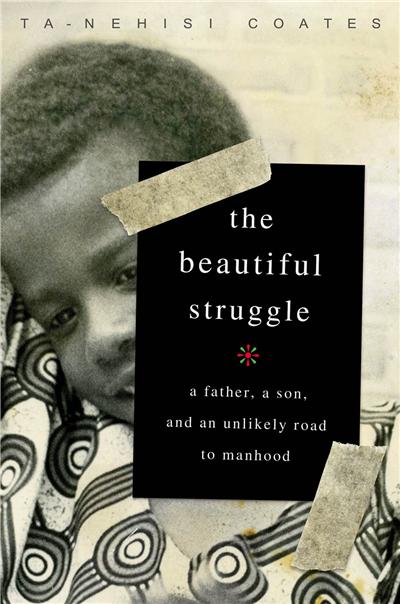
Ta-Nehisi Coates on Hip-Hop’s Daisy Age

Earlier this week, The Root published a fantastic excerpt from Ta-Nehisi Coates’s recent memoir The Beautiful Struggle. In “Hip-Hop’s Daisy Age,” Coates contextualizes a Golden Age–the arcadian summer of ’88–when a new “consciousness” movement in hip-hop brought together both the discordant militarism of Chuck D’s Public enemy and the neo-hippie soul of De La Soul. Although Coates grew up African-American in an economically-depressed Baltimore and I am white, and was living in Dunedin, New Zealand in the summer of ’88, we are roughly the same age. When he writes, “I was all X-Men, polyhedral dice, and Greek myths,” it’s not hard for me to imagine that we actually probably have at least a few things in common. And while I was clearly in a different cultural place, I owned and cherished most of the albums that Coates cites in his piece. I played them repeatedly, furtively listening in secret to the alien sounds on my Sony Walkman. I can’t help thinking of 3 Feet High and Rising without a warm tinge of nostalgia coupled with a sadness that something so fresh and vital and just plain different probably won’t come out of mainstream hip-hop again–or at least any time soon. Perhaps this is hip-hop’s legacy–20 years after its Golden Age, it’s earned the right to be as shitty, conformist, and downright stupid as any other commercial genre. But I’ve digressed. Coates’s piece is no lament. Instead, it’s a loving tribute to a particular moment, which, for him at least, seemed to transcend the space he was in and extend into all “the ghettos of the world, with their merchant vultures, wig stores, sidewalk sales, sub shops, fake gold, bastard boys, and wandering girls.” In the summer of ’88, I was living comfortably in a lovely harbor town, but the sentiment Coates expresses reached me nonetheless. As corny as it sounds, hip-hop in ’88 provided a cultural education for me, not just about the African-American experience specifically, but, more generally, as an expatriate, hip-hop told me something about what was new and fresh and vital in America. Now I realize that my own early love for hip-hop simply preceded the eventual mainstreaming, commercialization, and consequent dumbing-down of hip-hop. And honestly, I could never have the same spiritual attachment that Coates describes:

“…the rhyme-pad was a spell-book, it summoned asphalt elementals, elder gods, and weeping ancestors, all of whom had your back. That summer, I beheld the greatest lesson of 88, that when under the aegis of hip-hop, you never lived alone, you never walked alone.”

Where Coates experienced soul music, I heard punk rock. But for each of us, the hip-hop in ’88 was a new kind of rebel music. Looking back, it’s hard to believe that 20 years have passed. When I get home tonight, I’ll listen to EPMD’s Strictly Business and try to forget about Soulja Boy for 45 minutes.

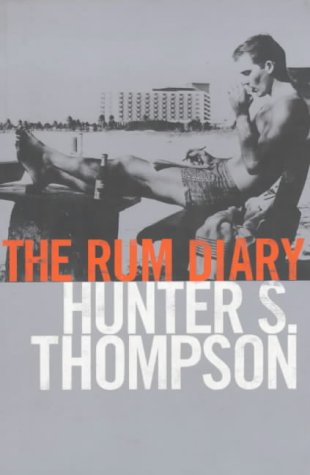
The Rum Diary–Hunter S. Thompson

Set in the 1950s, Hunter S. Thompson’s second novel The Rum Diary chronicles the drunken misadventures of Paul Kemp, a journalist who moves from New York City to Puerto Rico to write for a small newspaper. While there, Kemp gets involved with a crazy couple who fight all the time (he develops a serious crush on the girl), attends a rum festival, and winds up in jail. Along the way there’s enough drinking to put Hemingway’s characters to shame, and plenty of nude swimming to boot.

Although The Rum Diary was written in the early sixties, it wasn’t published until 1998, long after the infamous gonzo godfather had made his indelible mark on the American literary consciousness. Thompson was 22 when he wrote The Rum Diary, a significant eight years younger than his stand-in in the novel, jaded journalist Paul Kemp. And while it’s easy to imagine that HST was born a cranky old man, at times Kemp’s world-weariness reads more like an affected pose rather than an earned cynicism.

The novel works best when HST focuses on denigrating the cretins, phonies, perverts, and degenerates that are never in short supply in his sick universe. Where the average travel writer might see a joyous festival throbbing with life and humanity, HST finds dread and disgust, fear and loathing. His frenzied yet steady prose moves quickly, adding to the general manic tone of the novel, and, despite its 200+ pages, The Rum Diary is an easy weekend read. Additionally, HST’s reflections on American imperialism and tourism in general remain relevant and fresh over forty years later.

The Rum Diary is hardly the HST starting place, but this is quite obvious (if, dear reader, this is not obvious to you, get thee to a bookstore posthaste and obtain Fear and Loathing in Las Vegas). However, for casual fans The Rum Diary will make an interesting beach read. Apparently a movie featuring HST friend-alum Johnny Depp (as Paul Kemp) is slated to come out next year, so stay one step ahead of Hollywood by reading this now. Recommended.

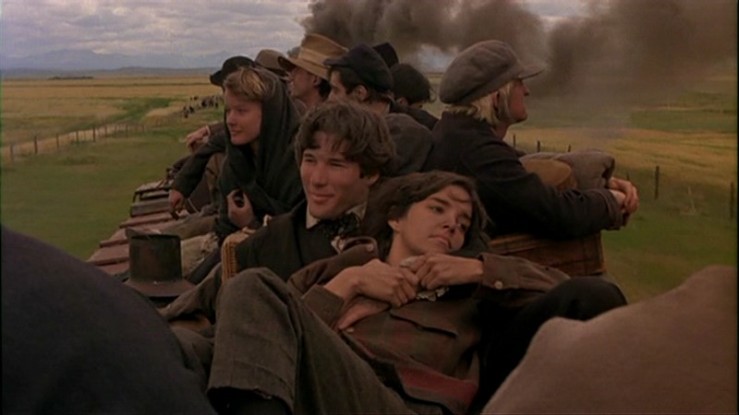
Days of Heaven–Terrence Malick

At a scant 93 minutes, Terrence Malick’s Days of Heaven is a paradoxically epic film, condensing the strange joy and bitter disappointments of four lives into something beautiful and marvelous. Days of Heaven is the story of three itinerant workers, Bill (Richard Gere), his girlfriend/common law wife Abby (Brooke Adams) and her younger sister Linda (a young Linda Manz, who is amazing in the role. She would go on to star in Out of the Blue and, uh, Gummo). Bill and Abby pretend that they are brother and sister because, as Linda (whose rambling introspection approximates narration) puts it, “people will talk.” The trio flees from Chicago after Bill kills a man, and soon find a job harvesting wheat in Texas for a rich farmer (Sam Shepard). The farmer, diagnosed with a terminal illness, falls in love with Abby. Bill encourages her to marry the farmer; he hopes that the rich man will die soon and that they will inherit his wealth. Jealousy, shame, confusion, and rage follow.

Days of Heaven seems much longer than its running time, and I mean this in a good way. Like Malick’s other films (Badlands, The Thin Red Line, The New World) it is not the seemingly improvised dialog that propels the narrative. Instead, Malick lets the story unfold in an impressionistic layering of images. Linda provides a voice over that occasionally gives a key insight to the desires of her sister/mother, brother/father, or even the farmer, but she’s just as likely to declare that she’d love to become a “mud doctor” and learn about the science of soil. And while the film has a strong and complex human, emotional core, like Malick’s other movies, it is very much a nature film, brimming with gorgeous shots of the farm, wild antelope, fowl, and other beasts. Malick’s lush shots make the Texas panhandle seem exotic, and Ennio Morricone’s masterful score is never obtrusive. This is a perfect film, and it’s a little sad to me that two whole decades passed between its release and The New World–but I suppose perfection and prolificness are not necessarily concomitant states. Let’s hope that Malick’s upcoming film, Tree of Life doesn’t take another twenty years to hit theaters. Highly recommended.

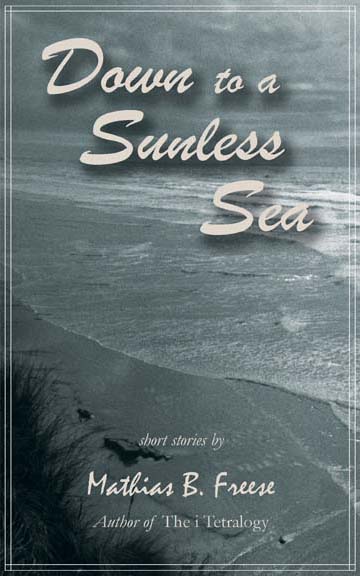
Down to a Sunless Sea

Mathias B. Freese’s slim collection of short stories, Down to a Sunless Sea, relays the weird, miserable, and even sometimes ghoulish existences of people you might pass on the street everyday. The stories read like psychological case studies, and there’s frequently a strange distance between the clinical detachment of the prose and the depressed or depraved sentiment expressed by the narrator. At times the effect is painful, as in “Herbie,” where the titular protagonist’s rage at his abusive father spills over into Oedipal violence. Elsewhere, the stories take on a wry surrealist humor. Freese’s knack for dissonance evinces in “Juan Peron’s Hands,” where a grave robber pines for a head but settles for hands. Far closer to home is “Young Man,” where Freese distills an entire life to a few bitter pages, exploring the modern disconnect between thought, action and identity.

I can’t be who I am in real life, so I can be who I am in thought, but who I am in thought is not who I am in deed, so I live between what is and what should be, and this serves to make sharper the cleavage–the crevices are clearly marked.

One of my favorites in the collection, “Arnold Schwarzenegger’s Father Was a Nazi,” disconcertingly (and humorously) condenses American obsession with celebrity into a fantasy ski trip, complete with the oddly sorta-prescient line: “I might even run for president if I can lose this accent” (the story was originally published in 1991). It is probably the deformed voyeur hero of “I’ll Make It, I Think” who delivers the closest thing to a mantra for these characters:

I’m not hurting anyone. So what if my morning shorts are sticky. I’m a good person. The outside, for sure, is a shambles–that’s not completely true, but I’ve made my point. Inside is fucked up some, but I’ll make it, I think.

Down to a Sunless Sea, for all its monsters and perverts and manic depressives, is never cruel in its darkness or unsympathetic in its distance. Freese creates real people here, and if we laugh at their pain, we’re laughing with them. Highly recommended.

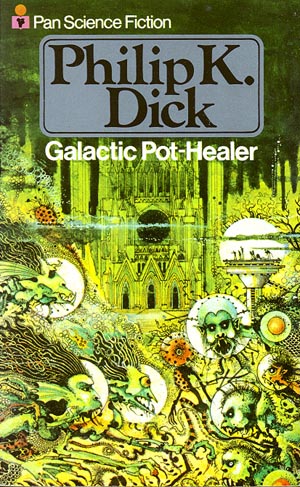
Galactic Pot-Healer–Philip K. Dick

Philip K. Dick’s bizarrely titled Galactic Pot-Healer begins in a dystopian future (more 1984 than Brave New World), before moving into–you guessed it–more galactic territory. Joe Fernwright “heals” ceramic pots–a relatively useless job, seeing as all the broken pots have now been mended. He wiles away his time playing word games with other cubicle minions across the globe, until an alien called Glimmung wisps him away to Sirius Five so that he can aid in resurrecting an ancient cathedral from the depths of an ocean where the laws of time do not apply. Lots of very strange stuff happens.

Galactic Pot-Healer is typical PKD, which is to say thoroughly atypical sci-fi with a philosophically paranoid twist (or is that a paranoid philosophical twist?). The story begins as a satire of modern workaday existence, and Dick’s assessment of cubicle life, written in the late 1960s, is almost too-prescient. Fernwright is a typical Dickian hero, a Walter Mitty figure who, real or not, gets to live his dream out (there’s a girl, of course, a sexy alien). After the action moves to Sirius Five, Dick becomes overtly concerned with the major themes of the novel. A precognitive alien race called the Kalends publish a book, a sort of daily newspaper, that accurately predicts the future. The Kalends predict that the raising of the cathedral will fail, and all involved will die. Glimmung, who is repeatedly compared to Faust by everyone in the book (all of these aliens from different planets are not only familiar with Goethe’s version, but other versions as well), attempts to prove that he is master of his own fate. Attracted to this, Fernwright risks his life in the project, and finds a new hope and vitality in meaningful work that he didn’t have back in his cubicle on Terra.

Galactic Pot-Healer is as weird as its title, and at times suffers from Dick’s manic jumpiness. One imagines him sweating out the novel over a few weeks, feverishly hacking at his typewriter. The links between concrete events–narrative action–are often frantic (if they exist at all), and there’s little subtlety here: Dick’s characters will quote verbatim Kant or Goethe, or wax heavy on determinism and ontology at the drop of a hat. At other times, the prose sings with lyrical beauty, sorrow, and a density of imagination that more than makes up for Dick’s occasional lack of cohesion. As good a place as any to begin a journey into the weird wonderful world of PKD.

(Images from philipkdick.com’s kickass covers gallery)

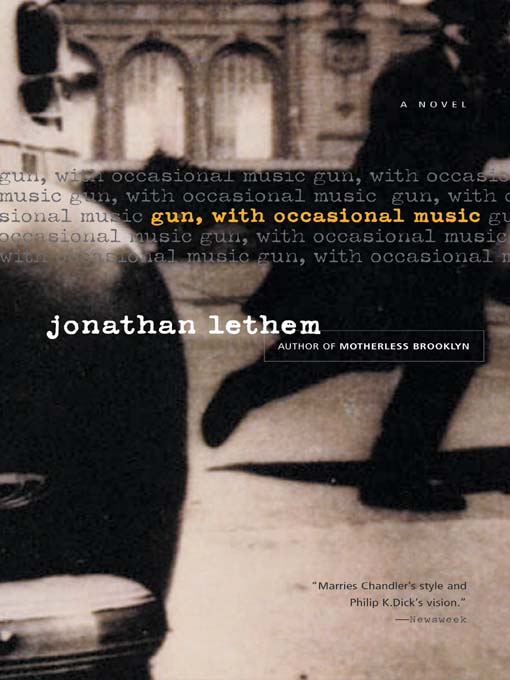
Gun, with Occasional Music–Jonathan Lethem

Jonathan Lethem’s novel Gun, with Occasional Music blends hardboiled crime noir with trippy sci-fi to examine the ethical ramifications of murder in a dystopian future where evolved animals work along side humans, mind altering drugs are not only free but encouraged by the authorities, and asking questions requires a license. Conrad Metcalf is a Private Inquisitor trying to solve a murder case involving a urologist, a baby-head (a failed evolved baby), and a gun-wielding kangaroo.

Two of the blurbs for Lethem’s debut describe the work as a marriage of Philip K. Dick and Raymond Chandler, but for my taste their wasn’t enough PKD. The details involving the “make” that Metcalf compulsively snorts, the genetic evolution techniques society now uses to produce children, and the genital nerve-ending swaps that people now enjoy are never fully explored. Sometimes bizarre details left unexplained create the dramatic immersion that the best SF achieves; Gun seems to throw ideas up against a wall to see if any stick. Many of the SF tropes that Lethem evokes are simply under-utilized. His ideas are playful, so why doesn’t he play with them more?

On the noir, end, the book also disappoints a little. The case is solved, but Metcalf’s solution–delivered entirely in a brief chapter crammed with exposition–seems hardly believable, or even really that interesting. This isn’t to suggest that Lethem’s/Conrad’s Chandlerisms aren’t enjoyable, and at times downright genius. Even when Lethem cranks out a clunker of a simile–and there’s more than one here–the rhetoric comes across more as satire of the genre as opposed to bad writing. The book also moves at a nice clip, with short, snappy chapters that always propel the narrative action. Eventually though, it just runs out steam. The story doesn’t really add up, and towards the end, it becomes clear that Lethem’s not going to fill us in on all of the cool ideas he initiated. I recommend those new to Lethem start with Motherless Brooklyn or The Fortress of Solitude instead. Or Men and Cartoons. Or The Disappointment Artist. Avoid You Don’t Love Me Yet like the plague.

Earth Day 2008: “Going Green” and the Rhetoric of Mainstream Environmentalism

Today is the thirty-eighth Earth Day and, at least from my perspective, it remains unclear what positive impact, if any, this “celebration” has had on long-term ecological/agricultural sustainability. In fact, I am going to argue that Earth Day and other instantiations of mainstream environmentalism serve to obfuscate the very problems that they intend to address. People buy into (both figuratively and literally) the rhetoric of mainstream environmentalism as a defense mechanism. The seduction of the phrase “going green” proposes a fashionable, celebrity-endorsed lifestyle that enables a person to resist, deny, or otherwise marginalize the fact that their continued existence on the planet costs–that they will always exist at the cost of something or someone else.

Before I continue my argument, let me make a couple of things clear. First, the only difference between my mindset and the mindset that I am critiquing here is that I am keenly aware of the cost of my existence. That is to say, I am in no way an ideologue, “environmentalist,” anti-capitalist, or whatever, but I also would never presume to deny that every part of my daily existence involves a Darwinian deflection of costs onto someone or something else. The gas I use in my car is gas that someone else can’t use. The bird I ate for dinner last night must die so that I can eat. The energy that runs my computer to write this post, that keeps this blog existent in cyberland is energy that cannot be reallocated to another purpose. I want to make clear then that I’m advocating nothing here except a resistance to illusion, a resistance to rhetoric that resists the reality of these costs. I’m not indicting people for jumping on the idea of “going green,”nor am I suggesting that their intentions and actions are ignoble or ignorant. I’m simply arguing that the rhetoric of mainstream environmentalism that the boomers and post-boomers are now recapitulating and buying into is part of a corporate shell game that masks the systemic problems of industrialized agribusiness and deflects responsibility away from those corporations and onto individuals.

Let’s now consider the current signal phrase of this mindset: “going green.” I don’t know where this came from, but it’s genius. Americans have been in love with the “gerund + noun” combination for years now (consider: Finding Nemo, Finding Forrester, Teaching Mrs. Tingle, Chasing Amy, Breaking Bad, etc.), and what’s catchier than the optimism of a verb like “go”? It radiates simple but strong action, movement, and also implies a teleological end, a positive destination–here, the mindset/pseudophilosophy “green.” And it’s alliterative to boot. People love to say this phrase, and love to believe that when they buy certified organic foods or remember to bring their own bags to the grocery store or put gas in their Priuses (Prii?) that they’ve somehow done something intrinsically and in and of itself, good. The rhetoric abrogates their culpability in a systemic denaturalization of the human position in the world which they cannot control. The rhetoric buys the lie of control and choice, and resists the truth that to live in our modern world is to live at the cost of someone or something else.

The phrase “Save the Planet” is less insidious by sheer virtue of its exaggerated ludicrousness. As rhetoric, “Save the Planet” is the worst kind of anthropomorphic evil, the hyperbolic illusion of the human as ultimate hero. If one simply considers for a moment the scope of what the slogan commands, one can see the sheer folly of such a mindset. A more appropriate vision would be: “Save Local Food” or “Save Your Money: Do You Really Need That Thing?”

Mainstream, corporate environmentalism reflects the will to god-like mastery over nature in the illusion of stewardship and care over the planet

“Recycle, Reduce, Reuse,” however, is not a bad mantra really–when detached from the rampant materialism it seeks to cover up, that is. In fact, the tenets of recycling and reusing are ancient, simply because before consumer culture, there wasn’t really another option. People had to squeeze the last little bit of use out of anything and everything they consumed.

There is a salient irony then in the boomers buying into these phrases–and I target boomers here, although every generation after the boomers is just as culpable. The boomers, however, are really the first American generation to accelerate the post-WWII homogenization of consumer culture, with all its implications to agribusiness, rampant stripmalling, and the emergence of the “corporate citizen.” The boomers’ massive ideological failure in the 1960s leads directly to the selfish materialism of those “Me” decades, the 70s and 80s (think of the final scenes of Woodstock: the party’s over and the pastoral landscape is now littered with every sort of consumerist debris).

Post-apocalyptic landscape (after peace, love, and understanding)

We are now trying to clean all this up, and the boomers, whose cultural norms still dictate this country, are finally getting on board. But the irony is that environmentalism-as-ideology was never much of an issue before the boomers got a stranglehold on this country, simply because every generation up to and including WWII had to be de facto environmentalists. Consumer society simply didn’t exist. People ate local food, walked most places, built their own houses, etc. (make no mistake–I’m not romanticizing or idealizing this: life was tough). This isn’t to suggest at all that the prescient efforts of John Muir, Teddy Roosevelt, Walt Whitman, Thoreau, Emerson, etc. were not important or meaningful or even necessary during their context, because they were. At this point, however, we are all implicated in a global economy in which an inequitable distribution of the world’s resources, coupled with the rapid emerging industrialization of the world’s two largest nations, India and China, entails an imminent ecological disaster. And appreciating nature in our glorious National Park System is not going to fix that, at least not on its own.

I hate to pose problems without solutions, but my solutions are admittedly vague and general. I return first to my real issue here: rhetoric. Mainstream, corporate environmentalism encourages people to shop their way out of this problem (see: greenwashing). People get to buy into the continued illusion of a cost-free existence, or at least to believe that their actions as consumers neutralize these (ecological, environmental, human, animal) costs. The first step, then, is to recognize that the small individual actions that corporations so readily promote are not enough. What is needed is full-scale, infrastructural changes focusing on local production of foods and usable mass transit systems. I believe that such changes can be more easily accomplished than the (Big Oil sponsored) U.S. government would like the average citizen to believe; currently, however, there are simply too many getting rich off the last few drops of cheap oil to redirect their efforts to such a project. So they distract us with sloganeering and feel-good celebrations as they rob the earth. We can beat this though. Let’s lose the illusion.

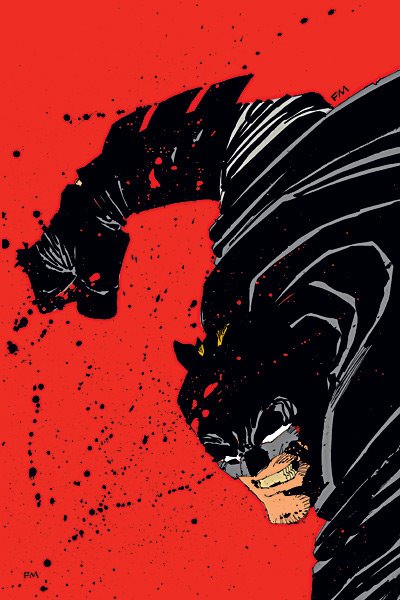
Frank Miller Reconsidered

During a horrible illness I suffered the other week, I turned to the only thing that I can digest when I’m really, really sick–comic books. I randomly chose to reread Frank Miller’s classic re-imagining of Batman, 1986‘s The Dark Knight Returns. I’ve read this comic–or “graphic novel,” if you want to sound like an asshole who’s afraid of being seen reading comic books–at least a dozen times now, I’d guess, but the last time I’d read it was after its sequel The Dark Knight Strikes Again came out in 2001.

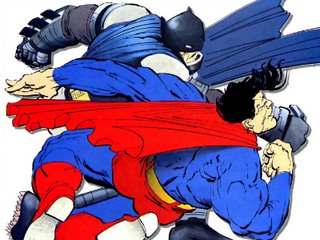
The Dark Knight Returns didn’t disappoint; it never does. Set in a future with a very old Bruce Wayne, the story figures Gotham City as an urban dystopia, chaotic with child-gangs running rampant. The superheroes that once policed the world–including Superman–have been forced to retire by the government. The anarchy in the city prompts The Batman to return. The Joker revives his old crime career. The Soviets invade a Caribbean island. Superman and Batman fight. Batman leads a youth revolution. It’s really fucking spectacular, grim, violent, and funny–the book works at all times to satire the media-obsessed materialism of the 80s. Great stuff.

I don’t own the sequel, The Dark Knight Strikes Again, which says a lot. The story’s not great; in fact, it’s highly forgettable.The plot overreaches, eschewing the essentially frail humanity of The Batman–always the character’s most interesting facet–in favor for a plot stuffed with too many of the truly extra-human characters of the DC universe. Superman, Brainiac, and Captain Marvel are just too hyperbolic to serve as effective foils for gritty Batman. Fifteen years later, Miller’s sequel overshoots, taking Batman from the underground, from the streets, and up into the air, where he just doesn’t belong.

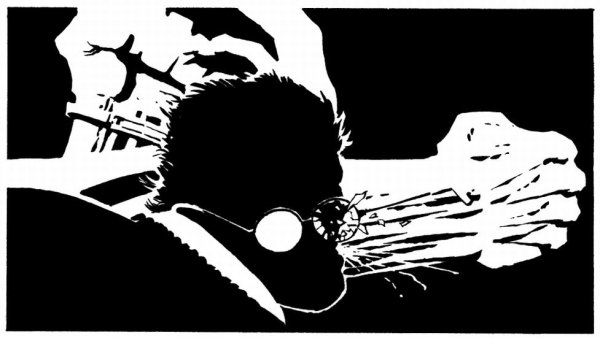
The Dark Knight Strikes Again also came out after Frank Miller had had tremendous success with his Sin City series, published by Dark Horse. I remember when the first Sin City comics came out: I was really disappointed. The artwork was fantastic–a new level of excellence for Miller, whose Jack Kirby-influenced lines always managed to convey energy, tension, and action. Sin City looked like no comic before it that I can think of, a chiaroscuro film noir that rippled and moved. Unfortunately, the story was basic at best and flat and one-dimensional at worst. Without thematic depth or any measure of subtlety, the Sin City stories are aesthetically pleasing but hardly essential.

When 300 came out as a film last year, I took the time to read it–at Barnes & Nobles. Again, the book, especially in its oversized format, is visually striking, but where the old Frank Miller–the guy who created Elektra and made Wolverine the coolest mutant in the world–would’ve just drawn a great story, the late nineties Miller forces the drama down the reader’s throats. On virtually every page, 300‘s narrator tells you how you should feel about what’s going on in the story; the book is probably better without any lettering at all.

Although 300 was published in 1998, as criticism of the film has shown, its themes of patriarchal violence, unabashed militarism, and outright xenophobia are amazingly prescient to America’s post 9/11 ideology (my biggest criticism is undoubtedly the film’s depictions of idealized bodies contrasted with the extreme vilification of any “othered” bodies: this is a film that hates the differently-abled at all turns). Frank Miller has been something of a spokesman for this gung-ho mentality. Consider his September 11th, 2006 contribution to NPR’s “This I Believe” series, in which he blandly recapitulates the Bush administration’s “with us or against us” (in being against them) ethos; in an interview (again on NPR) a few months later he rails the “Bush-hating” “spoiled brats” who are not on board with the Iraq war. For such comments, Miller’s become something of a hero among right-wing bloggers, and his work has been reinterpreted within this light.

I wouldn’t hold this against Miller if his work held up, but I’m not sure that it does. He hasn’t produced anything that could touch The Dark Knight Returns in the twenty-plus years since its publication, and his recent announcement that he is writing Holy Terror, Batman! a self-described “piece of propaganda” in which “Batman kicks al Qaeda’s ass” is a truly lamentable decision (even Stan Lee, of all people, described the idea as “corny” and out of touch). Miller’s aim to write a piece of “propaganda” seems dead on, actually. Divorce “propaganda” from whatever politics it’s meant to convey, for a moment, and you have exactly the kind of work Miller’s been producing for quite some time now: thoroughly one-dimensional, brutishly simple pulp that hides its vacuity under a thick veneer of stylized violence.

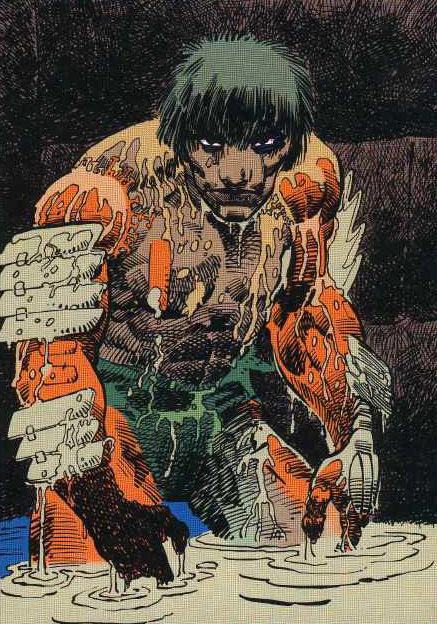
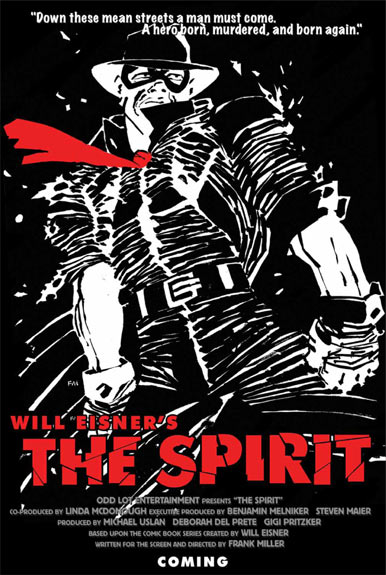
To come back to where this long post started: after I finished The Dark Knight Returns, I reread Ronin, Miller’s 1983 tale of a masterless samurai lost in an apocalyptic future New York. The story explores dystopic race relations, emerging technologies, telekinesis, and bioethics. There’s also a demon. Ronin is cyberpunk on par with the best of William Gibson, and certainly the best thing Miller ever produced–and possibly the most overlooked. Apparently, a film version of Ronin is planned for release in 2009, which will undoubtedly lead to future confusion connected to Frankenheimer’s 1998 car-chase opus (also titled Ronin). Miller, however, seems to have no major hand in the movie–he’s too busy adapting and directing Will Eisner’s classic strip The Spirit for a 2009 movie release. The Spirit is fantastic source material, and Samuel “I Will Act in Your Movie For Money” Jackson is playing the villain, The Octopus, so it might be good. Then again, Miller is the screenwriter responsible for both Robocop 2 and 3, movies that completely missed the tone of Verhoeven’s satirical original. And whether or not Miller’s future movies–including sequels to Sin City–are any good, the gritty and grimy tone that he established in series like Daredevil and the original Wolverine book, as well as his groundbreaking revisioning of Batman led to a new seriousness and depth to an art form that had too-long been relegated to the margins of literature. And that’s a good thing.

Oh Well, Whatever, Nevermind (Kurt Cobain Reconsidered)

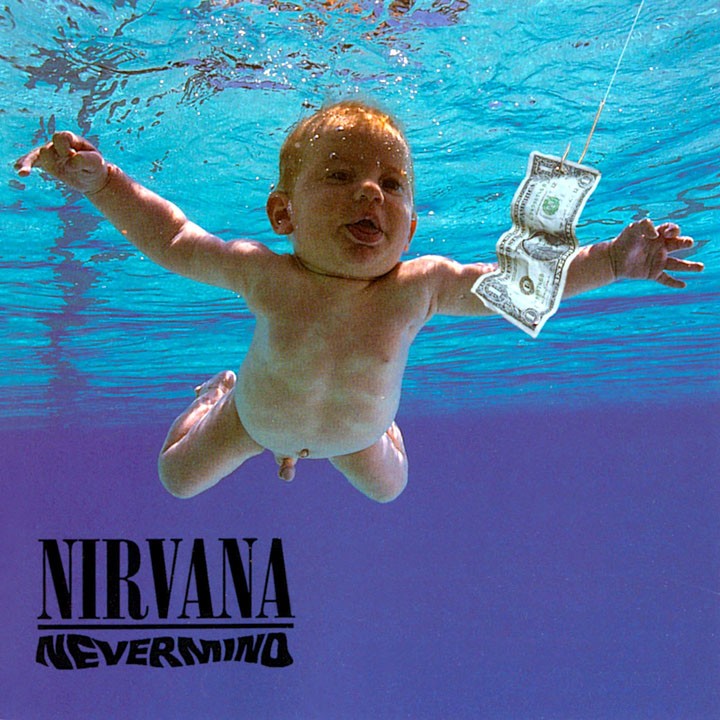
I was twelve years old when Nirvana’s landmark record Nevermind came out in September of 1991 and supposedly changed the American cultural landscape forever. I was the perfect age to be radically influenced by the onset of the whole grunge thing. Before I got a hold of Nevermind, my favorite records were R.E.M’s Out of Time and De La Soul’s De La Soul is Dead, both of which had come out a few months earlier that year. I also really, really loved Aerosmith’s Greatest Hits (you know…the red album), and U2’s The Joshua Tree. These were some of the earliest CDs I ever owned, and reflecting on this now, it seems odd that my truly favorite albums could also be brand new.

I mention a few of the CDs I owned because I think I’m a relatively typical audiophile of the age group I’m discussing here (roughly, persons born between 1975-1981, although these dates, as I write them, seem awfully silly and arbitrary). I had already outgrown dumb hair metal and had begun to realize that most of the hip-hop I was listening to was not nearly as offensive as I thought it should be. I wanted something new and different and weird, and by the beginning of the seventh grade I’d already begun to scour Rolling Stone, which still had a modicum of cultural relevance in the early nineties. I was also cherry-picking from cool movie soundtracks, and to this day I know that the soundtrack to the oh-so-forgettable 1990 film Pump Up the Volume (Christian Slater as pirate DJ leads a minor youth rebellion) had as much to do with the forging of my musical taste as any other source: this is where I was exposed to two of my favorite all-time bands, Pixies and The Sonic Youth. So, like many other young audiophiles, by the end of 1991–around the time “Smells Like Teen Spirit” was blowing up–I was already moving away from “mainstream” music as quickly as I knew how. Only Nirvana became the new mainstream, grunge became a fashion status, and, feeling like a cultural movement that I was barely even tangentially a part of had been commodified and commercialized, I had rejected the whole thing by the time I had gotten to high school in 1993. This meant rejecting wholesale a number of albums I had loved throughout middle school.

The same month Nevermind came out, so did the Red Hot Chili Pepper’s Blood Sugar Sex Magik, spawning the massive hit “Under the Bridge.” Pearl Jam’s debut Ten came out a month before Nevermind, but really didn’t pick up steam until mid ’92–grunge was in full effect by then; it too produced a mega-hit with “Jeremy.” U2’s Achtung Baby dropped in November–at this point they seemed like the elder statesmen of what was now so brashly defined as “alternative” music (“Alternative to what?” we wondered). “One” was a smash hit. The aforementioned R.E.M. album Out of Time became the year’s critical favorite, with “Losing My Religion” as one of the most unexpected number-ones of 1991. By the end of 1992, U2 and R.E.M. were “the most important bands in the world,” according to every music and entertainment magazine, and Nirvana was getting major credit for initiating a cultural revolution. I loved all of these albums dearly, and, as I mentioned above, denied all of them just a few short years later in favor of a new wave of independent label music–bands like Pavement, Superchunk, and the Archers of Loaf–bands that probably would never have achieved such successful careers without the aforementioned mega-hits that prompted the shift in cultural zeitgeist.

I present all of this evidence merely to point out that the success of these bands–contrasted with the other crap that was happening at the end of the 80s and beginning of the 90s, like White Snake and The New Kids on the Block and Warrant and Nelson and C + C Music Factory–points to something larger than the force of Nevermind alone. (It’s worth pointing out here that Guns N’ Roses released Use Your Illusion I & II a week before Nevermind; these albums had a number of hits including the monster-success of “November Rain,” and, in retrospect, I believe, for all their cock-rockery, are more akin to the albums indicative of paradigm shift I described above than to the hair metal schlock they’re often identified with). Nevermind is often credited with spearheading a musical/cultural “revolution”; this “revolution” in music was already well underway though.

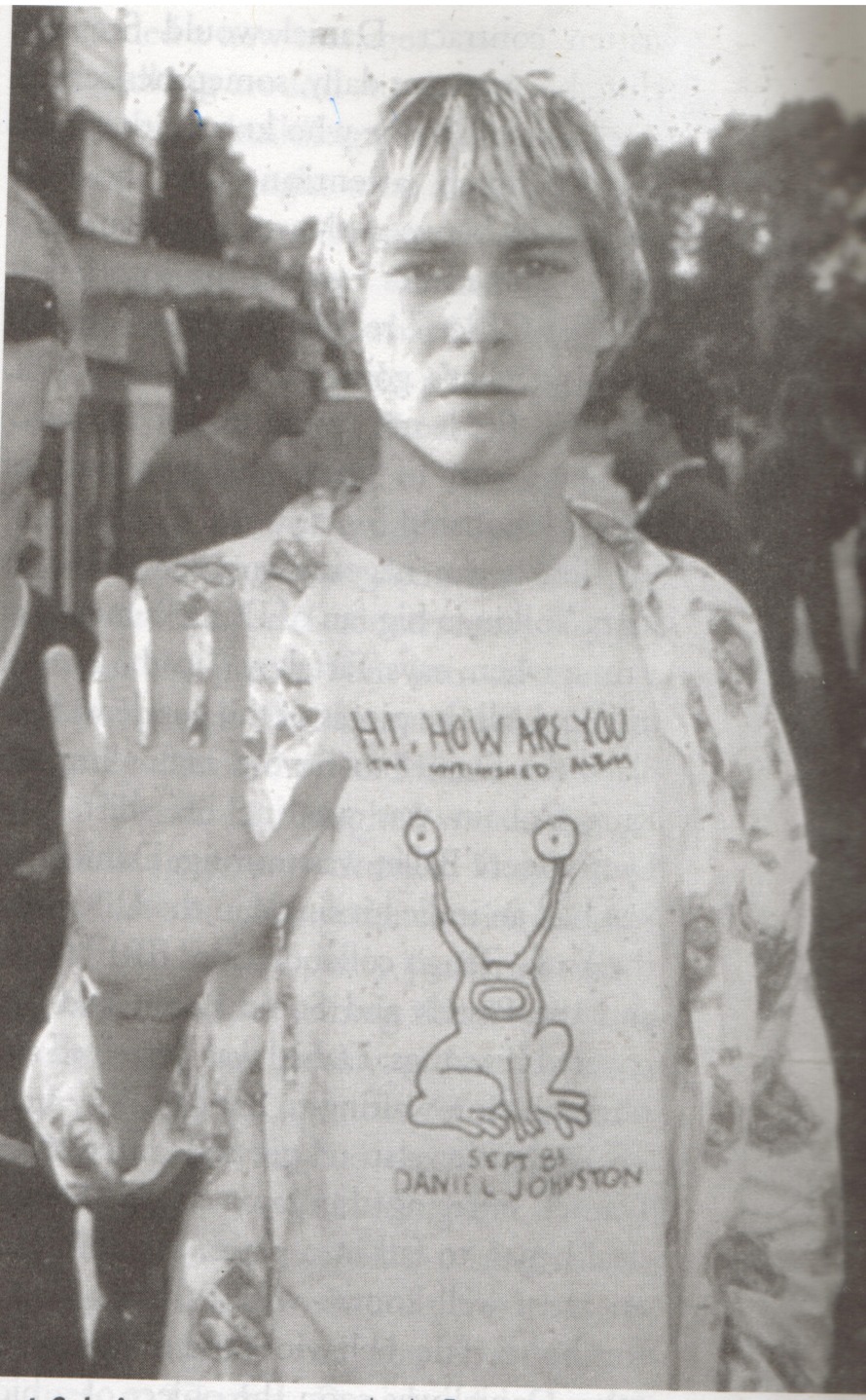
To be sure, Nevermind is a great album, but it’s cultural cache has more to do with the figure of Kurt Cobain than its relevance and popularity at the time (to see how the myth of Nevermind has grown, simply look at Rolling Stone‘s successive reviews of the album, from 1991, 1992, and 2004, respectively: the magazine gives the album three out of five stars, then four, before finally awarding it five stars thirteen years after the fact). Millions of kids saw Cobain wear Daniel Johnston t-shirts, reference the Melvins, and admit that his songs were really just crude Pixies ripoffs. Cobain, in short, exposed millions of regular kids to an angrier, rougher youth culture, a truly underground music that could react to the failed youth culture of the (now old) boomer generation of the 1960s, which had been forcing an illusory idealization of that decade down our throats forever. Ironically, it was this same boomer generation that greedily milked grunge for all it was worth, commodifying youth culture again into a twisted joke, a stupid lunch box, an action figure, a t-shirt at the mall. No wonder Cobain offed himself.

So why write about this now? It’s been almost 17 years, and there hasn’t been a record like Nevermind or mega-hits as salient, and dare I suggest meaningful, as “Smells Like Teen Spirit,” “Losing My Religion,” “Under the Bridge,” “One,” or “Jeremy” for quite sometime. The success in the mid-nineties of bands like Smashing Pumpkins and Soundgarden–bands that I didn’t hate but made fun of–seems strange now. Even the music of those elegant bachelors, the Stone Temple Pilots–grunge 2.0–seems oddly strong when held up against the watered-down drivel that passes for contemporary hard rock. Youth music today is archly, ironically aware of its own cultural position and its own performativity in a marketplace. I’m sickened by even thinking of the toothless fourth generation emo-or-whatever-you-wanna-call-it derived from Green Day (another band I didn’t hate but but made fun of) that passes for “pop-punk.” In all its silly winking at the audience, its safe-as-milk non-personality, much of this music represents the ultimate commodifiaction and commercialization of “punk”–the aesthetic that Nevermind helped to re-ignite. (In another genre, hip-hop, after 30 years of existence, has claimed its right–with a sharp vengeance–to be as stupid as any other form of music. Don’t get me started). The irony Cobain and others explored was never a smart-assed irony that coyly winked at the audience, inviting them to laugh along with whatever cultural references were being rehashed; Cobain’s irony was mean and angry–it was a critique of American hegemonic mall culture. Current youth music, rock, emo, whatever it is, is simply a celebration of greedy materialism hiding under the thinnest ironic sheen.

And here’s what I think is the saddest part: I don’t think there can be another Nevermind. To be sure, there will always be fantastic, landmark, music-changing records–I have no doubt about that (see: 1997’s OK Computer f’r’instance). But a record that channels a truly punk aesthetic into mainstream American consciousness is simply not going to happen again. For over fifteen years, critics (and executives) have been looking to award “next big thing” status to just about anyone (do you remember when the Chemical Brothers were supposed to be the “next big thing”? You don’t?). The internet has changed the old model. In the past, records like Nevermind propagated a “trickle-down” effect, if you will–kids in the heartland see Cobain give the Raincoats props, buy Raincoats’ records, get into X-Ray Spex, get into Black Flag, get into Pavement, whatever. In contrast, the internet provides a diffusion model of immediately accessible cultural immersion. Anyone with a DSL connection and a few hours to kill on Allmusic can access indie culture. And that’s a good thing. But still: I’ll get nostalgic here: in the old days, we used to write to the labels and get catalogs and order music via snail mail. We used to buy albums on pure faith that they were good. You couldn’t just click on an mp3 (or steal entire albums on p2p networks). But I’m not railing against the internet. I think it’s great that a kid in Montana can become thoroughly exposed to Drag City records or the works of Big Black in just a week. But that will never translate into a wide-scale youth culture shift. Instead, we’ll continue to have what we have now: lots of really, really shitty music on radio and TV. And this is our culture.

There won’t be another Beatles or another Sex Pistols–there won’t be another group that challenges our collective cultural sensibility to make a large jump. There won’t even be an Elvis or a Madonna, a performer that challenges our ethics and morality. Instead, we will continue to have watered-down crap on mainstream media, as well as plenty of choices for those who take the time to look. But those choices will be marginalized, kept on the sidelines out of mainstream American-consciousness, and what we’ll lose is an opportunity to progress and enrich the entirety of our culture. Who knows though–I could be wrong; perhaps I’m just old and out of touch. Perhaps a wholly new and dynamic artist or group will come out that will capture the anti-establishment roots of rock and roll and inspirit a new and dramatically different course in contemporary youth culture. But I don’t see it happening again. I hope I’m wrong.

Kurt Vonnegut Reconsidered

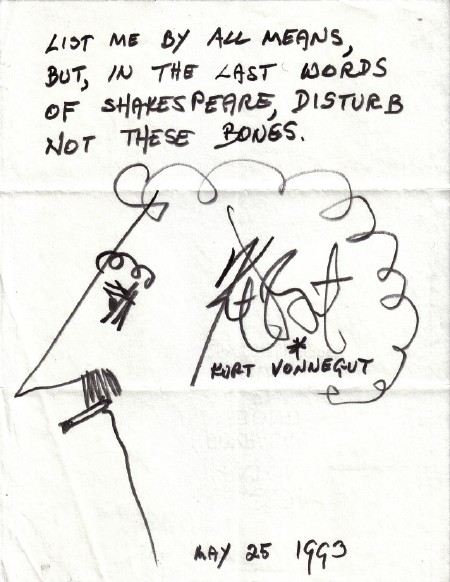
Kurt Vonnegut died a year ago today. Vonnegut’s death has left neither a cultural vacuum nor a pining after another great work now never to be. And why should it? He was pretty old–84–and he’d written a relatively substantial collection of novels, plays, essays, and short stories. And admittedly, he hadn’t written a truly great book in decades. Like Bob Dylan, Vonnegut produced his greatest work in the 1960s: Mother Night, Cat’s Cradle, God Bless You, Mr. Rosewater, and, of course, Slaughterhouse-Five (even 1968’s short story collection Welcome to the Monkey House–a book I proudly admit I stole from my 10th grade English teacher–is superior to Vonnegut’s later work). Yet there’s still something about his death that makes me feel a little melancholy, even now–not sad, per se, but rather–and it sounds corny–like something is missing.

See, I learned to read by reading Vonnegut. Sure, I knew how to read before I read Cat’s Cradle, but, beyond Tolkien, C.S. Lewis, and a number of classic adventure books by authors like Edgar Rice Burroughs and Mark Twain, Vonnegut was the first “literary” author I was exposed to. I learned irony. I learned detached pessimism. I was exposed to a writer who knew how to explode genre convention. And, in a short period–roughly from the ages of 12 to 16–I read everything that Vonnegut had written. Then I dismissed him as a “lesser” writer, and moved on, until I was required to re-read Slaughterhouse-Five in college. I’d forgotten how good it was. I re-read Cat’s Cradle, my first and favorite (to this day) Vonnegut novel. Again, great. I then picked up Vonnegut’s final novel, 1997’s Timequake, a shambolic wreck of semi-autobiography that is at turns drastically pessimistic, utterly depressive, and hilariously cynical. It’s really a terrible book, to be honest, but taken as a final statement, I think it works. In any case, after college I managed to get over the silly embarrassment I felt for my love of Vonnegut, an author often relegated to the second or even third tier of American letters, or, even worse, a personality reviled in the press (watch Fox News’s scandalous obituary. Or, if you prefer watching something positive, watch Vonnegut on The Daily Show.)

I suppose, when I say that Vonnegut’s death presents an absence, a feeling of something missing, I really mean to say that it marks me, it ages me: it makes me feel old. After all, we measure our own lives in part against the deaths of others, particularly against the deaths of the famous and celebrated. Vonnegut preceded me; his novels were there, waiting for me, and I was grateful. I read all of them–all of them–I don’t know if I can say that of another author (except maybe Salinger, and I don’t think that counts). But I still haven’t read A Man Without a Country, his 2005 collection of essays, and I haven’t read the posthumously published short story collection, Armageddon in Retrospect, which came out just the other week. It makes me happy to know that there’s something out there of his that I haven’t yet touched, that I can read for the first time as an adult, and not a teenager. I don’t know why I should feel this way, but I do. So it goes.

Vonnegut plays himself in an classic film:

A Midsummer Night’s Dream

Every year, I try to pick a different Shakespeare play to read with my students, preferably one I haven’t read in a long time. This year, I have one group of tenth graders, and right now we’re reading A Midsummer Night’s Dream. As I’ve mentioned elsewhere on this blog, most of the students at my school read well below their grade level, so Shakespearean language can often be a challenge. I’ve found that Alan Durband’s Shakespeare Made Easy series does a great job at clarifying the narrative action without sacrificing too much of Shakespeare’s poetry. It presents the original text on the left side with the clarified “translation” on the right, which allows us to read and act out the play without spending too much time and effort breaking down every little (or long…) speech. Every couple of pages I’ll pick out a key passage from the original text which we’ll read and discuss. I’ve also been showing them the film adaptation that came out in the nineties (with Kevin Kline, Michelle Pfeiffer, and Christian Bale). We’re about half way through so far, and we’re enjoying the whole process.

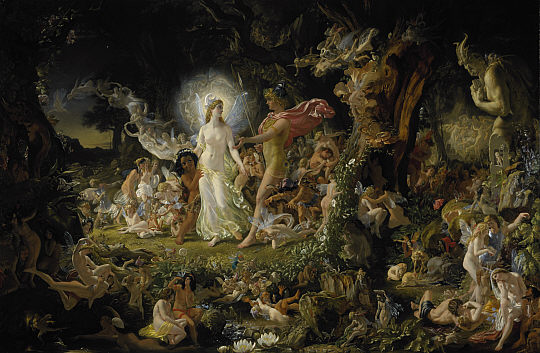
I haven’t read this play since I was in the tenth grade, and I really didn’t think too much of it then–it certainly didn’t seem as weighty as, say, Othello, Macbeth, or Hamlet. Anyway, in re-reading it, I notice now that there’s an underlying rape motif throughout the text. For example, Theseus has captured his bride Hippolyta by seizing her in a classical rape; Demetrius threatens taking the “rich worth” of Helena’s virginity if she won’t quit stalking him in the woods; Lysander forces himself onto Hermia in the woods, and she’s barely able to keep him off. Oberon and Titania’s quarrel over the beautiful Indian boy is pretty weird, and is just one strange detail in a play full of aggressive sexuality, possibly most neatly summed up in the bestiality implicit in Titania’s affair with ass-headed Bottom. Of course, Titania doesn’t really love bottom–she’s just been dosed by her jealous hubby, who has a frat boy’s penchant for drugging people to get the love buzz going. Good stuff.

Blood Meridian–Cormac McCarthy

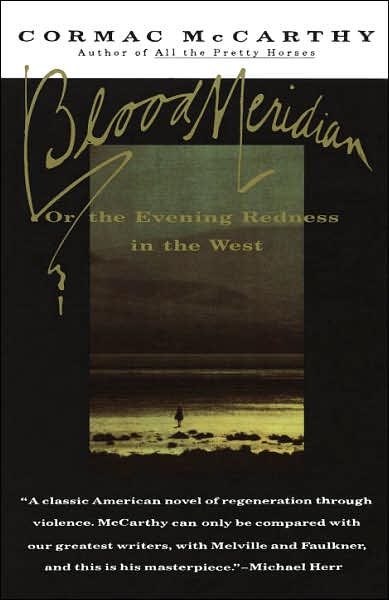
Blood Meridian is a blood-soaked, bloodthirsty bastard of a book, and certainly the most violent piece of literature I’ve read outside of the Bible and certain Greek tragedies. Cormac McCarthy’s 1985 novel passes itself off as a Western–and it is a Western, to be sure–but more than anything, it’s a brutal horror story.

Set predominantly in the 1850s, Blood Meridian chronicles the westward journey of a protagonist we know only as “the kid.” After a few false starts (including getting shot, robbed, arrested, and surviving a Comanche massacre) the kid eventually meets up with John Joel Glanton‘s “expedition”–a group of men of mixed backgrounds hired by Mexican authorities to kill–and scalp–the nomadic Apache that prey upon Mexican villages. However, led by the nefarious, larger-than-life Judge Holden, Glanton’s gang quickly descends into a relentless robbing, raping, and killing spree; they savagely massacre peaceful Indian settlements along with the Mexican villages they were contracted to protect.

I could keep summarizing the book, but I don’t see the point, honestly–a mere description of the plot could never do real justice to the weight of this book. The narrative is taut and fast-paced–in fact, at points the action is so radically condensed that I had to go back and re-read sections–and there’s no shortage of the “men doing men stuff” that McCarthy is so good at detailing–but it’s really the combination of the book’s evocative imagery and philosophical pondering that hook the reader.

Most of that philosophical pondering comes from the Judge, who waxes heavy on everything from space aliens to metallurgy. In his parables and aphorisms, the Judge comes across as part-Mephistophelean, part-Nietzschean, all dark wisdom and irreverent chaos. I found myself re-reading the Judge’s speeches several times and chewing them over, trying to digest them; for me, they were the best part of a great book.

Blood Meridian, like most excellent things, is simply not for everyone, and I don’t mean that in any snobbish, elitist sense. Any reader turned off by its freewheeling violence would be justified, and I’m sure plenty of folks out there would take issue with its ambiguous conclusion. Depictions of genocidal mania that seem to end inconclusively are not for everyone, particularly when they are rife with archaisms, untranslated Spanish, and McCarthy’s signature, apostrophe-free punctuation. I had two false starts with the novel, including one where, at about exactly half way through, I realized I had to go back and start the novel again. I owed it that much. And it was worth it.

Blood Meridian is literally stunning; perhaps the best analogy I can think of is going to see a really, really good band that plays really, really brutal and strange music that sorta melts your face off. After the show you’re sweaty and exhilarated and even unnerved; your ears are ringing and your chest is pounding. And then the band packs up, and the house lights go on, and they pump in music from a CD, of all things, and the music just sounds tinny and pale and blanched of life after the raw power you’ve witnessed. Reading anything else right after finishing Cormac McCarthy’s Blood Meridian, or the Evening Redness in the West is sort of like that. Highly recommended.

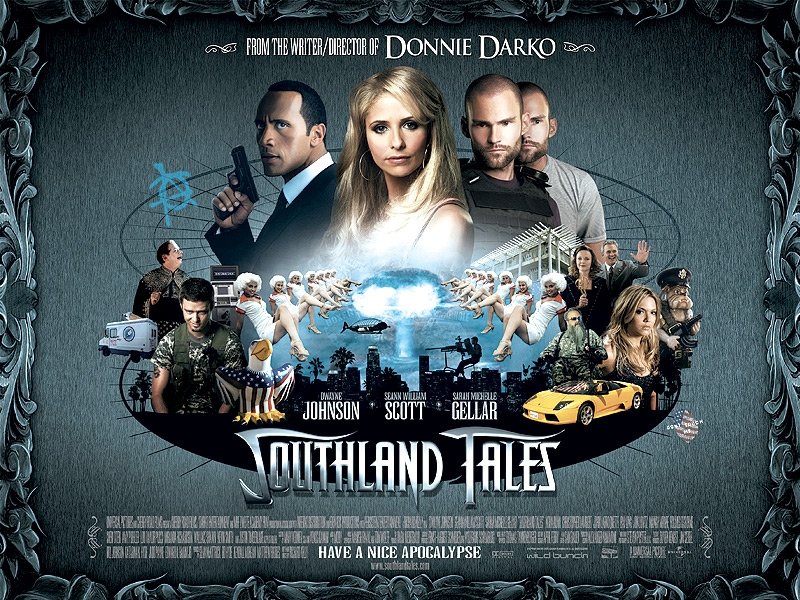
Southland Tales

Movies, Richard Kelly, Southland Tales, Confusion

OK. So. I’ve now aborted several attempts at properly reviewing Southland Tales so I figure I’ll just go for it. This might be a hack job; possibly one of the worst blogs I’ve ever written. In the spirit of Richard Kelly’s something-opus, I’ll do it anyway.

How much you love or hate (or are completely perplexed by) Southland Tales will rest on a number of factors:

How do you feel about overly-ambitious movies that sprawl in multiple directions? Are you OK with key plot lines not reaching resolution? Do you mind cartoonish violence and sophomoric humor mixed with biting satire? What about giant toilets? How would you feel about Dwayne “The Rock” Johnson relentlessly mugging for about 150 minutes? Would it bother you if thematic plot points hung on lines from poems by T.S. Eliot, Robert Frost, and lyrics from, uh, Perry Ferrell? Would you think that that was pretentious (or just plain dumb, perhaps)? Do you love to see ex-Saturday Night Live members in seemingly incongruous roles? What about watching a movie made a couple of years ago that intended to satirize the (then) near future, only the movie had major troubles getting distributed so when it finally got a national release the future it was satirizing was, like, now? How much did you love Donnie Darko (that won’t make a difference, actually…)? Can’t get enough Sarah Michelle Gellar? Are you OK with watching a movie that, like the original Star Wars trilogy, begins at part IV? How do you feel about Justin Timberlake? What about a “tell-don’t-show” voiceover courtesy of said JT? What about a soundtrack by Moby? SUVs humping? Are these fair questions? Is it fair to frame a movie review in a series of questions? No? Really?

OK. So. Now. How about this:

Philip K. Dick, crime noir, Neo-Marxism, Apocalypse Now, Natural Born Killers, David Lynch, Repo Man, comic books, Strange Days, Wim Wenders, psychotropic paranoia, Terry Gilliam, MAD magazine, epic confusion, Spring Break apocalypse, the Revelation to John, Disneyworld on acid, strange loops, Stanley Kubrick, bogus quantum theory, Los Angeles, nightmare comedy soap opera…

No? Just listing a bunch of references doesn’t qualify as decent critical appraisal? How about this, then:

–or this–

Wow. I was probably better off just not reviewing the damn thing. I want to see it again, like six or seven times, before deciding if I hate it or love it (my wife hated the parts that she didn’t sleep through, by the by. But she sleeps through about 75% of the movies we watch). Actually, after it was over, I immediately watched the whole last half hour again. Maybe you should just go here and read a bunch of real reviews of this movie. Or, better yet, just see it.