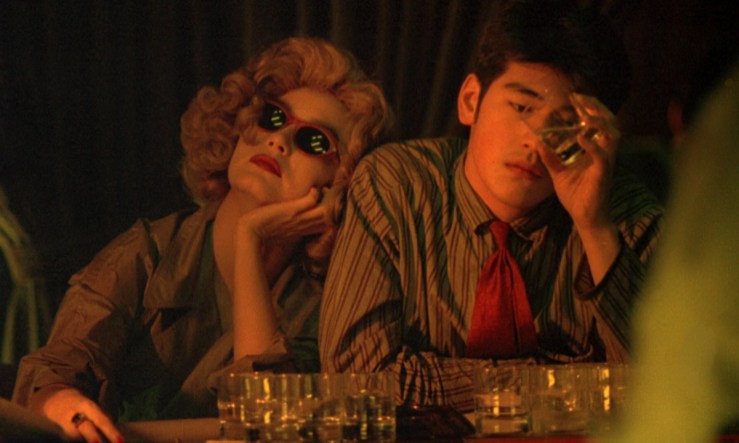
“Whole problem ’th you folks’s generation,” Isaiah opined, “nothing personal, is you believed in your Revolution, put your lives right out there for it—but you sure didn’t understand much about the Tube. Minute the Tube got hold of you folks that was it, that whole alternative America, el deado meato, just like th’ Indians, sold it all to your real enemies, and even in 1970 dollars—it was way too cheap. . . .”
A critique (by Gen X punker Isaiah Two Four) of the Baby Boomers. From Thomas Pynchon’s 1990 novel Vineland. The “Tube” is television, of course, but might be a placeholder for any passively-consumed entertainment.
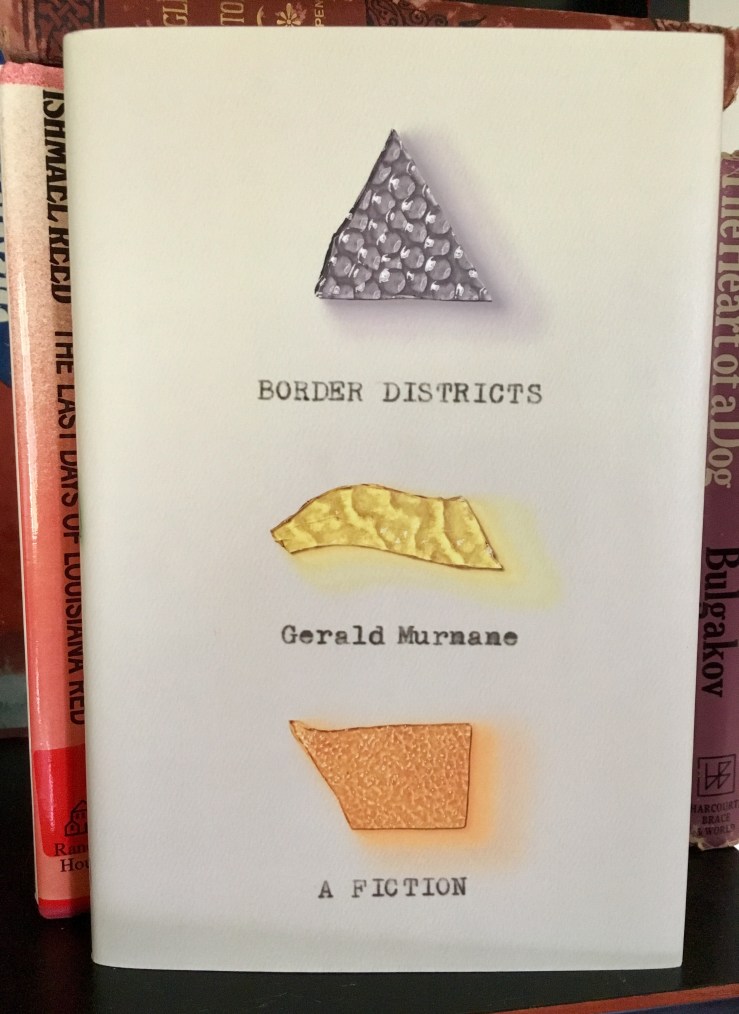
I picked up a hardback copy of Gerald Murnane’s latest novel Border Districts on something of a whim today. It’s only 120 pages in hardback, and, despite Murnane’s metamodernist mode, is probably a bit more cohesive than the last few novels I’ve read (Thomas Pynchon’s Vineland, Kathy Acker’s Don Quixote, and Marlon James’s Black Leopard, Red Wolf). First two paragraphs—
Two months ago, when I first arrived in this township just short of the border, I resolved to guard my eyes, and I could not think of going on with this piece of writing unless I were to explain how I came by that odd expression.
I got some of my schooling from a certain order of religious brothers, a band of men who dressed each in a black soutane with a bib of white celluloid at his throat. I learned by chance last year, and fifty years since I last saw anyone wearing such a thing, that the white bib was called a rabat and was a symbol of chastity. Among the few books that I brought here from the capital city is a large dictionary, but the word rabat is not listed in it. The word may well be French, given that the order of brothers was founded in France. In this remote district, I am even less inclined than I was in the suburbs of the capital city to seek out some or another obscure fact; here, near the border, I am even more inclined than of old to accept as well founded any supposition likely to complete a pattern in my mind and then to go on writing until I learn the meaning for me of such an image as that of the white patch which appeared just now against a black ground at the edge of my mind and will not be easily dislodged.
Mucho blinked sympathetically, a little sadly. “I guess it’s over. We’re on into a new world now, it’s the Nixon Years, then it’ll be the Reagan Years—”
“Ol’ Raygun? No way he’ll ever make president.”
“Just please go careful, Zoyd. ’Cause soon they’re gonna be coming after everything, not just drugs, but beer, cigarettes, sugar, salt, fat, you name it, anything that could remotely please any of your senses, because they need to control all that. And they will.”
“Fat Police?”
“Perfume Police. Tube Police. Music Police. Good Healthy Shit Police. Best to renounce everything now, get a head start.”
“Well I still wish it was back then, when you were the Count. Remember how the acid was? Remember that windowpane, down in Laguna that time? God, I knew then, I knew. . . .”
They had a look. “Uh-huh, me too. That you were never going to die. Ha! No wonder the State panicked. How are they supposed to control a population that knows it’ll never die? When that was always their last big chip, when they thought they had the power of life and death. But acid gave us the X-ray vision to see through that one, so of course they had to take it away from us.”
“Yeah, but they can’t take what happened, what we found out.”
“Easy. They just let us forget. Give us too much to process, fill up every minute, keep us distracted, it’s what the Tube is for, and though it kills me to say it, it’s what rock and roll is becoming—just another way to claim our attention, so that beautiful certainty we had starts to fade, and after a while they have us convinced all over again that we really are going to die. And they’ve got us again.” It was the way people used to talk.
“I’m not gonna forget,” Zoyd vowed, “fuck ’em. While we had it, we really had some fun.”
“And they never forgave us.” Mucho went to the stereo and put on The Best of Sam Cooke, volumes 1 and 2, and then they sat together and listened, both of them this time, to the sermon, one they knew and felt their hearts comforted by, though outside spread the lampless wastes, the unseen paybacks, the heartless power of the scabland garrison state the green free America of their childhoods even then was turning into.
An elegiac passage from Thomas Pynchon’s 1990 novel Vineland.
A few hours ago, my best friend send me a text with a link to listen to “All My Happiness Is Gone,” the first single from David Berman’s new band Purple Mountains. We’d been excited to hear the tune since it was announced last week. It’s been over a decade since Berman’s last record, Lookout Mountain, Lookout Sea came out, and I’ve missed his voice. The six records the Silver Jews put out between 1994 and 2008 were formative to me. I remember each distinctly as evocations of time and place, the songs on each record emotional spaces different versions of me inhabited.
I’ve listened to “All My Happiness Is Gone” about half a dozen times now, and listened to the two remixes of it a couple of times too. I really like the song—it’s sad and moving, a song about aging and friendship and, uh, despair, a song that opens with, “Friends are warmer than gold when you’re old / And keeping them is harder than you might suppose.”
When we were 15, my best friend, the one who texted me a link to listen to “All My Happiness Is Gone” a few hours ago, we were between bands. Or really, we were calling the music we made together in our bedrooms a band. We’d soon hook up with a drummer, and then another drummer, other players, and so on, different iterations of an amateur psych art rock band that played shows in clubs and smaller clubs, houses, record stores, art galleries and you get the idea. Anyway, when we were 15, between bands, we recorded what we called an “album” (an album!) on my then-girlfriend’s older brother’s 4-track. The tape we made is and was awful, but we covered the Silver Jews’ song “Trains Across the Sea,” all two chords of it, with what I still think of as a kind of clumsy grace, my best friend delivering the lead vocal with an admirably faulty feigned maturity. We even adapted the line “In 27 years I’ve drunk 50, 000 beers” to better suit our own then slim duration, even though we had to stretch the syllables in “15” a bit too far for the meter. Over the past 25 years I’ve recorded hundreds of hours of music, a lot of it with this friend, and that cover of “Trains Across the Sea” is maybe my favorite thing we ever did.
Wait—didn’t I say that this was a blog about “All My Happiness Is Gone,” a new song by the band Purple Mountains? I did, I know—but I can’t write about music. Sorry. It’s better to just hear the song, right? Here it is:
The first two minutes of this video aren’t part of the single edit, but I like the way Berman’s plunky guitar meanders around the melody and rhythm of the song before the canned orchestra propels us into the sad sad sad lyric. The intro also balances out the end of the song, which doesn’t so much conclude as it slows into near-collapse, stretched thin like the spirit of the song itself: ” …the fear’s so strong it leaves you gasping / No way to last out here like this for long.”
Berman’s albums with the Silver Jews were always tinged with melancholy or even outright depression, but there was always, at least in my estimation, a leavening irony. Take “Honk If You’re Lonely,” from American Water, for instance, in which Berman celebrates and sends up classic country tunes, and, ultimately connects to his audience: “Honk if you’re lonely tonight / If you need a friend to get through the night.” Two decades later in “All My Happiness Is Gone,” Berman sounds like the one who needs a friend:
Mounting mileage on the dash
Double darkness falling fast
I keep stressing, pressing on
Way deep down at some substratum
Feels like something really wrong has happened
And I confess I’m barely hanging on
The music is simple and sweet, moving between two chords for the most part—the second chord lingering just a bit longer before the chorus hits, the same trick that Berman pulled off in “Trains Across the Sea.” The chorus, in which Berman repeats the titular line with a plaintive sadness that hurts me, hangs around a melody that reads like a country goth cribbing of Modern English’s “I Melt with You.” It’s a bit of an emotional apocalypse, which is kinda maybe what you want from a sad song, but the sadness seems so sincere, the despair so visceral, that again, it hurts. Maybe share it with a friend.
So the bad Ninjamobile swept along on the great Ventura, among Olympic visitors from everywhere who teemed all over the freeway system in midday densities till far into the night, shined-up, screaming black motorcades that could have carried any of several office seekers, cruisers heading for treed and more gently roaring boulevards, huge double and triple trailer rigs that loved to find Volkswagens laboring up grades and go sashaying around them gracefully and at gnat’s-ass tolerances, plus flirters, deserters, wimps and pimps, speeding like bullets, grinning like chimps, above the heads of TV watchers, lovers under the overpasses, movies at malls letting out, bright gas-station oases in pure fluorescent spill, canopied beneath the palm trees, soon wrapped, down the corridors of the surface streets, in nocturnal smog, the adobe air, the smell of distant fireworks, the spilled, the broken world.
A description of the postmodern Preterite world from Thomas Pynchon’s 1990 novel Vineland.