The true paranoid for whom all is organized in spheres joyful or threatening | A passage from Thomas Pynchon’s The Crying of Lot 49

“Please,” the sailor said. “Go on now. You don’t want to stay here.” She looked in her purse, found a ten and a single, gave him the ten. “I’ll spend it on booze,” he said.
“Remember your friends,” said the arthritic, watching the ten.
“Bitch,” said the sailor. “Why didn’t you wait till he was gone?”
Oedipa watched him make adjustments so he’d fit easier against the mattress. That stuffed memory. Register A . . .
“Give me a cigarette, Ramírez,” the sailor said. “I know you got one.”
Would it be today? “Ramírez,” she cried. The arthritic looked around on his rusty neck. “He’s going to die,” she said.
“Who isn’t?” said Ramírez.
She remembered John Nefastis, talking about his Machine, and massive destructions of information. So when this mattress flared up around the sailor, in his Viking’s funeral: the stored, coded years of uselessness, early death, self-harrowing, the sure decay of hope, the set of all men who had slept on it, whatever their lives had been, would truly cease to be, forever, when the mattress burned. She stared at it in wonder. It was as if she had just discovered the irreversible process. It astonished her to think that so much could be lost, even the quantity of hallucination belonging just to the sailor that the world would bear no further trace of. She knew, because she had held him, that he suffered DT’s. Behind the initials was a metaphor, a delirium tremens, a trembling unfurrowing of the mind’s plowshare. The saint whose water can light lamps, the clairvoyant whose lapse in recall is the breath of God, the true paranoid for whom all is organized in spheres joyful or threatening about the central pulse of himself, the dreamer whose puns probe ancient fetid shafts and tunnels of truth all act in the same special relevance to the word, or whatever it is the word is there, buffering, to protect us from. The act of metaphor then was a thrust at truth and a lie, depending where you were: inside, safe, or outside, lost. Oedipa did not know where she was. Trembling, unfurrowed, she slipped sidewise, screeching back across grooves of years, to hear again the earnest, high voice of her second or third collegiate love Ray Glozing bitching among “uhs” and the syncopated tonguing of a cavity, about his freshman calculus; “dt,” God help this old tattooed man, meant also a time differential, a vanishingly small instant in which change had to be confronted at last for what it was, where it could no longer disguise itself as something innocuous like an average rate; where velocity dwelled in the projectile though the projectile be frozen in midflight, where death dwelled in the cell though the cell be looked in on at its most quick. She knew that the sailor had seen worlds no other man had seen if only because there was that high magic to low puns, because DT’s must give access to dt’s of spectra beyond the known sun, music made purely of Antarctic loneliness and fright. But nothing she knew of would preserve them, or him.

From Thomas Pynchon’s novel The Crying of Lot 49.

Thomas Pynchon’s recipe for what is arguably the first British Pizza | A passage from Mason & Dixon

“Lud wishes to know,” Whike relays at last, “Mr. Emerson’s Cousin’s Views, upon the Structure of the World.”
“A Spheroid, the last I heard of it, Sir.”
“Ahr Ahr ahr, ’ahr ahhrr!”
“ ’And I say, ’tis Flat,’” the Jesuit smoothly translates. “Why of course, Sir, flat as you like, flat as a Funnel-Cake, flat as a Pizza, for all that,— ”
“Apologies, Sir,—” Whike all Unctuosity, “the foreign Word again, was . . . ?”
“The apology is mine,— Pizza being a Delicacy of Cheese, Bread, and Fish ubiquitous in the region ’round Mount Vesuvius. . . . In my Distraction, I have reach’d for the Word as the over-wrought Child for its Doll.”
“You are from Italy, then, sir?” inquires Ma.
“In my Youth I pass’d some profitable months there, Madam.”
“Do you recall by chance how it is they cook this ‘Pizza’? My Lads and Lasses grow weary of the same Daily Gruel and Haggis, so a Mother is ever upon the Lurk for any new Receipt.”
“Why, of course. If there be a risen Loaf about . . . ?”
Mrs. Brain reaches ’neath the Bar and comes up with a Brown Batch-Loaf, rising since Morning, which she presents to “Cousin Ambrose,” who begins to punch it out flat upon the Counter-Top. Lud, fascinated, offers to assault the Dough himself, quickly slapping it into a very thin Disk of remarkable Circularity.
“Excellent, Sir,” Maire beams, “I don’t suppose anyone has a Tomato?”
“A what?”
“Saw one at Darlington Fair, once,” nods Mr.”“Brain.
“No good, in that case,— eaten by now.”
“The one I saw, they might not have wanted to eat . . . ?”
Dixon, rummaging in his Surveyor’s Kit, has come up with the Bottle of Ketjap, that he now takes with him ev’rywhere. “This do?”
“That was a Torpedo, Husband.”
“That Elecktrickal Fish? Oh . . . then this thing he’s making isn’t elecktrical?”
“Tho’ there ought to be Fish, such as those styl’d by the Neopolitans, Cicinielli. . . .”
“Will Anchovy do?” Mrs. Brain indicates a Cask of West Channel ’Chovies from Devon, pickl’d in Brine.
“Capital. And Cheese?”
“That would be what’s left of the Stilton, from the Ploughman’s Lunch.”
“Very promising indeed,” Maire wringing his Hands to conceal their trembling. “Well then, let us just . . .”
By the Time what is arguably the first British Pizza is ready to come out of the Baking-Oven beside the Hearth, the Road outside has gone quiet and the Moorland dark, several Rounds have come and pass’d, and Lud is beginning to show signs of Apprehension. “At least ’tis cloudy tonight, no Moonlight’ll be getting thro’,” his Mother whispers to Mr. Emerson.”

From Thomas Pynchon’s novel Mason & Dixon.

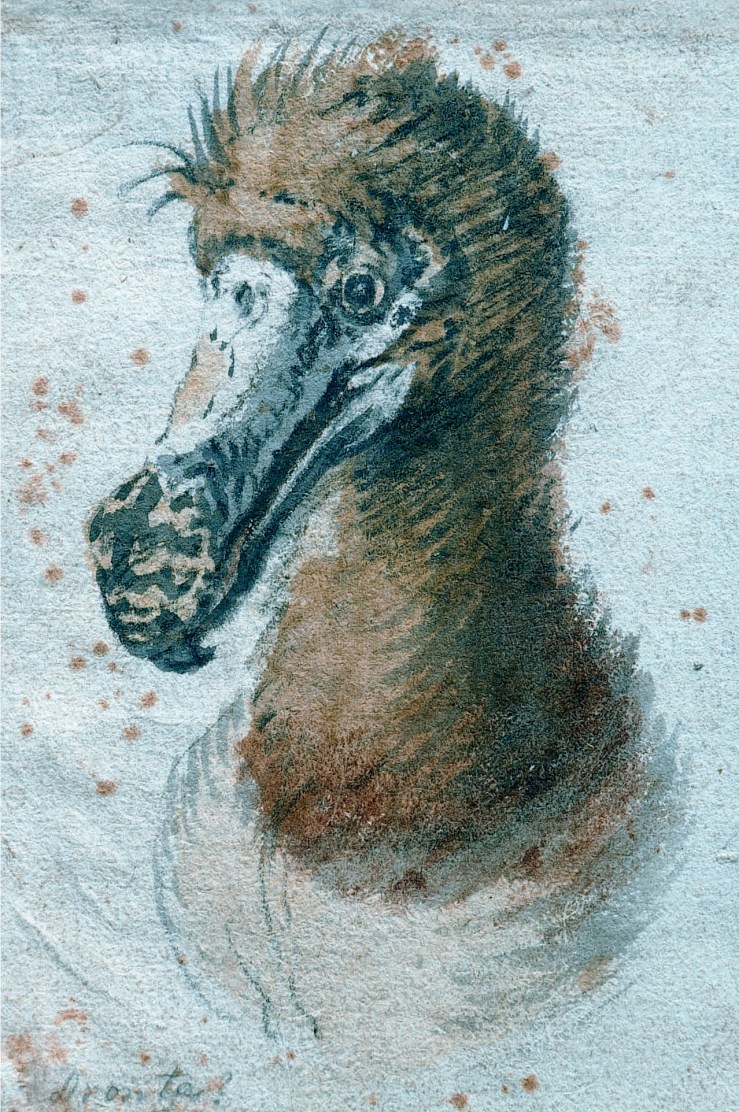
The extinction of the dodo | A passage from Thomas Pynchon’s Gravity’s Rainbow

saftleven_dodo
Dodo, 1638 by Cornelis Saftleven (1607-1681)

He left the dodoes to rot, he couldn’t endure to eat their flesh. Usually, he hunted alone. But often, after months of it, the isolation would begin to change him, change his very perceptions—the jagged mountains in full daylight flaring as he watched into freak saffrons, streaming indigos, the sky his glass house, all the island his tulipomania. The voices—he insomniac, southern stars too thick for constellations teeming in faces and creatures of fable less likely than the dodo—spoke the words of sleepers, singly, coupled, in chorus. The rhythms and timbres were Dutch, but made no waking sense. Except that he thought they were warning him… scolding, angry that he couldn’t understand. Once he sat all day staring at a single white dodo’s egg in a grass hummock. The place was too remote for any foraging pig to’ve found. He waited for scratching, a first crack reaching to net the chalk surface: an emergence. Hemp gripped in the teeth of the steel snake, ready to be lit, ready to descend, sun to black-powder sea, and destroy the infant, egg of light into egg of darkness, within its first minute of amazed vision, of wet downstirred cool by these south-east trades… . Each hour he sighted down the barrel. It was then, if ever, he might have seen how the weapon made an axis potent as Earth’s own between himself and this victim, still one, inside the egg, with the ancestral chain, not to be broken out for more than its blink of world’s light. There they were, the silent egg and the crazy Dutchman, and the hookgun that linked them forever, framed, brilliantly motionless as any Vermeer. Only the sun moved: from zenith down at last behind the snaggleteeth of mountains to Indian ocean, to tarry night. The egg, without a quiver, still unhatched. He should have blasted it then where it lay: he understood that the bird would hatch before dawn. But a cycle was finished. He got to his feet, knee and hip joints in agony, head gonging with instructions from his sleeptalkers droning by, overlapping, urgent, and only limped away, piece at right shoulder arms.

Continue reading “The extinction of the dodo | A passage from Thomas Pynchon’s Gravity’s Rainbow”

Three potential starting points for reading Thomas Pynchon

image1

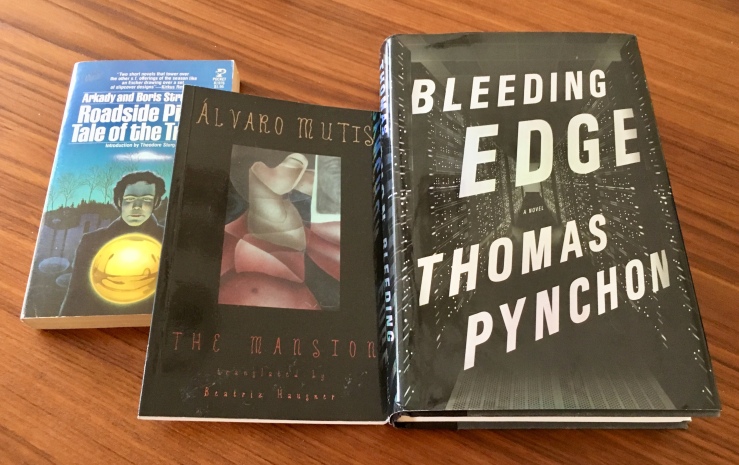
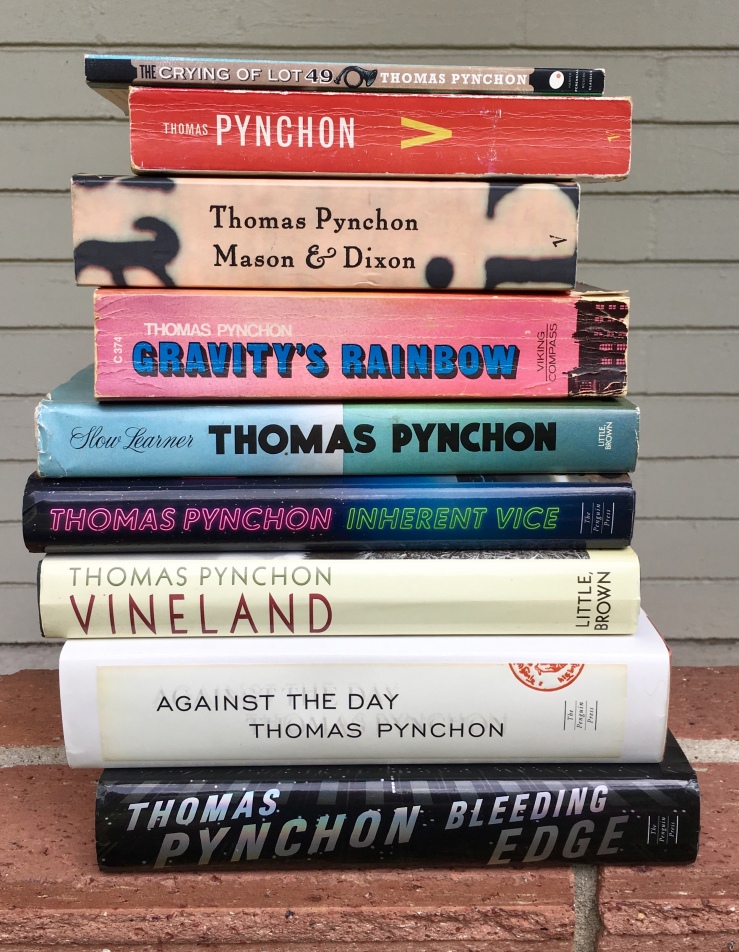
Today is Pynchon in Public Day, so here are three books that I think may make good entry points for those interested in, but perhaps unnecessarily daunted by, Thomas Pynchon. My intuition is that many readers’ first experiences reading Pynchon may have been like mine: I read The Crying of Lot 49 as a college assignment, found it bewildering and baffling, and despite understanding almost none of it, I then attempted Gravity’s Rainbow (the key word is attempted (failed will also do in a pinch)).

Many readers start with The Crying of Lot 49 because it’s short. While I like the novel (I wrote about it here), it’s also extraordinarily dense, a box so crammed with jokes and japes that some fail to spring out at full force. Lot 49 is a much better reading experience after you’ve read more of Pynchon.

Lots of readers new to Pynchon plunge into Gravity’s Rainbow, probably because it’s famous. I love love love Gravity’s Rainbow, but along with Mason & Dixon (which may be my favorite Pynchon novel), I do not think it is a good starting place for Pynchon. Gravity’s Rainbow is a rich, ringing vortex, a seven-hundred-and-something pager that almost necessitates that its reader immediately reread it. Gravity’s Rainbow is a very funny and very tragic book, and I think it is the work of genius that its reputation suggests—but it’s also one of the few books I can think of that get put on lists of Big Difficult Novels that is, actually, Difficult.

So here are my suggestions for starting places for Pynchon.

img_2195

Against the Day, 2006.

Okay. So maybe you’re saying, Waitisn’t that one, like, really long? Reader, you’re correct. At 1,085 pages Against the Day is Pynchon’s longest novel to date. But it’s also one of his most accessible, and, most importantly, it offers a condensation of Pynchon’s Big Ideas and Big Themes. (I wrote a list of 101 possible descriptors for Against the Day, if you’re interested in a short take; I also riffed on the book at some length in a series of posts).

img_2194

V., 1963.

V. is Thomas Pynchon’s first novel. It’s also the first Pynchon novel I read and loved and (possibly) understood. Like Against the DayV. lays out many of the themes and styles (and even a character or two) that appear elsewhere Pynchon’s oeuvre. In a loose sense, V. feels like a dress rehearsal for Gravity’s Rainbow. Oh, it’s also pretty discursive—in fact, you can read chunks of it almost as short stories. In fact, here’s a good way to break into Pynchon: Get V., and read Ch. 9–it stands on its own as a long short story, the tale of Kurt Mondaugen—and colonialism, siege paranoia, dark dread, etc.

img_2197

Inherent Vice, 2009.

I’ve heard Inherent Vice dismissed as “Pynchon lite,” which may be true—I’ve read the book twice now and if its shaggy threads connect, I can’t see it (unlike, say, Gravity’s Rainbow, which resolves like a complicated math problem). Still, Inherent Vice makes a nice gateway drug to Pynchon—it’s funny and loose, and even though it rambles through an enormous cast of characters and settings, it’s ultimately far, far more contained than sprawling novels like Mason & Dixon and Gravity’s Rainbow. Paul Thomas Anderson’s film adaptation also makes an interesting visual counterpart to the novel—which it somehow simultaneously condenses and expands. Inherent Vice—the novel—also seems to me a kind of bookend or sequel to The Crying of Lot 49. (I wrote a bit about that here).

Last thought: Ignore my suggestions. Pick any novel that interests you by Pynchon and dive in. Don’t get too frustrated if you’re not sure what’s going on. A lot of the time, that’s the point of it all. Enjoy it.

[Ed. note–Biblioklept ran a version of this post on 8 May 2016].

Boy with Book — Quint Buchholz 

quint-buchholz-boy-with-book-2013

Boy with Book, 2013 by Quint Buchholz (b. 1957)

Visitation (Detail) — Pontormo

Screenshot 2019-05-06 at 8.33.30 AM.png

Visitation, 1529 by  Pontormo (1494 –1557)

“Covered Mirrors,” a very short story by Jorge Luis Borges

“Covered Mirrors”

by

Jorge Luis Borges

Translated by Andrew Hurley


Islam tells us that on the unappealable Day of Judgment, all who have perpetrated images of living things will reawaken with their works, and will be ordered to blow life into them, and they will fail, and they and their works will be cast into the fires of punishment. As a child, I knew that horror of the spectral duplication or multiplication of reality, but mine would come as I stood before large mirrors. As soon as it began to grow dark outside, the constant, infallible functioning of mirrors, the way they followed my every movement, their cosmic pantomime, would seem eerie to me. One of my insistent pleas to God and my guardian angel was that I not dream of mirrors; I recall clearly that I would keep one eye on them uneasily. I feared sometimes that they would begin to veer off from reality; other times, that I would see my face in them disfigured by strange misfortunes. I have learned that this horror is monstrously abroad in the world again. The story is quite simple, and terribly unpleasant.

In 1927, I met a grave young woman, first by telephone (because Julia began as a voice without a name or face) and then on a corner at nightfall. Her eyes were alarmingly large, her hair jet black and straight, her figure severe. She was the granddaughter and greatgranddaughter of Federalists, as I was the grandson and great-grandson of Unitarians, but that ancient discord between our lineages was, for us, a bond, a fuller possession of our homeland. She lived with her family in a big run-down high-ceiling’d house, in the resentment and savorlessness of genteel poverty. In the afternoons— only very rarely at night—we would go out walking through her neighbor-hood, which was Balvanera.  We would stroll along beside the high blank wall of the railway yard; once we walked down Sarmien to all the way to the cleared grounds of the Parque Centenario. Between us there was neither love itself nor the fiction of love; I sensed in her an intensity that was utterly unlike the intensity of eroticism, and I feared it. In order to forge an intimacy with women, one often tells them about true or apocryphal things that happened in one’s youth; I must have told her at some point about my horror of mirrors, and so in 1928 I must have planted the hallucination that was to flower in 1931. Now I have just learned that she has gone insane, and that in her room all the mirrors are covered, because she sees my reflection in them—usurping her own—and she trembles and cannot speak, and says that I am magically following her, watching her, stalking her.

What dreadful bondage, the bondage of my face—or one of my former faces. Its odious fate makes me odious as well, but I don’t care anymore.

The Soul of Wine — Carlos Schwabe

fc7133811beac0416b995d5fc6f460a8

The Soul of Wine, 1900 by Carlos Schwabe (1866–1926)

Illustration for Les Fleurs du mal by Charles Baudelaire.

“The Soul of Wine”

by

Charles Baudelaire

English translation by

William Aggeler


One night, the soul of wine was singing in the flask:
“O man, dear disinherited! to you I sing
This song full of light and of brotherhood
From my prison of glass with its scarlet wax seals.

I know the cost in pain, in sweat,
And in burning sunlight on the blazing hillside,
Of creating my life, of giving me a soul:
I shall not be ungrateful or malevolent,

For I feel a boundless joy when I flow
Down the throat of a man worn out by his labor;
His warm breast is a pleasant tomb
Where I’m much happier than in my cold cellar.

Do you hear the choruses resounding on Sunday
And the hopes that warble in my fluttering breast?
With sleeves rolled up, elbows on the table,
You will glorify me and be content;

I shall light up the eyes of your enraptured wife,
And give back to your son his strength and his color;
I shall be for that frail athlete of life
The oil that hardens a wrestler’s muscles.

Vegetal ambrosia, precious grain scattered
By the eternal Sower, I shall descend in you
So that from our love there will be born poetry,
Which will spring up toward God like a rare flower!”


Blog about acquiring some books (Books acquired, 3 May 2019)

img_2751

Yesterday marked both my wedding anniversary and the end of my spring semester, so I celebrated by spending a spare hour browsing my beloved used bookshop. I had dropped by last week to drop off a box of trade books—mostly old instructor editions of textbooks no longer in use—but I didn’t pick anything up. I did, however, snap a few photographs of the covers of the old 1980s Latin American authors series that Avon Bard put out. I love these covers, and have bought a few over the years.

I ended up picking up two yesterday: Gabriel Garcia Marquez’s In Evil Hour and Machado de Assis’s Dom Casmurro. The cover for Dom Casmurro is pretty bad, actually, but I want to read it.

img_2752

Near the Machado de Assis, I found a used copy of Berlin Alexanderplatz by Alfred Döblin, which I couldn’t resist. I also found a Grove edition of Kathy Acker’s Don Quixote, which I haven’t read since college.

img_2753

I also got a book in the mail. I loved Ann Quin’s novel Berg so much that I had to get more Quin, so I ordered The Unmapped Country from publisher And Other Stories. Very excited for this one.

img_2754

Armless (George Herriman’s Krazy Kat)

krazy-kat-19190515-s

Two Elders Seated — Jayne Holsinger

4_2_nyfa

Two Elders Seated, 2007 by Jayne Holsinger

Mayday — Julie Heffernan

heffernan

Mayday, 2018 by Julie Heffernan (b. 1956)

“Axe Handles” — Gary Snyder

“Axe Handles”
by
Gary Snyder

One afternoon the last week in April
Showing Kai how to throw a hatchet
One-half turn and it sticks in a stump.
He recalls the hatchet-head
Without a handle, in the shop
And go gets it, and wants it for his own.
A broken-off axe handle behind the door
Is long enough for a hatchet,
We cut it to length and take it
With the hatchet head
And working hatchet, to the wood block.
There I begin to shape the old handle
With the hatchet, and the phrase
First learned from Ezra Pound
Rings in my ears!
“When making an axe handle
                 the pattern is not far off.”
And I say this to Kai
“Look: We’ll shape the handle
By checking the handle
Of the axe we cut with—”
And he sees. And I hear it again:
It’s in Lu Ji’s Wên Fu, fourth century
A.D. “Essay on Literature”-—in the
Preface: “In making the handle
Of an axe
By cutting wood with an axe
The model is indeed near at hand.”
My teacher Shih-hsiang Chen
Translated that and taught it years ago
And I see: Pound was an axe,
Chen was an axe, I am an axe
And my son a handle, soon
To be shaping again, model
And tool, craft of culture,
How we go on.

Head — Gerhard Richter

7802

Head, 2005 by Gerhard Richter (b. 1932)

With the Valour of My Tongue — Sanam Khatibi

2016_with20the20valour20of20my20tongue_59.12520x2070.87520ins

With the Valour of My Tongue, 2016 by Sanam Khatibi (b. 1979)

The fragrance of the arbutus is spicy and exquisite | Nathaniel Hawthorne’s journal entry for April 28th, 1851

April 28th.–For a week we have found the trailing arbutus pretty abundant in the woods. A day or two since, Una found a few purple violets, and yesterday a dandelion in bloom. The fragrance of the arbutus is spicy and exquisite.

Nathaniel Hawthorne’s journal entry for April 28th, 1851. From Passages from the American Note-Books

Friendship — Jane Graverol

2011_par_01046_0157_000jane_graverol_lamitie

Friendship, 1977 by Jane Graverol (1905–1984)