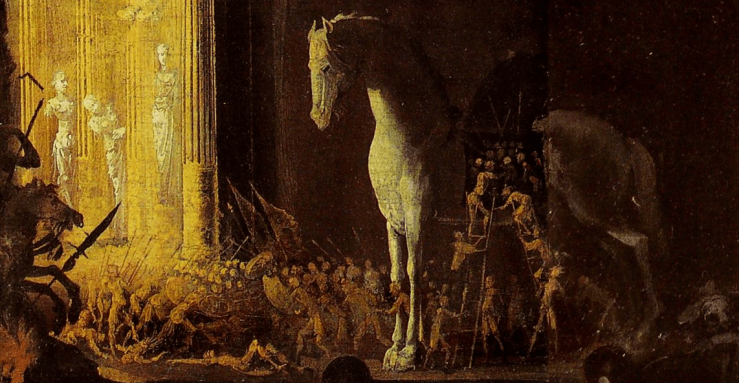
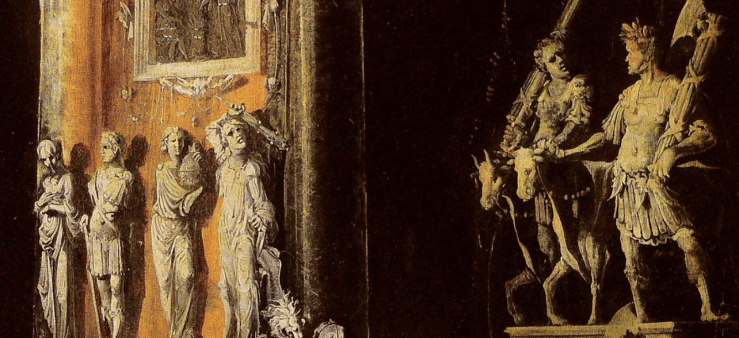
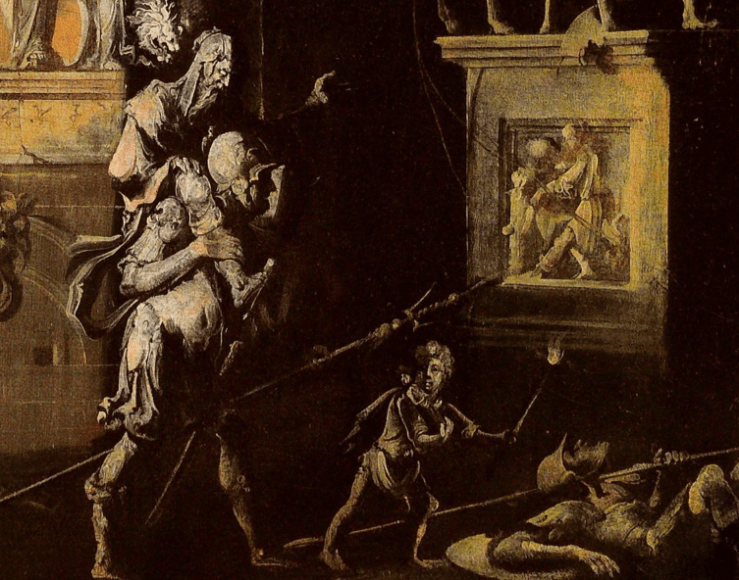
The Lovers — Remedios Varo

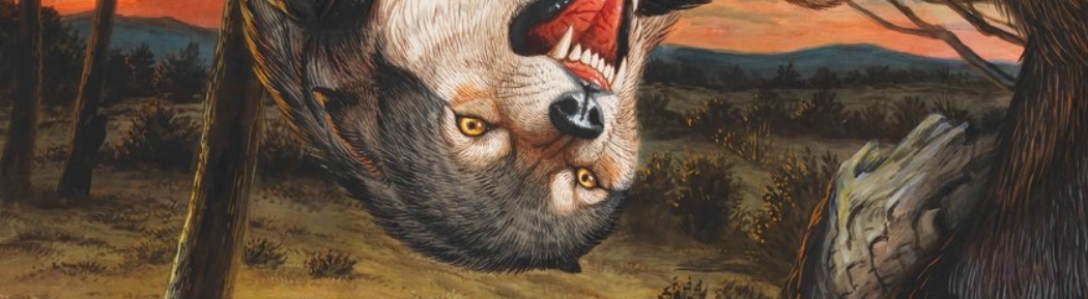
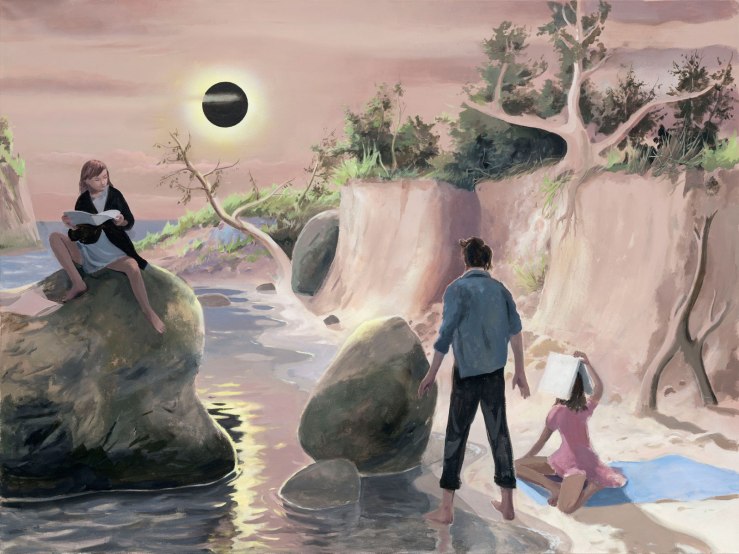
Cat.356-Los-Amantes-1963

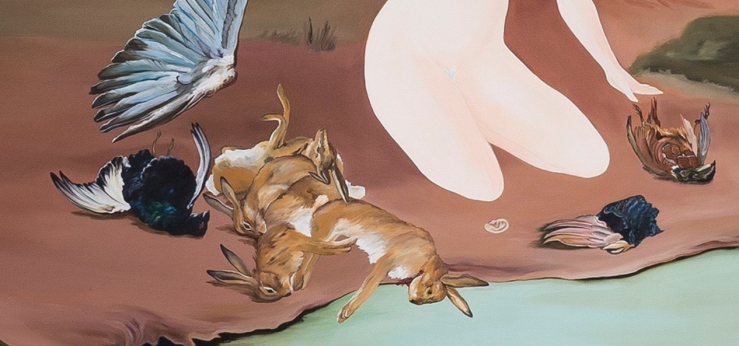
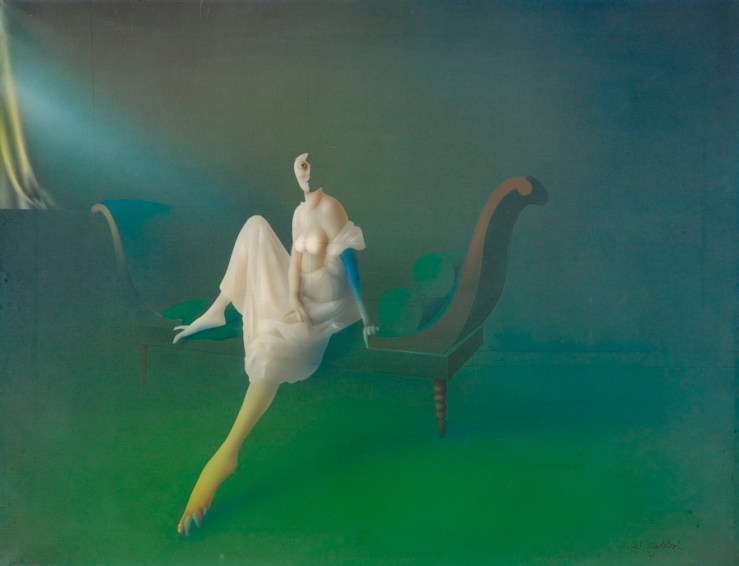
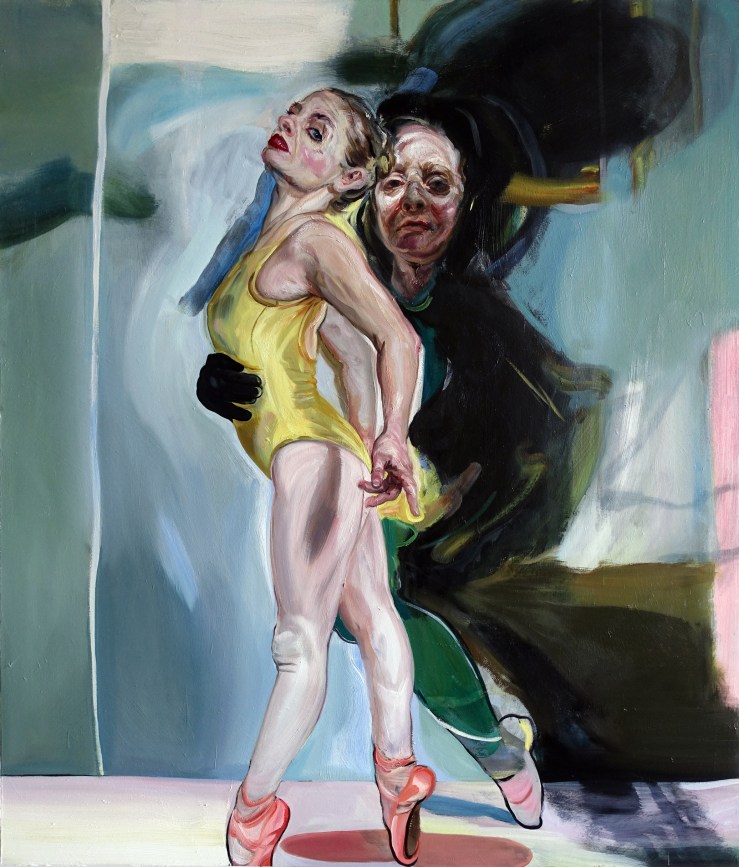
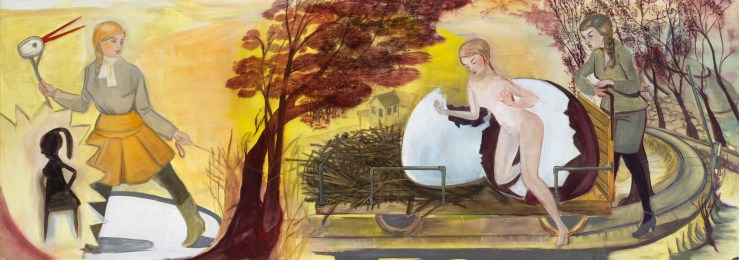
The Lovers, 1963 by Remedios Varo (1908-1963)

Screenshot 2018-12-16 at 6.41.23 PM

Screenshot 2018-12-16 at 6.42.07 PM

Screenshot 2018-12-16 at 6.41.42 PM

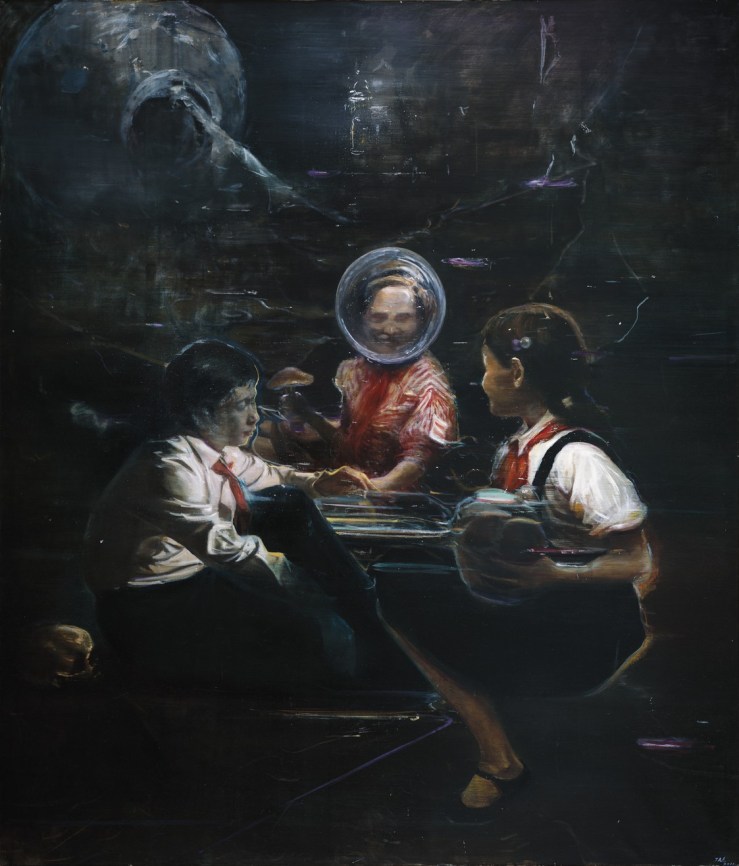
Aello — Francis Picabia

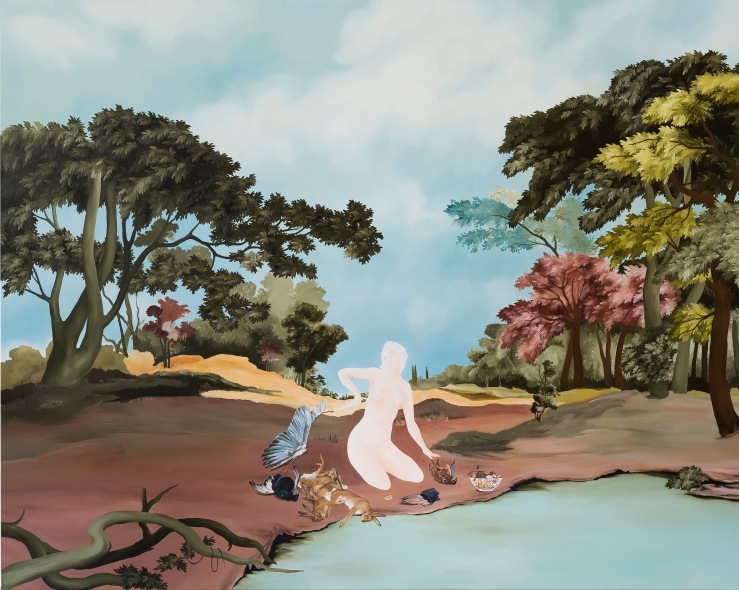
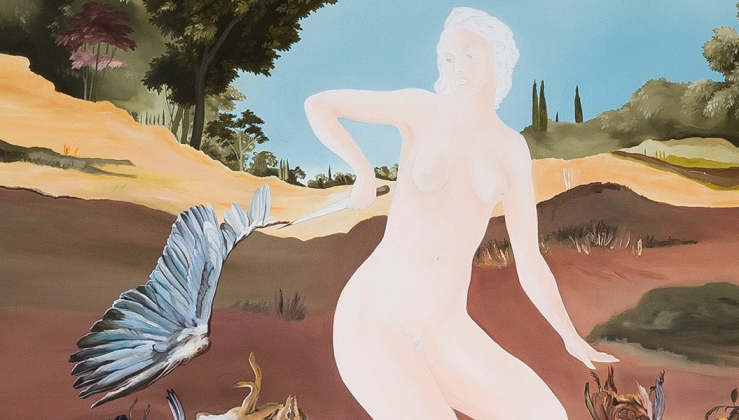
9.20Aello

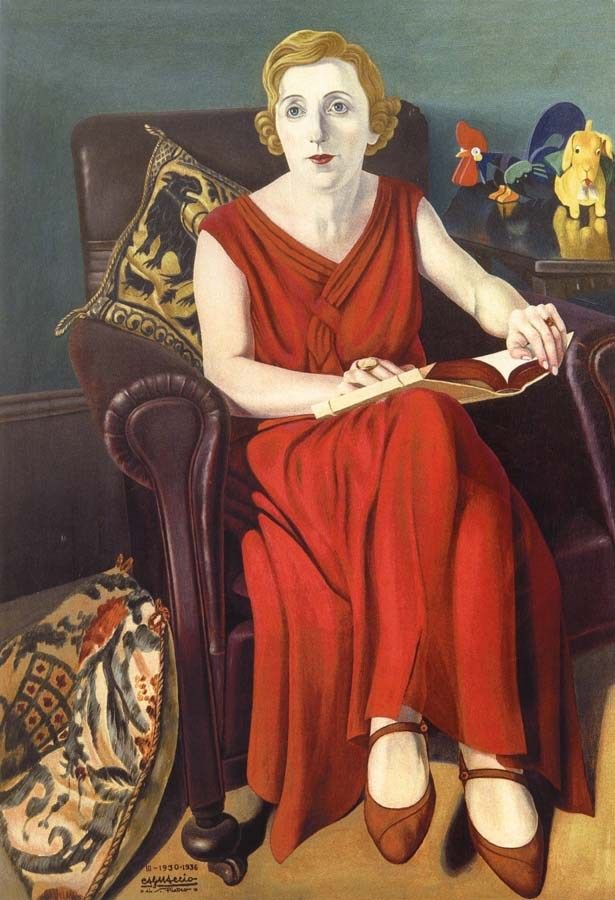
Aello, 1930 by Francis Picabia (1879-1953)

“A Chapter on Dreams” — Robert Louis Stevenson

“A Chapter on Dreams”

by

Robert Louis Stevenson

from

Across the Plains (1915)


The past is all of one texture—whether feigned or suffered—whether acted out in three dimensions, or only witnessed in that small theatre of the brain which we keep brightly lighted all night long, after the jets are down, and darkness and sleep reign undisturbed in the remainder of the body.  There is no distinction on the face of our experiences; one is vivid indeed, and one dull, and one pleasant, and another agonising to remember; but which of them is what we call true, and which a dream, there is not one hair to prove.  The past stands on a precarious footing; another straw split in the field of metaphysic, and behold us robbed of it.  There is scarce a family that can count four generations but lays a claim to some dormant title or some castle and estate: a claim not prosecutable in any court of law, but flattering to the fancy and a great alleviation of idle hours.  A man’s claim to his own past is yet less valid.  A paper might turn up (in proper story-book fashion) in the secret drawer of an old ebony secretary, and restore your family to its ancient honours, and reinstate mine in a certain West Indian islet (not far from St. Kitt’s, as beloved tradition hummed in my young ears) which was once ours, and is now unjustly some one else’s, and for that matter (in the state of the sugar trade) is not worth anything to anybody.  I do not say that these revolutions are likely; only no man can deny that they are possible; and the past, on the other baud, is, lost for ever: our old days and deeds, our old selves, too, and the very world in which these scenes were acted, all brought down to the same faint residuum as a last night’s dream, to some incontinuous images, and an echo in the chambers of the brain.  Not an hour, not a mood, not a glance of the eye, can we revoke; it is all gone, past conjuring.  And yet conceive us robbed of it, conceive that little thread of memory that we trail behind us broken at the pocket’s edge; and in what naked nullity should we be left! for we only guide ourselves, and only know ourselves, by these air-painted pictures of the past.

Upon these grounds, there are some among us who claim to have lived longer and more richly than their neighbours; when they lay asleep they claim they were still active; and among the treasures of memory that all men review for their amusement, these count in no second place the harvests of their dreams.  There is one of this kind whom I have in my eye, and whose case is perhaps unusual enough to be described.  He was from a child an ardent and uncomfortable dreamer.  When he had a touch of fever at night, and the room swelled and shrank, and his clothes, hanging on a nail, now loomed up instant to the bigness of a church, and now drew away into a horror of infinite distance and infinite littleness, the poor soul was very well aware of what must follow, and struggled hard against the approaches of that slumber which was the beginning of sorrows.

But his struggles were in vain; sooner or later the night-hag would have him by the throat, and pluck him strangling and screaming, from his sleep.  His dreams were at times commonplace enough, at times very strange, at times they were almost formless: he would be haunted, for instance, by nothing more definite than a certain hue of brown, which he did not mind in the least while he was awake, but feared and loathed while he was dreaming; at times, again, they took on every detail of circumstance, as when once he supposed he must swallow the populous world, and awoke screaming with the horror of the thought.  The two chief troubles of his very narrow existence—the practical and everyday trouble of school tasks and the ultimate and airy one of hell and judgment—were often confounded together into one appalling nightmare.  He seemed to himself to stand before the Great White Throne; he was called on, poor little devil, to recite some form of words, on which his destiny depended; his tongue stuck, his memory was blank, hell gaped for him; and he would awake, clinging to the curtain-rod with his knees to his chin. Continue reading ““A Chapter on Dreams” — Robert Louis Stevenson”

Gorgon — Ithell Colquhoun

img190

Gorgon, 1945 by Ithell Colquhoun (1906–1988)

“All art constantly aspires towards the condition of music”

Crane in Waves — Utagawa Hiroshige

crane-in-waves-1835

Crane in Waves, c. 1835 by Utagawa Hiroshige (1797-1858)

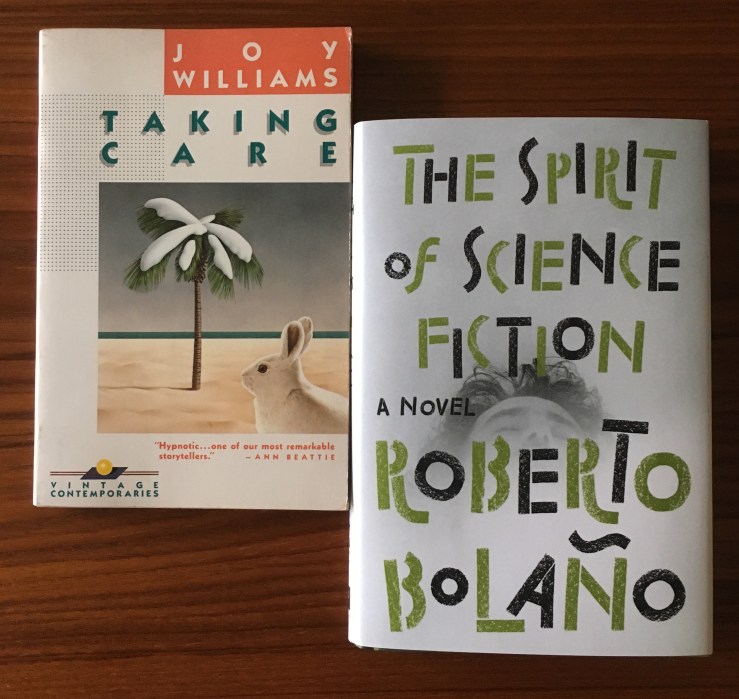
Robert Coover’s The Enchanted Prince (Book acquired, 11 Dec. 2018, read 13 Dec. 2018)

DuJ5a5XWoAAyuRS

Robert Coover’s not-quite-novella The Enchanted Prince (or is it “The Enchanted Prince”?) was first published last year in The Evergreen Review’s Winter 2017 issue. Foxrock Books and OR Books have collaborated to release a cute little volume of the story/stories/metastory/etc. I read the book the other day during an occasion where my attention was supposed to be elsewhere; I slipped it easily into some other papers. It’s a good read to slyly read on the sly. The Enchanted Prince is a postmodern fantasy riff on film and filmmaking techniques, as well as desire and drive. The basic moves here could fit into Coover’s 1987 collection A Night at the Movie’s horny postmodernism, only with some new technological updates—as well as a more pronounced theme of aging.  As always, Coover offers meta-line after meta-line of self-description, including this parenthetical nugget, which maybe kinda yeah surely describes Coover in action: “(stimulation and frustration, fort and da: it’s only the dailies, but the old metacineast is at it again).” Here’s the publisher’s more thorough blurb, which also contains a Cooverian self-description from the novel (the B-movie bit):

Literary grandmaster Robert Coover has long been obsessed with myth, decay, sex and narrative, time and technology: and these themes come together in this short, dark fable that centers around the once-grand, now-aged Princess. Years ago a star of the classic film “The Enchanted Prince,” she has become a cult figure—with mind intact but body failing, she remains a figure of cinematic royalty, but one who cannot turn away from the persistent demands of the camera and the ever-present director, himself a flabby iteration of the wunderkind-that-was, who is filming the last remake (in a long series of remakes) of the classic that made the Princess a star.

“The world is a bad B-movie,” he says. “We try to make better ones, but it probably can’t be done. Still, we go on cranking them out. Nothing else to do.”

Coover’s sardonic, biting humor—and his deep sympathy for the players in his game, all both manipulators and manipulated—has never been more clearly on display than in this brief, intense dose of verbal subterfuge about film within film within the book, itself a two-dimensional “film.” “The book is an essentially realistic tale about two ancient survivors of the New Wave (I had in mind people like Jean Seberg, Jean-Luc Godard) in the digital age,” writes the author about this novella. “The more fanciful elements are torturous parodies of fairytale movies.”

And a sample paragraph:

The movie’s plot was a folktale cliché. Until the box office tallies came in, critics treated it as a joke. A Prince on a knightly quest to liberate an oppressed and bewitched people comes on a runaway Princess of the corrupt kingdom and they fall in love on the spot. The Queen has died and her father the King, under a spell, has been trapped in marriage by an old harpy with brutish unshaven sons who grunt like hogs. The Prince whisks the Princess back to his place, but on her wedding day she’s abducted by her badboy stepbrothers, with black-magic assistance from their mother, and forced to work in the scullery. She’s eventually rescued by the Prince, and they fall into a forever-after kiss at their wedding.

Riverbed — F. Scott Hess

n19s73-b781258863z.120140219165436000gtj1ijbm8.1

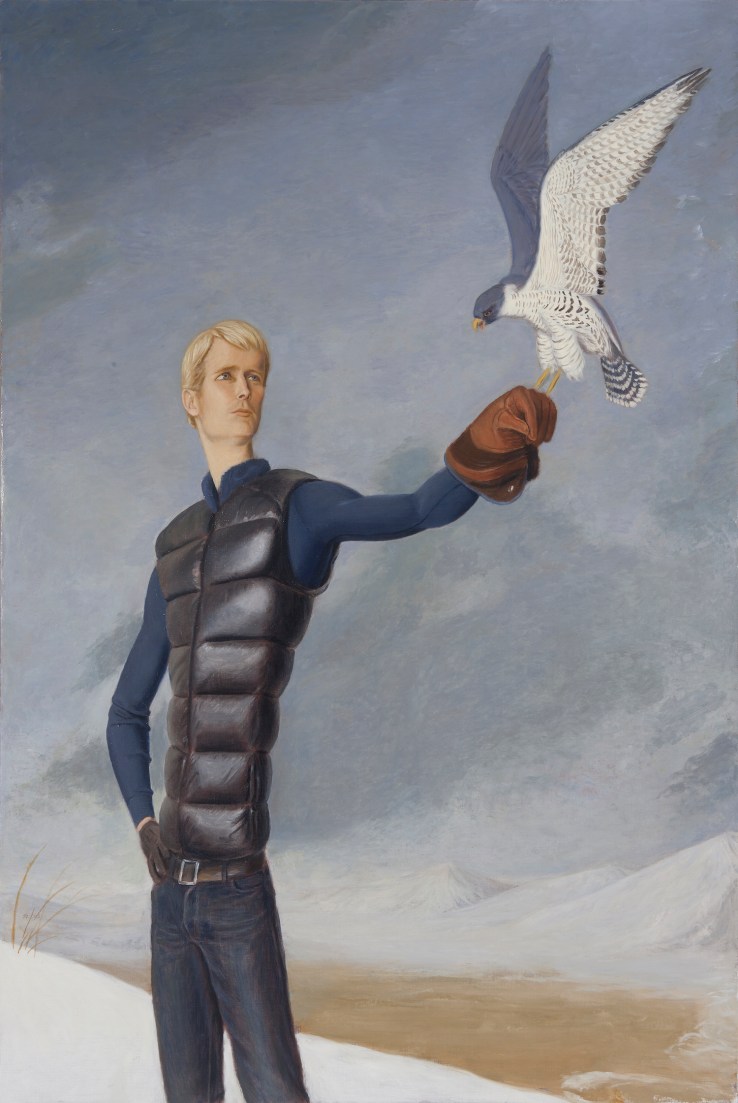
Riverbed, 2004 by F. Scott Hess (b. 1955)

The Prayers — Bo Bartlett

EDD

The Prayers, 2004 by Bo Bartlett (b. 1955)

Read an excerpt from Antoine Volodine’s novel Lisbon, Last Frontier

5

The latest issue of The Evergreen Review features a long excerpt from Antoine Volodine’s novel Lisbon, Last FrontierThe excerpt is translated by Andrew Wilson and features some pretty cool art by Billy Jacobs. Here are the first six paragraphs:

On the Rua do Arsenal, in Lisbon, gallows abound.

“What?” he asked, startled. “What did you say?”
“Gallows,” she confirmed, with a provocative movement of her shoulder.
And: I’ve always wanted to start my novel that way, with a sentence that slaps them in the face. And him: Your novel? You aren’t seriously going to write it? And anyway who is slapping whom? And her: It just hauls off and slaps them, all of them, the overfed slaves of Europe, pudgy little slaves and their tie wearing masters, and all the managers, militarized by America, and the employers’ serfs and all those pathetic types, subjugated by everyone, and the social-traitors and their bulldogs, and you as well, my bulldog, you as well.

He sensed she was drifting, on the verge of hysteria again, and if that happened she was liable to lose the fundamental sense of things, attracting the not necessarily indulgent attention of the passers-by, and creating a scene and, in the wake of that scene, a disaster; for herself certainly, but also for him, for he was up to his neck in this affair. “A slap to the snout of the Western pig,” she hissed playfully. “Please don’t tell me you’re going to ruin everything by writing a book riddled with information,” he countered, “where anyone who cares in the German police will find all he needs to pluck you from your hiding-place, not to mention plucking me from my not so hiding-place and breaking me, dismantling in turn what’s left of your network of nutjobs? Don’t forget I’m up to my neck in this thing.” And her: Would you get a hold of yourself, my brave bulldog, I’d never rat on you. I wouldn’t rat on you for anything in the world. And him: Again happy. And her: Nevertheless, my novel will open with a vision of gallows. And him: That’s absurd. Don’t write anything. And her: I remind you that we are in fact on the Rua do Arsenal, in Lisbon, and gallows do abound. As throughout Europe, I might add. And him: Darling, let me just say: you’re fucking nuts.

He hastily examined the messages being sent by her pupils, diving immediately for the shadows and light, which conveyed, from the other end of this tunnel, her intellect. She’d turned toward him, her sunglasses perched atop her head, as if to hold back abundant curls, but for the past two weeks she’d worn her hair short; it was the face of a young woman sunning, only tormented and hard; her features ravished by passions, hatreds and fear. An arid veil was morphing the transparent blue-green of her eyes; darkening the silver glints, until recently so bright: a wind carrying charred dust across an age-old steppe, where presently everything alive was tempted to rave. She’s going mad, he thought. Despondency rose in him. Her mind is fading, she’s drowning. A cynical mistrust had sunk its claws into him, and already he was drawing up contingency plans, already he was preparing emergency measures, sirens wailing. Their joint survival rested on a ruse. If Ingrid were to crack, she would take him down with her. And he, Kurt, had no intention of stumbling into the void just to keep her company.

As he stared her down, she reigned in her smile, and then broke free, joyous. She nodded with her chin towards the clumps of dried cod hanging in front of the markets.

And: You see, I’m not lying, all around us it’s nothing but disfigured corpses. And him: I’m sorry, I misunderstood. I thought you were sinking into madness. And her: Oh don’t worry I sank ages ago, now I’m just pretending. My bulldog was the only one to realize, such a clever bloodhound. And him: Forget about writing this book. The trail will be too visible. And what’s the point of leaving clues? Forget about literature. And her: First I give up my machine gun, and now black ink; is that how it is, my bulldog?

Read the rest of the excerpt at The Evergreen Review (the last paragraph is, uh, really something).

Woman at a Window, Waving at a Girl — Jacobus Vrel

jacobus-vrel_woman-at-a-window-waving-at-a-girl_ca1655-fritslugtcollection-fondationcustodiaparis

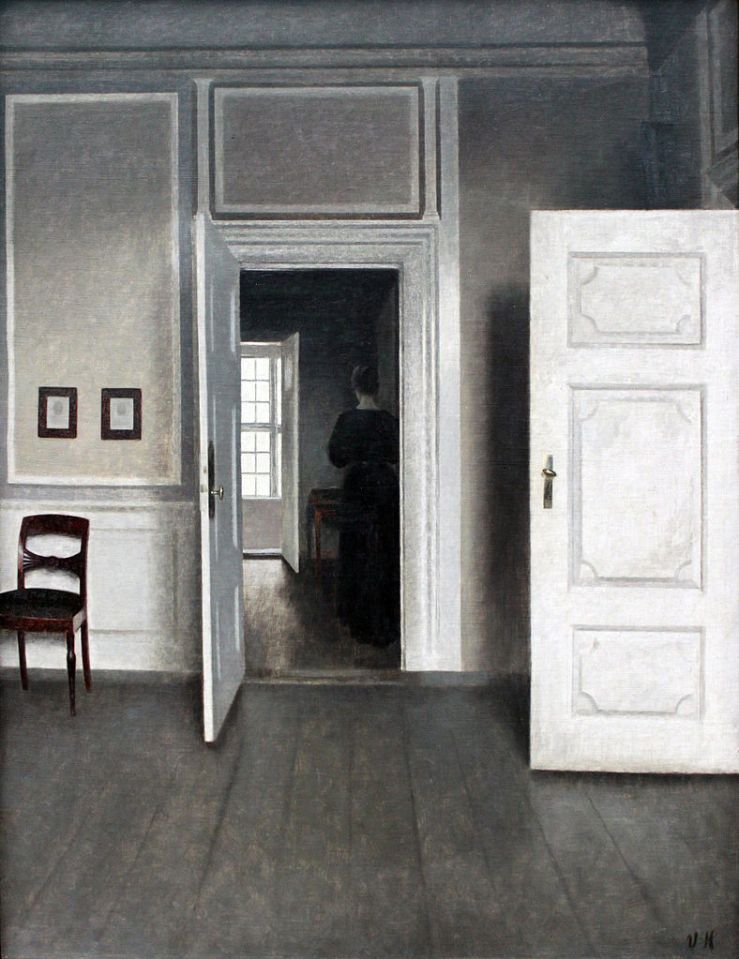
Woman at a Window, Waving at a Girl, c. 1650 by Jacobus Vrel (active 1654 – 1662)

The Moment — James Ward

The Moment 1831 by James Ward 1769-1859

The Moment, 1831 by James Ward (1769–1859)

Shooting Barry Lyndon

“Civilization — spurns — the Leopard!” — Emily Dickinson

leopard

The Queen — Gertrude Abercrombie

abercrombie-0498

The Queen, 1954 by Gertrude Abercrombie (1909–1977)

I stole a book (Clarice Lispector)

The moment her aunt went to pay for her purchases, Joana removed the book and slipped it furtively between the others she was carrying under her arm. Her aunt turned pale.

Once in the street, the woman chose her words carefully:

— Joana.. . Joana, I saw you…

Joana gave her a quick glance. She remained silent.

— But you have nothing to say for yourself? — her aunt could no longer restrain herself, her voice tearful. — Dear God, what is to become of you?

— There’s no need to fuss, Auntie.

— But you’re still a child… Do you realize what you’ve done?

— I know…

— Do you know… do you know what it’s called… ?

— I stole a book, isn’t that what you’re trying to say?

— God help me! I don’t know what I’m going to do, you even have the nerve to own up!

— You forced me to own up.

— Do you think that you can… that you can just go around stealing?

— Well… perhaps not.

— Why do you do it then… ?

— Because I want to.

— You what?

— her aunt exploded.

— That’s right, I stole because I wanted to. I only steal when I feel like it. I’m not doing any harm.

— God help me! So, stealing does no harm, Joana.

— Only if you steal and are frightened. It doesn’t make me feel either happy or sad.

The woman looked at her in despair.

— Look child, you’re growing up, it won’t be long before you’re a young lady… Very soon now you will be wearing your clothes longer… I beg of you: promise me that you won’t do it again, promise me, think of your poor father who is no longer with us.

Joana looked at her inquisitively:

— But I’m telling you I can do what I like, that…

A biblioklept episode from Clarice Lispector’s novel Near to the Wild Heart. English translation by Alison Entrekin.


Gibberish Chill 2 — Ori Toor

f277c234-3aab-4943-a83e-6751caa14997_rw_1920

Gibberish Chill 2, 2018 by Ori Toor