Study Sheet with Seven Hands — Vincent van Gogh

Studies of the Hands of Erasmus of Rotterdam — Hans Holbein the Younger

Study of Arms and Hands — Leonardo da Vinci

Study of Hands — Albrecht Durer

Best Part of a Bad Painting 2 — Seth Alverson

43

Another Freedom — Ricardo Fernández Ortega

Ambidextrous — Tim Head

Translation — Agnes Lawrence Pelton

“Night of the Nonconsumer” — Tom Clark

nonc

Food, a surreal short film by Jan Švankmajer

Allegory of Desire from the Fourth Freedom — Marc Dennis

marc-dennis-allegory-of-desire-from-the-fourth-freedom_2014_oil-on-linen_44x52inches

That morning, the city was celebrating Consumer Thanksgiving Day (Italo Calvino)

A few paragraphs from Italo Calvino’s 1968 story “The Daughters of the Moon”:

That morning, the city was celebrating Consumer Thanksgiving Day. This feast came around every year, on a day in November, and had been set up to allow shoppers to display their gratitude toward the god Production, who tirelessly satisfied their every desire. The biggest department store in town organized a parade every year: an enormous balloon in the shape of a garishly colored doll was paraded through the main streets, pulled by ribbons that sequin-clad girls held as they marched behind a musical band. That day, the procession was coming down Fifth Avenue: the majorette twirled her baton in the air, the big drums banged, and the balloon giant, representing the Satisfied Customer, flew among the skyscrapers, obediently advancing on leashes held by girls in kepis, tassels, and fringed epaulets, riding spangly motorcycles.

At the same time, another parade was crossing Manhattan. The flaky, moldy moon was also advancing, sailing between the skyscrapers, pulled by the naked girls, and behind it came a line of beat-up cars and skeletons of trucks, amid a silent crowd that was gradually increasing in size. Thousands of people joined the throng that had been following the moon since the early hours of the morning, people of all colors, whole families with children of every age, especially as the procession filed past the crowded black and Puerto Rican areas of Harlem.

The lunar procession zigzagged around uptown, then started down Broadway, and came quickly and silently to converge with the other procession, which was dragging its balloon giant along Fifth Avenue.

At Madison Square, one procession met the other; or, more precisely, the two became a single procession. The Satisfied Customer, perhaps owing to a collision with the moon’s jagged surface, deflated into a rubber rag. On the motorcycles now were the Dianas, pulling the moon with multicolored ribbons; or, rather, since the number of naked women had at least doubled, the female motorcyclists must have thrown away their uniforms and kepis. A similar transformation had overtaken the motorcycles and the cars in the parade. You could no longer tell which were the old cars and which were the new: the twisted wheels, the rusty fenders were mixed together with bodywork as shiny as a mirror and paint that gleamed like enamel.

Read “The Daughters of the Moon” in full at The New Yorker (translation by Martin McLaughlin) (or have novelist Robert Coover read it to you, also via The New Yorker).

Happy Thanksgiving! Here’s a bunch of literary recipes and a painting

Merry Family, Jan Steen, 1688

F. Scott Fitzgerald’s Turkey Twelve Ways

Gordon Lish’s Chicken Soup

Zora Neale Hurston’s Mulatto Rice

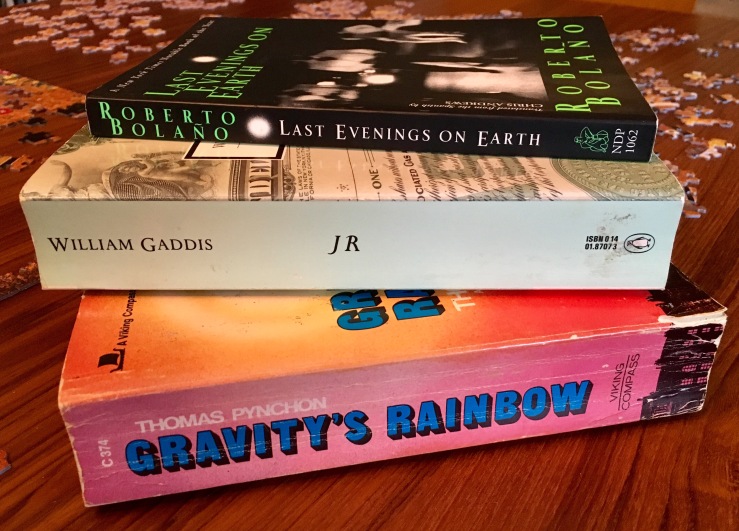
Roberto Bolaño’s Brussels Sprouts with Lemon

Ian McEwan’s Fish Stew

James Joyce’s Burnt Kidney Breakfast

Herman Melville’s Whale Steaks

Ernest Hemingway’s Absinthe Cocktail, Death in the Afternoon

Vladimir Nabokov’s Eggs à la Nabocoque

Thomas Pynchon’s Banana Breakfast

Cormac McCarthy’s Turtle Soup

Robert Crumb’s Macaroni Casserole

Truman Capote’s Caviar-Smothered Baked Potatoes with 80-Proof Russian Vodka

Emily Dickinson’s Cocoanut Cake

Thomas Jefferson’s Vanilla Ice Cream

Charles Dickens’s Own Punch

Ben Jonson’s Egg Wine

Willam Faulkner’s Hot Toddy

Christmas Bonus:  George Orwell’s Recipes for Plum Cake and Christmas Pudding

Unexpected View — Remedios Varo

Read “John Inglefield’s Thanksgiving,” a short story by Nathaniel Hawthorne

“John Inglefield’s Thanksgiving”

by

Nathaniel Hawthorne


On the evening of Thanksgiving day, John Inglefield, the blacksmith, sat in his elbow-chair, among those who had been keeping festival at his board. Being the central figure of the domestic circle, the fire threw its strongest light on his massive and sturdy frame, reddening his rough visage, so that it looked like the head of an iron statue, all aglow, from his own forge, and with its features rudely fashioned on his own anvil. At John Inglefield’s right hand was an empty chair. The other places round the hearth were filled by the members of the family, who all sat quietly, while, with a semblance of fantastic merriment, their shadows danced on the wall behind then. One of the group was John Inglefield’s son, who had been bred at college, and was now a student of theology at Andover. There was also a daughter of sixteen, whom nobody could look at without thinking of a rosebud almost blossomed. The only other person at the fireside was Robert Moore, formerly an apprentice of the blacksmith, but now his journeyman, and who seemed more like an own son of John Inglefield than did the pale and slender student.

Only these four had kept New England’s festival beneath that roof. The vacant chair at John Inglefield’s right hand was in memory of his wife, whom death had snatched from him since the previous Thanksgiving. With a feeling that few would have looked for in his rough nature, the bereaved husband had himself set the chair in its place next his own; and often did his eye glance thitherward, as if he deemed it possible that the cold grave might send back its tenant to the cheerful fireside, at least for that one evening. Thus did he cherish the grief that was dear to him. But there was another grief which he would fain have torn from his heart; or, since that could never be, have buried it too deep for others to behold, or for his own remembrance. Within the past year another member of his household had gone from him, but not to the grave. Yet they kept no vacant chair for her.

While John Inglefield and his family were sitting round the hearth with the shadows dancing behind them on the wall, the outer door was opened, and a light footstep came along the passage. The latch of the inner door was lifted by some familiar hand, and a young girl came in, wearing a cloak and hood, which she took off, and laid on the table beneath the looking-glass. Then, after gazing a moment at the fireside circle, she approached, and took the seat at John Inglefield’s right hand, as if it had been reserved on purpose for her. Continue reading “Read “John Inglefield’s Thanksgiving,” a short story by Nathaniel Hawthorne”

Four Strings of the Violin — Edward Okuń

The Train — Leonor Fini