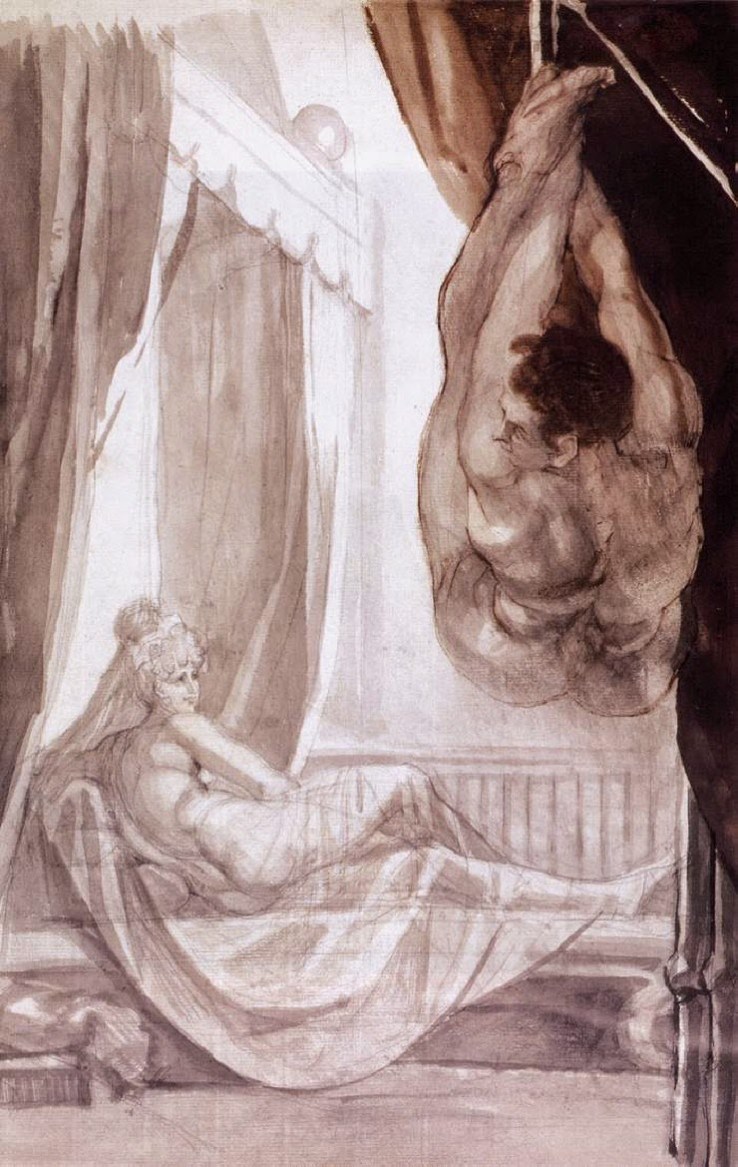
Brunhilde Observing Gunther, Whom She Has Tied to the Ceiling — Henry Fuseli

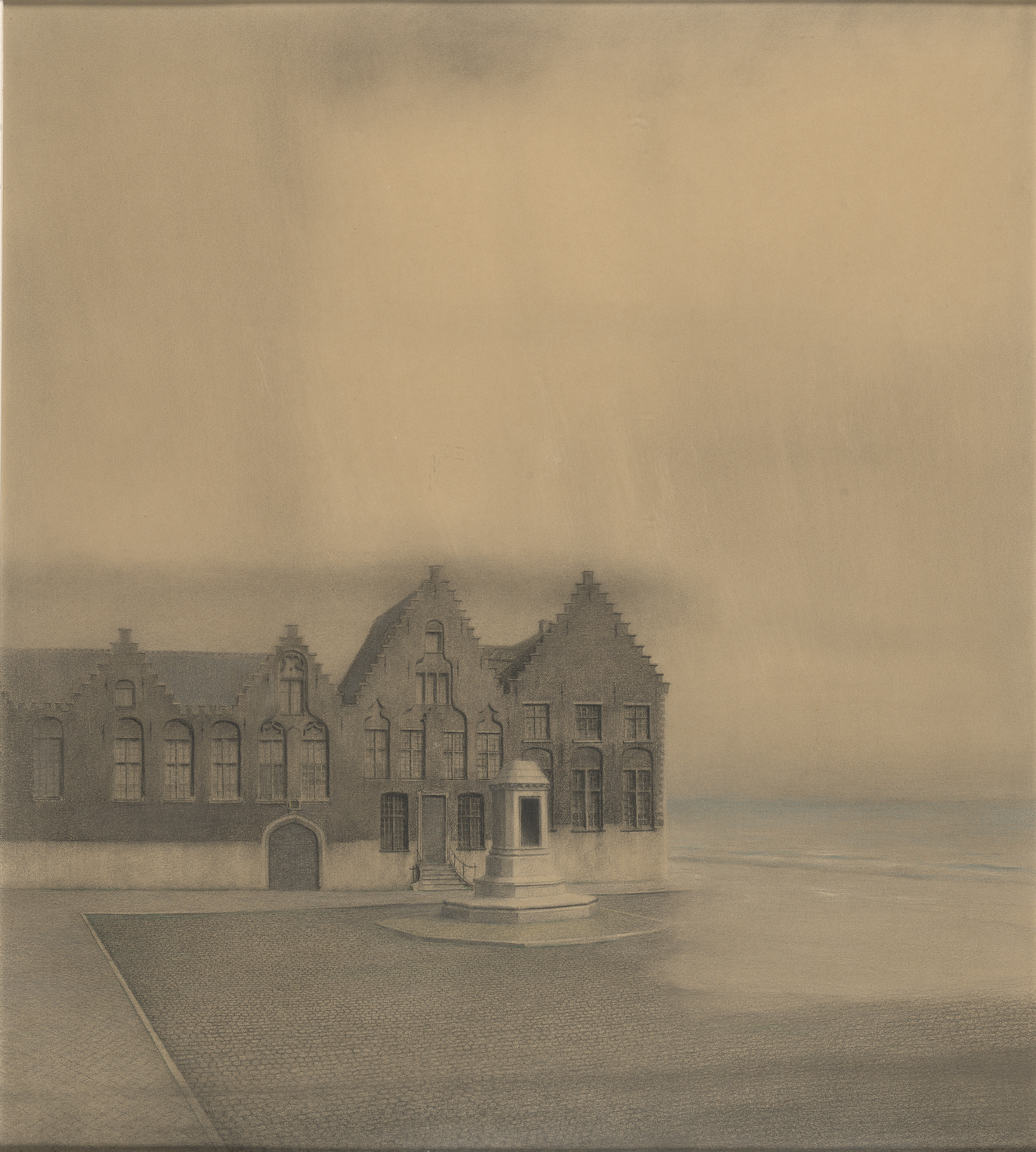
The Abandoned City — Fernand Khnopff

The Major Refutation (Book acquired, 12.19.2016)

img_4568

Pierre Senges’s novel The Major Refutation is new in English translation by Jacob Siefring from Contra Mundum Press. It looks pretty cool. Here’s their full “blurb”:

“Few or none of them heard of a book entitled Refutatio major, falsely attributed to Don Antonio de Guevara, in which the aforementioned Guevara avers that there does not exist a New World, but only chimaeras, malevolent rumors, and inventions spread by schemers. These same persons affirm that the reasons set forth by the aforementioned Guevara are highly disconcerting.” — Bonaventura d’Arezzo, Treatise on Shadows (1531)

“If this new world actually existed, if its measure could be had in hectares and in tons, or more maliciously in carats to reflect the value of its diamond mines, or in nautical miles because it is seemingly capable of devouring an entire hemisphere as a crab would, going from north to south and from east to west — if this were the case, then adventurers would have set foot there long ago, smugglers failing to find a better use for their discovery would have taken it as their refuge, and instead of traffickers by nature mute about their rallying points, we would have heard the cries of one thousand boasters, one thousand returning voyagers.” — The Major Refutation

Here is a book that unites all books: adventure book, historical panorama, satirical tale, philosophical summa, polemical mockery, geographical treatise, political analysis.

This edition of The Major Refutation is followed by a scholarly afterword discussing the conditions of the text’s genesis.

Pierre Senges is the author of fifteen books. His long novel, Fragments of Lichtenberg, is forthcoming in English from Dalkey Archive Press in 2017.

Winter — Mikalojus Ciurlionis

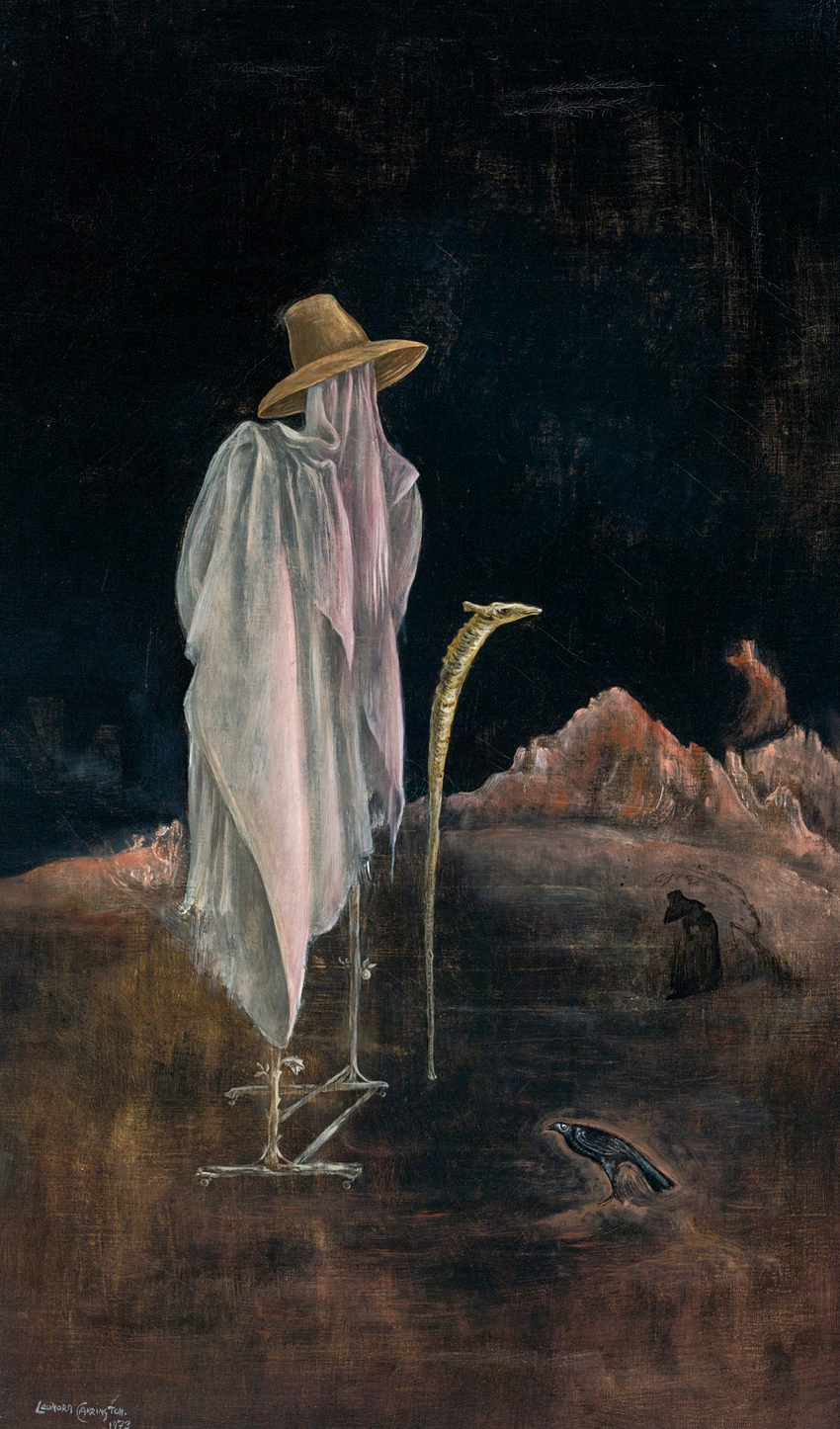
Tuatha Dé Danann — Leonora Carrington

Let Those Swim Who Can – The Heavy May Sink! — George Grosz

w1siziisijexnjq0myjdlfsiccisimnvbnzlcnqilcitcmvzaxplideznjz4mtm2nlx1mdazzsjdxq

Books abandoned, 2016

img_4551

As always: I’m sure it was my fault, and not the book’s fault, that I abandoned it.


(Except when it was the book’s fault).


And also: “Abandoned” doesn’t necessarily mean that I won’t come back to some of these books. (One of them even ended up on a list I made earlier this year of the books I’ve started the most times without ever finishing (and I finished one of those books this year, by the way)).


That big guy down on the bottom there, Arno Schmidt’s Bottom’s Dream (Eng. trans. by John Woods)?—I didn’t so much abandon it as I was told to put it away before we served Thanksgiving dinner at our house. There really isn’t a place for me to read the damn thing besides the dining room table. I’m sure I’ll dip into it more and I’m pretty sure I’ll never finish it in this lifetime. But I haven’t abandoned it forever. Earlier this year I wrote about the anxiety Bottom’s Dream produces in me.

Louis Armand’s The Combinations had the misfortune to show up as I was in the middle of a third reading of Gravity’s Rainbow. I read the first two chapters of Armand’s 888 page opus, then some other stuff showed up at the house in the mail, and then The Combinations got pushed to the back of the reading stack. The novel still interests me, but I’m not sure if I have the stamina right now.

Most of my reading experiences have as much to do with the time and the place that I read the book as they do with the form and content of the book. This year was not the time or the place for me to read Elizabeth Hardwick’s Sleepless Nights, a strange book I really, really, really wanted to love, but abandoned maybe 35 pages in.

I actually read a large portion of Peter Biskind’s history of the New Hollywood movement of the 1970s, Easy Riders, Raging Bulls. I broke down and finally bought it this summer after multiple viewings of William Friedkin’s film Sorcerer and two trips through Michael Cimino’s Heaven’s Gate. Biskind’s style is insufferable—gossipy and tawdry—and he swings wildly from venerating the book’s heroes (Bogdanovich, Coppola, Nichols, Scorsese, Malick, De Palma) to tearing them down (um, yeah, they were assholes). But there is an index which is of some use (although in reading Easy Riders, Raging Bulls you’re more likely to find out about a director’s drug problems or sex problems or money problems than you are to find out about, like, filmmaking). The worst part of Biskind’s book though is its repetitive insistence that not only did the Baby Boomers save Hollywood filmmaking, but also that the Boomers’ films were the last real outsider art ever to come out of Hollywood. Yeesh. 

The first several stories in James Purdy’s short story collection 63: Dream Palace made me feel very, very sad, so I shelved it.

I read the first 258 pages of Samuel Delany’s novel Dhalgren. The book is 801 pages long and I couldn’t see it improving any. The book might be as great as everyone says it is, but it was mostly a boring mess (pages and pages of a character moving furniture around). On page 258, a character declares “There’s no reason why all art should appeal to all people.” I took that as a sign to ditch.

End with two limes: I’ve tried reading Thomas Bernhard’s The Limeworks too many times. I tried twice this year (once in the summer when it was simply too hot to read Thomas Bernhard). I read Bernhard’s Woodcutters though, and it is amazing.

And: I was reading John Hawkes’s The Lime Twig on Election Day, 2016 and haven’t been able to pick it up since then.

The Temptation of St. Anthony — Leonora Carrington

Maybe Jonathan Richman can make me smile now, I don’t know, let’s see

Tree of Life — Leonora Carrington

Sunday Comics 


Cerebus #85, April 1986 (Aardvark Vanaheim), by Dave Sim and Gerhard. This was the first Cerebus back issue I bought (in like ’91 or ’92). It’s near the beginning of Church & State II (which is to say, in the middle of Church & State, which is to say, in the middle of the best parts of Cerebus). The issue introduces Sim’s parodies of Mick and Keith (um, Mick n’ Keef); Prince Mick shares codeine-laced whiskey with Cerebus. Vomiting, hallucination, and friendship ensue.

“Therefore I Am” (Live) — Jim O’Rourke

Untitled — Richard Müller

Kullervo’s Curse — Akseli Gallen-Kallela

A II 765 taiteilija: Gallen-Kallela, Akseli nimi: Kullervon kirous museo/om.: AT ; LV ; kokoelma: Antell ajoitus: 1899 mitat: 184x102,5 cm pääluokka: maalaus kuvanro: 26294 tyyppi: LAAKADIA valokuvaaja: Pirje Mykkänen, KKA, 1995 laite: Agfa T5000+/ColorExact1.5/photoshop6.01/ profiili: AdobeRGB1998 skannauspvm:30.11.2001/an

A kind of Kafka steeped in LSD and rage (Roberto Bolaño on Philip K. Dick)

Roberto Bolaño on Philip K. Dick. from New Directions’ collection of Bolaño’s newspaper columns, forewords, and other ephemera Between Parentheses)—

Dick was a schizophrenic. Dick was a paranoiac. Dick is one of the ten best American writers of the 20th century, which is saying a lot. Dick was a kind of Kafka steeped in LSD and rage. Dick talks to us, in The Man in the High Castle, in what would become his trademark way, about how mutable reality can be and therefore how mutable history can be. Dick is Thoreau plus the death of the American dream. Dick writes, at times, like a prisoner, because ethically and aesthetically he really is a prisoner. Dick is the one who, in Ubik, comes closest to capturing the human consciousness or fragments of consciousness in the context of their setting; the correspondence between what he tells and the structure of what’s told is more brilliant than similar experiments conducted by Pynchon or DeLillo.

Philip K. Dick — Kent Bellows

152c72f8881a7ca73dbd22a2c3e1c094