A probably incomplete list of books I’ve read so far this year

The Crying of Lot 49, Thomas Pynchon

Dockwood, Jon McNaught

A German Picturesque, Jason Schwartz

Inherent Vice, Thomas Pynchon

Two Serious Ladies, Jane Bowles

Flee, Evan Dara

Birchfield Close, Jon McNaught

Signs Preceding the End of the World, Yuri Herrera

Infinite Fictions, David Winters

Syrian Notebooks, Jonathan Littell

Girl in a Band, Kim Gordon

Can’t and Won’t, Lydia Davis

Gravity’s Rainbow, Thomas Pynchon

Gaha: Babes of the Abyss, Jon Frankel

The Spectators, Victor Hussenot

Mumbo Jumbo, Ishmael Reed

Infinite Jest, David Foster Wallace

The Wallcreeper, Nell Zink

Cess, Gordon Lish

Station Eleven, Emily St. John Mandel

High Rise, J.G. Ballard

Millennium People, J.G. Ballard

Pale Fire, Vladimir Nabokov


Updating the reviews page to this blog today (a chore! a bore!) I realized just how many books I’d read this year and failed to write about…so far, anyway. The list above is probably incomplete, and only includes books I read cover-to-cover (or in a few cases audited on mp3)—so stuff like essays by William Gass and collections like Vollmann’s Last Stories and William T. Vollmann: A Critical Companion (etc.) I left off. And yes, I’m aware that the list is heavy on white guys.

The Sun in His Wrath — William Blake

“The Stolen Body,” a weird short story by H.G. Wells

“The Stolen Body”

by

H.G. Wells


Mr. Bessel was the senior partner in the firm of Bessel, Hart, and Brown, of St. Paul’s Churchyard, and for many years he was well known among those interested in psychical research as a liberal-minded and conscientious investigator. He was an unmarried man, and instead of living in the suburbs, after the fashion of his class, he occupied rooms in the Albany, near Piccadilly. He was particularly interested in the questions of thought transference and of apparitions of the living, and in November, 1896, he commenced a series of experiments in conjunction with Mr. Vincey, of Staple Inn, in order to test the alleged possibility of projecting an apparition of one’s self by force of will through space.

Their experiments were conducted in the following manner: At a prearranged hour Mr. Bessel shut himself in one of his rooms in the Albany and Mr. Vincey in his sitting-room in Staple Inn, and each then fixed his mind as resolutely as possible on the other. Mr. Bessel had acquired the art of self-hypnotism, and, so far as he could, he attempted first to hypnotise himself and then to project himself as a “phantom of the living” across the intervening space of nearly two miles into Mr. Vincey’s apartment. On several evenings this was tried without any satisfactory result, but on the fifth or sixth occasion Mr. Vincey did actually see or imagine he saw an apparition of Mr. Bessel standing in his room. He states that the appearance, although brief, was very vivid and real. He noticed that Mr. Bessel’s face was white and his expression anxious, and, moreover, that his hair was disordered. For a moment Mr. Vincey, in spite of his state of expectation, was too surprised to speak or move, and in that moment it seemed to him as though the figure glanced over its shoulder and incontinently vanished.

It had been arranged that an attempt should be made to photograph any phantasm seen, but Mr. Vincey had not the instant presence of mind to snap the camera that lay ready on the table beside him, and when he did so he was too late. Greatly elated, however, even by this partial success, he made a note of the exact time, and at once took a cab to the Albany to inform Mr. Bessel of this result. Continue reading ““The Stolen Body,” a weird short story by H.G. Wells”

Mad Max: Fury Road film poster by Kilian Eng

tumblr_no7a7gVl3W1qbluruo1_1280

Struggle (Wittgenstein)

Screenshot 2015-08-07 at 4.26.38 PM

From Culture and Value.

The Laundress, Blue Room — Felix Vallotton

The ocean is to lose its saltness (Nathaniel Hawthorne’s journal entry for August 7, 1851)

Screenshot 2015-08-04 at 10

Optical Parable — Manuel Alvarez Bravo

William Burroughs and Andy Warhol eat rabbit, discuss chicken-fried steak; Nico sings a bit

Plant Architecture — Remedios Varo

Nabokov, in answer to the question: What scenes one would like to have filmed

IN ANSWER TO THE QUESTION: WHAT SCENES ONE WOULD LIKE TO HAVE FILMED

Shakespeare in the part of the King’s Ghost.

The beheading of Louis the Sixteenth, the drums drowning his speech on the scaffold.

Herman Melville at breakfast, feeding a sardine to his cat.

Poe’s wedding. Lewis Carroll’s picnics.

The Russians leaving Alaska, delighted with the deal. Shot of a seal applauding.

From a 1966 interview with Alfred Appel Jr., originally published in Wisconsin Studies and reprinted in the collection Strong Opinions (1973).

House with Drying Laundry — Egon Schiele

Ugly/beautiful (Wittgenstein)

Screenshot 2015-08-05 at 12.05.32 PM

From Culture and Value.

Our Lady of the Dry Tree – Petrus Christus

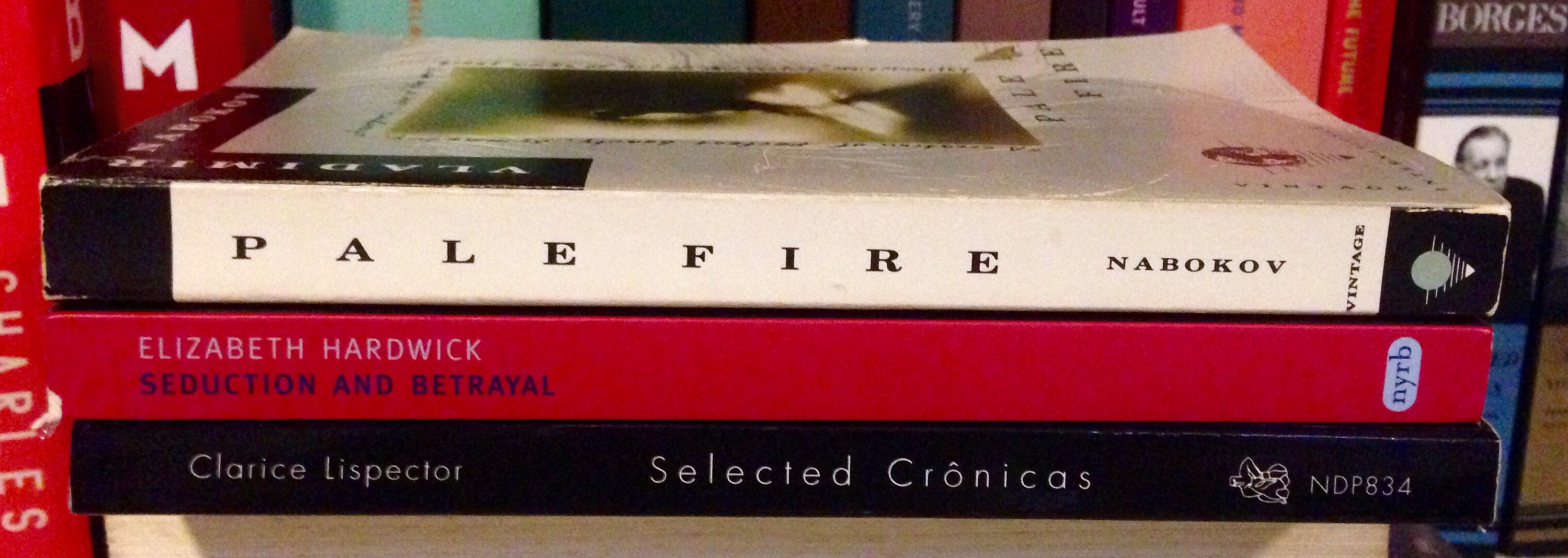
Nabokov/Hardwick/Lispector (Books acquired, 7.21.2015)

I picked up Vladimir Nabokov’s novel Pale Fire on a weird whim. I mean, I quite literally passed by it in the bookshop I frequent; it was misshelved, or unshelved, really. Someone had left it in sci-fi, near the “Bs” (B-for-Ballard, if you must know). Pale Fire, eh? I thought. Can’t remember this one. Because I had never read it, somehow. An amazing novel, one I dove into after sampling a bit of Clarice Lispector’s Selected Cronicas (still sampling—this is one of those books that’s lovely to dip gently into between selections) and after failing to get through the first essay in Elizabeth Hardwick’s Seduction and Betrayal. Not sure if I can (should?) muster a “review” of Pale Fire, but it’s one of the better prepostmodern-postmodernist novels I’ve ever read—very very funny and a beautiful mindfuck.

Undine Giving the Ring to Massaniello, Fisherman of Naples — William Turner

The Gift — Man Ray