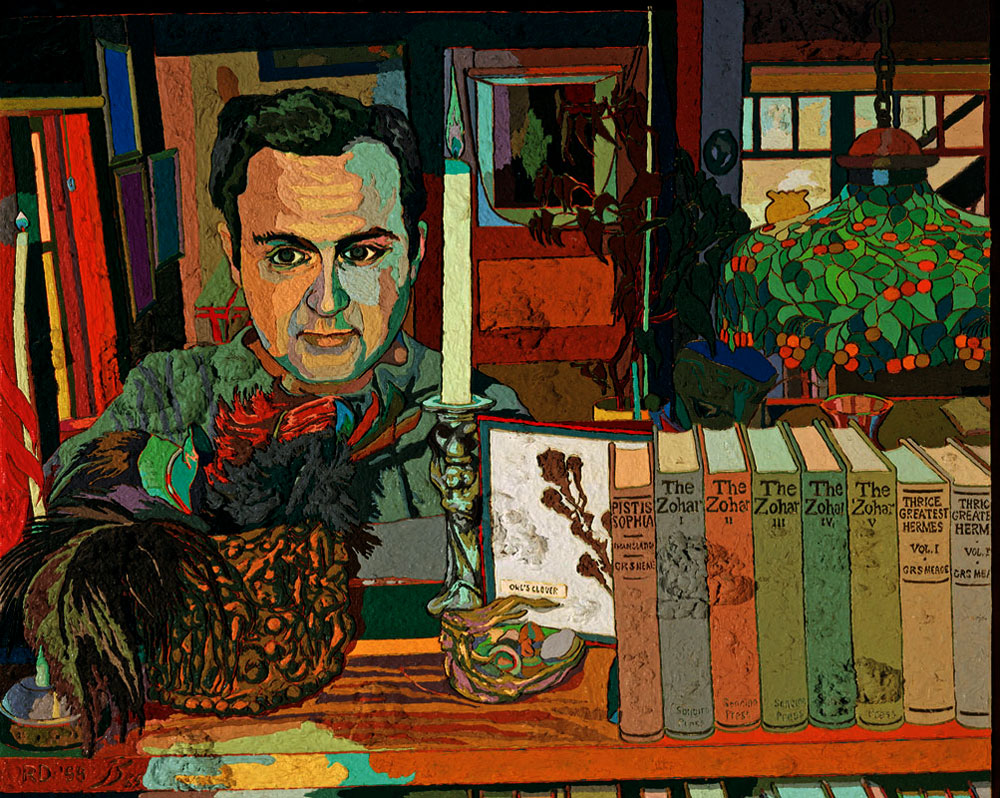
St. Patrick and the Druid, an episode from Finnegans Wake (with explication from Joseph Campbell)

On pages 611-613 of James Joyce’s Finnegans Wake, St. Patrick meets the archdruid Balkelly:

Tunc. Bymeby, bullocky vampas tappany bobs topside joss pidgin fella Balkelly, archdruid of islish chinchinjoss in the his heptachromatic sevenhued septicoloured roranyellgreenlindigan mantle finish he show along the his mister guest Patholic with alb belongahim the whose throat hum with of sametime all the his cassock groaner fellas of greysfriaryfamily he fast all time what time all him monkafellas with Same Patholic, quoniam, speeching, yeh not speeching noh man liberty is, he drink up words, scilicet, tomorrow till recover will not, all too many much illusiones through photoprismic velamina of hueful panepiphanal world spectacurum of Lord Joss, the of which zoantholitic furniture, from mineral through vegetal to animal, not appear to full up to-gether fallen man than under but one photoreflection of the several iridals gradationes of solar light, that one which that part of it (furnit of heupanepi world) had shown itself (part of fur of huepanwor) unable to absorbere, whereas for numpa one pura —— duxed seer in seventh degree of wisdom of Entis–Onton he savvy inside true inwardness of reality, the Ding hvad in idself id est, all objects (of panepiwor) allside showed themselves in trues coloribus resplendent with sextuple gloria of light actually re-tained, untisintus, inside them (obs of epiwo). Rumnant Patholic, stareotypopticus, no catch all that preachybook, utpiam, tomorrow recover thing even is not, bymeby vampsybobsy tap — panasbullocks topside joss pidginfella Bilkilly–Belkelly say pat — fella, ontesantes, twotime hemhaltshealing, with other words verbigratiagrading from murmurulentous till stridulocelerious in a hunghoranghoangoly tsinglontseng while his comprehen-durient, with diminishing claractinism, augumentationed himself in caloripeia to vision so throughsighty, you anxioust melan-cholic, High Thats Hight Uberking Leary his fiery grassbelong- head all show colour of sorrelwood herbgreen, again, nigger- blonker, of the his essixcoloured holmgrewnworsteds costume the his fellow saffron pettikilt look same hue of boiled spinasses,other thing, voluntary mutismuser, he not compyhandy the his golden twobreasttorc look justsamelike curlicabbis, moreafter, to pace negativisticists, verdant readyrainroof belongahim Exuber High Ober King Leary very dead, what he wish to say, spit of superexuberabundancy plenty laurel leaves, after that com-mander bulopent eyes of Most Highest Ardreetsar King same thing like thyme choppy upon parsley, alongsidethat, if please-sir, nos displace tauttung, sowlofabishospastored, enamel Indian gem in maledictive fingerfondler of High High Siresultan Em-peror all same like one fellow olive lentil, onthelongsidethat, by undesendas, kirikirikiring, violaceous warwon contusiones of facebuts of Highup Big Cockywocky Sublissimime Autocrat, for that with pure hueglut intensely saturated one, tinged uniformly, allaroundside upinandoutdown, very like you seecut chowchow of plentymuch sennacassia Hump cumps Ebblybally! Sukkot?

Punc. Bigseer, refrects the petty padre, whackling it out, a tumble to take, tripeness to call thing and to call if say is good while, you pore shiroskuro blackinwhitepaddynger, by thiswis aposterioprismically apatstrophied and paralogically periparo-lysed, celestial from principalest of Iro’s Irismans ruinboon pot before, (for beingtime monkblinkers timeblinged completamen-tarily murkblankered in their neutrolysis between the possible viriditude of the sager and the probable eruberuption of the saint), as My tappropinquish to Me wipenmeselps gnosegates a handcaughtscheaf of synthetic shammyrag to hims hers, seeming-such four three two agreement cause heart to be might, saving to Balenoarch (he kneeleths), to Great Balenoarch (he kneeleths down) to Greatest Great Balenoarch (he kneeleths down quite-somely), the sound salse sympol in a weedwayedwold of the firethere the sun in his halo cast. Onmen.

That was thing, bygotter, the thing, bogcotton, the very thing, begad! Even to uptoputty Bilkilly–Belkelly-Balkally. Who was for shouting down the shatton on the lamp of Jeeshees. Sweating on to stonker and throw his seven. As he shuck his thumping fore features apt the hoyhop of His Ards.

Thud.

Good safe firelamp! hailed the heliots. Goldselforelump! Halled they. Awed. Where thereon the skyfold high, trampa-trampatramp. Adie. Per ye comdoom doominoom noonstroom. Yeasome priestomes. Fullyhum toowhoom.


Continue reading “St. Patrick and the Druid, an episode from Finnegans Wake (with explication from Joseph Campbell)”

An alternative list to The Atlantic’s “The Great American Novels” list (Part II, 1975-1999)

I left off fifty years ago, in 1974, in my silly response list to The Atlantic’s silly list of “The Great American Novels.”  Today, here’s the rest of my run, spanning 1975-1999.

1975

The Atlantic selected

Corregidora, Gayl Jones

Biblioklept selects

J R, William Gaddis

The Dead Father, Donald Barthelme

1976

The Atlantic selected

Speedboat, Renata Adler

Biblioklept selects

Roots, Alex Haley

Speedboat, Renata Adler

1977

The Atlantic selected

Ceremony, Leslie Marmon Silko

Song of Solomon, Toni Morrison

Biblioklept selects

The Public Burning, Robert Coover

Song of Solomon, Toni Morrison

Players, Don DeLillo

1978

The Atlantic selected

A Contract With God, Will Eisner

Dancer From the Dance, Andrew Holleran

The Stand, Stephen King

Biblioklept selects

An Armful of Warm Girl, W.M Spackman

Airships, Barry Hannah

(It might as well be a novel.)

1979

The Atlantic selected

The Dog of the South, Charles Portis

Kindred, Octavia E. Butler

Biblioklept selects

Suttree, Cormac McCarthy

The Dog of the South, Charles Portis

1980

The Atlantic selected

Housekeeping, Marilynne Robinson

The Salt Eaters, Toni Cade Bambara

Biblioklept selects

Great Expectations, Kathy Acker

The Shadow of the Torturer, Gene Wolfe

1981

The Atlantic selected

Little, Big: Or, the Fairies’ Parliament, John Crowley

Biblioklept selects

Cities of the Red Night, William S. Burroughs

1982

The Atlantic selected

Oxherding Tale, Charles Johnson

Biblioklept selects

The Terrible Twos, Ishmael Reed

1983

The Atlantic selected

nothing.

Biblioklept selects

Angels, Denis Johnson

1984

The Atlantic selected

Machine Dreams, Jayne Anne Phillips

Biblioklept selects

Blood and Guts in High School, Kathy Acker

Neuromancer, William Gibson

1985

The Atlantic selected

Blood Meridian, Cormac McCarthy

Biblioklept selects

Blood Meridian, Cormac McCarthy

Masters of Atlantis, Charles Portis

Days Between Stations, Steve Erickson

1986

The Atlantic selected

A Summons to Memphis, Peter Taylor

Watchmen, Alan Moore and Dave Gibbons

Biblioklept selects

Hatchet, Gary Paulsen

1987

The Atlantic selected

Beloved, Toni Morrison

Dawn, Octavia E. Butler

Biblioklept selects

Beloved, Toni Morrison

1988

The Atlantic selected

nothing

Biblioklept selects

Breaking and Entering, Joy Williams

Wittgenstein’s Mistress, David Markson

1989

The Atlantic selected

Geek Love, Katherine Dunn

Tripmaster Monkey, Maxine Hong Kingston

Biblioklept selects

Geek Love, Katherine Dunn

1990

The Atlantic selected

Dogeaters, Jessica Hagedorn

Biblioklept selects

Tehanu, Ursula K. Le Guin

1991

The Atlantic selected

American Psycho, Bret Easton Ellis

How the García Girls Lost Their Accents, Julia Alvarez

Mating, Norman Rush

Biblioklept selects

Gringos, Charles Portis

1992

The Atlantic selected

Bastard Out of Carolina, Dorothy Allison

The Secret History, Donna Tartt

Biblioklept selects

Jesus’ Son, Denis Johnson

Negrophobia, Darius James

Snow Crash, Neal Stephenson

1993

The Atlantic selected

So Far From God, Ana Castillo

Stone Butch Blues, Leslie Feinberg

The Shipping News, Annie Proulx

Biblioklept selects

Palestine, Joe Sacco

1994

The Atlantic selected

nothing

Biblioklept selects

A Frolic of His Own, William Gaddis

The Crossing, Cormac McCarthy

1995

The Atlantic selected

Native Speaker, Chang-rae Lee

Sabbath’s Theater, Philip Roth

Under the Feet of Jesus, Helena María Viramontes

Biblioklept selects

The Lost Scrapbook, Evan Dara

1996

The Atlantic selected

Infinite Jest, David Foster Wallace

Biblioklept selects

Infinite Jest, David Foster Wallace

1997

The Atlantic selected

I Love Dick, Chris Kraus

Underworld, Don DeLillo

Biblioklept selects

Mason & Dixon, Thomas Pynchon

Underworld, Don DeLillo

1998

The Atlantic selected

nothing

Biblioklept selects

Cartesian Sonata, William H. Gass

1999

The Atlantic selected

The Intuitionist, Colson Whitehead

Biblioklept selects

Motherless Brooklyn, Jonathan Lethem

2000 and after…

The Atlantic’s list for books post-2000 contains some books that I think will hold up decades from now, but I’d predict more misses than hits. There are a handful of novels I would’ve added or substituted from the post-1999 selections, but I see no reason to go forward. Ultimately, I enjoyed going through the Atlantic list, taking note of some titles I was unfamiliar with as well as ones I’ve been overdue to check out. I’ve undoubtedly missed so, so many titles from my own list; if anything’s absence is egregious, let me know in a comment.

An alternative list to The Atlantic’s “The Great American Novels” list (Part I, 1924-1974)

The Atlantic released a list of “The Great American Novels” today, purportedly covering the last one hundred years of American fiction. The list is not terrible, but lists as organizing principles are always up for interrogation.

1924

The Atlantic

did not select a novel from 1924 for their list, despite their claim that they “narrowed our aperture to the past 100 years.” That’s fine.

Biblioklept’s selection

Billy Budd, Herman Melville.

Okay, look, Melville died in 1891. But his marvelous novella wasn’t published until 1924. So let its inclusion at the outset of this list bear a trace of resentment and ridicule to all such lists. Great fuckin’ book.

1925

The Atlantic selected

The Great Gatsby, F. Scott Fitzgerald

An American Tragedy, Theodore Dreiser

The Making of Americans, Gertrude Stein

Biblioklept selects

The Great Gatsby, F. Scott Fitzgerald

1926

The Atlantic selected

nothing, just like for 1924

Biblioklept selects

The Sun Also Rises, Ernest Hemingway

1927

The Atlantic selected

Death Comes for the Archbishop, Willa Cather

Biblioklept selects

Death Comes for the Archbishop, Willa Cather

Cather’s novel is the right pick, but let’s give an honorable mention to the first of Franklin W. Dixon’s Hardy Boys books, The Tower Treasure. 

1928

The Atlantic selected

nothing again

Biblioklept selects

Quicksand, Nella Larsen

1929

The Atlantic selected

A Farewell to Arms, Ernest Hemingway

Passing, Nella Larsen

The Sound and the Fury, William Faulkner

Biblioklept selects

A Farewell to Arms, Ernest Hemingway

Passing, Nella Larsen

The Sound and the Fury, William Faulkner

Wonderful trifecta there of great novels that are thematically very, very American.

1930-35

The Atlantic selected

nothing for these five years.

Biblioklept selects

1930 — As I Lay Dying, William Faulkner

1931 — Nothing (not gonna give it to Faulkner’s Sanctuary)

1932 — Light in August, William Faulkner

1933 — The Thin Man, Dashielle Hammett

1934 — Tropic of Cancer, Henry Miller; The Postman Always Rings Twice, James M. Cain

1935 — Little House on the Prairie, Laura Ingalls Wilder

1936

The Atlantic selected

Nightwood, Djuna Barnes

Absalom, Absalom!, William Faulkner

Biblioklept selects

Nightwood, Djuna Barnes

Absalom, Absalom!, William Faulkner

In Dubious Battle, John Steinbeck

1937

The Atlantic selected

East Goes West, Younghill Kang

Their Eyes Were Watching God, Zora Neale Hurston

U.S.A., John Dos Passos

Biblioklept selects

Their Eyes Were Watching God, Zora Neale Hurston

Of Mice and Men, John Steinbeck

1938

The Atlantic selected

nothing

Biblioklept selects

The Yearling, Marjorie Kinnans Rawlings

(Could just be the Floridian in me).

1939

The Atlantic selected

Ask the Dusk, John Fante

The Big Sleep, Raymond Chandler

The Day of the Locust, Nathanael West 

The Grapes of Wrath, John Steinbeck

Biblioklept selects

The Grapes of Wrath, John Steinbeck

Finnegans Wake, James Joyce

(If The Atlantic can choose Watchmen, the work of two Englishmen, as one of the Great American Novels, I am more than licensed to claim Finnegans Wake.)

1940

The Atlantic selected

Native Son, Richard Wright

The Heart Is a Lonely Hunter, Carson McCullers

Biblioklept selects

Native Son, Richard Wright

1941

The Atlantic selected

again, nothing.

Biblioklept selects

Mildred Pierce, James M. Cain

1942

The Atlantic selected

A Time to Be Born, Dawn Powell

Biblioklept selects

The Runaway Bunny, Margaret Wise Brown

As American literary critics like Leslie Fiedler and Arnold Weinstein have pointed out, there’s a strong streak of the will to escape that courses throughout American literature—escape into the wild, escape into new frontiers, yes, but also to escape from the “sivilizin'” powers of domesticity that Huck Finn tries to evade when he vows to “light out to the Territory ahead of the rest.” We find it in Ishmael taking to the sea, Queequeg his wife; we find in so much of Hemingway; we find it in all of Faulkner, whose heroes repudiate generation itself. The hero of Margaret Wise Brown’s wonderful fable is another such hero, an American Hero, aiming to light out for the Territory himself.

1943-45

The Atlantic selected

nothing again.

Biblioklept selects

1943 — Two Serious Ladies, Jane Bowles

1944 — Strange Fruit, Lillian Smith

1945 — Black Boy, Richard Wright

1946

The Atlantic selected

All the King’s Men, Robert Penn Warren

The Street, Ann Petry

Biblioklept selects

Paterson, William Carlos Williams

1947

The Atlantic selected

In a Lonely Place, Dorothy B. Hughes

The Mountain Lion, Jean Stafford

Biblioklept selects

Under the Volcano, Malcolm Lowry

How in the fuck could those hacks at The Atlantic overlook this US American masterpiece! What the hell are they even doing over there! I reviewed the novel thirteen years ago here, arguing that—

For all its bleak, bitter bile, Volcano contains moments of sheer, raw beauty, especially in its metaphysical evocations of nature, which always twist back to Lowry’s great themes of Eden, expulsion, and death. Lowry seems to pit human consciousness against the naked power of the natural world; it is no wonder then, against such a grand, stochastic backdrop, that his gardeners should fall. The narrative teems with symbolic animals — horses and dogs and snakes and eagles — yet Lowry always keeps in play the sense that his characters bring these symbolic identifications with them. The world is just the world until people walk in it, think in it, make other meanings for it.

What a great American novel!!!

…Wait what the fuck Lowry was English?

1948-50

The Atlantic selected

nada.

Biblioklept selects

1948 — nada

1949 — Death of a Salesman, Arthur Miller

A horrible play, truly wretched, but very American.

— Killers of the Dream, Lillian Smith

1950 — Strangers on a Train, Patricia Highsmith

1951

The Atlantic selected

The Catcher in the Rye, J.D. Salinger

Biblioklept selects

The Catcher in the Rye, J.D. Salinger

End the boring discourse! It’s a novel, not a moral map!

1952

The Atlantic selected

Charlotte’s Web, E.B. White

Invisible Man, Ralph Ellison

Biblioklept selects

Invisible Man, Ralph Ellison

1953

The Atlantic selected

Fahrenheit 451, Ray Bradbury

Maud Martha, Gwendolyn Brooks

The Adventures of Augie March, Saul Bellow

Biblioklept selects

nada.

1954

The Atlantic selected

nothin’.

Biblioklept selects

nothin’.

1955

The Atlantic selected

Lolita, Vladimir Nabokov

Biblioklept selects

The Recognitions, William Gaddis

1956

The Atlantic selected

Giovanni’s Room, James Baldwin

Peyton Place Grace Metalious

Biblioklept selects

Howl, Allen Ginsberg

Don’t give me any That’s not a novel, Ed shit. It’s a novel.

1957

The Atlantic selected

Deep Water, Patricia Highsmith

No-No Boy, John Okada

On the Road, Jack Kerouac

Biblioklept selects

On the Road, Jack Kerouac

1958

The Atlantic selected

zip.

Biblioklept selects

I mean I guess I could give it to Kerouac’s The Dharma Bums, which I don’t think is that great but is definitely of its time, or Terry Southern’s Candy (ditto), but let’s just give a general early award to Charles M. Schulz’s strip Peanuts.

1959

The Atlantic selected

The Haunting of Hill House, Shirley Jackson

Biblioklept selects

Naked Lunch, William S. Burroughs

The Sirens of Titan, Kurt Vonnegut

The Real Cool Killers, Charles Himes

The Haunting of Hill House, Shirley Jackson

1960

The Atlantic selected

nothing.

Biblioklept selects

The Sot-Weed Factor, John Barth

And look, To Kill a Mockingbird might have some huge problems, but not putting it on the list is a choice.

1961

The Atlantic selected

Catch-22, Joseph Heller

Biblioklept selects

Catch-22, Joseph Heller

The Phantom Tollbooth, Norton Juster

1962

The Atlantic selected

A Wrinkle in Time, Madeleine L’Engle

Another Country, James Baldiwin

One Flew Over the Cuckoo’s Nest, Ken Kesey

Pale Fire, Vladimir Nabokov

The Zebra-Striped Hearse, Ross MacDonald

Biblioklept selects

Pale Fire, Vladimir Nabokov

Mother Night, Kurt Vonnegut

We Have Always Lived in the Castle, Shirley Jackson

1963

The Atlantic selected

The Bell Jar, Sylvia Plath

The Group, Mary McCarthy

Biblioklept selects

Where the Wild Things Are, Maurice Sendak

Cat’s Cradle, Kurt Vonnegut

1964-65

The Atlantic selected

nothing.

Biblioklept selects

1964 — Nothing.

1965 — Everything that Rises Must Converge, Flannery O’Connor

So, okay, so novels is there in the list’s title. But: O’Connor’s better medium was stories, and she was a master. The stories in Everything converge intro a clear aesthetic statement clearer and better and more intense than most novels of 1965. Or now.

1966

The Atlantic selected

The Crying of Lot 49, Thomas Pynchon

Biblioklept selects

Omensetter’s Luck, William H. Gass

Norwood, Charles Portis

The Crying of Lot 49, Thomas Pynchon

Babel-17, Samuel R. Delany

1967

The Atlantic selected

A Sport and a Pastime, James Salter

Biblioklept selects

The Free-Lance Pall Bearers, Ishmael Reed

The Outsiders, S.E. Hinton

1968

The Atlantic selected

Couples, John Updike

Do Androids Dream Electric Sheep?, Philip K. Dick

Biblioklept selects

Do Androids Dream Electric Sheep?, Philip K. Dick

A Wizard of Earthsea, Ursula K. Le Guin

True Grit, Charles Portis

1969

The Atlantic selected

Divorcing, Susan Taubes

Portnoy’s Complaint, Philip Roth

Slaughterhouse-Five, Kurt Vonnegut

Biblioklept selects

The Left Hand of Darkness, Ursula K. Le Guin

Slaughterhouse-Five, Kurt Vonnegut

Fat City, Leonard Gardner

1970

The Atlantic selected

Are You There God? It’s Me Margaret, Judy Blume

Desperate Characters, Paula Fox

Play It as It Lays, Joan Didion

Biblioklept selects

The Bluest Eye, Toni Morrison

1971

The Atlantic selected

not even one novel.

Biblioklept selects

Fear and Loathing in Las Vegas, Hunter S. Thompson

Grendel, John Gardner

1972

The Atlantic selected

Mumbo Jumbo, Ishmael Reed

Log of the S.S. Mrs. Unguentine, Stanley Crawford

Biblioklept selects

Mumbo Jumbo, Ishmael Reed

Motorman, David Ohle

1973

The Atlantic selected

Sula, Toni Morrison

The Revolt of the Cockroach People, Oscar Zeta Acosta

Biblioklept selects

Gravity’s Rainbow, Thomas Pynchon

Sula, Toni Morrison

Breakfast of Champions, Kurt Vonnegut

Child of God,  Cormac McCarthy

State of Grace, Joy Williams

There Is a Tree More Ancient Than Eden, Leon Forrest

1974

The Atlantic selected

Oreo, Fran Ross

The Dispossessed, Ursula K. Le Guin

Winter in the Blood, James Welch

Biblioklept selects

The Dispossessed, Ursula K. Le Guin

Dog Soldiers, Robert Stone

Oreo, Fran Ross

The Last Days of Louisiana Red, Ishmael Reed

Where the Sidewalk Ends, Shel Silverstein

1974-2024 to come, although I will probably not offer too much on anything published after 2000.

“Phosphates,” a short story by Hob Broun

img_9613

“Phosphates”

by

Hob Broun


CONLAN BOUNCED IN THE Ford and his fresh cigarette rolled under the pedals. He tried to stamp out the coal and lurched. How could the road be so muddy and still bounce him? Conlan was no scientist, that he’d grant. Breath plumed out of his mouth, made a milky blue patch on the windshield. His tongue was dry. It wanted to taste raspberry.

“Mutual trust,” Mr. Tunbridge said every September. “That’s what makes the stars come out.”

And then he gave Conlan something in advance.

“MULLED cider, cocoa, herb teas,” the brother said in answer to the question of how he could keep his soda fountain open through the winter.

Conlan looked up and down the street, which had only two summers ago been paved. “Herb teas,” he repeated. “You’re dreaming.”

“People need a wholesome place to come,” the brother said. “After the sleigh ride, after the skaters’ party. And the community sing. That’s every week.”

“You’re a bloody public servant now?” Conlan spat with finesse. “You’ll put bloody marshmallows in the cocoa, and no extra charge.”

The brother was waiting for the Syracuse truck that brought him gassed water.

“And what would you have me do, then? Go out on the lake with you and fish through the ice?”

“Nah, you’d find a way to drown.”

Conlan felt his nose going red in the sun. The street was giving up vapors.

EVERYTHING was bare, except for the oaks, always the last to let go. The birches were right without leaves, their black limbs striping the white sky, their white paper bark mottled black. Conlan viewed uncreased gray water through them, the lake, Racquet Lake, which the Tunbridges could have named after themselves, but hadn’t, which they owned in some different way than their ore mountains and smelters and ships. More intimately, more seriously. Conlan went into the boathouse. He looked at the racked canoes, smelled varnish. His palms felt cold; his fingers tingled and twitched as if he had just held someone under, fatally.

FOR a living, the brother had cut wood and shot quail and hung windows and so on. People in the town liked his thrift. Then he wooed and won Miss Loretta Frame, who had served eight years as governess to the younger Tunbridge children, and they liked his sand. The brother had foresight, and was not ashamed. His fountain had a veined marble counter, checkered floor tiles, filigreed taps and faucets, an etched blue mirror, and in their season, fresh flowers at every table. Father Voss, the Lutheran, who liked a tulip sundae, said the brother’s place was so comfortable it made him think about retirement. The brother had to have new dentures, he smiled so much. Conlan wasn’t exactly jealous; but he was irritated. It was weak to take the money. He told Loretta the children wept whenever her name was mentioned.

THE Tunbridge family carried history the way soda carried the colors of syrup. They knew things by instinct.

Riker, the in-law whose cups of tea were always laced, lectured on eugenics at Cornell. While the rest of the family was under sail, racing one another from cove to cove, Riker stayed uncoaxable in shade, painting the wicker.

“I read in this morning’s paper,” he said, “of Mrs. Elise Winch of Oneida being bitten by an owl. She was only thirty-four.”

Inside the house, in the hexagonal library on the third floor, where planets were painted in color on the ceiling, the skull of Garrison Tunbridge, Sr., who found copper in Wyoming and guano in Peru, was displayed under glass.

“One must expand or go mad,” said Auntie Vera, who could dance in Italian.

Conlan imagined the nests of hair under her arms.

THUNDER rolled away across the northern scarp. Hat brims dripped and shingles glistened. Inside the rain-battered cups of columbine and tiger lily, bees died of exhaustion.

“Lemon phosphate.”

“Cherry phosphate.”

The twins exchanged looks in the blue mirror. Their faces were as identical as their coifs, bicycles, leg-of-mutton sleeves.

“With ice, please,” they said.

The temperature swing brought on by the storm made the brother ill. His skin was clammy and he trembled. With disagreeable vividness came recollection of the home left near forty years ago, tea and treacle by a peat fire.

“And extra straws.”

The matched white faces looming, dead white under freckles.

AS Conlan swept the porch, he heard stones click in the lapping water. The lake at its deepest was said to be twelve hundred feet. It was terribly cold there and all the fish were blind. The music room and parlor, as Conlan peered through the windows, seemed deep in that forbidding way. He shivered, imagining the piano keys’ slick cold like some ancient ice unpleasantly preserved. Red-brown geometries floated up. He turned away, mouth curling around the taste of foreign carpet.

LORETTA said, “This is the weekend I go to New York.”

The brother understood about interest on a loan.

“I’ll need new pajamas,” he said.

He took his wife to the station with an hour to spare. Alone on the platform, they watched and were watched by a murder of crows.

“Your brother,” Loretta began.

Desperately inspired, her husband emptied his pockets of change, fell on his knees to retrieve it, and she pointed out coins with the triangular toe of her boot.

“Phone me tonight,” he said.

She smiled from the compartment window, pretending not to hear, subtle as tailings.

“HELP yourself, Conlan,” said G.T., Jr.

The squash were enormous, the cucumbers ready to explode. Tunbridge, in pressed green overalls and striped engineer’s hat, enhanced a proprietary gleam. He was proud of the family fertilizer, a secret blend. Knowing the invitation as otherwise meant—he was free to take, but invisibly, please—Conlan still bit a tomato, inhaling seed clumps like frog eggs, only warm. Tunbridge caught the gesture, but maintained his gleam, sharpened it.

“We used to call them love apples,” he said. “A member of the nightshade family.”

OBSESSIVELY, the brother thought about sherbet. He stared out the bay window, past his backwards name in gold paint shaded with black. The street stayed empty, the main street without a policeman to patrol it. Azalea sherbet? Rosemary? Mushroom? French monks had recipes, and sultans did. Knowledge was money, history was money, and so on. The brother wiped the marble counter until he could see himself wiping. The veins in the marble, unlike the veins in the body, wer
e confused and led nowhere. Blue veins in orderly fashion shipped blood the color of sherbet, an essence. If fact was fact and the street was empty, why not a supernatural sherbet? One that removed the power of speech and made music.

IT felt safest to enter by the kitchen. The Ford refused to turn over in the falling chill, and now Conlan was inside the house, drawn to white surfaces—cupboards, stove, and sink—which made the most of last light. But he heard things like dance steps on the lake and voices from under the carpet. Conlan had always understood the way of being alone, and to lose that would leave him with nothing. When he stole something from the house last summer, it had been a little picture book that no one would miss; it had been a gesture for himself alone. Pictures had nothing behind them, were only themselves. We would miss you, Conlan. He began searching every drawer for candles.

The Coffin-Head Machine Right After Shooting the Witch — Davor Gromilovic

The Coffin-Head Machine Right After Shooting the Witch, 2022 by Davor Gromilovic (b. 1985)

Simplest possible statement

The teacher or lecturer is a danger. He very seldom recognizes his nature or his position. The lecturer is a man who must talk for an hour.

France may possibly have acquired the intellectual leadership of Europe when their academic period was cut down to forty minutes.

I also have lectured. The lecturer’s first problem is to have enough words to fill forty or sixty minutes. The professor is paid for his time, his results are almost impossible to estimate.

The man who really knows can tell all that is transmissible in a very few words. The economic problem of the teacher (of violin or of language or of anything else) is how to string it out so as to be paid for more lessons.

Be as honest as you like, but the danger is there even when one knows it. I have felt the chill even in this brief booklet. In pure good will, but because one must make a rough estimate, the publishers sent me a contract: 40,000 to 50,000 words. I may run over it, but it introduces a ‘factor’, a component of error, a distraction from the true problem.

What is the simplest possible statement?

From ABC of Reading by Ezra Pound

Rainer J. Hanshe’s Dionysos Speed (Book acquired, 4 March 2024)

Rainer J. Hanshe’s Dionysos Speed is out next month from Contra Mundum. Their description:

As the digitization of every aspect of existence grows more pervasive and absolute, from the monitoring of thought to the tracking even of genitals, the central nervous system of the human body has been completely rewired. In the mapping of space-time, the species has moved into a state of total possession, of the enslavement of its drives, imagination, and will. Through this virtualization of life, the society of the spectacle has reached a point of unparalleled monstrosity, with the simulacrum usurping reality itself. The species is divided between the digitalists who see the technologization of the human as its natural evolutionary development, and those who stand against them.

At this epochal crux, an enigmatic faction of anonymous figures engages in coordinated global poetic acts of destruction and creation, ludic and radical capers, dismantling machines of control and surveillance. The society of the spectacle is thereby short-circuited, scrambled, cut-up via skirmishes, détournements, and other subversive acts of havoc wreaking, interruption, and sabotage. Can these dice throws overturn all the mediums of control and enslavement? As time grows more and more constricted, the serendipities and transfigurations of human life suffer swift evisceration. In the midst of this, the anonymous clowns of revolt seek to resurrect the moments and marvels when great forces open up the boundless and the limitless, creating combustion engines of play so as to generate new hemispheres of possibility.

Written as a burst of epigrammatic sequences, like Molotov cocktails arriving from elsewhere, Dionysos Speed is a series of erupting geysers, comets flashing thru space and dispersing new forces. Akin to a Heraclitean fire machine, this book is an act meant to give birth once again to dissonant desire through the powers of the dice throw, a machine forged to release by way of its ludic freedom the vital forces of the cosmos.

Gass was important to Gaddis

Gass read his peers’ work and commented on it regularly, in interviews, guest lectures, critical articles, and book reviews. Gaddis, on the other hand, was not inclined to read his contemporaries. Steven Moore writes that “[h]e seemed to have little interest in the novels of those contemporaries with whom he is most often associated,” including Barth, Donald Barthelme, Robert Coover, Don DeLillo, John Hawkes, Cormac McCarthy, and Thomas Pynchon. “William H. Gass was an exception,” says Moore, “whom he admired both personally and professionally.” At the tribute to her father in 1999, Sarah Gaddis said, “William Gass was important to Gaddis. . . . He held Gass in the highest esteem for his work, and no other writer made him feel so understood.” ( This respect for Gass and his opinions, literary and otherwise, is made clear by Gaddis’s frequently quoting or paraphrasing his friend in letters to others over the years; and his admiration for Gass’s abilities as a writer is put plainly in an April 13, 1994, letter to Michael Silverblatt, host of the literary radio program Bookworm: “Gass is for me our foremost writer, a magician with the language.”

From Ted Morrissey’s essay “‘Honored by the Error’: The Literary Friendship of Gaddis and Gass”. Morrissey’s essay is part of Electronic Book Review’s special issue, “Gaddis at His Centenary,” which includes Gaddis scholarship, histories, unpublished Gaddisalia, and some roundtable discussions.

The Park — Benny Andrews

The Park, 1978 by Benny Andrews (1930-2006)

“Five Dream Units” — David Berman

Five Dream Units:

1. Knock the frog

2. Kick it out

3. Push it through

4. Cranial amphibian

5. Forget the happening

6. Your head/furnace


From “Riot in the Eye” by David Berman

Responsibilities | Grace Paley

It is the responsibility of society to let the poet be a poet

It is the responsibility of the poet to be a woman

It is the responsibility of the poets to stand on street corners giving out poems and beautifully written leaflets also leaflets they can hardly bear to look at because of the screaming rhetoric

It is the responsibility of the poet to be lazy, to hang out and prophesy

It is the responsibility of the poet not to pay war taxes

It is the responsibility of the poet to go in and out of ivory towers and two-room apartments on Avenue C and buckwheat fields and Army camps

It is the responsibility of the male poet to be a woman

It is the responsibility of the female poet to be a woman

It is the poet’s responsibility to speak truth to power, as the Quakers say

It is the poet’s responsibility to learn the truth from the powerless

It is the responsibility of the poet to say many times: There is no freedom without justice and this means economic justice and love justice

It is the responsibility of the poet to sing this in all the original and traditional tunes of singing and telling poems

It is the responsibility of the poet to listen to gossip and pass it on in the way storytellers decant the story of life

There is no freedom without fear and bravery. There is no freedom unless earth and air and water continue and children also continue

It is the responsibility of the poet to be a woman, to keep an eye on this world and cry out like Cassandra, but be listened to this time.

From Grace Paley’s 1986 essay “Poetry and the Women of the World.” Collected in Just as I Thought.

Christine Brooke-Rose/Miguel de Unamuno (Books acquired, 23 Feb. 2024)

Picked up Christine Brooke-Rose’s 1984 postmodern novel Amalgamemnon and the Grove Press collection of Three Exemplary Novels by Miguel de Unamuno the other day. Those three exemplary novels are Marquis of Lubria; Two Mothers; and Nothing Less Than a Man, in translation by Angel Flores. It’s an older edition; Grove Press’s contemporary copy offers the following:

In Two Mothers, the demonic will of a woman runs amok in a whirlwind of maternal power, and in The Marquis of Lumbria, another unforgettable heroine steers a violent course through the dense sea of tradition. By contrast, Nothing Less Than a Man, Unamuno’s most forceful piece of writing, focuses on a truly Nietzchean hero, a man who embodies human will deprived of spiritual strength.

And here’s a bit on Brooke-Rose’s Amalgamemnon from Susie E. Hawkins’ essay “Innovation/History/Politics: Reading Christine Brooke-Rose’s Amalgamemnon” from the Spring 1991 issue of Contemporary Literature:

While the title signals possible mythic revisions of Aeschylus’s play Agamemnon, such anticipations on the reader’s part prove to be utterly unfounded. To begin with, there is no “story” as such, there are no “characters,” no “plot,” no “conflict,” and certainly no “climax.” In addition, the fiction is cast entirely in the future and conditional tenses with a few imperatives and subjunctives thrown in. Although Amalgamemnon exhibits few remnants of a traditional narrative desire for unity, presence, psychological accuracy, closure, and so forth, it does do what most innovative writing should do: it challenges the audience in terms of accustomed modes of perception, interpretation, and reading strategies – in short, challenges readerly ideology. In part, this text enacts such a challenge by performing itself, by “being about” language, by being a performance. The text becomes a space in which a cacophony of voices, or discursive amplifications, or babble, or little stories – whichever term best suits — enact their own sounding.

March — Djuna Barnes

img_1649

From Djuna Barnes’s Ladies Almanack.

The examination | From Percival Everett’s I Am Not Sidney Poitier

At the next class meeting, Everett informed us that we would be taking an essay examination that day.

“You said ‘no tests,’ ” one of the women said.

“This is an examination,” Everett said.

“That doesn’t make sense,” she said.

“Well, be that as it may.” He passed around the exam. “There are three questions, and I urge you to divide your time unevenly on them, as they are of equal value. Since one hundred is not divisible by three, there is no way for you to achieve a perfect score. Unless of course we decide that ninety-nine is a perfect score, and I wouldn’t mind that at all.”

The examination:

1) Imagine a radical and formidable contextualism that derives from a hypostatization of language and that it anticipates a liquefied language, a language that exists only in its mode of streaming. How is a speaker to avoid the pull into the whirl of this nonoriented stream of language?

2) Is the I one’s body? Is fantasy the specular image? And what does this have to do with the Borromean knot? In other words, why is there no symptom too big for its britches?

3) How might it feel to burn with missionary zeal? Don’t be shy in your answer.

We students looked at each other with varying degrees of confusion, panic, and anger. And like idiots, we set to work. At least they did. I read the questions over and over and after the numbers 1 and 2 on my paper I wrote, I don’t know. After the number 3 I wrote, Awful, then added, damn it.

From Percival Everett’s novel I Am Not Sidney Poitier.

Beautiful gory layout (Peanuts)

Syllable | Emily Dickinson

Could mortal lip divine
The undeveloped freight
Of a delivered syllable,
‘T would crumble with the weight.

Emily Dickinson

Tomoé Hill’s Songs for Olympia (Book acquired, 16 Feb. 2024)

So I started in on Tomoé Hill’s Songs for Olympia last night—poetic, critical, personal, strange in the right ways. Here’s publisher Sagging Meniscus’ blurb:

In the twilight of life, a black ribbon emerges from a frame and coils itself inside the mind of one of the great French chroniclers of the internal. Across the world, a young girl stares at an image in a book: a woman, naked but for slippers, jewels, and the same ribbon which so captivates the writer. At opposite poles of experience, one follows the ribbon as it winds its way round longings, regrets, and contemplations; the other, at the beginning of development and yet to discover the world, traces the ribbon with a finger, not realising how it will imprint itself upon her.

Years later, the girl—now woman—encounters the ribbon face to face and on the page. Manet’s Olympia and the words of Michel Leiris come together, and an imaginary conversation ensues. It will be a collision and collaboration of sensorial memories and observations on everything from desire and illness to writing and grief. These frames are used to examine both interlocutors; simultaneously, a frame of another sort is removed from Olympia and her artistic kin. Everything from her flowers, Louise Bourgeois’s Sainte Sébastienne, and Francis Bacon’s Henrietta Moraes are reimagined and given new regard.

Songs for Olympia, written in the form of a response to Michel Leiris’s The Ribbon at Olympia’s Throat, itself a highly personal response to Manet’s painting, is an ode to the both the ribbon and the memory: what leads us to constantly rediscover ourselves and a world so easily assumed as viewed through a single frame.