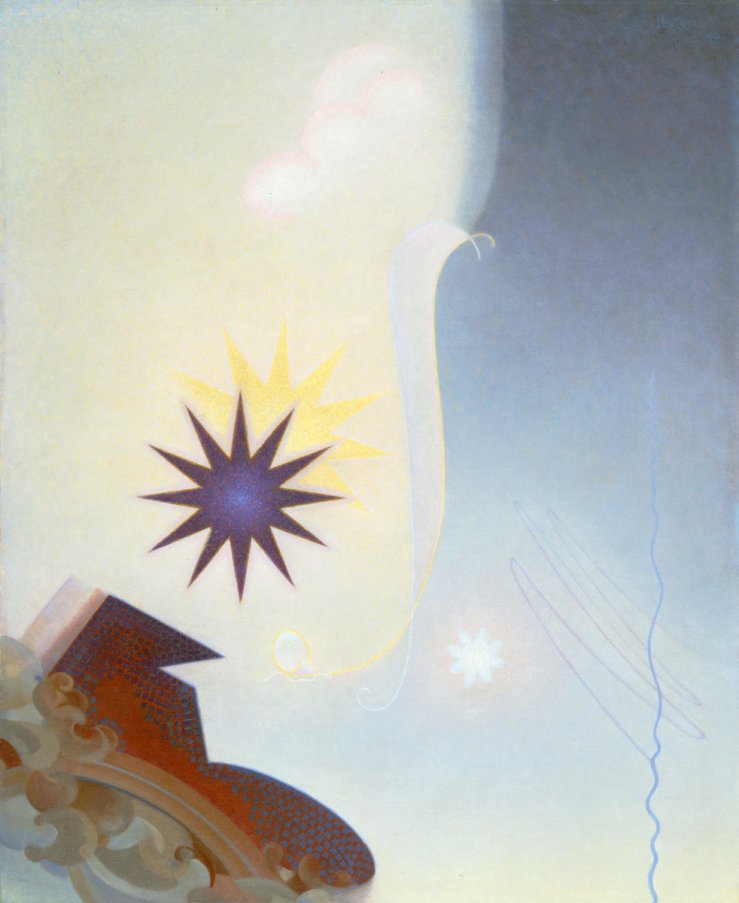
Labor — Will Barnet

Labor, 1935 by Will Barnet (1911-2012)

“Marabou” — Joy Williams

“Marabou”

by

Joy Williams


The funeral of Anne’s son, Harry, had not gone smoothly. Other burials were taking place at the same hour, including that of a popular singer several hundred yards away whose mourner fans carried on loudly under a lurid striped tent. Still more fans pressed against the cemetery’s wrought-iron gates, screaming and eating potato chips. Anne had been distracted. She gazed at the other service in disbelief, thinking of the singer’s songs that she had heard now and then on the radio.

Her own group, Harry’s friends, was subdued. They were pale, young, and all wore sunglasses. Most of them were classmates from the prep school he had graduated from two years before, and all were addicts, or former addicts of some sort. Anne couldn’t tell the difference between those who were recovering and those who were still hard at it. She was sure there was a difference, of course, and it only appeared there wasn’t. They all had a manner. There were about twenty of them, boys and girls, strikingly alike in black. Later she took them all out to a restaurant. “Death … by none art thou understood,” one boy kept saying. “Henry Vaughan.”

They were all bright enough, Anne supposed. After a while he stopped saying it. They had calamari, duck, champagne, everything. They were on the second floor of the restaurant and had the place to themselves. They stayed for hours. By the time they left, one girl was saying earnestly, “You know a word I like is interplanetary.” Continue reading ““Marabou” — Joy Williams”

Milking Practice with Artificial Udder — Evelyn Dunbar

Milking Practice with Artificial Udders, 1940 by Evelyn Dunbar (1906-1960)

While the World Is Burning — Willehad Eilers

While the World Is Burning, 2022 by Willehad Eilers (b. 1981)

“Fridge,” a very short story by Stuart Dybek

“Fridge”

by

Stuart Dybek


At midnight the expedition of the bride and groom arrives at the Fridge and pauses to get its bearings from the pale, arctic twenty-watt sun before proceeding across a border there is no need to map.

Before them lies the taiga where the wolf vowel of wind penetrates the heart with the aim of a winter draft through an uncaulked bedroom window—a draft that feels its way down corridors of sleep, its Freon breath scented with the rotten moss of unmade salads and wilted scallions.

And beyond the taiga, a tundra stretches that, from its smell, must be the snow-blinding white of sour milk.

There’s a sadness locked away here that emerges slowly like the freezer-burned flavors from some glacial past molded into cubes of ice. There’s a cheese never meant to be blue. There are undesired dreams and memories preserved in an isolation in which dream and memory have become indistinguishable from one another, both smoldering like ghosts of cold around a temperature dial forced beyond its lowest subtraction.

Here are the silent regions of rock-hard meat frozen into obscene postures like the dead around Stalingrad, regions where body heat has vanished beneath a crust of frost, where breath hangs although the breathers are long gone; dangerous regions where, even after the plug has been pulled, love can still be smothered as if it were a child playing hide-and-seek in a junked appliance.

Untitled (The Island of Doctor Moreau) — Charles Burns

Charles Burns’ illustration for a Jan. 2000 Esquire article by Jeff Gordinier titled “The Best Movies You’ve Never Seen.”

Hurricane — Alphonse Legros

Hurricane by Alphonse Legros (1837-1911)

Oh yeah. Debridement is one of the great words, says novelist William Gaddis, one of the great survivors.

Yeah . . . stubbing out another cigarette, in a voice like warm asphalt — this was an arrangement I had in hard times. I had root canal work to be done, and this man, who was an endodontologist, which is a root canal man, was writing pieces for dental journals. But he was not awfully good with the language, so we made an agreement, a barter arrangement, of one paper, one root. So I’d come in with one tooth with two bad roots and he would do them and then I’d rewrite, really write, because these were very, and there was a battle in the endodontological world about whether debridement was desirable or even possible. Debridement is when they try to remove any source of infection so that when they do pack the root, it won’t come to life. And his side was debridement was possible and necessary and can be done. So that’s the side I was supporting.

— Nice word, isn’t it.

— Oh yeah. Debridement is one of the great words . . . says novelist William Gaddis, one of the great survivors.

The first paragraph of a 23 Aug. 1985 profile on William Gaddis in The Washington Post by Lloyd Grove.

Untitled (Secret’s Safe) — Raymond Pettibon

Untitled, 2003 by Raymond Pettibon (b. 1957)

Illustration for Cormac McCarthy’s All the Pretty Horses — Marshall Arisman

An illustration by Marshall Arisman (1937-1922) that accompanied a March 1992 excerpt of Cormac McCarthy’s novel All the Pretty Horses that appeared in Esquire.

Coat Check Girl — Nigel Van Wieck

Coat Check Girl by Nigel Van Wieck (b. 1947)

Ukuphicotha Kwento Xa Ingaziwa — Cinga Samson

Ukuphicotha Kwento Xa Ingaziwa, 2023 by Cinga Samson (b. 1986)

It was the Gramarye of the Middle Ages, which some people are accustomed to think of as the Dark Ages, and Arthur had made it what it was | From T.H. White’s The Candle in the Wind

It was the Gramarye of the Middle Ages, which some people are accustomed to think of as the Dark Ages, and Arthur had made it what it was. When the old King came to his throne it had been an England of armoured barons, and of famine, and of war. It had been the country of trial by ordeal with red-hot irons, of the Law of Englishry, and of the sad, wordless song of Morfa-Rhuddlan. Then, on the sea-coast, within a foreign vessel’s reach, not an animal, not a fruit tree, had been left. Then, in the fens and the vast forests, the last of the Saxons had defended themselves against the bitter rule of Uther the Conqueror; then the words “Norman” and “Baron” had been equivalent to the modern word of “Sahib”; then Llewellyn ap Griffith’s head, in its crown of ivy, had mouldered on the clustered spikes of the Tower; then you would have met the mendicants by the roadside, mutilated men who carried their right hands in their left, and the forest dogs would have trotted beside them, also mutilated by the removal of one toe—so that they could not hunt in the woodlands of the lord. When Arthur first came, the country people had been accustomed to bar themselves in their cottages every night as if for siege, and had prayed to God for peace during darkness, the goodman of the house repeating the prayers used at sea on the approach of storm and ending with the plea “the Lord bless us and help us,” to which all present had replied “Amen.” In the baron’s castle, in the early days, you would have found the poor men being disembowelled—and their living bowels burned before them—men being slit open to see if they had swallowed their gold, men gagged with notched iron bits, men hanging upside down with their heads in smoke, others in snake pits or with leather tourniquets round their heads, or crammed into stone-filled boxes which would break their bones. You have only to turn to the literature of the period, with its stories of the mythological families such as Plantagenets, Capets and so forth, to see how the land lay. Legendary kings like John had been accustomed to hang twenty-eight hostages before dinner; or, like Philip, had been defended by “sergeants-at-mace,” a kind of storm troopers who guarded their lord with maces; or, like Louis, had decapitated their enemies on scaffolds under the blood of which the children of the enemy had been forced to stand. This, at all events, is what Ingulf of Croyland used to tell us, until he was discovered to be a forgery. Then there had been Archbishops nicknamed “Skin-villain,” and churches used as forts—with trenches in the graveyards among the bones—and price-lists for fining murderers, and bodies of the excommunicated lying unburied, and famishing peasants eating grass or tree-bark or one another. (One of them ate forty-eight.) There had been roasting heretics on the one hand—forty-five Templars had been burned in one day—and the heads of captives being thrown into besieged castles from catapults on the other. Here a leader of the Jacquerie had been writhing in his chains, as he was crowned with a red-hot tripod. There a Pope had been complaining, as he was held to ransom, or another one had been wriggling as he was poisoned. Treasure had been cemented into castle walls, in the form of gold bars, and the builders had been executed afterwards. Children playing in the streets of Paris had frolicked with the dead body of a Constable, and others, with the women and old men, had starved outside the walls of beleaguered towns, yet inside the ring of the besiegers. Hus and Jerome, with the mitres of apostasy upon their heads, had flamed and fizzled at the stake. The hamstrung imbeciles of Jumièges had floated down the Seine. Giles de Retz had been found to have no less than a ton of children’s bones, calcined, in his castle, after having murdered them at the rate of twelve score a year for nine years. The Duke of Berry had lost a kingdom through the unpopularity which he earned by feeling sorry for eight hundred foot soldiers who had been killed in a battle. The youthful count of St. Pol had been taught the arts of war by being given twenty-four living prisoners to slaughter in various ways, for practice. Louis the Eleventh, another of the fictional kings, had kept obnoxious bishops in rather expensive cages. The Duke Robert had been surnamed “the Magnificent” by his nobles—but “the Devil” by his parishioners. And all the while, before Arthur came, the common people—of whom fourteen were eaten by wolves out of one town in a single week, of whom one third were to die in the Black Death, of whom the corpses had been packed in pits “like bacon,” for whom the refuges at evening had often been forests and marshes and caves, for whom, in seventy years, there had been known to be forty-eight of famine—these people had looked up at the feudal nobility who were termed the “lords of sky and earth,” and—themselves battered by bishops who, because they were not allowed to shed blood, went for them with iron clubs—had cried aloud that Christ and his saints were sleeping.

“Pourquoi,” the poor wretches had sung in their misery:

Pourquoi nous laisser faire dommage?
Nous sommes hommes comme ils sont.

From The Candle in the Wind by T.H. White.

Country Church — Robin Ironside

Country Church, 1951 by Robin Ironside (1912-1965)

“Faith of Our Fathers” — Philip K. Dick

“Faith of Our Fathers”

by

Philip K. Dick


On the streets of Hanoi he found himself facing a legless peddler who rode a little wooden cart and called shrilly to every passer-by. Chien slowed, listened, but did not stop; business at the Ministry of Cultural Artifacts cropped into his mind and deflected his attention: it was as if he were alone, and none of those on bicyles and scooters and jet-powered motorcycles remained. And likewise it was as if the legless peddler did not exist.

“Comrade,” the peddler called however, and pursued him on his cart; a helium battery operated the drive and sent the cart scuttling expertly after Chien. “I possess a wide spectrum of time-tested herbal remedies complete with testimonials from thousands of loyal users; advise me of your malady and I can assist.”

Chien, pausing, said, “Yes, but I have no malady.” Except, he thought, for the chronic one of those employed by the Central Committee, that of career opportunism testing constantly the gates of each official position. Including mine.

“I can cure for example radiation sickness,” the peddler chanted, still pursuing him. “Or expand, if necessary, the element of sexual prowess. I can reverse carcinomatous progressions, even the dreaded melanomae, what you would call black cancers.” Lifting a tray of bottles, small aluminum cans and assorted powders in plastic jars, the peddler sang, “If a rival persists in trying to usurp your gainful bureaucratic position, I can purvey an ointment which, appearing as a dermal balm, is in actuality a desperately effective toxin. And my prices, comrade, are low. And as a special favor to one so distinguished in bearing as yourself I will accept the postwar inflationary paper dollars reputedly of international exchange but in reality damn near no better than bathroom tissue.” Continue reading ““Faith of Our Fathers” — Philip K. Dick”

HELP! A Stereophonic Narrative for Authorial Voice — John Barth


“HELP! A Stereophonic Narrative for Authorial Voice” by John Barth.

Aira/Márquez/Moore (Books acquired, 18 Aug. 2023)

Last week I read a 1985 Washington Post profile of the American novelist William Gaddis. The profile, by Lloyd Grove, celebrated the publication of Gaddis’s third novel Carpenter’s Gothic. In the profile, Grove paraphrases literary critic Frederick Karl’s 1985 essay “The Mega-Novel” in the following way:

Karl argues that unlike “categories of Jewish novelists, gays, Black writers [and] female authors” who address special interests, “these white Protestant males [Gaddis, Pynchon, John Barth et al.] write very close to what America is,” having “sensed the country as a whole.”

I tracked down and read Karl’s essay “The Mega-Novel”; it is, almost entirely, a sustained argument for the kind of giant-assed so-called “experimental” novels typical of the bracketed Gaddis, Pynchon, and Barth above. And yet Karl seems to slide into and side with Harold Bloom in that old man’s pompous war against the so-called “School of Resentment”; once in the quote above, and then a few pages later, when he chooses to claim that “The Mega-Novelists have avoided the individuation of ethnic, gay, female (or even strictly male) experience and sensed the country as a whole.” Yes—Grove weds this second line in Karl’s covert attack on the “School of Resentment,” this maddening and dismissive “country as a whole” bit to the previous language. The effect is so odd, as if Grove has purposefully ignored every other bit of Karl’s essay and cherry-picked the lines that valorize the Real American Viewpoint™ as White Protestant Straight and Male.

Karl’s essay is, apart from these unnecessary declarations, really quite good—he champions Gaddis’s J R and Joseph McElroy’s Lookout Cartridge in particular. And yet I found myself troubled by his claim that it is the dead white guys who write very close to what America is because they sense the country as a whole, in a way that somehow, like, I guess Ishmael Reed or Fran Ross or Toni Morrison or etc. just can’t. And because I’m so simpatico with Karl’s general idea in “The Mega-Novel,” I found myself looking for his 1983 book American Fictions 1940-1980 : A Comprehensive History and Critical Evaluation.

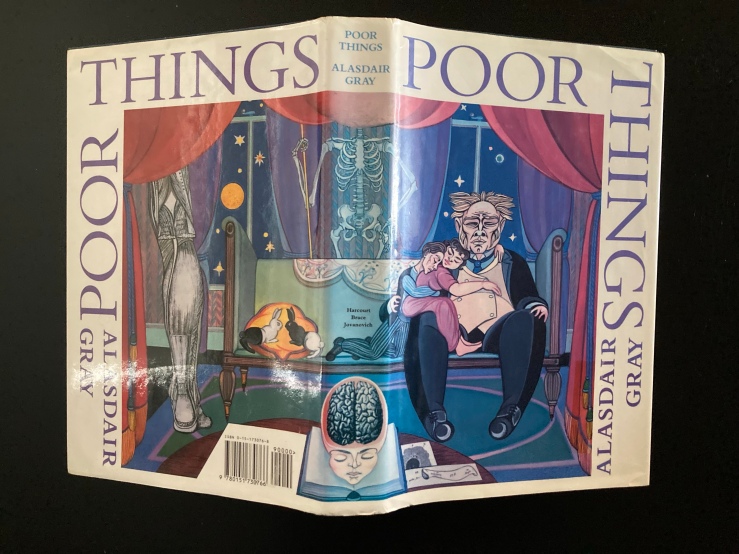
While I didn’t find it in the literary criticism section of my beloved used bookmine, I did find the second volume of Gaddis-scholar Steven Moore’s The Novel, covering 1600-1800.

I also picked up César Aira’s An Episode in the Life of a Landscape Painter (in translation by Chris Andrews) and Gabriel García Márquez’s In Evil Hour (in translation by Gregory Rabassa). The latter is another title in Avon/Bard’s Latin American authors series, and I can’t resist them.


The next day, yesterday, Saturday, I participated in an online discussion about the literature of William Gaddis on non-academic forums. (I represented Ye Olde Bloggers, and I will share more about the forum some time in the future.) Early in our forum, one of the participants, the author Jeff Bursey, raised a copy of Frederick Karl’s American Fictions 1940-1980 in front of his webcam. I believe he declared it one of the first places he’d heard of Gaddis, although I could be misremembering. It seemed like a serendipitous moment. I hope to muster more words on most of this later.