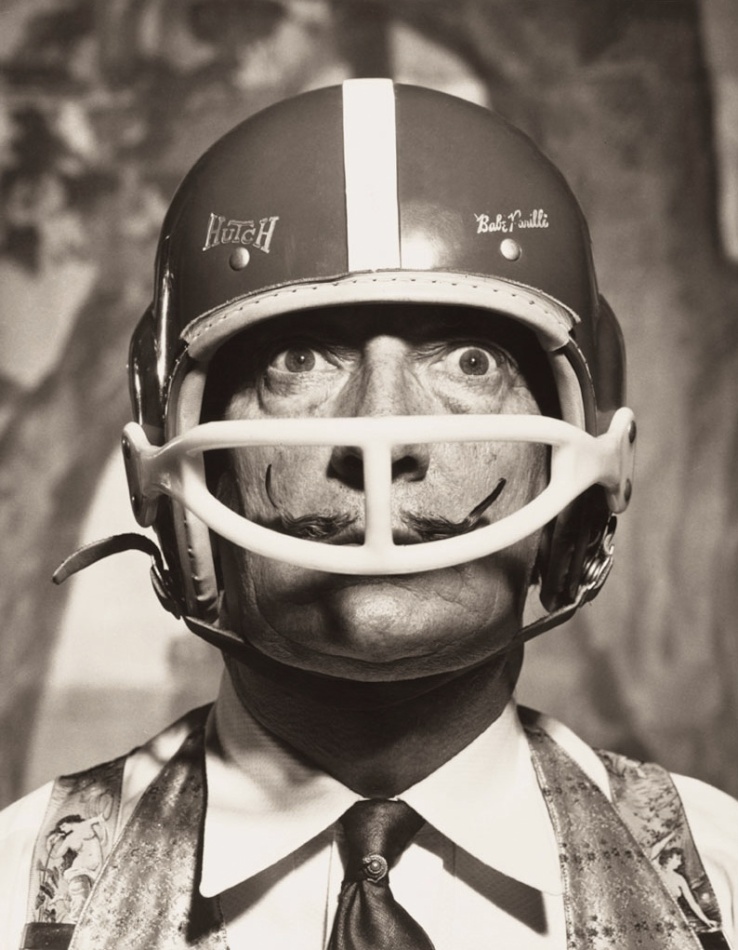
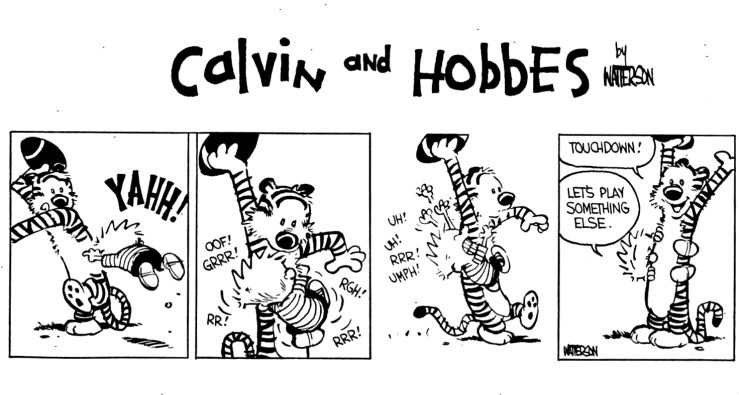
Calvin & Hobbes play football

Capture

“For the portrait of an African boy after the manner of Gauguin” — Langston Hughes

Capture

February — Michael Sowa

february

One reads for oneself and for strangers (Harold Bloom)

The terms “power” and “authority” have pragmatically opposed meanings in the realms of politics and what we still ought to call “imaginative literature.” If we have difficulty in seeing the opposition, it may be because of the intermediate realm that calls itself “spiritual.” Spiritual power and spiritual authority notoriously shade over into both politics and poetry. Thus we must distinguish the aesthetic power and authority of the Western Canon from whatever spiritual, political, or even moral consequences it may have fostered. Although reading, writing, and teaching are necessarily social acts, even teaching has its solitary aspect, a solitude only the two could share, in Wallace Stevens’s language. Gertrude Stein maintained that one wrote for oneself and for strangers, a superb recognition that I would extend into a parallel apothegm: one reads for oneself and for strangers. The Western Canon does not exist in order to augment preexisting societal elites. It is there to be read by you and by strangers, so that you and those you will never meet can encounter authentic aesthetic power and the authority of what Baudelaire (and Erich Auerbach after him) called “aesthetic dignity.” One of the ineluctable stigmata of the canonical is aesthetic dignity, which is not to be hired.

From The Western Canon by Harold Bloom.

The Pagans — Oskar Kokoschka

Avant-gardes are fragile affairs (William H. Gass)

Avant-gardes are fragile affairs. The moment they become established, they cease to be – success as well as failure finishes them off. Their unity depends upon a common “no,” not on some “yes” that is jointly loved. And insofar as the movement moves at all, it requires the shoulders of many others at its wheels, support which most of the artists suspect is actually their exploitation. Poems must be written, paintings must be painted, but mere coffeehouse talk is not irrelevant to the success of the cause, nor are letters, broadsides, feuilletons, essays, reviews, catalogue copy, the quarrels of the cafés and the slanders of the salons; nor are tumults in the stalls, outrages of public decency, arrests, or other excursions and alarms.


Every effort to prolong an avant-garde beyond a certain point becomes of doubtful value, because an avant-garde can have but a mayfly’s life: the artists have only their negations to chorus; both their attitudes and their art will alter as they age; society’s methods of co-optation and disarmament will, in general, be effective; their anger will be softened by success and their aims divided, their attention distracted; the institutions set up by most Establishments, even if assaulted, will take longer dying than most avant-gardes can expect to live; while the strength of the support groups, so necessary to the energy of any movement, are even more fragile and momentary, depending, as they do, on the loyalty of a publisher, the generosity of a patron, the length of a love life, the cuisine of a café.

From William H. Gass’s essay “The Vicissitudes of the Avant-Garde.”

The Hard Lesson — William-Adolphe Bouguereau

IMG_4969

Nausicaä

52413304a196

The Reconciliation — Judson Huss

jh

Paul Thomas Anderson talks to VICE about Inherent Vice

“The Blue Jay” by Billy Gaddis — Juvenilia from William Gaddis

billy

William Gaddis juvenilia from Washington University’s Modern Literature collection. (You can read the entire piece there).

The Acrobat’s Family, The Injured Child — Gustave Dore

Gustave_Dore_-_'La_famille_du_saltimbanque,_l’enfant_blessé

“People often ask me, ‘How can you be so stupid and still proclaim yourself a communist?'” (Slavoj Žižek)

The Sea of Flames — Rene Magritte

Read “Entropy,” a short story by Thomas Pynchon

“Entropy”

by

Thomas Pynchon

Boris has just given me a summary of his views. He is weather prophet. The weather will continue bad, he says. There will be more calamities, more death, more despair. Not the slightest indication of a change anywhere…. We must get into step, a lockstep toward the prison of death. There is no escape. The weather will not change. – Tropic of Cancer

Downstairs, Meatball Mulligan’s lease-breaking party was moving into its 40th hour. On the kitchen floor, amid a litter of empty champagne fifths, were Sandor Rojas and three friends, playing spit in the ocean and staying awake on Heidseck and benzedrine pills. In the living room Duke, Vincent, Krinkles and Paco sat crouched over a 15-inch speaker which had been bolted into the top of a wastepaper basket, listening to 27 watts’ worth of The Heroes’ Gate at Kiev. They all wore hornrimmed sunglasses and rapt expressions, and smoked funny-looking cigarettes which contained not, as you might expect, tobacco, but an adulterated form of cannabis sativa. This group was the Duke di Angelis quartet. They recorded for a local label called Tambú and had to their credit one 10″ LP entitled Songs of Outer Space. From time to time one of them would flick the ashes from his cigarette into the speaker cone to watch them dance around. Meatball himself was sleeping over by the window, holding an empty magnum to his chest as if it were a teddy bear. Several government girls, who worked for people like the State Department and NSA, had passed out on couches, chairs and in one case the bathroom sink.

This was in early February of’57 and back then there were a lot of American expatriates around Washington, D.C., who would talk, every time they met you, about how someday they were going to go over to Europe for real but right now it seemed they were working for the government. Everyone saw a fine irony in this. They would stage, for instance, polyglot parties where the newcomer was sort of ignored if he couldn’t carry on simultaneous conversations in three or four languages. They would haunt Armenian delicatessens for weeks at a stretch and invite you over for bulghour and lamb in tiny kitchens whose walls were covered with bullfight posters. They would have affairs with sultry girls from Andalucía or the Midi who studied economics at Georgetown. Their Dôme was a collegiate Rathskeller out Wisconsin Avenue called the Old Heidelberg and they had to settle for cherry blossoms instead of lime trees when spring came, but in its lethargic way their life provided, as they said, kicks.

At the moment, Meatball’s party seemed to be gathering its second wind. Outside there was rain. Rain splatted against the tar paper on the roof and was fractured into a fine spray off the noses, eyebrows and lips of wooden gargoyles under the eaves, and ran like drool down the windowpanes. The day before, it had snowed and the day before that there had been winds of gale force and before that the sun had made the city glitter bright as April, though the calendar read early February. It is a curious season in Washington, this false spring. Somewhere in it are Lincoln’s Birthday and the Chinese New Year, and a forlornness in the streets because cherry blossoms are weeks away still and, as Sarah Vaughan has put it, spring will be a little late this year. Generally crowds like the one which would gather in the Old Heidelberg on weekday afternoons to drink Würtzburger and to sing Lili Marlene (not to mention The Sweetheart of Sigma Chi) are inevitably and incorrigibly Romantic. And as every good Romantic knows, the soul (spiritus, ruach, pneuma) is nothing, substantially, but air; it is only natural that warpings in the atmosphere should be recapitulated in those who breathe it. So that over and above the public components—holidays, tourist attractions—there are private meanderings, linked to the climate as if this spell were a stretto passage in the year’s fugue: haphazard weather, aimless loves, unpredicted commitments: months one can easily spend in fugue*, because oddly enough, later on winds, rains, passions of February and March are never remembered in that city, it is as if they had never been.

Read the rest of “Entropy” online here—alongside a Spanish translation and explanatory notes—or read it in the collection of early Pynchon shorties Slow Learner.