Blue Night — Edward Hopper

PLEASE HELP WHAT HORROR IS THIS

20140306-180113.jpg

Seriously:

What horror is this?

Via frequent commenter Will C., a nightmare image (he linked it, and rightly so, to some other horror).

Posted in Art

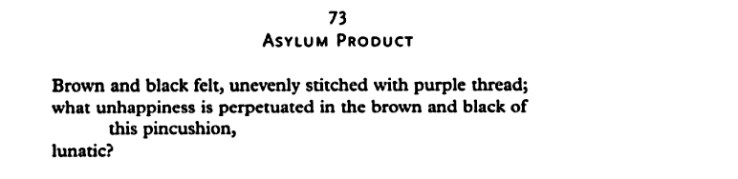
“Asylum Product” — Charles Reznikoff

as

“All art constantly aspires towards the condition of music”

“The King of Jazz” — Donald Barthelme

“The King of Jazz”

by

Donald Barthelme

Well, I’m the king of jazz now, thought Hokie Mokie to himself as he oiled the slide on his trombone. Hasn’t been a ‘bone man been king of jazz for many years. But now that Spicy MacLammermoor, the old king, is dead, I guess I’m it. Maybe I better play a few notes out of this window here, to reassure myself.

“Wow!” said somebody standing on the sidewalk. “Did you hear that?”

“I did,” said his companion.

“Can you distinguish our great homemade American jazz performers, each from the other?”

“Used to could.”

“Then who was that playing?”

“Sounds like Hokie Mokie to me. Those few but perfectly selected notes have the real epiphanic glow.”

“The what?”

“The real epiphanic glow, such as is obtained only by artists of the caliber of Hokie Mokie, who’s from Pass Christian, Mississippi. He’s the king of jazz, now that Spicy MacLammermoor is gone.”

Hokie Mokie put his trombone in its case and went to a gig. At the gig everyone fell back before him, bowing.

“Hi Bucky! Hit Zoot! Hi Freddie! Hi George! Hi Thad! Hi Roy! Hi Dexter! Hi Jo! Hi Willie! Hi Greens!”

“What we gonna play, Hokie? You the king of jazz now, you gotta decide.”

“How ’bout ‘Smoke’?”

“Wow!” everybody said. “Did you hear that? Hokie Mokie can just knock a fella out, just the way he pronounces a word. What an intonation on that boy! God Almighty!” Continue reading ““The King of Jazz” — Donald Barthelme” →
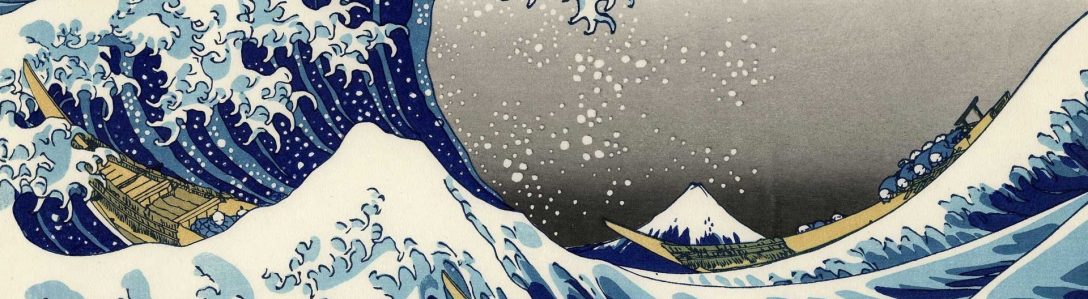
St. Augustine Reading — Marco Zoppo

Night Hauling — Andrew Wyeth

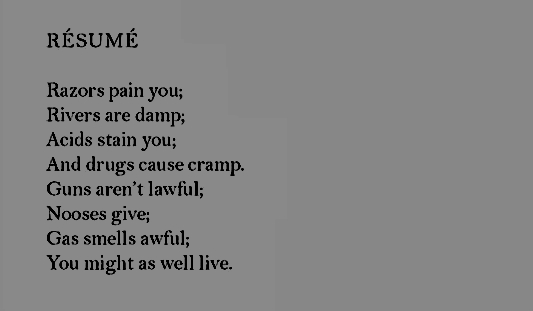
“Résumé” — Dorothy Parker

dp

The London Jungle Book (Book Acquired, 2.28.2014)

20140303-140624.jpg

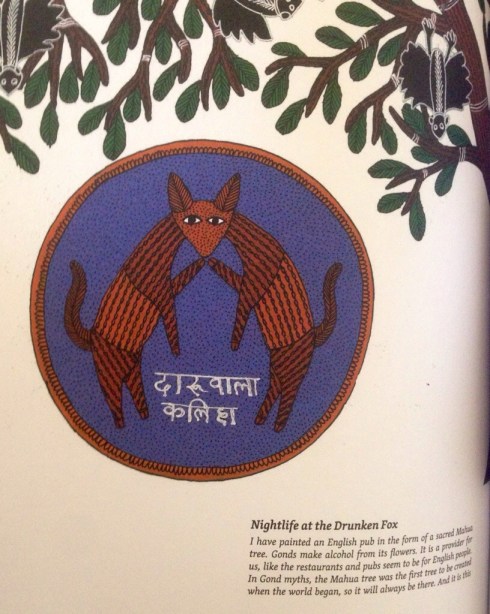
Bhajju Shyam’s The London Jungle Book arrived a few days ago: Beautiful stuff. Full review to come, but blurb for now:

Hailed as a book that reverses the anthropological gaze, ‘The London Jungle Book’ is the personal story of Indian tribal artist Bhajju Shyam’s first encounter with a western city. Revised & fully updated to mark the 10th anniversary of that momentous journey, Bhajju’s rich art and poignant reflections are as relevant today as they ever were.

20140303-140645.jpg

Impressive View of the Go River –Ikeno Taiga

Ash Wednesday — Carl Spitzweg

Portrait of Maffeo Barberini — Caravaggio

The Hands — Edvard Munch

Black Moon — Louis Malle (Full Film)

Pôster

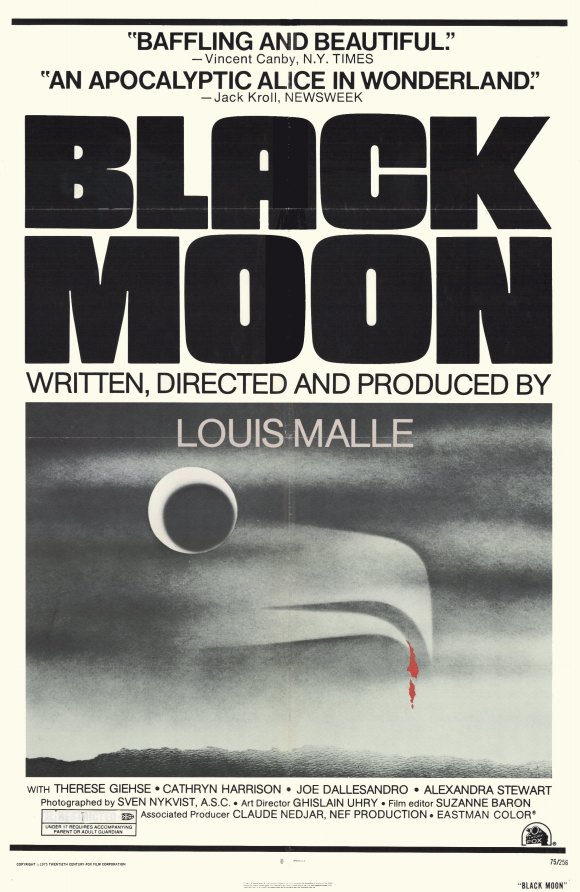
Black Moon may well deserve the title of Louis Malle’s film maudit. The release in September 1975 of what he called his “mythological fairy tale taking place in the near future” disconcerted many, especially as people had expected him to follow up on his previous work, the groundbreaking German-occupation drama Lacombe, Lucien (1974). As a result, the film was his least successful at the box office, and despite receiving two Césars in 1976, it remained until recently one of his most difficult to see.

Black Moon opens as quasi science fiction—there seems to be some kind of nuclear war going on, with soldiers wearing gas masks—but immediately evolves into an elaborate surrealist fantasy. In a deserted countryside, a fair young woman (Cathryn Harrison) fleeing the armed conflict stumbles upon a series of animals, ranging from the rural—a badger, pigs, sheep, snakes, and a horse—to a mythical unicorn. Narrowly escaping being shot, she ends up in a beautiful mansion that is itself overrun by animals, those she has seen outside now joined by a tame rat and an eagle, among others. The human inhabitants of the house are an androgynous and incestuous brother and sister couple, possibly twins (played by Alexandra Stewart and Joe Dallesandro), who, like the heroine, are both called Lily, and their bedridden elderly mother (Thérèse Giehse, who had played the grandmother in Lacombe, Lucien and whom Malle credited with indirectly generating Black Moon by suggesting that he make a film without dialogue; he dedicated the film to her, as she died before it was released). Although Black Moon was produced in an English and a French version—and Malle stated that he preferred the English one—language is reduced to a few grunts, a minute amount of intelligible dialogue, and animal noises. The film is instead replete with surrealist images, such as a talking piglet in a child’s high chair, decapitated animals, feral naked children driving pigs or sheep, and both the female twin and the heroine at one point breast-feeding the old woman.

From Ginette Vincendeau’s essay “Black Moon: Louis in Wonderland.“

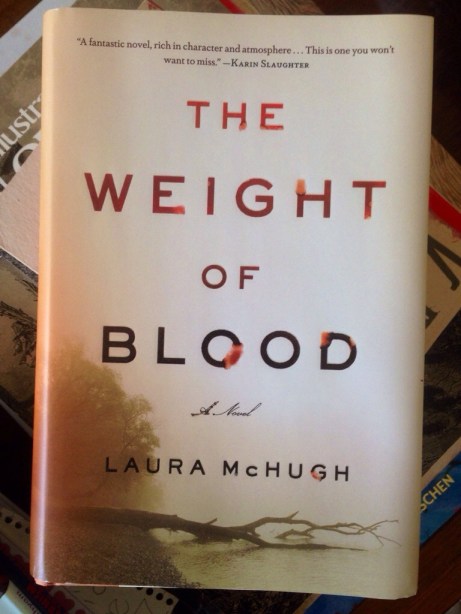
The Weight of Blood (Book Acquired, 2.24.2014)

20140303-140605.jpg

Laura McHugh’s novel The Weight of Blood is new in trade hardback next week from Random House. Their blurb:

The town of Henbane sits deep in the Ozark Mountains. Folks there still whisper about Lucy Dane’s mother, a bewitching stranger who appeared long enough to marry Carl Dane and then vanished when Lucy was just a child. Now on the brink of adulthood, Lucy experiences another loss when her friend Cheri disappears and is then found murdered, her body placed on display for all to see. Lucy’s family has deep roots in the Ozarks, part of a community that is fiercely protective of its own. Yet despite her close ties to the land, and despite her family’s influence, Lucy—darkly beautiful as her mother was—is always thought of by those around her as her mother’s daughter. When Cheri disappears, Lucy is haunted by the two lost girls—the mother she never knew and the friend she couldn’t save—and sets out with the help of a local boy, Daniel, to uncover the mystery behind Cheri’s death.

What Lucy discovers is a secret that pervades the secluded Missouri hills, and beyond that horrific revelation is a more personal one concerning what happened to her mother more than a decade earlier.

The Weight of Blood is an urgent look at the dark side of a bucolic landscape beyond the arm of the law, where a person can easily disappear without a trace. Laura McHugh proves herself a masterly storyteller who has created a harsh and tangled terrain as alive and unforgettable as the characters who inhabit it. Her mesmerizing debut is a compelling exploration of the meaning of family: the sacrifices we make, the secrets we keep, and the lengths to which we will go to protect the ones we love.

The Pancake Baker — Adriaen Brouwer

RIP Robert Ashley

ashleybysavio2

RIP Robert Ashley, 1930-2014