
- Socrates
- Guy Debord
- Sylvia Plath
- David Foster Wallace
- Hunter S. Thompson
- Gérard de Nerval
- Tadeusz Borowski
- Spalding Gray
- Virginia Woolf
- Lucan
- Thomas Disch
- Vachel Lindsay
- Ernest Hemingway
- Yasunari Kawabata
- Paul Celan
- Seneca
- Heinrich von Kleist
- John Kennedy Toole
- Sarah Kane
- Breece D’J Pancake
- Gilles Deleuze
- Robert E. Howard
- Richard Brautigan
- Anne Sexton
- Stefan Zweig
- John Berryman
- Walter Benjamin
- Primo Levi
- Jerzy Kosinski
- Hart Crane
- Yukio Mishima
Author: Biblioklept
RIP Elmore Leonard
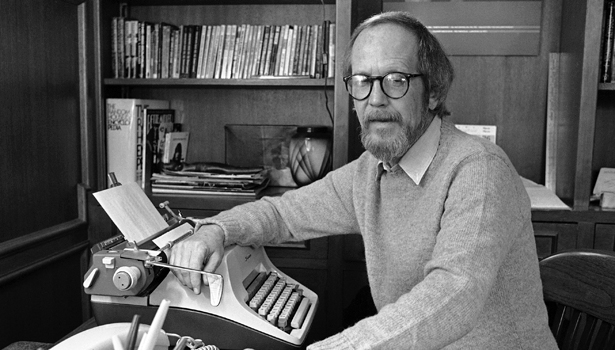
RIP Elmore Leonard, 1925 – 2013

“I Am Essentially Marxian” and Other Notes from F. Scott Fitzgerald’s Notebooks
- D. H. Lawrence great attempt to synthesize animal and emotional—things he left out. Essential pre-Marxian. Just as I am essentially Marxian.
- When Whitman said “Oh Pioneers” he said all.
- Byron’s mountains warm.
- Reporting the extreme things as if they were the average things will start you on the art of fiction.
- Work out my hard luck season—my most productive seasons, etc
- Conrad’s secret theory examined.He knew that things do transpire about people. Therefore he wrote the truth and transposed it to parallel to give that quality, adding confusion however to his structure. Nevertheless there is in his scheme a desire to imitate life which is in all the big shots. Have I such an idea in the composition of this book?
- Conrad influenced by Man Without a Country
- No English painting because of their putting everything into words.
- List of Zelda’s faults and virtues as a writer.
- Chapter in slow motion.
- Right to Pretty heroines
- Tie up with Faulkner—Lord Fauntleroy.
–From F. Scott Fitzgerald’s The Notebooks.
Reading Rabelais — Jehan Georges Vibert

Dwarf Caiman and False Coral Snake — Maria Sibylla Merian

Thor vs. The Thing — Jack Kirby
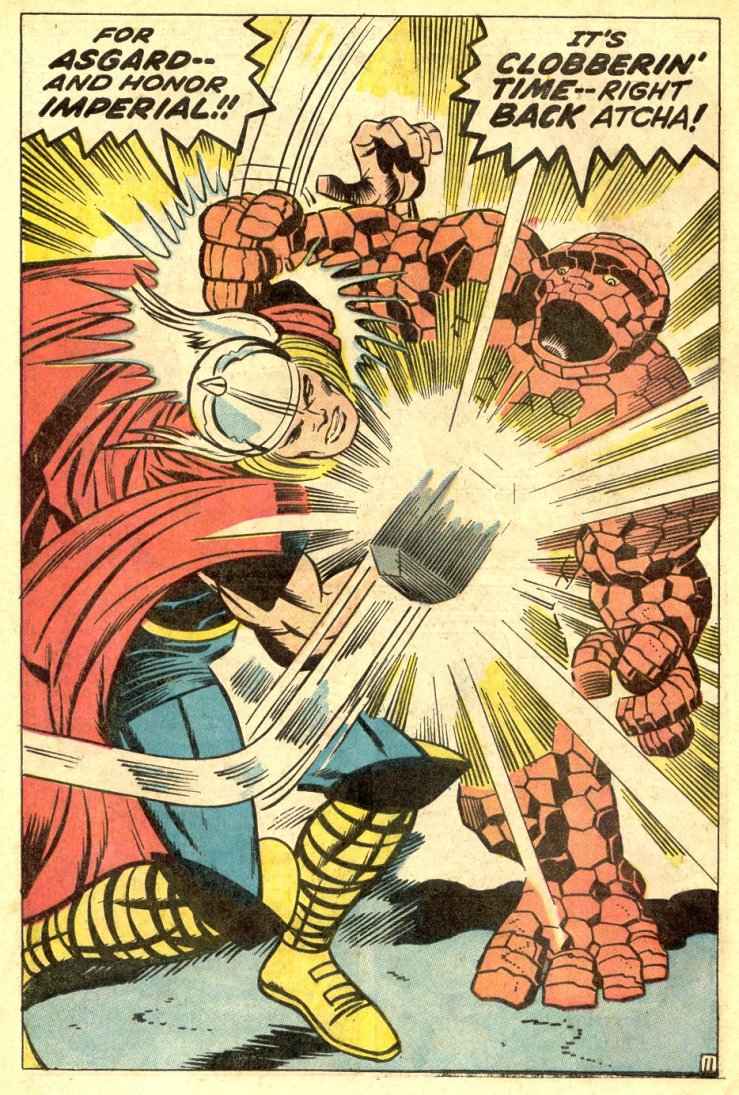
(Via).
“Vague longing and boredom are close akin” (Schopenhauer)
* * * * *
Goethe says somewhere that man is not without a vein of veneration. To satisfy this impulse to venerate, even in those who have no sense for what is really worthy, substitutes are provided in the shape of princes and princely families, nobles, titles, orders, and money-bags.
* * * * *
Vague longing and boredom are close akin.
* * * * *
When a man is dead, we envy him no more; and we only half envy him when he is old.
* * * * *
Misanthropy and love of solitude are convertible ideas.
* * * * *
In chess, the object of the game, namely, to checkmate one’s opponent, is of arbitrary adoption; of the possible means of attaining it, there is a great number; and according as we make a prudent use of them, we arrive at our goal. We enter on the game of our own choice.
Nor is it otherwise with human life, only that here the entrance is not of our choosing, but is forced on us; and the object, which is to live and exist, seems, indeed, at times as though it were of arbitrary adoption, and that we could, if necessary, relinquish it. Nevertheless it is, in the strict sense of the word, a natural object; that is to say, we cannot relinquish it without giving up existence itself. If we regard our existence as the work of some arbitrary power outside us, we must, indeed, admire the cunning by which that creative mind has succeeded in making us place so much value on an object which is only momentary and must of necessity be laid aside very soon, and which we see, moreover, on reflection, to be altogether vanity—in making, I say, this object so dear to us that we eagerly exert all our strength in working at it; although we knew that as soon as the game is over, the object will exist for us no longer, and that, on the whole, we cannot say what it is that makes it so attractive. Nay, it seems to be an object as arbitrarily adopted as that of checkmating our opponent’s king; and, nevertheless, we are always intent on the means of attaining it, and think and brood over nothing else. It is clear that the reason of it is that our intellect is only capable of looking outside, and has no power at all of looking within; and, since this is so, we have come to the conclusion that we must make the best of it.
Notes from “Psychological Observations.”
The Little School Boy — Pierre-Auguste Renoir

Two Wine Glasses — John Singer Sargent

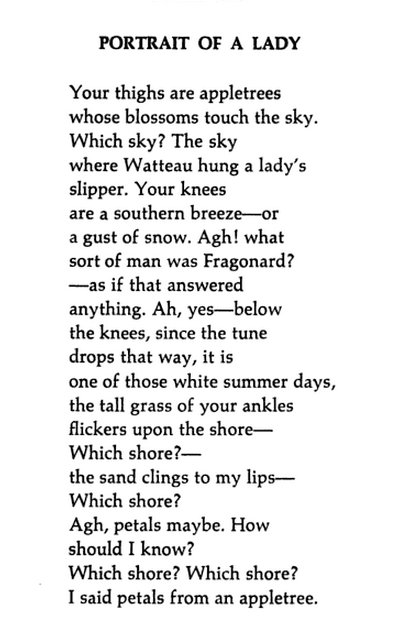
“Portrait of a Lady” — William Carlos Williams
Suicide — Andy Warhol

“Genius and Virtue” — Arthur Schopenhauer
“Genius and Virtue” by Arthur Schopenhauer
When I think, it is the spirit of the world which is striving to express its thought; it is nature which is trying to know and fathom itself. It is not the thoughts of some other mind, which I am endeavouring to trace; but it is I who transform that which exists into something which is known and thought, and would otherwise neither come into being nor continue in it.
In the realm of physics it was held for thousands of years to be a fact beyond question that water was a simple and consequently an original element. In the same way in the realm of metaphysics it was held for a still longer period that the ego was a simple and consequently an indestructible entity. I have shown, however, that it is composed of two heterogeneous parts, namely, the Will, which is metaphysical in its character, a thing in itself, and the knowing subject, which is physical and a mere phenomenon.
Let me illustrate what I mean. Take any large, massive, heavy building: this hard, ponderous body that fills so much space exists, I tell you, only in the soft pulp of the brain. There alone, in the human brain, has it any being. Unless you understand this, you can go no further.
Truly it is the world itself that is a miracle; the world of material bodies. I looked at two of them. Both were heavy, symmetrical, and beautiful. One was a jasper vase with golden rim and golden handles; the other was an organism, an animal, a man. When I had sufficiently admired their exterior, I asked my attendant genius to allow me to examine the inside of them; and I did so. In the vase I found nothing but the force of gravity and a certain obscure desire, which took the form of chemical affinity. But when I entered into the other—how shall I express my astonishment at what I saw? It is more incredible than all the fairy tales and fables that were ever conceived. Nevertheless, I shall try to describe it, even at the risk of finding no credence for my tale.
In this second thing, or rather in the upper end of it, called the head, which on its exterior side looks like anything else—a body in space, heavy, and so on—I found no less an object than the whole world itself, together with the whole of the space in which all of it exists, and the whole of the time in which all of it moves, and finally everything that fills both time and space in all its variegated and infinite character; nay, strangest sight of all, I found myself walking about in it! It was no picture that I saw; it was no peep-show, but reality itself. This it is that is really and truly to be found in a thing which is no bigger than a cabbage, and which, on occasion, an executioner might strike off at a blow, and suddenly smother that world in darkness and night. The world, I say, would vanish, did not heads grow like mushrooms, and were there not always plenty of them ready to snatch it up as it is sinking down into nothing, and keep it going like a ball. This world is an idea which they all have in common, and they express the community of their thought by the word “objectivity.”
In the face of this vision I felt as if I were Ardschuna when Krishna appeared to him in his true majesty, with his hundred thousand arms and eyes and mouths. Continue reading ““Genius and Virtue” — Arthur Schopenhauer”
Don Quixote Reads a Sonnet — Gustave Doré

Detail from The Temptation of St. Anthony — Hieronymus Bosch

“Whenever I look at people, I look at unhappy people” (Thomas Bernhard’s Gargoyles)
“Whenever I look at people, I look at unhappy people,” the prince said. “They are people who carry their torment into the streets and thus make the world a comedy, which is of course laughable. In this comedy they all suffer from tumors both mental and physical; they take pleasure in their fatal illness. When they hear its name, no matter whether the scene is London, Brussels, or Styria, they are frightened, but they try not to show their fright. All these people conceal the actual play within the comedy that this world is. Whenever they feel themselves unobserved, they run away from themselves toward themselves. Grotesque. But we do not even see the most ridiculous side of it because the most ridiculous side is always the reverse side. God sometimes speaks to them, but he uses the same vulgar words as they themselves, the same clumsy phrases. Whether a person has a gigantic factory or a gigantic farm or an equally gigantic sentence of Pascal’s in his head, is all the same,” the prince said. “It is poverty that makes people the same; at the human core, even the greatest wealth is poverty. In men’s minds and bodies poverty is always simultaneously a poverty of the body and a poverty of the mind, which necessarily makes them sick and drives them mad. Listen to me, Doctor, all my life I have seen nothing but sick people and madmen. Wherever I look, the worn and the dying look back at me. All the billions of the human race spread over the five continents are nothing but one vast community of the dying. Comedy!” the prince said. “Every person I see and everyone I hear anything about, no matter what it is, prove to me the absolute obtuseness of this whole human race and that this whole human race and all of nature are a fraud. Comedy. The world actually is, as has so often been said, a stage on which roles are forever being rehearsed. Wherever we look it is a perpetual learning to speak and learning to walk and learning to think and learning by heart, learning to cheat, learning to die, learning to be dead. This is what takes up all our time. Men are nothing but actors putting on a show all too familiar to us. Learners of roles,” the prince said. “Each of us is forever learning one (his) or several or all imaginable roles, without knowing why he is learning them (or for whom). This stage is an unending torment and no one feels that the events on it are a pleasure. But everything that happens on this stage happens naturally. A critic to explain the play is constantly being sought. When the curtain rises, everything is over.” Life, he went on, changing his image, was a school in which death was being taught. It was filled with millions and billions of pupils and teachers. The world was the school of death. “First the world is the elementary school of death, then the secondary school of death, then, for the very few, the university of death,” the prince said. People alternate as teachers or pupils in these schools. “The only attainable goal of study is death,” he said.
—From Thomas Bernhard’s novel Gargoyles.
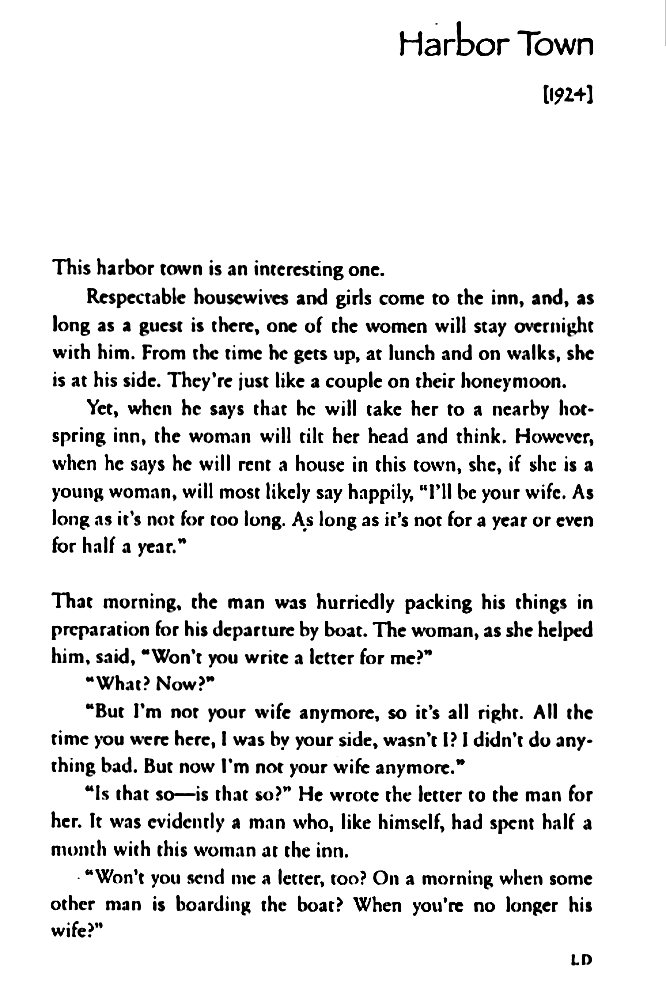
“Harbor Town” — Yasunari Kawabata
New Trailer for Hayao Miyazaki’s Forthcoming Film, The Wind Rises
This one’s a lot more substantive than the teaser that came out earlier this year.

