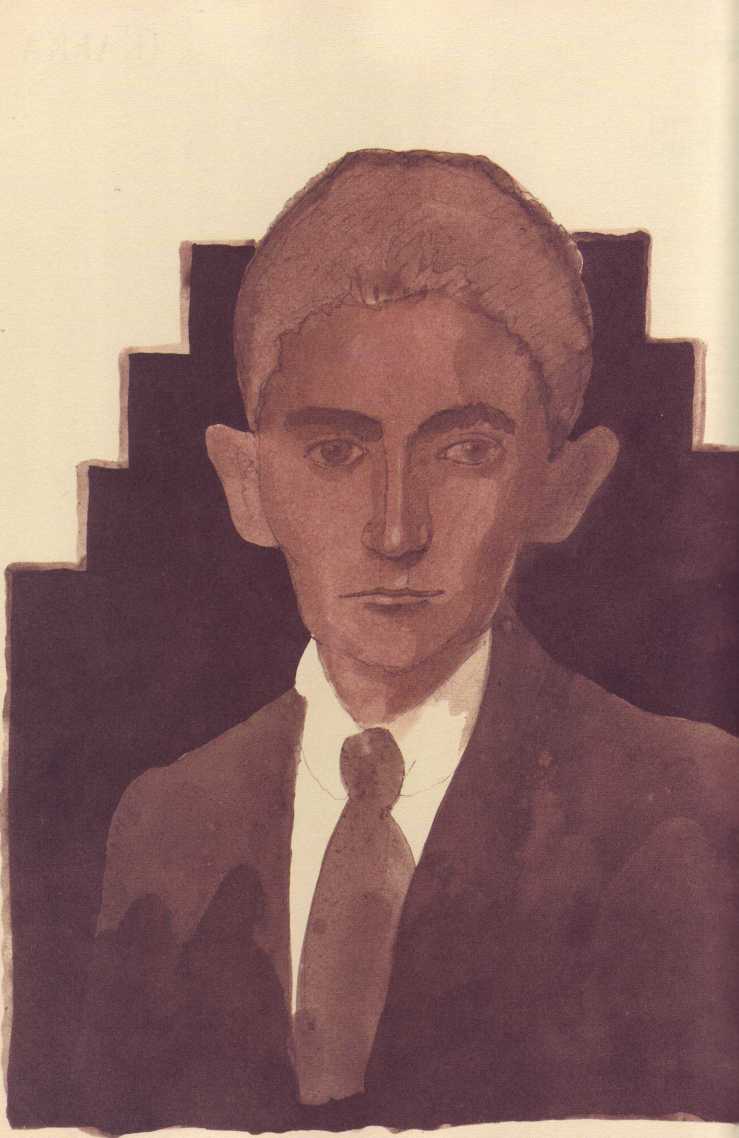
I am looking, as I write of Kafka, at the photograph taken of him at the age of forty (my age)—it is 1924, as sweet and hopeful a year as he may ever have known as a man, and the year of his death.His face is sharp and skeletal, a burrower’s face:pronounced cheekbones made even more conspicuous by the absence of sideburns; the ears shaped and angled on his head like angel wings; an intense, creaturely gaze of startled composure—enormous fears, enormous control; a black towel of Levantine hair pulled close around the skull the only sensuous feature; there is a familiar Jewish flare in the bridge of the nose, the nose itself is long and weighted slightly at the tip—the nose of half the Jewish boys who were my friends in high school.Skulls chiseled like this one were shoveled by the thousands from the ovens; had he lived, his would have been among them, along with the skulls of his three younger sisters.
Of course, it is no more horrifying to think of Franz Kafka in Auschwitz than to think of anyone in Auschwitz—it is just horrifying in its own way.But he died too soon for the holocaust.Had he lived, perhaps he would have escaped with his good friend Max Brod, who found refuge in Palestine, a citizen of Israel until his death there in 1968.But Kafka escaping?It seems unlikely for one so fascinated by entrapment and careers that culminate in anguished death.Still, there is Karl Rossmann, his American greenhorn.Having imagined Karl’s escape to America and his mixed luck here, could not Kafka have found a way to execute an escape for himself?The New School for Social Research in New York becoming his Great Nature Theatre of Oklahoma?Or perhaps, through the influence of Thomas Mann, a position in the German department at Princeton … But then, had Kafka lived, it is not at all certain that the books of his which Mann celebrated from his refuge in New Jersey would ever have been published; eventually Kafka might either have destroyed those manuscripts that he had once bid Max Brod to dispose of at his death or, at the least, continued to keep them his secret.The Jewish refugee arriving in America in 1938 would not then have been Mann’s “religious humorist” but a frail and bookish fifty-five-year-old bachelor, formerly a lawyer for a government insurance firm in Prague, retired on a pension in Berlin at the time of Hitler’s rise to power—an author, yes, but of a few eccentric stories, mostly about animals, stories no one in America had ever heard of and only a handful in Europe had read; a homeless K., but without K.’s willfulness and purpose, a homeless Karl, but without Karl’s youthful spirit and resilience; just a Jew lucky enough to have escaped with his life, in his possession a suitcase containing some clothes, some family photos, some Prague mementos, and the manuscripts, still unpublished and in pieces, of Amerika, The Trial, The Castle, and (stranger things happen) three more fragmented novels, no less remarkable than the bizarre masterworks that he keeps to himself out of oedipal timidity, perfectionist madness, and insatiable longings for solitude and spiritual purity.
–From Philip Roth’s essay “ ‘I Always Wanted You to Admire My Fasting’; or, Looking at Kafka.” Read the entire essay.