
- Carlos Castaneda
- Tom Robbins
- Paulo Coelho
- John Irving
- Tom Wolfe
- Bret Easton Ellis
- James McInerney
- Mark Leyner
- Miranda July
- Tao Lin
Author: Biblioklept
Mike Leigh Offers an Alphabetized List of Themes in His Film Life Is Sweet
Wednesday (Charles Addams)

“The Singing Lesson” — Katherine Mansfield
“The Singing Lesson” — Katherine Mansfield
With despair—cold, sharp despair—buried deep in her heart like a wicked knife, Miss Meadows, in cap and gown and carrying a little baton, trod the cold corridors that led to the music hall. Girls of all ages, rosy from the air, and bubbling over with that gleeful excitement that comes from running to school on a fine autumn morning, hurried, skipped, fluttered by; from the hollow class-rooms came a quick drumming of voices; a bell rang; a voice like a bird cried, “Muriel.” And then there came from the staircase a tremendous knock-knock-knocking. Some one had dropped her dumbbells.
The Science Mistress stopped Miss Meadows.
“Good mor-ning,” she cried, in her sweet, affected drawl. “Isn’t it cold? It might be win-ter.”
Miss Meadows, hugging the knife, stared in hatred at the Science Mistress. Everything about her was sweet, pale, like honey. You wold not have been surprised to see a bee caught in the tangles of that yellow hair.
“It is rather sharp,” said Miss Meadows, grimly.
The other smiled her sugary smile.
“You look fro-zen,” said she. Her blue eyes opened wide; there came a mocking light in them. (Had she noticed anything?)
“Oh, not quite as bad as that,” said Miss Meadows, and she gave the Science Mistress, in exchange for her smile, a quick grimace and passed on…
Forms Four, Five, and Six were assembled in the music hall. The noise was deafening. On the platform, by the piano, stood Mary Beazley, Miss Meadows’ favourite, who played accompaniments. She was turning the music stool. When she saw Miss Meadows she gave a loud, warning “Sh-sh! girls!” and Miss Meadows, her hands thrust in her sleeves, the baton under her arm, strode down the centre aisle, mounted the steps, turned sharply, seized the brass music stand, planted it in front of her, and gave two sharp taps with her baton for silence. Continue reading ““The Singing Lesson” — Katherine Mansfield”
Leontine Reading — Pierre-Auguste Renoir

Fitzcardboardaldo / The Corrugation of Dreams
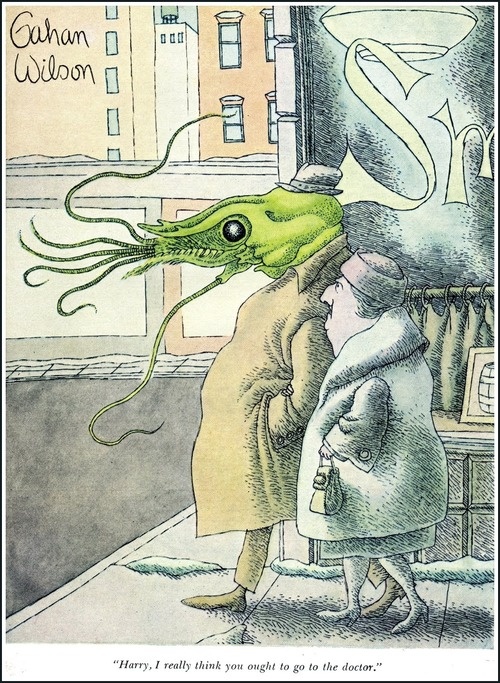
Advice (Gahan Wilson Comic)
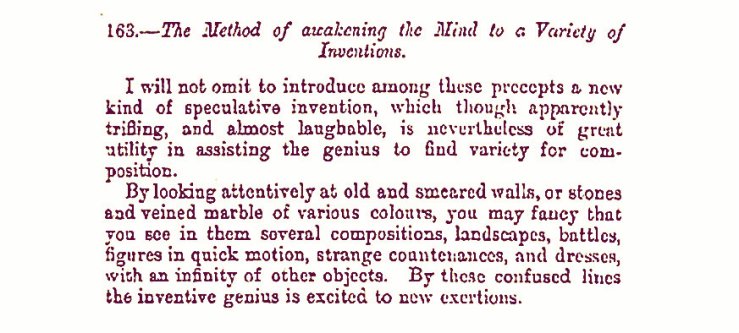
“The Method of Awakening the Mind to a Variety of Inventions” — Leonardo da Vinci
“Liar” — Royal Trux
Cat and Mouse — Huang Yongyu

“Hawthorne and His Mosses” — Herman Melville
“Hawthorne and His Mosses” by Herman Melville
A papered chamber in a fine old farm-house–a mile from any other dwelling, and dipped to the eaves in foliage–surrounded by mountains, old woods, and Indian ponds,–this, surely is the place to write of Hawthorne. Some charm is in this northern air, for love and duty seem both impelling to the task. A man of a deep and noble nature has seized me in this seclusion. His wild, witch voice rings through me; or, in softer cadences, I seem to hear it in the songs of the hill-side birds, that sing in the larch trees at my window.
Would that all excellent books were foundlings, without father or mother, that so it might be, we could glorify them, without including their ostensible authors. Nor would any true man take exception to this;–least of all, he who writes,–“When the Artist rises high enough to achieve the Beautiful, the symbol by which he makes it perceptible to mortal senses becomes of little value in his eyes, while his spirit possesses itself in the enjoyment of the reality.”
But more than this, I know not what would be the right name to put on the title-page of an excellent book, but this I feel, that the names of all fine authors are fictitious ones, far more than that of Junius,–simply standing, as they do, for the mystical, ever-eluding Spirit of all Beauty, which ubiquitously possesses men of genius. Purely imaginative as this fancy may appear, it nevertheless seems to receive some warranty from the fact, that on a personal interview no great author has ever come up to the idea of his reader. But that dust of which our bodies are composed, how can it fitly express the nobler intelligences among us? With reverence be it spoken, that not even in the case of one deemed more than man, not even in our Saviour, did his visible frame betoken anything of the augustness of the nature within. Else, how could those Jewish eyewitnesses fail to see heaven in his glance.
It is curious, how a man may travel along a country road, and yet miss the grandest, or sweetest of prospects, by reason of an intervening hedge, so like all other hedges, as in no way to hint of the wide landscape beyond. So has it been with me concerning the enchanting landscape in the soul of this Hawthorne, this most excellent Man of Mosses. His “Old Manse” has been written now four years, but I never read it till a day or two since. I had seen it in the book-stores–heard of it often–even had it recommended to me by a tasteful friend, as a rare, quiet book, perhaps too deserving of popularity to be popular. But there are so many books called “excellent,” and so much unpopular merit, that amid the thick stir of other things, the hint of my tasteful friend was disregarded; and for four years the Mosses on the Old Manse never refreshed me with their perennial green. It may be, however, that all this while, the book, like wine, was only improving in flavor and body. At any rate, it so chanced that this long procrastination eventuated in a happy result. At breakfast the other day, a mountain girl, a cousin of mine, who for the last two weeks has every morning helped me to strawberries and raspberries,–which like the roses and pearls in the fairy-tale, seemed to fall into the saucer from those strawberry-beds her cheeks,–this delightful crature, this charming Cherry says to me–“I see you spend your mornings in the hay-mow; and yesterday I found there ‘Dwight’s Travels in New England’. Now I have something far better than that,–something more congenial to our summer on these hills. Take these raspberries, and then I will give you some moss.”–“Moss!” said I–“Yes, and you must take it to the barn with you, and good-bye to ‘Dwight.'” Continue reading ““Hawthorne and His Mosses” — Herman Melville”
By the River — John Singer Sargent

BALLERS

Old Foucault Place — Glen Baxter

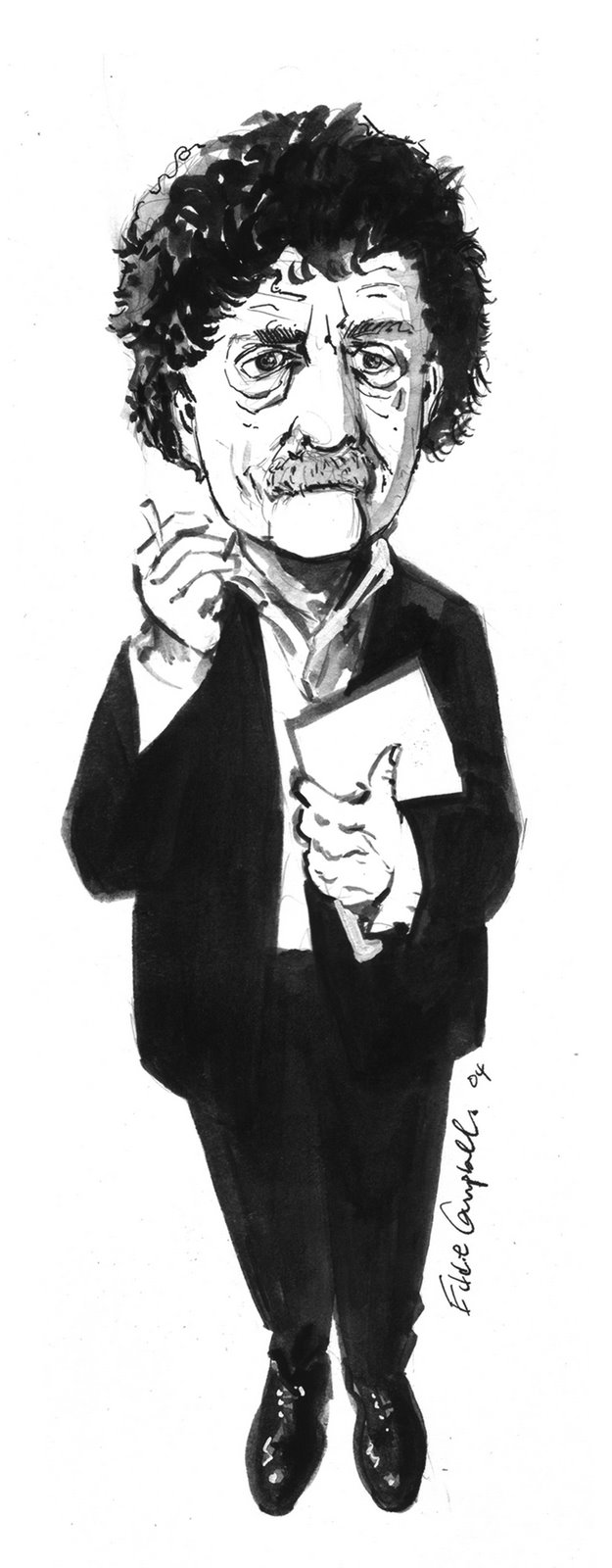
Portrait of Kurt Vonnegut — Eddie Campbell
(Via).
Watch Idem Paris, David Lynch’s Short Film About Lithography
(About/via).
Trachemys scripta elegans (Wied) — Karl Bodmer

 Biblioklept