Enormous Norm Sibum Novel (Book Acquired, 6.06.2013)

20130610-135947.jpg

A reader copy of Norm Sibum’s enormous (like, 700 page) debut novel The Traymore Rooms arrived last week. I’d normally be wary of a 700-page debut novel but Sibum, a poet, has been publishing for years, and the blurb intrigued me. Here is publisher Biblioasis’s blurb:

A place: the Traymore Rooms, downtown Montreal, an old walk-up. Those who live there and drink at the nearby café form the heart of Traymorean society. Their number includes: Eggy, red-faced, West Virginian, a veteran of Korea; Eleanor R (not Eleanor Roosevelt); Dubois, French-Canadian, optimist; Moonface, waitress-cum-Latin-scholar and sexpot inexpert; and, most recently, our hero Calhoun. A draft dodger and poetical type.

For a time all is life-as-usual: Calhoun argues with Eggy and Dubois, eats Eleanor’s cobblers, gossips of Moonface, muses on Virgil and the Current President. With the arrival of a newcomer to Traymore, however, Calhoun’s thoughts grow fixated and dark. He comes to believe in the reality of evil. This woman breaks no laws and she inflicts no physical harm—yet for the citizens of Traymore, ex-pats and philosophers all, her presence becomes a vortex that draws them closer to the America they dread.

Intelligent and frighteningly absurd, with a voice as nimble as Gass’s and satire that pierces like Wallace’s, The Traymore Rooms is a sustained howl against libertarianism under George W. Bush.

I read the first book of the first book of this book on Saturday, in a hammock—great start. Dude can write.

Here’s an excerpt of an excerpt:

Now Edward Sanders, aka Fast Eddy, hatless in winter, beetle-browed and barrel-chested, shows up in the Blue Danube, the left side of his face inflamed. He is not happy; deep-set eyes accuse. Silent, he joins us at our table. A round of greetings. He raises his hand to check our effusions. He will make the most of this moment, encased in layers of sweatshirts, nylon coat, baggy denims. His pale blue eyes flirt with woe and misery. His eyes are absolutes, so complete is his revulsion for all accidents of time and space, he claiming a sparrow flew into his mug. Well, how? He was turning a corner at the back of his duplex just as a bird endeavoured to do the same, its flight path minimizing the possibilities of attack from predators. Chicago school of physics: two solid objects cannot, at one and the same time, inhabit the same space, unless one was to speak of hand-to-hand combat or acts of passion.

Eggy, old and decrepit, snorts, octogenarian bravado and envy asserting: ‘She must’ve squeezed too hard.’ Yes, there it is, what explains Fast Eddy’s wounded pride. But his love of Moonface is pure, as the girl is a noble creature, she our waitress. Eggy’s hand begins its journey to his glass. Eventually, the glass secured, wine is consumed. And the world, like Fast Eddy, might have cause to complain of what has been seemingly inadvertent, all the world gobsmacked by phantom dominion. ‘Oh well,’ says Eggy, ‘just trying to cheer you up. Effing hell.’ The old man would sow the wild oats he had failed to sow, his Ebenezer, willie, Priapus now inert. One day, perhaps, Fast Eddy may declare to Moonface his love of her, and she grant him the justice of his argument; and she reward him with some tender ministration, her smile daffy. Fast Eddy blinks, frowns and suffers. He might have to see a doctor, his left ear shiny red, grown enormous.

I have been a Traymorean for some time. Congratulations are in order, I think. It is to say I reside in the Traymore Rooms – along with Eggy, Moonface, Dubois and Eleanor R, Mrs Petrova our live-in landlady – and they have not yet turfed me into the street. What has been more spectacular than spectacular failure, than the truths that did not quite endure, than the lies that all too often succeeded? In any case, snow is falling. It settles on fur hats and tuques and caps. Wind drives it against scarved shoulders. I observe what, beyond the cold café window, has all the attributes of a dream: the afternoon commute, its sounds muffled

Borges Takes a Leak

duende6

(About).

List with No Name #30

  1. The Wizard of Oz
  2. Howl’s Moving Castle
  3. Wild at Heart
  4. Zardoz
  5. Return to Oz
  6. Oz the Great and Powerful
  7. The Wiz

Prehistoric Women — James Tissot

“Old Red” by Caroline Gordon

“Old Red” by Caroline Gordon

I

WHEN THE DOOR HAD closed behind his daughter, Mr. Maury went to the window and stood a few moments looking out. The roses that had grown in a riot all along that side of the fence had died or been cleared away, but the sun lay across the garden in the same level lances of light that the remembered. He turned back into the room. The shadows had gathered until it was nearly all in gloom. The top of his minnow bucket just emerging from his duffel bag glinted in the last rays of the sun. He stood looking down at his traps all gathered neatly in a heap at the foot of the bed. He would leave them like that. Even if they came in here sweeping and cleaning up — it was only in hotels that a man was master of his own room — even if they came in here cleaning up he would tell them to leave all his things exactly as they were. It was reassuring to see them all there together, ready to be taken up in the hand to be carried down and put into a car, to be driven off to some railroad station at a moment’s notice.

As he moved toward the door he spoke aloud, a habit that was growing on him:

“Anyhow I won’t stay but a week…. I ain’t going to stay but a week, no matter what they say….”

Downstairs in the dining room they were already gathered at the supper table: his white-haired, shrunken mother in-law; his tall sister-in-law who had the proud carriage of the head, the aquiline nose, but not the spirit of his dead wife; his lean, blond, new son-in-law; his black eyed daughter who, but that she was thin, looked so much like him, all of them gathered there waiting for him, Alexander Maury. It occurred to him that this was the first time he had sat down in the bosom of the family for some years. They were always writing saying that he must make a visit this summer or certainly next summer — “. . . all had a happy Christmas together, but missed you….” They had even made the pretext that he ought to come up to inspect his new son-in-law. As if he hadn’t always known exactly the kind of young man Sarah would marry! What was the boy’s name? Stephen, yes, Stephen. He must be sure and remember that.

He sat down and, shaking out his napkin, spread it over his capacious paunch and tucked it well up under his chin in the way his wife had never allowed him to do. He let his eyes rove over the table and released a long sigh.

“Hot batter bread,” he said, “and ham. Merry Point ham. I sure am glad to taste them one more time before I die.”

The old lady was sending the little Negro girl scurrying back to the kitchen for a hot plate of batter bread. He pushed aside the cold plate and waited. She had bundled when he spoke of the batter bread and a faint flush had dawned on her withered cheeks. Vain she had always been as a peacock, of her housekeeping, her children, anything that belonged to her. She went on now, even at her advanced age, making her batter bread, smoking her hams according to that old recipe she was so proud of, but who came here now to this old house to eat or to praise?

He helped himself to a generous slice of batter bread, buttered it, took the first mouthful and chewed it slowly. He shook his head.

“There ain’t anything like it,” he said. “There ain’t anything else like it in the world. ”

His dark eye roving over the table fell on his son-in-law. “You like batter bread?” he inquired. Continue reading ““Old Red” by Caroline Gordon” →

Reader on a Black Background — Henri Matisse

The Company of Wolves (Full Film)

Untitled No. 49 — William Fisk

william77

(More photorealistic oil paintings at the artist’s site).

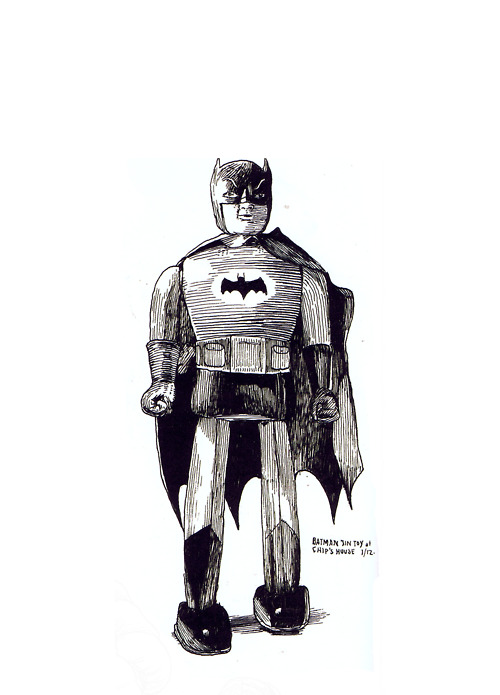
Batman Toy — Chris Ware

tumblr_m1yuf5luq61qa0q13o1_500(Via).

Untitled — Zdzisław Beksiński

“Was” by William Faulkner

“Was” by William Faulkner

Isaac McCaslin, ‘Uncle Ike’, past seventy and nearer eighty than he ever corroborated any more, a widower now and uncle to half a county and father to no one

this was not something participated in or even seen by himself, but by his elder cousin, McCaslin Edmonds, grandson of Isaac’s father’s sister and so descended by the distaff, yet notwithstanding the inheritor, and in his time the bequestor, of that which some had thought then and some still thought should have been Isaac’s, since his was the name in which the title to the land had first been granted from the Indian patent and which some of the descendants of his father’s slaves still bore in the land. But Isaac was not one of these:-a widower these twenty years, who in all his life had owned but one object more than he could wear and carry in his pockets and his hands at one time, and this was the narrow iron cot and the stained lean mattress which he used camping in the woods for deer and bear or for fishing or simply because he loved the woods; who owned no property and never desired te since the earth was no man’s but all men’s, as light and air and weather were; who lived still in the cheap frame bungalow in Jefferson which his wife’s father gave them on their marriage and which his wife had willed to him at her death and which he had pretended to accept, acquiesce to, to humor her, ease her going but which was not his, will or not, chancery dying wishes mortmain possession or whatever, himself merely holding it for his wife’s sister and her children who had lived in it with him since his wife’s death, holding himself welcome to live in one room of it as he had during his wife’s time or she during her time or the sister-in-law and her children during the rest of his and after not something he had participated in or even remembered except from the hearing, the listening, come to him through and from his cousin McCaslin born in 1850 and sixteen years his senior and hence, his own father being near seventy when Isaac, an only child, was born. rather his brother than cousin and rather his father than either, out of the old time, the old days.

When he and Uncle Buck ran back to the house from discovering that Tomey’s Turl had run again, they heard Uncle Buddy cursing and bellowing in the kitchen, then the fox and the dogs came out of the kitchen and crossed the hall into the dogs’ room and they heard them run through the dogs’ room into his and Uncle Buck’s room then they saw them cross the hall again into Uncle Buddy’s room and heard them run through Uncle Buddy’s room into the kitchen. Where Uncle Buddy was picking the breakfast up out of the ashes and wiping it off with his apron. “What in damn’s hell do you mean,” he said “turning that damn fox out with the dogs all loose in the house?”

“Damn the fox” Uncle Buck said. “Tomey’s Turl has broke out again. Give me and Cass some breakfast quick we might just barely catch him before he gets there.” Continue reading ““Was” by William Faulkner” →

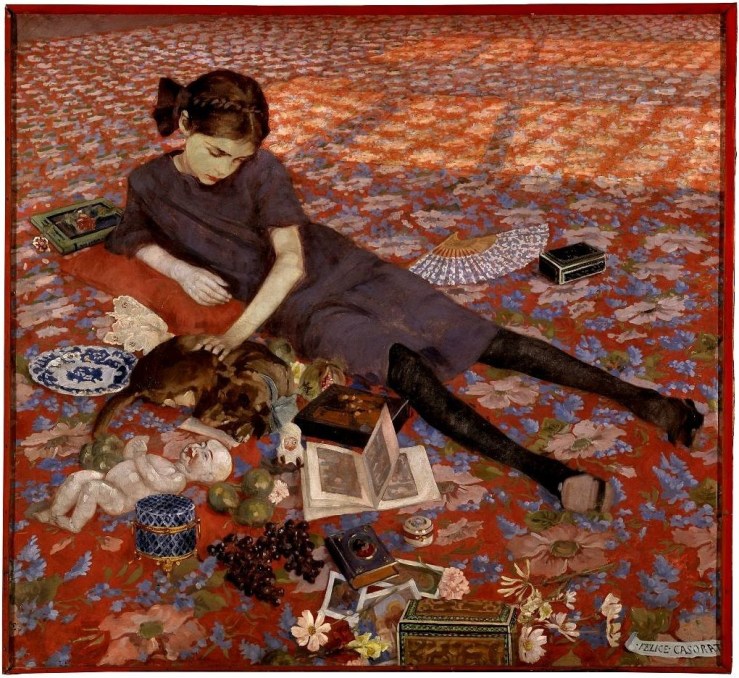
Girl On a Red Carpet — Felice Casorati

girl

Beach House, Live at the Interface in 2010

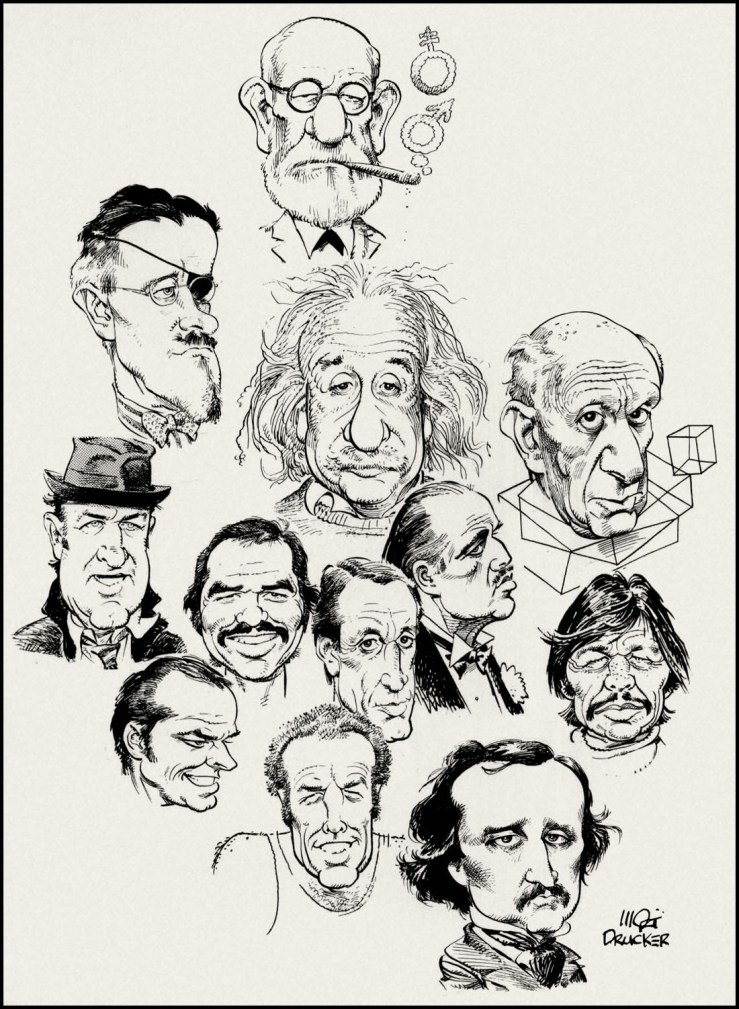
Mort Drucker Portraits of Freud, Joyce, Poe, Einstein, Charles Bronson, Etc.

mort drucker

Interrogation II — Leon Golub

golub

“Recording the humiliation with a camera, with the perpetrators, a stupid grin on their faces, included in the picture, side by side with the twisted naked bodies of their prisoners, is an integral part of the process…The very positions and costumes of the prisoners suggest a theatrical staging, a kind of tableau vivant, which cannot but bring to mind the whole spectrum of American performance art and ‘theatre of cruelty’ the photos of Mapplethorpe, the weird scenes in David Lynch, to name but two” — Slavoj Žižek on Abu Ghraib (Violence)

A Ballad of the Captains — Harry Clarke

0068 The Year's At The Spring - Harry Clarke - A Ballad of the Captains 2

(Via/more).

“Science and Philosophy” — William Carlos Williams

1

            2

“Science and Philosophy” by William Carlos Williams is collected in The Embodiment of Knowledge (New Directions).