Goya’s Witch/Clergy Axis (Robert Hughes)

In a disguised way, Goya in the Caprichos drew a parallel between witchcraft and the activities of the clergy. He stressed the resemblance between witches and friars in their obedience to the hierarchy of their calling, the younger deferring to the older. In plate 47, Obsequio al maestro (“Homage to the master”), an apparently senior witch looks down with stony disdain at another, who ois offering her (or him) the gift of a dead baby; the supplicant’s gesture reminds one of a groveling postulant kissing the cardinal’s ring. “Es muy justo,” runs the Prado text: “This is quite fair, they would be ungrateful disciples who failed to visit their professor, to whom they owe everything they know about their diabolical faculties.”

Plate 46, Correccion (“Correction”), shows a group of brujos, male witches, as seminarians, consulting “the great witch who runs the Barahona seminary” — whatever that institution may have been. Of course, Goya could not be too explicit about this: on the other side of any public criticism of clerical practices lay the ever-watchful eye of the Inquisition, which Goya had to be at pains to avoid.

—From Robert Hughes’s biography Goya.
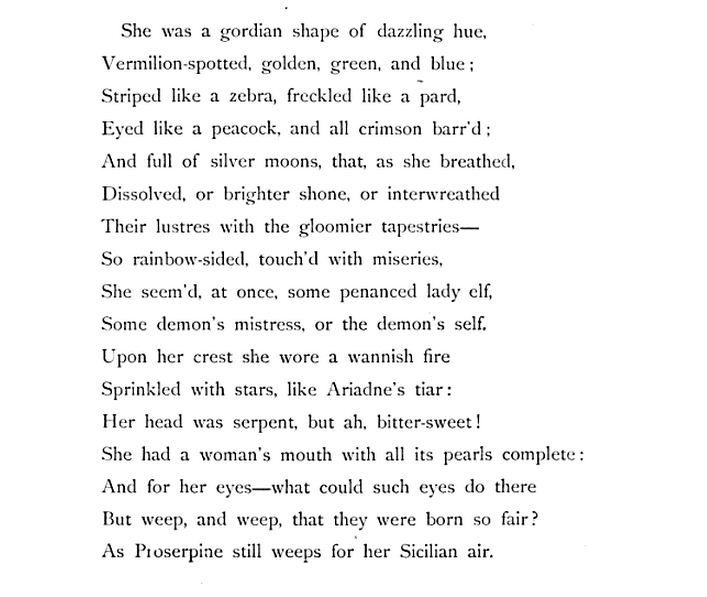
“A Gordian Shape of Dazzling Hue” (Keats’s Lamia)

(Read the entirety of John Keats’s supernatural long poem Lamia as a free illustrated ebook).

Portrait of Madame Ginoux (L’Arlesienne) — Vincent van Gogh

Eraserhead — David Lynch

Witches in the Air — Francisco Goya

“Manifest Destiny” — Kate Beaton Does Robinson Crusoe

(More/via).

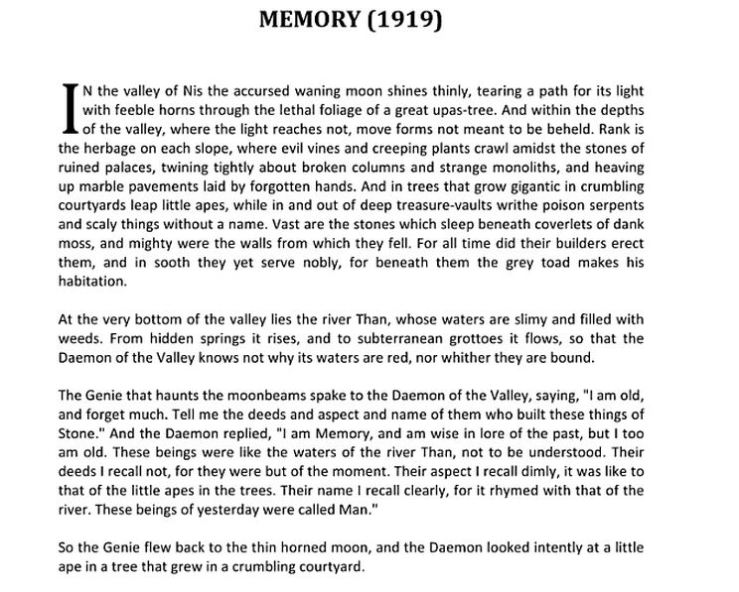
“Memory” — H.P. Lovecraft

A Young Girl Reading — Jean-Honore Fragonard

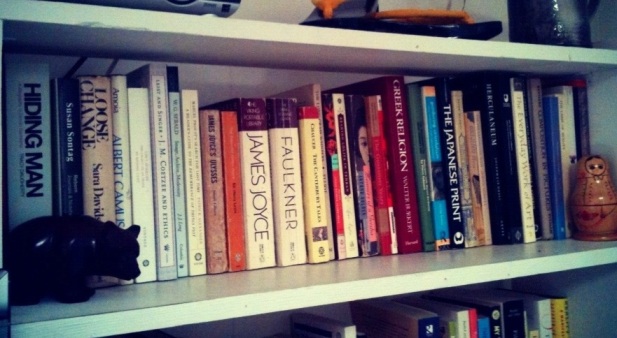
Book Shelves #43, 10.21.2012

20121021-104711.jpg

Book shelves series #43, forty-third Sunday of 2012

Kind of a hodgepodge shelf—some literary biography, a few now-redundant collections, some literary criticism, art books, etc.

Tracy Daugherty’s Donald Barthelme biography Hiding Man is on the far left; I reviewed it a few years ago, taking note of my favorite part, the so-called postmodernists’ dinner.

Next to it is Susan Sontag’s Reborn, a collection of early journals that I also reviewed.

Next to these two is Sara Davidson’s Loose Change. My aunt gave me a box of books years ago (lots of Asimov and Octavia Butler) and this was in here.

I knew about it because of a long essay in a 2007 issue of The Believer.

20121021-104718.jpg

I picked up Penguin’s The Essential James Joyce in Jimbocho, an area in Tokyo known for used bookstores.

I recall paying maybe ¥100 for it. It comprises a few selections from Ulysses and Finnegans Wake, some of  Joyce’s (totally unessential) poetry, and the entirety of Dubliners, Exiles, and Portrait. I’ve kept it because of sentiment (and  I like the cover).

20121021-104725.jpg

The Laughing Demon — Katsushika Hokusai

Totoro Jack O’ Lantern Stencil

Do you still need an idea for a jack o’ lantern? Are you a fan of Hayao Miyazaki films? Even the really sweet and gentle ones, like Ponyo and My Neighbor Totoro? And, are you, like, totally skilled at carving pumpkins? If so, have at it with this cool stencil by Flickr user PlayWithFire:

You can see variations on Totoro jack o’ lanterns–and other cool Miyazaki-inspired pumpkins here. From that set, here’s Flickr user C. Lambert’s Totoro pumpkin–

“Robinson Crusoe” — Kafka

“Robinson Crusoe” by Franz Kafka:

Had Robinson Crusoe never left the highest, or more correctly the most visible point of his island, from desire for comfort, or timidity, or fear, or ignorance, or longing, he would soon have perished; but since without paying any attention to passing ships and their feeble telescopes he started to explore the whole island and take pleasure in it, he managed to keep himself alive and finally was found after all, by a chain of causality that was, of course, logically inevitable.


Reading a Book — James Tissot

Sonic Youth Live in ’87

Muddy Alligators — John Singer Sargent

Reading-as-Nature or Nature-as-Reading (From Thomas Berhnhard’s Correction)

We couldn’t endure a life in nature, necessarily always a free nature, without respite, so we always step outside nature, for no reason but survival, and take refuge in our reading, and live for a long time in our books, a more undisturbed life. I’ve lived half my life not in nature but in my books as a nature-substitute, and the one half was made possible only by the other half. Or else we exist in both simultaneously, in nature and in reading-as-nature, in this extreme nervous tension which as a form of consciousness is endurable only for the shortest possible time span. The question can’t be whether I live in nature as nature, or in reading-as-nature, or in nature-as-reading, in the nature of nature-as-reading andsoforth, so Roithamer. To everything that we think and fill our own life and that we hear and see, perceive, we always have to add: the truth, however, is … as a result, uncertainty has become a chronic condition with us. Those abrupt transitions from one nature into the other, from one form of awareness into the other, so Roithamer. When we think, we know nothing, everything is open, nothing, so Roithamer.

From Thomas Bernhard’s novel Correction.


Devil — Jan Matejko