Nurse Reading to a Little Girl — Mary Cassatt

Collision — Wojciech Siudmak

Little Nemo: Adventures in Slumberland (Full Film)

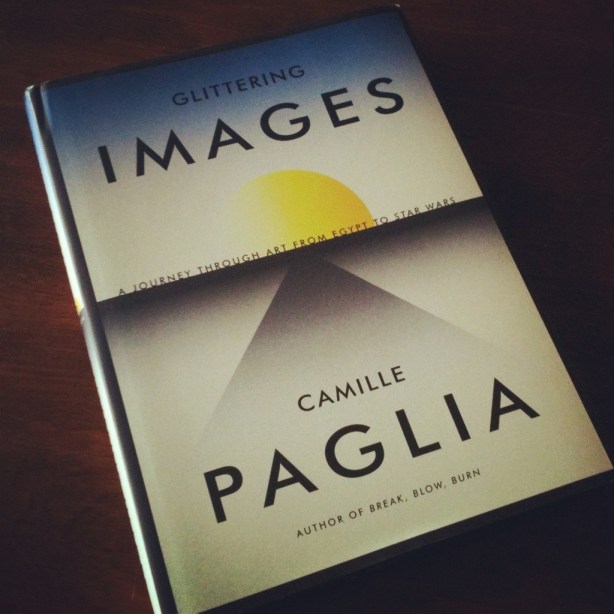
Camille Paglia’s Glittering Images (Book Acquired, 10.02.2012)

20121009-161046.jpg

Camille Paglia’s latest is a gorgeous, glossy, oversized collection of essays on imagery and art. I haven’t read it in full yet, but Paglia considers an image or series of images (reproduced in full, of course), and then considers the image in a loose, riffing essay of a few short pages. She does this for almost thirty images, but I was immediately drawn to her final essay, a glowing adoration of George Lucas’s Revenge of the Sith. She had me at that moment—I’m a passionate defender of Sith, a film that navigates the tension between democracy and egotism. 

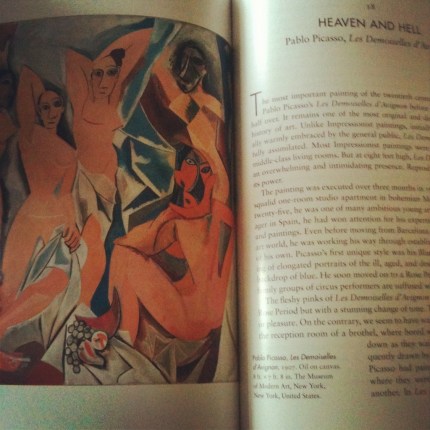
Anyway, full review to come. Here’s a lousy pic of the interior (glossy pages = glare).
20121009-161056.jpg

Publisher Pantheon’s blurb:

From the best-selling author of Sexual Personae and Break, Blow, Burn and one of our most acclaimed cultural critics, here is an enthralling journey through Western art’s defining moments, from the ancient Egyptian tomb of Queen Nefertari to George Lucas’s volcano planet duel in Revenge of the Sith.

America’s premier intellectual provocateur returns to the subject that brought her fame, the great themes of Western art. Passionately argued, brilliantly written, and filled with Paglia’s trademark audacity, Glittering Images takes us on a tour through more than two dozen seminal images, some famous and some obscure or unknown—paintings, sculptures, architectural styles, performance pieces, and digital art that have defined and transformed our visual world. She combines close analysis with background information that situates each artist and image within its historical context—from the stone idols of the Cyclades to an elegant French rococo interior to Jackson Pollock’s abstract Green Silver to Renée Cox’s daring performance piece Chillin’ with Liberty. And in a stunning conclusion, she declares that the avant-garde tradition is dead and that digital pioneer George Lucas is the world’s greatest living artist. Written with energy, erudition, and wit, Glittering Images is destined to change the way we think about our high-tech visual environment.

William H. Gass on Robert Walser: “His Is the Perfect Stroller’s Psychology”

William H. Gass on Robert Walser. From Gass’s introduction to Masquerade and Other Stories; also collected in Gass’s Finding a Form.

Mo Yan Wins the 2012 Nobel Prize in Literature

https://i0.wp.com/www.granta.com/dyn/1334837960936.jpegChinese author Mo Yan has won the 2012 Nobel Prize in Literature, who, according to the committee, “with hallucinatory realism merges folk tales, history and the contemporary.”
From Nobel’s biography:

“As a twelve-year-old during the Cultural Revolution he left school to work, first in agriculture, later in a factory. In 1976 he joined the People’s Liberation Army and during this time began to study literature and write. His first short story was published in a literary journal in 1981. His breakthrough came a few years later with the novella Touming de hong luobo (1986, published in French as Le radis de cristal1993).”

You can read an interview with Mo Yan at Granta.
Here’s a Time profile of the author.
And another profile at China Through a Lens.

The Pinch of Snuff — Marc Chagall

Diogenes — Jean-Leon Gerome

Watership Down (Full Film)

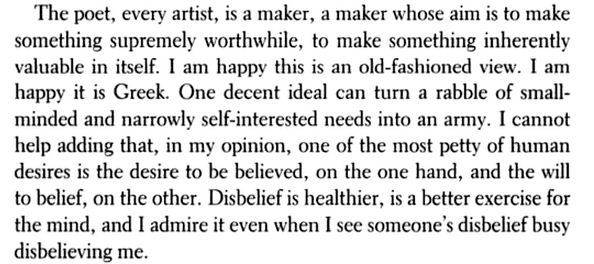
William H. Gass: The Poet Is a Maker

–from William H. Gass’s essay “Finding a Form.”

List with No Name #11

  1.  The Sailor Who Fell From Grace With the Sea
  2. The Big Sleep
  3. The Way of All Flesh
  4. Woodcutters
  5. The Melancholy of Resistance
  6. Aurelia and Other Writings
  7. The Hearing Trumpet
  8. The Invention of Morel
  9. The Narrow Road to the Deep North and Other Travel Sketches
  10. Today I Wrote Nothing
  11. The Red and the Black

Cézanne: A Life (Book Acquired, 10.09.2012)


20121009-155918.jpg

I was pleasantly surprised yesterday to find a big ole biography of Paul Cézanne on my doorstep. I probably won’t get to Alex Danchev’s Cézanne: A Life anytime soon (at least not until I finish Robert Hughes’s Goya bio), but it looks like a pretty solid read—with lovely glossy pictures to boot:

20121009-155926.jpg

In the meantime, check out Evan McMurry’s full, in depth review at Bookslut.

Or, if you’re too busy, here’s the Kirkus write up in full:

A formidable biography of the Father of Modern Art bound for the annals of academia.

Danchev . . .  has researched every facet and nuance of Paul Cézanne’s life (1839–1906). His comfortable childhood in Provence, his years in Paris, where he was influenced by the Impressionists, and his dependence on the allowance from his father created the artist some suggested was “not all there.” There is a wealth of information in the correspondence between the artist and his childhood friend, Émile Zola, in which they parodied Virgil, joked in Latin and discussed Stendhal. Zola knew that Cézanne’s art was a corner of nature seen through his own curious temmpérammennte. The artist didn’t paint things; he painted the effect they had on him. He saw colors as he read a book or looked at a person, understood the inner life of an object and let his brain rework that object, sometimes illuminating it, sometimes distorting it. Danchev rightly subscribes to the theory that understanding the man is important to understanding his work, and he attempts to parse Cézanne’s psyche, digging into the background of nearly every author he discussed in his letters, quoting every writer who based a character on the man. Cézanne’s work will influence artists and confuse patrons for decades to come, especially those who have the patience to study Danchev’s comprehensive, occasionally ponderous tome.

A fairly impressive achievement of a Sisyphean task—definitely a book to keep in your library.


First Page of an Early Draft of Blood Meridian


Nice article at Slate on Cormac McCarthy’s Blood Meridian, touching on how “all the way to galley proof in 1984, McCarthy whittled Blood Meridian down into the lean nightmare we now know. He cut whole characters and became more and more sparing of his description of the ones that remained. This was nowhere more pronounced than with the character of the kid, the nameless ruffian and pseudo-protagonist of the tale.” Good stuff. (Thanks to Garrett for alerting me to it).


William Burroughs on Sex, Computers, Mutation

From William S. Burroughs’s 1972 interview with Penthouse magazine.

Perrault — Gustave Dore

Saint George Fighting the Dragon (Perseus Delivering Andromeda) — Eugene Delacroix

Wizards, Ralph Bakshi’s Goofy Post-Apocalyptic Tale of the Struggle for World Supremacy Fought Between the Powers of Technology and Magic (Full Film)