Hawthorne and Thoreau Dine Together Then Take a Stroll

From Nathaniel Hawthorne’s journal (via):

September 1, 1842. Mr. Thoreau dined with us yesterday…. He is a keen and delicate observer of nature–a genuine observer–which, I suspect, is almost as rare a character as even an original poet; and Nature, in return for his love, seems to adopt him as her especial child, and shows him secrets which few others are allowed to witness. He is familiar with beast, fish, fowl, and reptile, and has strange stories to tell of adventures, and friendly passages with these lower brethren of mortality. Herb and flower, likewise, wherever they grow, whether in garden or wildwood, are his familiar friends. He is also on intimate terms with the clouds, and can tell the portents of storms. It is a characteristic trait that he has a great regard for the memory of the Indian tribes, whose wild life would have suited him so well; and strange to say, he seldom walks over a ploughed field without picking up an arrow-point, a spearhead, or other relic of the red men–as if their spirits willed him to be the inheritor of their simple wealth.

With all this he has more than a tincture of literature,–a deep and true taste for poetry, especially for the elder poets, and he is a good writer,–at least he has written a good article, a rambling disquisition on Natural History, in the last Dial, which, he says, was chiefly made up from journals of his own observations. Methinks this article gives a very fair image of his mind and character,–so true, innate, and literal in observation, yet giving the spirit as well as letter of what he sees, even as a lake reflects its wooded banks, showing every leaf, yet giving the wild beauty of the whole scene. Then there are in the article passages of cloudy and dreamy metaphysics, and also passages where his thoughts seem to measure and attune themselves into spontaneus verse, as they rightfully may, since there is real poetry in them. There is a basis of good sense and of moral truth, too, throughout the article, which also is a reflection of his character; for he is not unwise to think and feel, and I find him a healthy and wholesome man to know.

After dinner (at which we cut the first watermelon and muskmelon that our garden has ripened) Mr. Thoreau and I walked up the bank of the river; and, at a certain point, he shouted for his boat. Forthwith, a young man paddled it across the river, and Mr. Thoreau and I voyaged farther up the stream, which soon became more beautiful than any picture, with its dark and quiet sheet of water, half shaded, half sunny, between high and wooded banks. The late rains have swollen the stream so much that many trees are standing up to their knees, as it were, in the water, and boughs, which lately swung high in air, now dip and drink deep of the passing wave. As to the poor cardinals which glowed upon the bank a few days since, I could see only a few of their scarlet hats, peeping above the tide. Mr. Thoreau managed the boat so perfectly, either with two paddles or with one, that it seemed instinct with his own will, and to require no physical effort to guide it. He said that, when some Indians visited Concord a few years since, he found that he had acquired, without a teacher, their precise method of propelling and steering a canoe. Nevertheless he was desirous of selling the boat of which he is so fit a pilot, and which was built by his own hands; so I agreed to take it, and accordingly became possessor of the Musketaquid. I wish I could acquire the aquatic skill of the original owner.

from American Notebooks (1835-42)

Carousel-Animal Opera — Joseph Cornell

Girl in Bed — John Currin

“Readers’ Bad Manners” — Nietzsche

Friedrich Nietzsche. From Mixed Opinions and Maxims:

(130) Reader’s bad manners. —A reader is doubly guilty of bad manners against the author when he praises his second book at the expense of the first (or vice versa) and then asks the author to be grateful for that.


Read “Labyrinth,” an Excerpt from Roberto Bolaño’s Forthcoming Work, The Secret of Evil

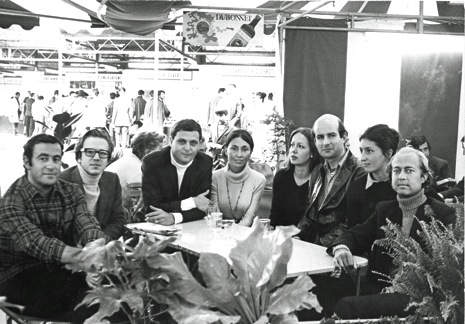
The New Yorker has published an excerpt from The Secret of Evil, the latest posthumous offering from Roberto Bolaño (new this spring from New Directions). The excerpt begins by extrapolating on a photo of some of the Tel Quel folks, (including a striking Julia Kristeva):

They’re seated. They’re looking at the camera. They are captioned, from left to right: J. Henric, J.-J. Goux, Ph. Sollers, J. Kristeva, M.-Th. Réveillé, P. Guyotat, C. Devade, and M. Devade.

There’s no photo credit.

They’re sitting around a table. It’s an ordinary table, made of wood, perhaps, or plastic, it could even be a marble table on metal legs, but nothing could be less germane to my purpose than to give an exhaustive description of it. The table is a table that is large enough to seat the above-mentioned individuals and it’s in a café. Or appears to be. Let’s suppose, for the moment, that it’s in a café.

The eight people who appear in the photo, who are posing for the photo, are fanned out around one side of the table in a crescent or a kind of opened-out horseshoe, so that each of them can be seen clearly and completely. In other words, no one is facing away from the camera. In front of them, or rather between them and the photographer (and this is slightly strange), there are three plants—a rhododendron, a ficus, and an everlasting—rising from a planter, which may serve, but this is speculation, as a barrier between two distinct sections of the café.

Read more.

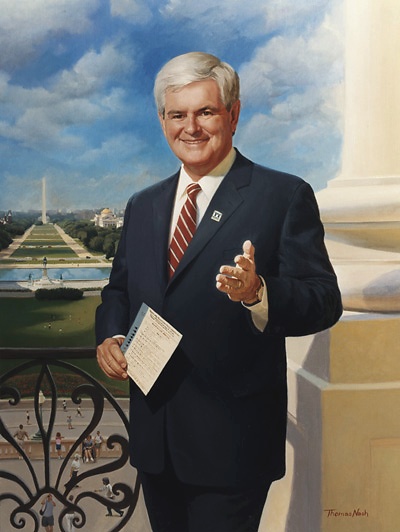
Newt Gingrich (And Other Portraits of Old, Rich White Men) by Thomas V. Nash

I recently saw this portrait of current Republican nomination candidate/constant font of regressive ideas Newt Gingrich on an image board I frequent. It’s by Georgia-based portrait artist Thomas Nash, whose website I had to visit after seeing this picture.

For some reason I can’t quite articulate, Nash’s portraits are surreal to me. I don’t think it’s purposeful, of course—he’s clearly a technically competent artist whose oil paintings are meant to confer a sense of power twinned in benevolence.

It must be my own sense of history, of power, of irony, that makes me feel thoroughly creeped out by this portrait of Newt—the manically glib glint in his eye (his left eyebrow ever-so slightly arched in cocky condescension), the sinister light that seems to emanate from his upraised, extended left hand, the mysterious document casually clutched in his right, the phallic authority of the Washington Monument jutting out from the Mall in the background as tiny tourists mill about, one even pausing to aim his camera from behind the scroll work at the viewer . . .

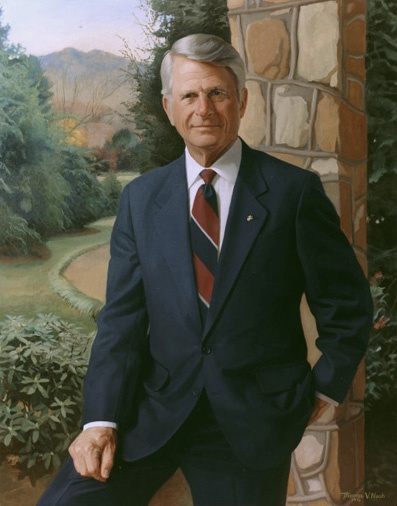
It’s odd, malevolent, and engrossing, but when paired against the other portraits in Nash’s collection of “Men,” like former Democratic Senator (and George W. Bush supporter) Zell Miller, it seems even more sinister and ironic to me, as if some evil scream lurked in the background, suppressed, detained, a black hood over its metaphorical head:

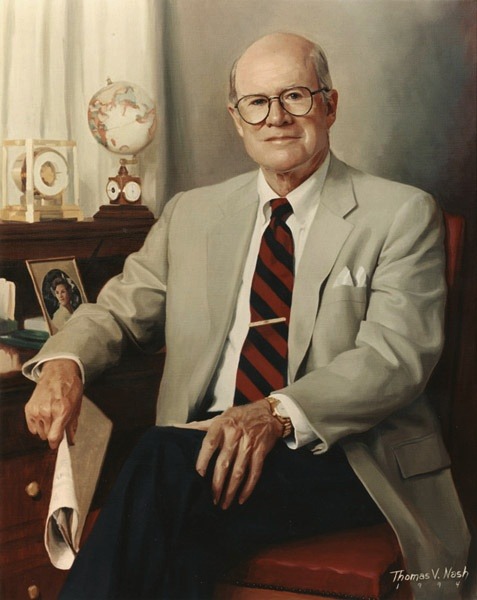
Or these guys:

In some sense, these paintings strike me as the strange dry twins of the work of sensualist John Currin, a subjective claim that is perhaps unsupportable but nevertheless seems true to me.

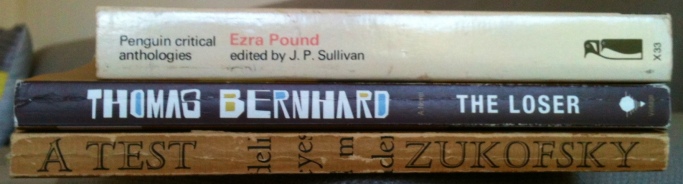
Books Acquired, 1.13.2012 (Ezra Pound, Thomas Bernhard, Louis Zukofsky)

20120115-163012.jpg

Picked up these three last Friday.

20120115-163023.jpg

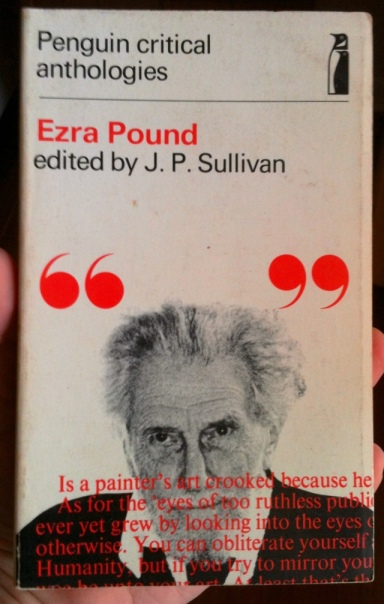
This is a collection of letters to and from Ezra Pound, as well as criticism, introductions, etc. I like the cover, which is a bit too busy.

20120115-163044.jpg

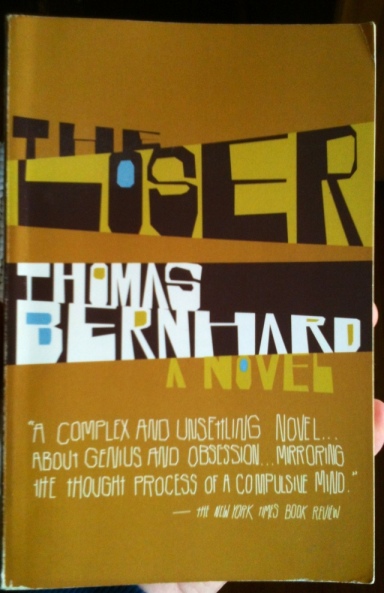
I picked up Thomas Bernhard’s Correction last year on reader recommendation (recommendation: read Bernhard). Saw The Loser in the shop used, so I picked it up. Any recommendation on which one to start with?

20120115-163114.jpg

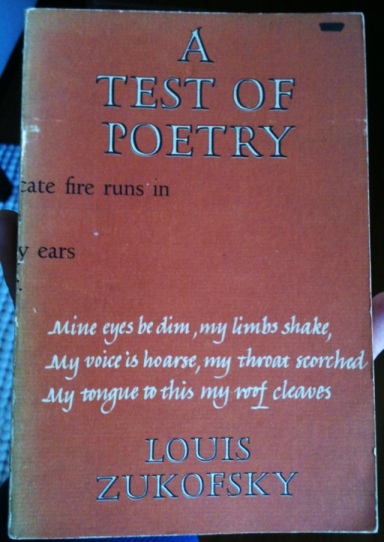
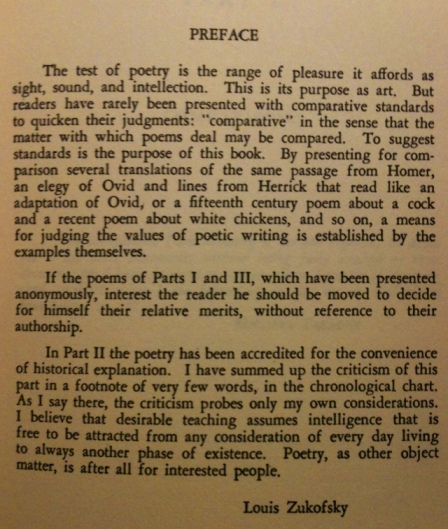
A midcentury paperback of Louis Zukofsky’s A Test of Poetry. This is a strange book. I’d better let Zukofsky explain it:

20120116-175731.jpg

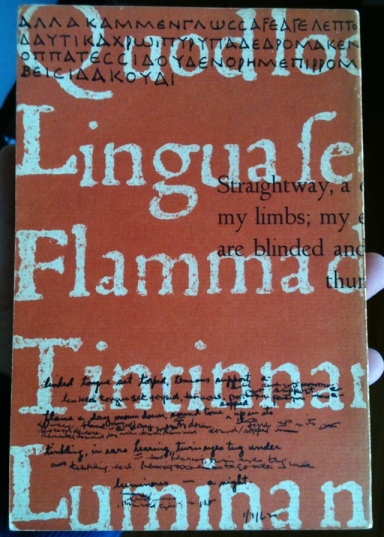
The back cover is lovely as well:

20120115-163132.jpg

Check Out Movie Critic Armond White’s 2011 Better-Than-List

Critic/contrarian Armond White’s 2011 Better-Than-List uses one movie to beat up on another. It’s grand reading—read it in full! A few choice snips:

Duchamp Is Our Misfortune — Art Spiegelman


20120116-110047.jpg

Book Shelves #3, 1.15.2012

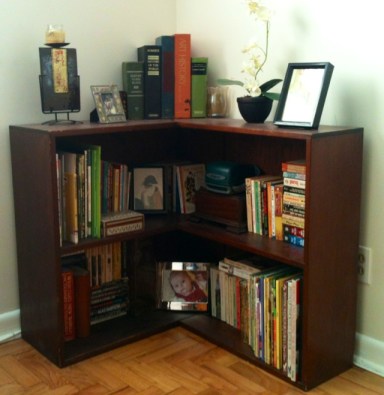
Book shelves series #3, third Sunday of 2012: In which we revisit the master bedroom corner piece bookshelf in the southwest corner; two tiers + top shelf.

So, in last week’s engrossing installment our hero photographed and discussed some of the books in this bookshelf:

20120115-103251.jpg

The post optimistically concluded: “So we’ve made it out of my bedroom” — but not so, dear reader, as post-Christmas/New Year cleaning up type activities led to a box of books, still in a storage room in the back of my house, needing to finally be shelved or ejected from the house. Said box:

20120115-103300.jpg

Most of the volumes herein are aesthetically-challenged/of a certain sentimental value: lots of books from my youth and the youth of my wife; lots of books that taught me how to read, books that weirded me out, books that I hope my kids will want to read in a few years. The corner piece bookshelf had the most (only, really) free space for shelving; it’s also tucked away from public view where an eyesore like my crumbling copy of Vonnegut’s Cat’s Cradle won’t sore eyes:

20120115-103312.jpg

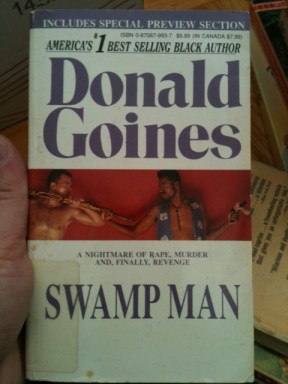
I actually read Goines’s Swamp Man. It’s not the Deliverance knock off you might expect, although it is singularly horrific.

20120115-103322.jpg

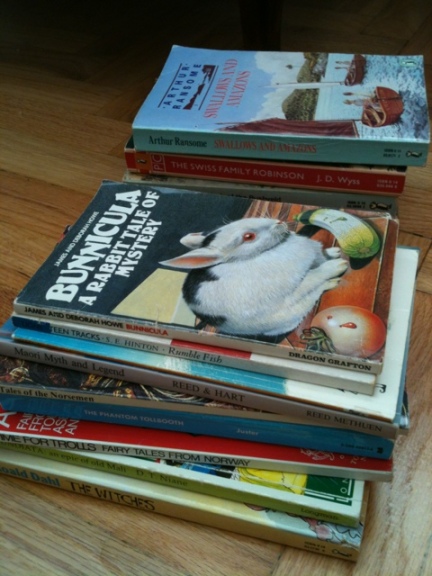
Some beloved childhood classics. Arthur Ransome, S.E. Hinton, various myths and legends, Roald Dahl, etc.:

20120115-103331.jpg

Two books I hated. Hated. I keep them as badges of a strange honor, a sort of “I did it, okay?”:

20120115-103343.jpg

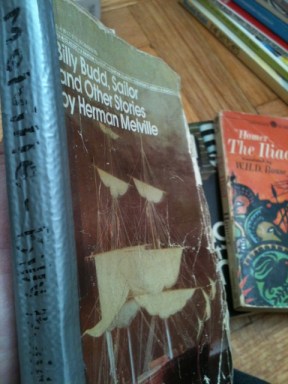
Melville stories held together with duct tape. This was the copy my 11th grade teacher assigned; I stole it of course. I used it in numerous subsequent courses and the annotations I made are somehow (unduly) precious to me. I can’t part with it even though I have at least two other volumes of Melville stories;

20120115-103358.jpg

Never sure where to shelve this RAW volume:

20120115-103428.jpg

Not sure if you can make out the title of this one, but it’s Alcoholic Anonymous’s Big Book. I found it on the beach one night when I was maybe 17 or 18. It’s full of highlighted passages and annotations and I’ve always been intrigued at what led the former owner to cast it away into cattailed dunes, as if the person couldn’t wait to be rid of it but couldn’t bear to bury it in a garbage can. Anyway, I picked it up because I pick up any discarded book, but I’ve kept it because I don’t know why I’ve kept it. Maybe it helped inform my reading of Infinite Jest, I don’t know:

20120115-103503.jpg

And here’s the “after” shot. I’ll try not to fret over re-shooting shelves again. But moving the box of books yesterday, knowing I was going to do the book shelf post today, I couldn’t help but photograph some of these as I went.

20120115-103518.jpg

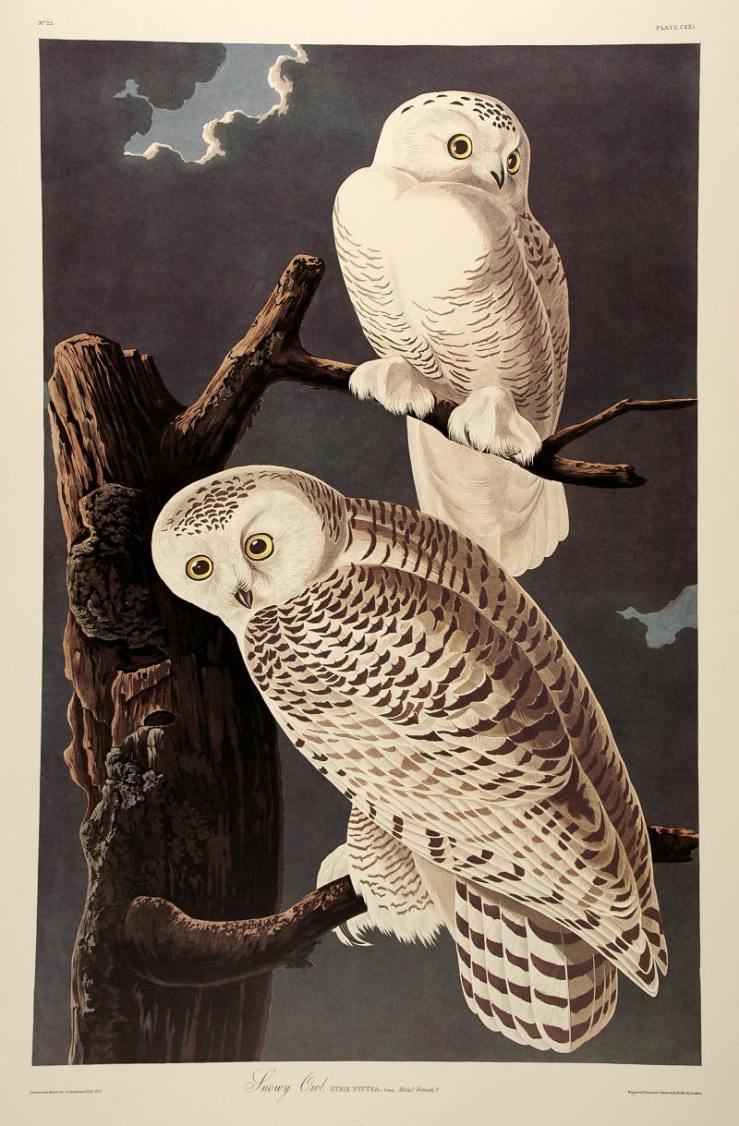
Snowy Owl — John James Audubon

Book Acquired, 1.12.2012


20120114-110434.jpg

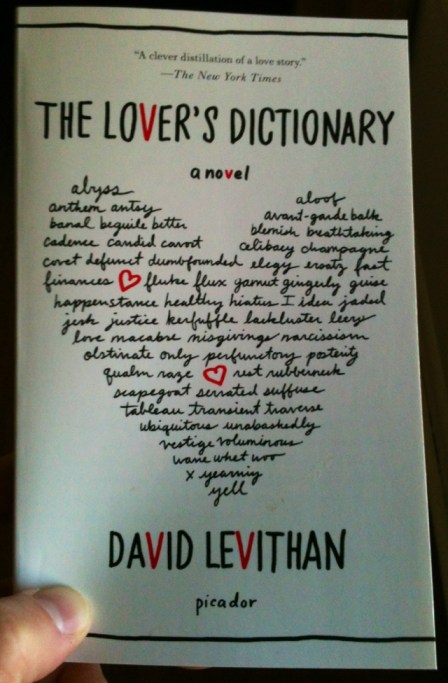
In the post from the kind people at Picador, The Lover’s Dictionary by David Levithan (I want to type “Leviathan,” of course). Publisher’s description:

How does one talk about love? Is it even possible to describe something at once utterly mundane and wholly transcendent, that has the power to consume our lives completely, while making us feel part of something infinitely larger than ourselves? Taking a unique approach to this age-old problem, the nameless narrator of David Levithan’sThe Lover’s Dictionary constructs the story of a relationship as a dictionary. Through these sharp entries, he provides an intimate window into the great events and quotidian trifles of coupledom, giving us an indelible and deeply moving portrait of love in our time.

Joseph Campbell on Circumcision

Read an Excerpt from Stuart Kendall’s New Translation of Gilgamesh

Contra Mundum Press is publishing a new translation of the epic of Gilgamesh by renowned translator and scholar Stuart Kendall, who has translated works by Bataille, Blanchot, and Debord, among others. You can read (and download if you like) a good chunk of this text now. It’s good stuff.

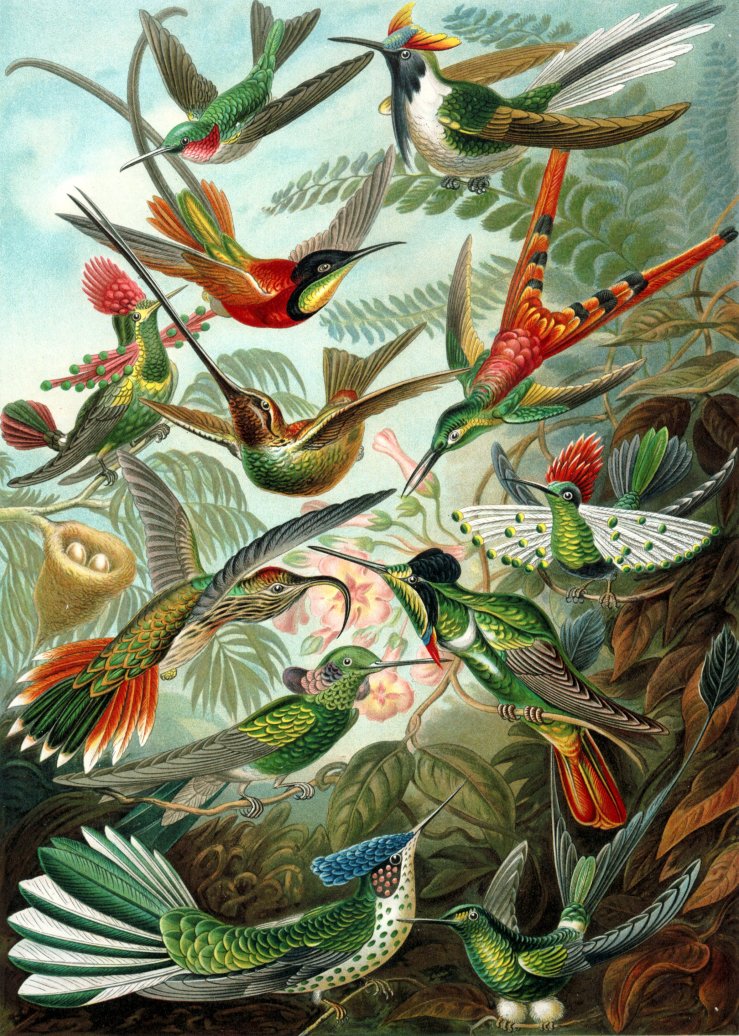
Trochilidae — Ernst Haeckel

McNulty’s Fake English Accent (The Wire)

Book Acquired, 1.11.2012 (Teju Cole Edition)

20120111-194217.jpg

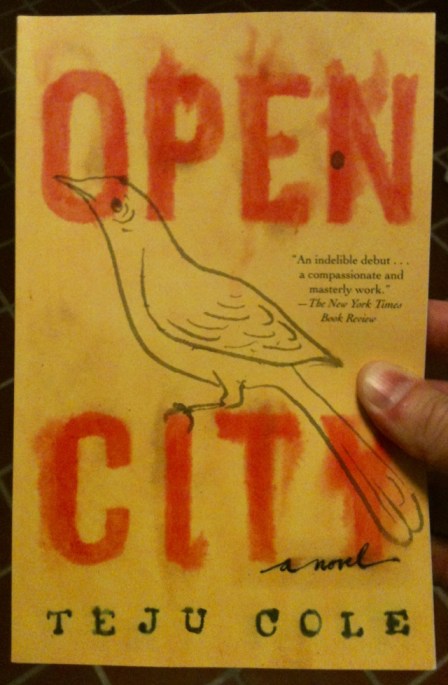
Teju Cole’s Open City was a big favorite for many lit folks last year, including Anthony at Times Flow Stemmed, a blog I admire. The book seems similar to Sebald’s strange opus The Rings of Saturn. In short, very excited for this one.  From the write-up at Times Flow Stemmed:

Open City is narrated by Julius, a part Nigerian, part German psychiatry student. Beginning with a strong Sebaldian influence as Julius aimlessly wanders around the streets and parks of New York, the story develops into a modern inquiry into the foundation of personality, memory, nationhood and dislocation.

Although written in the first person the narrator remains at a distance, a lonely, bookish character, more comfortable discussing literary or musical influences (Mahler, Coetzee, Barthes) than developing a relationship with a childhood friend or dying professor. This distance allows Cole, as James Wood explains . . .  to make his novel ‘as close to a diary as a novel can get, with room for reflection, autobiography, stasis, and repetition.’