Grand Larousse — Guy Laramée

(More).

“Hair Rebels” (A Favorite Scene from a Favorite Film, if . . . .)

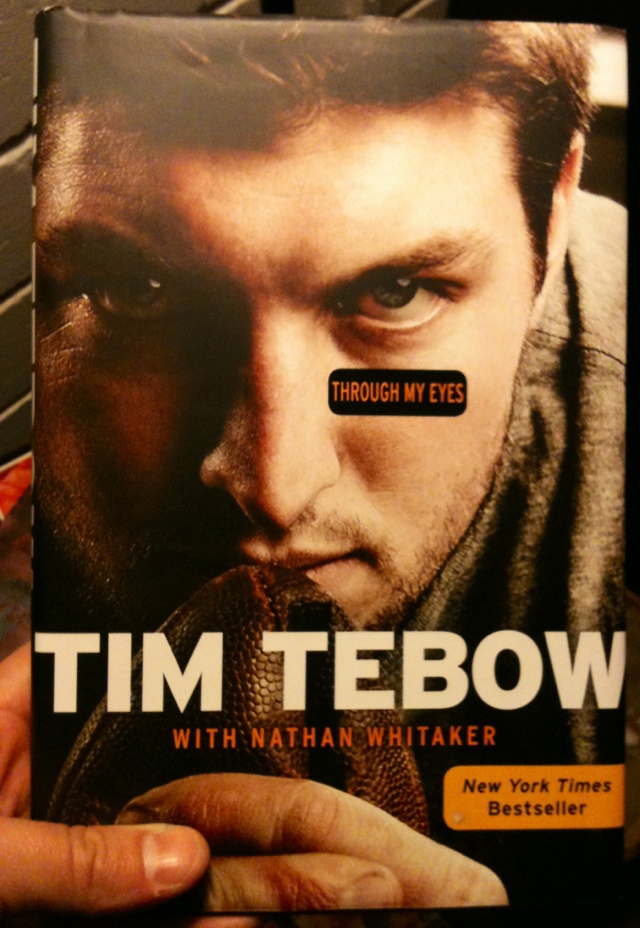
Book Acquired 1.03.2012 — Tim Tebow Edition

My father doesn’t read a lot of books, or at least I don’t think he does, but I know he read Through My Eyes, the Tim Tebow memoir. I’m pretty sure he must have gotten a duplicate for Christmas, because he sent a copy my way yesterday.

If you don’t know who Tim Tebow is (that is, if you’re not a fan of U.S. football, or not from the States, or you just don’t care about sports, or Twitter, or whatever), he was one of the greatest college players of all time, leading the Florida Gators to two national championship titles and two SEC titles. He’s also a devout Christian, the son of missionaries. He currently is the starting quarterback for the Denver Broncos, a team he helped take (quite improbably) to the playoffs this year.

Also: a vocal contingent of people really enjoy hating on him.

Not me. Tebow is from my hometown. I went to the University of Florida. I’m a big Gator fan. And even though I’m not exactly simpatico with evangelical Christianity, Tebow has always struck me as a genuinely good, nice person.

Anyway, I have some interest in the book, although I’m sure it’s pretty standard ghostwritten sports celebrity memoir stuff.

20120103-175429.jpg

Here is what my dad also got for Christmas: a signed Tebow ball. (My name is also Ed, so one day maybe I will have this ball too):

20120103-175448.jpg

“Seen in a Junk Yard” — F. Scott Fitzgerald

From F. Scott Fitzgerald’s Notebooks—

Dogs, chickens with few claws, brass fittings, T’s elbow, rust everywhere, bales of metal 1800 lbs., plumbing fixtures, bathtubs, sinks, water pumps, wheels, Fordson tractor, Acetylene lamps for tractors, sewing machine, bell on dingy, box of bolts, No. 1 van, stove, auto stuff (No. 2), army trucks, cast iron, body hot dog stand, dinky engines, sprockets like watch parts, hinge all taken apart on building side, motorcycle radiators, George on the high army truck.

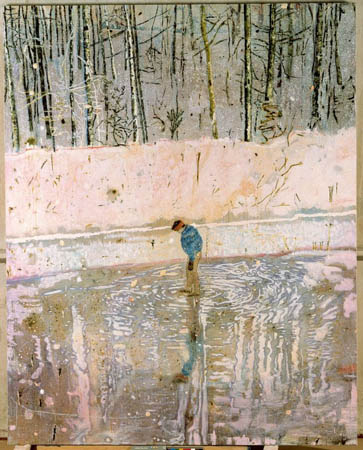
Blotter — Peter Doig

“Halleluhwah” — Can

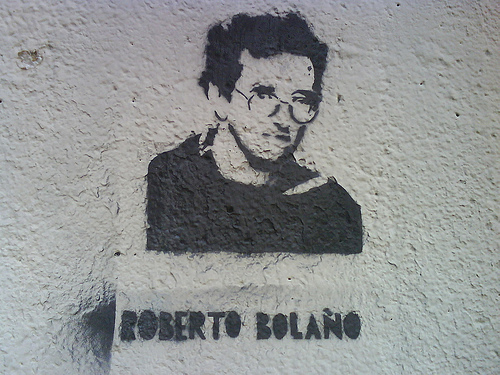
“Books Are Like Ghosts” — Roberto Bolaño on Lost Books

Roberto Bolaño on lost books. From Between Parentheses:

To search for those copies or similar copies, the same font, the same layout, the same plot, the dark or bright syntax, somehow forces me to remember a time when I was young and poor and careless, though I know that the same copies, the exact same ones, will never be found, and to set myself to such a task would be like marching into Florida in search of El Dorado.

Even so, I often browse used bookstores, sorting through stacks of books left behind by others or sold in a dark moment, and in corners like these I try to find the books that I lost or forgot more than thirty years ago on another continent, with the hope and dedication and bitterness of those who search for their first lost books, books that if found I wouldn’t read anyway, because I’ve already read them over and over, but that I would look at and touch just as the miser strokes the coins under which he’s buried.

But books have nothing to do with greed, though they do have something to do with coins. Books are like ghosts.

Slavoj Žižek on David Lynch’s Lost Highway

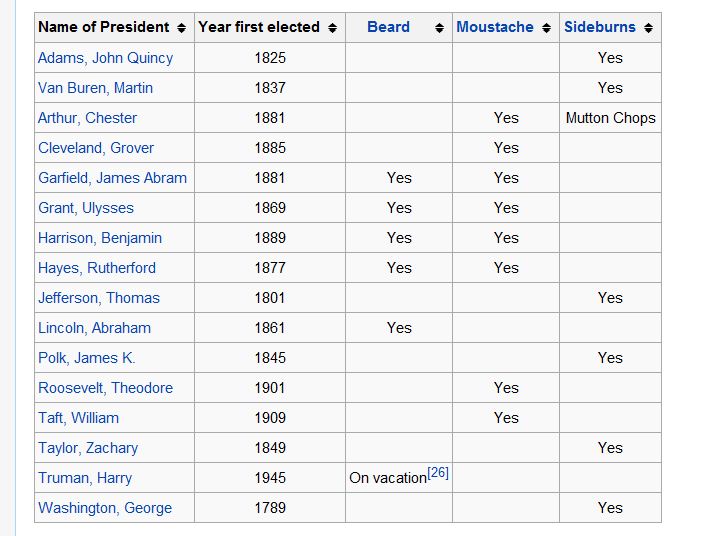
A Chart of U.S. Presidents Who Sported Facial Hair

(From Wikipedia, natch).

Book Shelves #1, 1.01.2012

Every library answers a twofold need, which is often also a twofold obsession: that of conserving certain objects (books) and that of organizing them in certain ways.

—Georges Perec, from “Brief Notes on the Art and Manner of Arranging One’s Books” (1978)

For all of 2011 and half of 2010, I ran a death mask on this blog every Sunday. I liked the idea of having a regular, uniform post on the blog, and I enjoyed searching for death masks (and life masks) and learning about them. However, my interest is waning; it’s time to move on.

Still wanting to run a regular post each Sunday, I’ve elected to photograph the bookshelves, or the surfaces that hold books in my house. These will not be beautiful, arranged pictures, but rather simple pics from my iPhone documenting the spaces that books occupy. I will photograph each space “as is” and then remove a book or two, photograph it, and then comment on it.

I didn’t know where to start, so I started with what may be the most plain book shelves in my home, the nightstand next to my bed. (Right now it is unusually tidy, having been cleaned out and partially restocked for the new year; in a week or two it will be crammed to its wooden gills). Here is what it looks like:
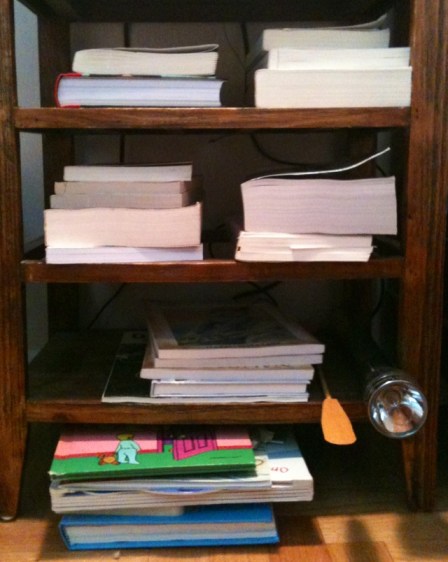
20111231-112128.jpg

Not very exciting, I know! This is perhaps the only photo in this book shelf series that will not feature shots of spines. Like I said, I don’t plan to arrange any of the shots in this series. I talked about a lot of what’s in here in yesterday’s riff on recent reading and a post last week on stuff I plan to read in 2012.

Stuff on the top tier tends to be stuff I’m currently reading; the second shelf is filled with books I’m always rereading, or picking at slowly. The third shelf is where stuff goes to marinate or get dusty or cry to be shelved.

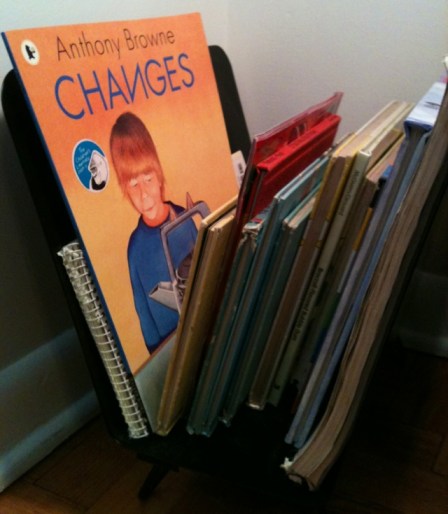
There’s also a bunch of kids book on the floor. More kids books are in this giant magazine stand, along with some notebooks, art pads, and probably an actual magazine or two (Anthony Browne’s book Changes is a surrealist masterpiece for kids, by the way):
20111231-112135.jpg

The Perec quote above comes from an essay collected in Species of Spaces and Other Pieces. “Brief Notes on the Art and Manner of Arranging One’s Books” will be in some ways the guiding inspiration for the Biblioklept book shelf series; my aim is not so much to present beautiful pictures that show off my books (I’m not equipped to do that, and other people do it very well already), but to comment on how my books are arranged and how they move and flow throughout the house; it will also give me a good opportunity to pick up books that might have been lingering (do books linger?) on a shelf for sometime.

I pulled these three books, not quite at random, from the shelves. The Perec book is one of those volumes I like to read scattershot-style. The latest issue of Paris Review still has a few pieces I haven’t read. Nausicaa: I meant to start it the other night. It will migrate to another room, a day-reading room, not a night-reading room:

20111231-112151.jpg

I don’t anticipate future book shelf posts being quite this long; my intention here is to kind of set the ground rules (for myself) or delineate both spirit and letter to this project. As such, a final note on movement: I will move “outward” from this nightstand, photographing any place where books are set. I will photograph every kind of book in this house in its natural habitat; this includes children’s books and cookbooks, but does not include personal photograph albums, instruction manuals, or anything else of that nature. I plan to do 53 total book shelf posts, including this one (there are 53 Sundays in 2012).

My hope is that readers will respond to these posts by sharing their own bookshelving habits.

A Scapegoat for Promiscuous Drunks, Friendly Calls, and Humbug Resolutions

mark-twain

From Mark Twain’s January 1st, 1863 column in the Territorial Enterprise:

Now is the accepted time to make your regular annual good resolutions. Next week you can begin paving hell with them as usual. Yesterday, everybody smoked his last cigar, took his last drink, and swore his last oath. To-day, we are a pious and exemplary community. Thirty days from now, we shall have cast our reformation to the winds and gone to cutting our ancient short comings considerably shorter than ever. We shall also reflect pleasantly upon how we did the same old thing last year about this time. However, go in, community. New Year’s is a harmless annual institution, of no particular use to anybody save as a scapegoat for promiscuous drunks, and friendly calls, and humbug resolutions, and we wish you to enjoy it with a looseness suited to the greatness of the occasion.

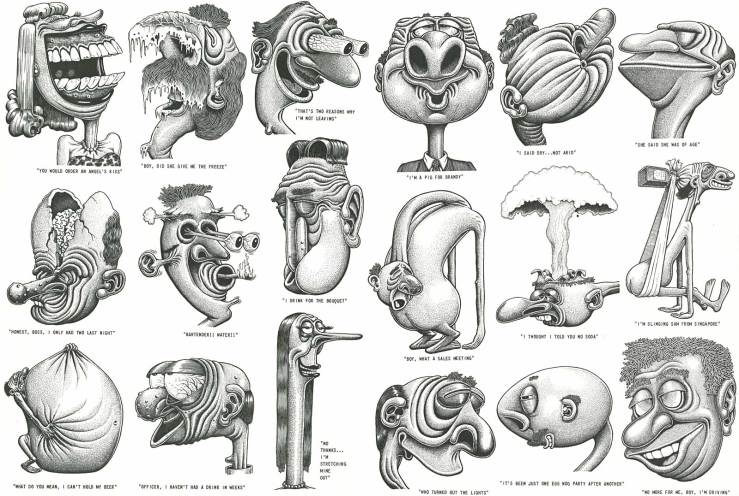
Basil Wolverton’s Guide to Drinking

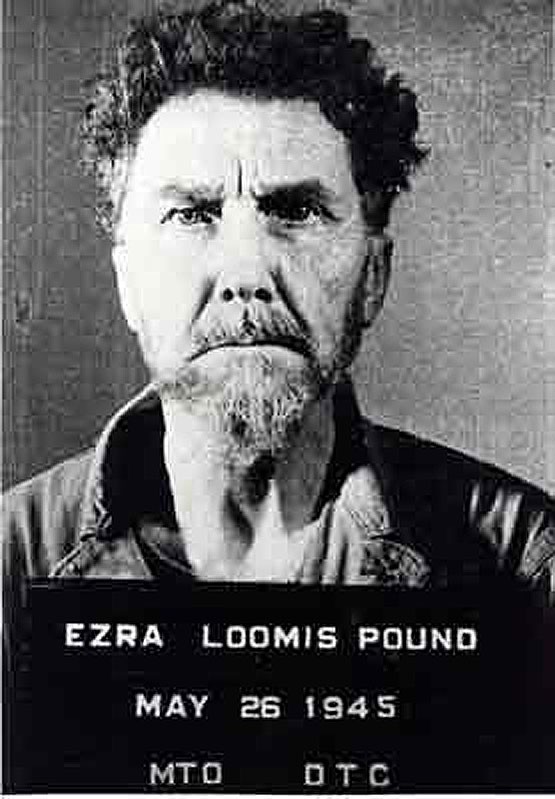
Ezra Pound’s Mugshot

From the Wikipedia entry “1945 in poetry”:

May 2, 1945, Ezra Pound was arrested by Italian partisans, and taken (according to Hugh Kenner) “to their HQ in Chiavari, where he was soon released as possessing no interest.” The next day, he turned himself in to U.S. forces. He was incarcerated in a United States Army detention camp outside Pisa, spending 25 days in an open cage before being given a tent. Here he appears to have suffered a nervous breakdown. While in the camp he drafted the Pisan Cantos, a section of the work in progress which marks a shift in Pound’s work, being a meditation on his own and Europe’s ruin and on his place in the natural world. The Pisan Cantos won the firstBollingen Prize from the Library of Congress in 1948.

John Cage Performs “Waterwalk” in front of a Laughing Audience

John Cage Plays a Cactus with a Feather

(From Nam June Paik’s Good Morning Mr. Orwell.)

Books Acquired, 12.21.2011

20111227-194728.jpg

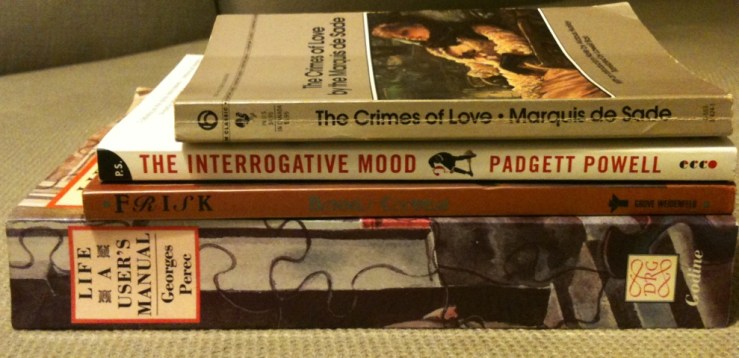
So, obviously I can’t manage to do these “Books Acquired” posts in a timely fashion, let alone chronologically. Anyway, I’m certain of the date I picked up these four because I ended up writing this post about why novels make lousy gifts later that day. As always, the iPhone pic is a bit blurry. It’s tough work lighting books, believe it or not, and they’re usually different dimensions, etc., gripe, whine. Jeez. So these books are: The Crimes of Love by Marky de Sade, which I dunno, I’ve been compelled to read him lately; The Interrogative Mood by Padgett Powell, which did you know is written entirely in questions? And did you know that Powell was (is) the big-time writer in res at my alma mater? And do you care? And why? The Dennis Cooper novel is Frisk. I always scour this particular bookshop for Cooper, but have never had any luck. So on this particular trip, of course someone has let go of his entire collection of Cooper, like six or seven novels (not God Jr. or the short story collection though, which seemed like good starting places). I picked Frisk sort of at random. I’ve been looking for Georges Perec’s Life: A User’s Manual for a while too, so I was happy to pick it up. I consider it assigned reading in 2012.

I also picked up books as gifts that day, including some children’s books for my kids, and a first edition hardback copy of Brugo Partridge’s A History of Orgies. 

Symbiont Carrier — Dougal Dixon