Euphemania — Ralph Keyes


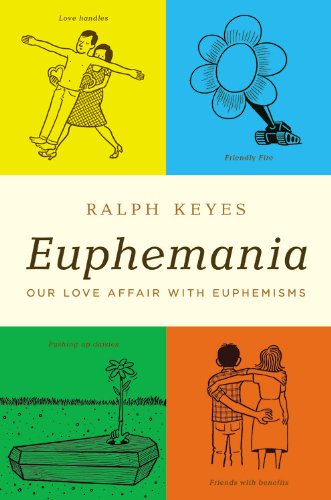
In his new book Euphemania, a cultural history of euphemisms, Ralph Keyes takes a frank and often bawdy look at why we use euphemisms in social and political discourse, even when such evasions can degrade communication. “We all rely on euphemisms to tiptoe around what makes us uneasy, and have done so for most of recorded history,” writes Keyes, adding that “Euphemisms are a function of their times.” As such, Euphemania surveys different euphemisms throughout different cultures and times, from ancient Greece to the Roman republic, to Shakespeare’s England and the Victorian era (a treasure trove of euphemisms), to our modern age–which Keyes argues is not nearly as frank and open as we might like to think; indeed, one of his most intriguing arguments points out that modern discourse has simply opened up more topics to euphemism, including medicine, politics, and advertising.

Keyes doesn’t intend his book to be a straightforward history or dictionary of euphemisms; rather, he writes “it’s a consideration of the ways euphemisms enter our conversations and how they reflect their time and place. Euphemizing most often results from an excess of politeness and prudery, but it can also demonstrate creativity and high good humor.” Although Keyes always has a keen eye on the prudish mores of which ever age he’s discussing, he balances this analysis with plenty of humorous examples. His tone is fun and earthy, drawing examples from literature, film, TV, advertising, and political rhetoric. Between discussions of the Bowdlerization of Shakespeare, W.C. Fields’s difficulties with censors, or dialog from The Wire, Keyes also holds forth on the strange etymologies of our words. The root of the word bear (the mammal, not the verb) simply means “brown” or “the brown one” — the word bear is an unexpected euphemism, a refusal to name a lethal wild animal. Such examples can often magnify one’s awareness of how indebted our language is to euphemisms. Even when we reach for one of those Latinate technical words, we’ve really just picked up another culture’s euphemism. Our medical standby penis, for example, comes from the Latin word for “tail.” Vagina was a Roman synonym too–it means “sheath” or “scabbard.”

Euphemania is best when Keyes is riffing on naughty bits like these–or sex, or excretions, or violence, or all those things we’d like to otherwise gloss over. Most readers will likely gravitate to chapters like “Anatomy Class” or “Speaking of Sex.” Although Keyes is never dull (if anything, he’s at times too effervescent), his book is less convincing when discussing why we use euphemisms, simply because, at least to this reader, the answers are so obvious–euphemisms are part of the intrinsic codes of our culture. They make it easier to discuss unpleasant things; they build a sense of shared knowledge; they alleviate anxieties of race, place, and gender. At the same time, the cost of euphemisms–particularly in contemporary political discourse–can be astounding, leading to the evasion or outright denial of dramatic problems. Keyes doesn’t offer a pat solution to this problem, which is really better, if one thinks about it, because after all, wouldn’t an overly simplified, self-satisfied answer be just another dodge, another evasion, another euphemism? Good stuff.

Euphemania is new in hardback from Hatchette/Little, Brown and Company.

Heroes of 2010 — David Mitchell

Vice Interviews Sam Lipsyte

Vice interviews Sam Lipsyte–good stuff. From the interview, here’s Lipsyte on writing comedy–

The page is very different than what a stand-up comic does. A comedian has a physical body—gestures, vocal intonations, double takes—whatever they’re going to do to bring across the comedy. They can make a phrase funny just by the way they say it. Authors don’t have any of those tools at our disposal, so we have to find lingual ways to do it. So much of it is how you build to something, how wide you make a loop of description before you veer off and land somewhere totally unrelated. You have to learn how that rhythm works in prose. It has to be something you feel.

I don’t want it to be too jokey, I don’t want it to be making claims for itself as funny, but then you must laugh because it is a funny moment. I pursue… something strange, usually, in every paragraph. It may be funny, or it may be something I don’t think is that funny. I’ve had people come up to me and say, “That was so funny!” and I think, “Dude, that’s the most devastating moment in the book.” I’ve realized that it’s both. In my work the funniest thing is usually the most devastating thing, and that’s where they play with each other.

“The Savior must have been a docile Gentleman” — Emily Dickinson

Emily Dickinson’s nativity poem, “The Savior must have been a docile Gentleman”–

The Savior must have been
A docile Gentleman—
To come so far so cold a Day
For little Fellowmen—

The Road to Bethlehem
Since He and I were Boys
Was leveled, but for that ‘twould be
A rugged Billion Miles—

James Joyce’s Death Mask

Heroes of 2010 — Neko Case

Charles Burns Talks to Vice; Discusses Subconscious Tintin Influences

At Vice, Sammy Markham (Crickets) interviews one of our heroes of Charles Burns. Read our review of Burns’s latest, X’ed Out. From the interview with Markham, Burns discusses subconscious influences–

There’s work that I grew up with and looked at and internalized. It is still in my subconscious, and I pay attention to that part of myself, and those images come through. For example, I looked at Tintin books when I was really, really young—before I could even read—and so there were elements of the stories that I didn’t understand the relevance of. In The Secret of the Unicorn there’s one scene where Tintin is down in this basement. He’s been kidnapped. He wakes up and there’s this intercom that’s stuck on the wall. And in my mind, I had no idea what an intercom was, but I could tell that there was a voice balloon coming from this little hole in the wall.

In a weird and felicitous coincidence, I happened to have read The Secret of the Unicorn just last week and then read a comic by Burns in the May or June 2010 issue of The Believer where he riffs on the very scene he’s described above, a comic I only understood after reading Unicorn. Here’s the comic–

“A Christmas Greeting” — Walt Whitman

“A Christmas Greeting” by Walt Whitman

Welcome, Brazilian brother–thy ample place is ready;
A loving hand–a smile from the north–a sunny instant hall!
(Let the future care for itself, where it reveals its troubles,
impedimentas,
Ours, ours the present throe, the democratic aim, the acceptance and
the faith;)
To thee to-day our reaching arm, our turning neck–to thee from us
the expectant eye,
Thou cluster free! thou brilliant lustrous one! thou, learning well,
The true lesson of a nation’s light in the sky,
(More shining than the Cross, more than the Crown,)
The height to be superb humanity.

“Welcome” — Deb Olin Unferth

“Welcome,” a short story by Deb Olin Unferth, published in Vice’s annual fiction issue. A sample–

I finally figured it out and I said it: You want me to leave?

I said this because I did have small evidences. The day before they had gotten a little meaner, one of them especially, the bigger one, the one who had earlier been my champion. But I didn’t understand. I had been having such a nice time. I was bewildered. Why did they suddenly not love me?

And then the next morning it happened again. The big one had a mean look on his face. The other figured she didn’t need to have an ugly look on her face because the big one was taking care of it, so she could just stand to the side and look on, bemused. But I was so stupid, I still didn’t understand. I looked at the littler one as if to say, Why is he acting this way?

Anton Corbijn on Captain Beefheart

Vodpod videos no longer available.

(Via).

A Gordon Lish Sentence That Cracked Me Up

Today, I listened to Iambik’s audiobook version of Collected Fictions, a selection of stories written and read by the inimitable Gordon Lish. Lish reads a few choice stories from four of his volumes in a wry, gruff tone; he’s got a wonderful rhythmic style, and he pauses to reflect on some of the selections before and after reading them. I’ll give the volume a proper review down the line, but I wanted to share a passage–a long sentence, really—that made me laugh out loud from the story “Mr. Goldbaum,” from the 1988 collection Mourner at the Door. I actually own Mourner at the Door, and had read “Mr. Goldbaum” sometime earlier this year or last year, but I don’t remember it being nearly as funny or touching. Must be Lish’s delivery. Anyway, the Lishness, which can be appreciated entirely out of context–

What if your father was the kind of father who was dying and he called you to him and you were his son and he said for you to come lie down on the bed with him so that he could hold you and so that you could hold him so that you both could be like that hugging with each other like that to say goodbye before you had to actually go leave each other and did it, you did it, you god down on the bed with your father and you got up close to your father and you got your arms around your father and your father was hugging you and you were hugging your father and there was one of you who could not stop it, who could not help it, but who just got a hard-on?

Or both did?

Picture that.

Not that I or my father ever hugged like that.

RIP Captain Beefheart

Read a proper eulogy here.

“Santa” — Kate Beaton

Kate Beaton’s “Santa,” from her site Hark, a Vagrant!

“Christmas at Sea” — Robert Louis Stevenson

“Christmas at Sea” by Robert Louis Stevenson

The sheets were frozen hard, and they cut the naked hand;
The decks were like a slide, where a seamen scarce could stand;
The wind was a nor’wester, blowing squally off the sea;
And cliffs and spouting breakers were the only things a-lee.

They heard the surf a-roaring before the break of day;
But ’twas only with the peep of light we saw how ill we lay.
We tumbled every hand on deck instanter, with a shout,
And we gave her the maintops’l, and stood by to go about.

All day we tacked and tacked between the South Head and the North;
All day we hauled the frozen sheets, and got no further forth;
All day as cold as charity, in bitter pain and dread,
For very life and nature we tacked from head to head.

We gave the South a wider berth, for there the tide-race roared;
But every tack we made we brought the North Head close aboard:
So’s we saw the cliffs and houses, and the breakers running high,
And the coastguard in his garden, with his glass against his eye.

The frost was on the village roofs as white as ocean foam;
The good red fires were burning bright in every ‘long-shore home;
The windows sparkled clear, and the chimneys volleyed out;
And I vow we sniffed the victuals as the vessel went about.

The bells upon the church were rung with a mighty jovial cheer;
For it’s just that I should tell you how (of all days in the year)
This day of our adversity was blessed Christmas morn,
And the house above the coastguard’s was the house where I was born.

O well I saw the pleasant room, the pleasant faces there,
My mother’s silver spectacles, my father’s silver hair;
And well I saw the firelight, like a flight of homely elves,
Go dancing round the china-plates that stand upon the shelves.

And well I knew the talk they had, the talk that was of me,
Of the shadow on the household and the son that went to sea;
And O the wicked fool I seemed, in every kind of way,
To be here and hauling frozen ropes on blessed Christmas Day.

They lit the high sea-light, and the dark began to fall.
“All hands to loose topgallant sails,” I heard the captain call.
“By the Lord, she’ll never stand it,” our first mate Jackson, cried.
…”It’s the one way or the other, Mr. Jackson,” he replied.

She staggered to her bearings, but the sails were new and good,
And the ship smelt up to windward just as though she understood.
As the winter’s day was ending, in the entry of the night,
We cleared the weary headland, and passed below the light.

And they heaved a mighty breath, every soul on board but me,
As they saw her nose again pointing handsome out to sea;
But all that I could think of, in the darkness and the cold,
Was just that I was leaving home and my folks were growing old.

Heroes of 2010 — John Stewart

Vodpod videos no longer available.

Vodpod videos no longer available.

The AV Club Interviews Lynda Barry

The AV Club’s Tasha Robinson interviews comix legend Lynda Barry. In the (rather lengthy) interview, Barry discusses teaching her craft–

It’s a really hard thing to teach students. The two things I always try to teach them is, one, you have to stay in motion. It doesn’t mean that you have to just write blah, blah, blah, blah, blah. Write the alphabet. You have to stay in motion. And the other thing is, when you get stuck, don’t read over what you just wrote. Especially if you have a computer. Maybe by hand is not so bad, but with a computer, what happens is… My experience has always been that there is a point when the story just stops. Always. You know, it’s just like when you’re dancing. There’s a time when you’re fake-dancing, because the groove has stopped. Then you’re back in the groove. So if people understood that that’s a natural part of making something, and they knew what to do during that time… But what people will do if they’re writing on a computer is, when that time comes and it’s quiet for a minute, they panic and go back and start fixing stuff above it that was not even broken. You can’t start to fix something until you know what it’s for, you know? So I always try to get my students to just sustain the state of mind for a certain amount of time. Even though I use 24 panels for my students, they’ll have seven minutes to just sustain this open state of mind while they’re writing, keep their hand in motion. But it’s really tough to get them to believe me, to just to even give it a try. And then once they do, it’s really fun.

Heroes of 2010 — Janelle Monáe