“The novel, so unanimously acclaimed, was called Twilight” — An Excerpt from Roberto Bolaño’s 2666

The following excerpt of Roberto Bolaño’s 2666 is more or less self-contained, or at least as self-contained as anything in that labyrinth. It’s the summary of a character named Ansky’s novel; Hans Reiter (aka Archimboldi) is reading Ansky’s diaries while hiding during the war–

The novel, so unanimously acclaimed, was called Twilight and its plot was very simple: a boy of fourteen abandons his family to join the ranks of the revolution. Soon he’s engaged in combat against Wrangel’s troops. In the midst of battle he’s injured and his comrades leave him for dead. But before the vultures come to feed on the bodies, a spaceship drops onto the battlefield and takes him away, along with some of the other mortally wounded soldiers. Then the spaceship enters the stratosphere and goes into orbit around Earth. All of the men’s wounds are rapidly healed. Then a very thin, very tall creature, more like a strand of seaweed than a human being, asks them a series of questions like: how were the stars created? where does the universe end? where does it begin? Of course, no one knows the answers. One man says God created the stars and the universe begins and ends wherever God wants. He’s tossed out into space. The others sleep. When the boy awakes he finds himself in a shabby room, with a shabby bed and a shabby wardrobe where his shabby clothes hang. When he goes to the window he gazes out in awe at the urban landscape of New York. But the boy finds only misfortune in the great city. He meets a jazz musician who tells him about chickens that talk and probably think.

“The worst of it,” the musician says to him, “is that the governments of the planet know it and that’s why so many people raise chickens.”

The boy objects that the chickens are raised to be eaten. The musician says that’s what the chickens want. And he finishes by saying:

“Fucking masochistic chickens, they have our leaders by the balls.”

He also meets a girl who works as a hypnotist at a burlesque club, and he falls in love. The girl is ten years older than the boy, or in other words twenty-four, and although she has a number of lovers, including the boy, she doesn’t want to fall in love with anyone because she believes that love will use up her powers as a hypnotist. One day the girl disappears and the boy, after searching for her in vain, decides to hire a Mexican detective who was a soldier under Pancho Villa. The detective has a strange theory: he believes in the existence of numerous Earths in parallel universes. Earths that can be reached through hypnosis. The boy thinks the detective is swindling him and decides to accompany him in his investigations. One night they come upon a Russian beggar shouting in an alley. The beggar shouts in Russian and only the boy can understand him. The beggar says: I fought with Wrangel, show some respect, please, I fought in Crimea and I was evacuated from Sevastopol in an English ship. Then the boy asks whether the beggar was at the battle where he fell badly wounded. The beggar looks at him and says yes. I was too, says the boy. Impossible, replies the beggar, that was twenty years ago and you weren’t even born yet.

Then the boy and the Mexican detective set off west in search of the hypnotist. They find her in Kansas City. The boy asks her to hypnotize him and send him back to the battlefield where he should have died, or accept his love and stop fleeing. The hypnotist answers that neither is possible. The Mexican detective shows an interest in the art of hypnosis. As the detective begins to tell the hypnotist a story, the boy leaves the roadside bar and goes walking under the night sky. After a while he stops crying.

He walks for hours. When he’s in the middle of nowhere he sees a figure by the side of the road. It’s the seaweedlike extraterrestrial. They greet each other. They talk. Often, their conversation is unintelligible. The subjects they address are varied: foreign languages, national monuments, the last days of Karl Marx, worker solidarity, the time of the change measured in Earth years and stellar years, the discovery of America as a stage setting, an unfathomable void—as painted by Dore—of masks. Then the boy follows the extraterrestrial away from the road and they walk through a wheat field, cross a stream, climb a hill, cross another field, until they reach a smoldering pasture.

In the next chapter, the boy is no longer a boy but a young man of twenty-five working at a Moscow newspaper where he has become the star reporter. The young man receives the assignment to interview a Communist leader somewhere in China. The trip, he is warned, is extremely difficult, and once he reaches Peking, the situation may be dangerous, since there are lots of people who don’t want any statement by the Chinese leader to get out. Despite these warnings, the young man accepts the job. When, after much hardship, he finally gains access to the cellar where the Chinese leader is hidden, the young man decides that not only will he interview him, he’ll also help him escape the country. The Chinese leader’s face, in the light of a candle, bears a notable resemblance to that of the Mexican detective and former soldier under Pancho Villa. The Chinese leader and the young Russian, meanwhile, come down with the same illness, brought on by the pestilence of the cellar. They shake with fever, they sweat, they talk, they rave, the Chinese leader says he sees dragons flying low over the streets of Peking, the young man says he sees a battle, perhaps just a skirmish, and he shouts hurrah and urges his comrades onward. Then both lie motionless as the dead for a long time, and suffer in silence until the day set for their flight.

Each with a temperature of 102 degrees, the two men cross Peking and escape. Horses and provisions await them in the countryside. The Chinese leader has never ridden before. The young man teaches him how. During the trip they cross a forest and then some enormous mountains. The blazing of the stars in the sky seems supernatural. The Chinese leader asks himself: how were the stars created? where does the universe end? where does it begin? The young man hears him and vaguely recalls a wound in his side whose scar still aches, darkness, a trip. He also remembers the eyes of a hypnotist, although the woman’s features remain hidden, mutable. If I close my eyes, thinks the young man, I’ll see her again. But he doesn’t close them. They make their way across a vast snow-covered plain. The horses sink in the snow. The Chinese leader sings. How were the stars created? Who are we in the middle of the boundless universe? What trace of us will remain?

Suddenly the Chinese leader falls off his horse. The young Russian examines him. The Chinese leader is like a burning doll. The young Russian touches the Chinese leader’s forehead and then his own forehead and understands that the fever is devouring them both. With no little effort he ties the Chinese leader to his mount and sets off again. The silence of the snow-covered plain is absolute. The night and the passage of stars across the vault of the sky show no signs of ever ending. In the distance an enormous black shadow seems to superimpose itself on the darkness. It’s a mountain range. In the young Russian’s mind the certainty takes shape that in the coming hours he will die on that snow-covered plain or as he crosses the mountains. A voice inside begs him to close his eyes, because if he closes them he’ll see the eyes and then the beloved face of the hypnotist. It tells him that if he closes his eyes he’ll see the streets of New York again, he’ll walk again toward the hypnotist’s house, where she sits waiting for him on a chair in the dark. But the Russian doesn’t close his eyes. He rides on.
“Hamlet Is a Human Being, but He Is a Son Only” — James Joyce Explains Why Ulysses Is the Most “Complete Man” in Literature

From Frank Budgen’s Conversations with Joyce (1934) —

Hamlet is a human being, but he is a son only. Ulysses is son to Laertes, but he is father to Telemachus, husband to Penelope, lover of Calypso, companion in arms of the Greek warriors around Troy and King of Ithaca. He was subjected to many trials, but with wisdom and courage came through them all. Don’t forget that he was a war dodger who tried to evade military service by simulating madness. He might never have taken up arms and gone to Troy, but the Greek recruiting sergeant was too clever for him and, while he was ploughing the sands, placed young Telemachus in front of his plough. But once at the war the conscientious objector became a jusqu’auboutist. When the others wanted to abandon the siege he insisted on staying till Troy should fall.

A jusqu’auboutist is one who sticks it out to the end.

See the Trailer for the HBO Production of Cormac McCarthy’s The Sunset Limited

The Sunset Limited premieres Saturday, February 12th on HBO. Read our review of the book here.

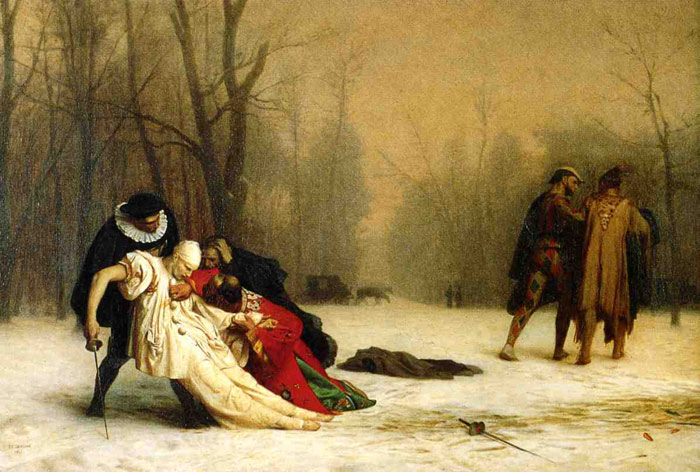
Duel After the Masked Ball — Jean-Léon Gérôme

“Life, Friends, Is Boring” — John Berryman

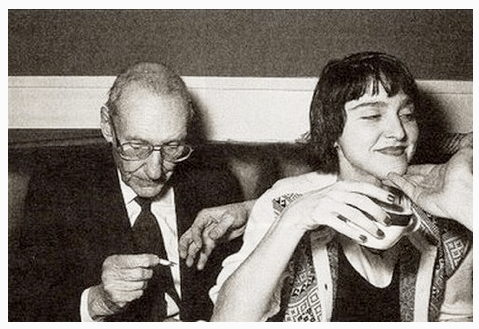
William Burroughs (and Madonna)

The Paris Review Will Publish Roberto Bolaño’s The Third Reich; Read an Excerpt Now

Beginning with its next issue, The Paris Review will serialize Roberto Bolaño’s “lost manuscript,” The Third Reich. The Wall Street Journal’ Speakeasy blog has a (very short) excerpt. An excerpt of that excerpt–

“Poor man,” I heard Hanna say.

I asked to whom she was referring; I was told to take a closer look without being obvious about it. The rental guy was dark, with long hair and a muscular build, but the most noticeable thing about him by far was the burns—I mean burns from a fire, not the sun—that covered most of his face, neck, and chest, and which he displayed openly, dark and corrugated, like grilled meat or the crumpled metal of a downed plane.

“Poem For People That Are Understandably Too Busy To Read Poetry” — Stephen Dunn

“Poem For People That Are Understandably Too Busy To Read Poetry” by Stephen Dunn–
Relax. This won’t last long.
Or if it does, or if the lines
make you sleepy or bored,
give in to sleep, turn on
the T.V., deal the cards.
This poem is built to withstand
such things. Its feelings
cannot be hurt. They exist
somewhere in the poet,
and I am far away.
Pick it up anytime. Start it
in the middle if you wish.
It is as approachable as melodrama,
and can offer you violence
if it is violence you like. Look,
there’s a man on a sidewalk;
the way his leg is quivering
he’ll never be the same again.
This is your poem
and I know you’re busy at the office
or the kids are into your last nerve.
Maybe it’s sex you’ve always wanted.
Well, they lie together
like the party’s unbuttoned coats,
slumped on the bed
waiting for drunken arms to move them.
I don’t think you want me to go on;
everyone has his expectations, but this
is a poem for the entire family.
Right now, Budweiser
is dripping from a waterfall,
deodorants are hissing into armpits
of people you resemble,
and the two lovers are dressing now,
saying farewell.
I don’t know what music this poem
can come up with, but clearly
it’s needed. For it’s apparent
they will never see each other again
and we need music for this
because there was never music when he or she
left you standing on the corner.
You see, I want this poem to be nicer
than life. I want you to look at it
when anxiety zigzags your stomach
and the last tranquilizer is gone
and you need someone to tell you
I’ll be here when you want me
like the sound inside a shell.
The poem is saying that to you now.
But don’t give anything for this poem.
It doesn’t expect much. It will never say more
than listening can explain.
Just keep it in your attache case
or in your house. And if you’re not asleep
by now, or bored beyond sense,
the poem wants you to laugh. Laugh at
yourself, laugh at this poem, at all poetry.
Come on:

Good. Now here’s what poetry can do.

Imagine yourself a caterpillar.
There’s an awful shrug and, suddenly,
You’re beautiful for as long as you live.

“They’re Very Prone to Hypnosis” — Werner Herzog on Chickens

(See also.)

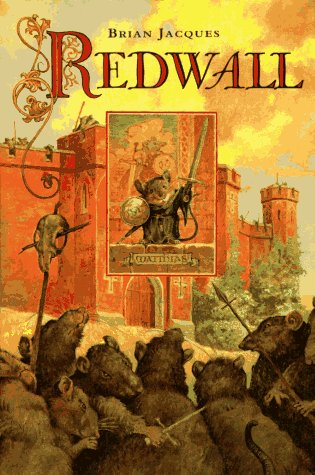
RIP Brian Jacques

Brian Jacques, author of the Redwall series of novels beloved by young readers around the world died this weekend at 71. Jacques published 21 books in the Redwood series during his lifetime, with a new book scheduled for later this year. I still remember picking up the first (and second) Redwall novel in my school’s library when I was ten years old. Jacques’s world of anthropomorphic mice pitted against evil rats (there were other fauna of course) helped lead me to books by Tolkien, Lloyd Alexander, and eventually Watership Down. RIP.
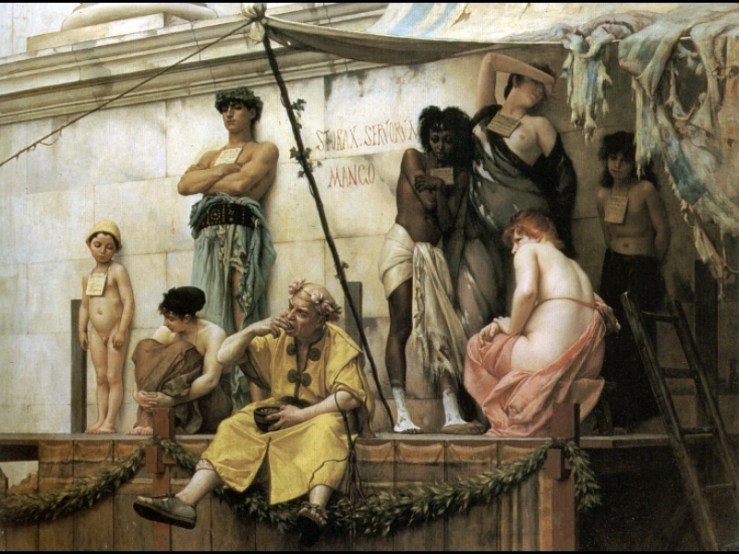
The Slave Market — Gustave Boulanger

“The Starlight on Idaho” — Denis Johnson

“The Reader Is a Person You Need to Charm” — Writing Advice from George Saunders

“The Other Place” — New Fiction from Mary Gaitskill

The New Yorker has published “The Other Place,” a new short story from Mary Gaitskill. A taste–

My son, Douglas, loves to play with toy guns. He is thirteen. He loves video games in which people get killed. He loves violence on TV, especially if it’s funny. How did this happen? The way everything does, of course. One thing follows another, naturally.

Naturally, he looks like me: shorter than average, with a fine build, hazel eyes, and light-brown hair. Like me, he has a speech impediment and a condition called “essential tremor” that causes involuntary hand movements, which make him look more fragile than he is. He hates reading, but he is bright. He is interested in crows because he heard on a nature show that they are one of the only species that are more intelligent than they need to be to survive. He does beautiful, precise drawings of crows.

Mostly, though, he draws pictures of men holding guns. Or men hanging from nooses. Or men cutting up other men with chainsaws—in these pictures there are no faces, just figures holding chainsaws and figures being cut in two, with blood spraying out.

My wife, Marla, says that this is fine, as long as we balance it out with other things—family dinners, discussions of current events, sports, exposure to art and nature. But I don’t know. Douglas and I were sitting together in the living room last week, half watching the TV and checking e-mail, when an advertisement for a movie flashed across the screen: it was called “Captivity” and the ad showed a terrified blond girl in a cage, a tear running down her face. Doug didn’t speak or move. But I could feel his fascination, the suddenly deepening quality of it. And I don’t doubt that he could feel mine. We sat there and felt it together.

And then she was there, the woman in the car. In the room with my son, her black hair, her hard laugh, the wrinkled skin under her hard eyes, the sudden blood filling the white of her blue eye. There was excited music on the TV and then the ad ended. My son’s attention went elsewhere; she lingered.

“Tribal Images of Many Irish Heroes and Heroines of Antiquity” — A Passage from James Joyce’s Ulysses

This is one of my favorite passages in Ulysses (it’s from the “Cyclops” chapter, episode 12). Hilarious–

He wore a long unsleeved garment of recently flayed oxhide reaching to the knees in a loose kilt and this was bound about his middle by a girdle of plaited straw and rushes. Beneath this he wore trews of deerskin, roughly stitched with gut. His nether extremities were encased in high Balbriggan buskins dyed in lichen purple, the feet being shod with brogues of salted cowhide laced with the windpipe of the same beast. From his girdle hung a row of seastones which dangled at every movement of his portentous frame and on these were graven with rude yet striking art the tribal images of many Irish heroes and heroines of antiquity, Cuchulin, Conn of hundred battles, Niall of nine hostages, Brian of Kincora, the Ardri Malachi, Art MacMurragh, Shane O’Neill, Father John Murphy, Owen Roe, Patrick Sarsfield, Red Hugh O’Donnell, Red Jim MacDermott, Soggarth Eoghan O’Growney, Michael Dwyer, Francy Higgins, Henry Joy M’Cracken, Goliath, Horace Wheatley, Thomas Conneff, Peg Woffington, the Village Blacksmith, Captain Moonlight, Captain Boycott, Dante Alighieri, Christopher Columbus, S. Fursa, S. Brendan, Marshal Mac-Mahon, Charlemagne, Theobald Wolfe Tone, the Mother of the Maccabees, the Last of the Mohicans, the Rose of Castille, the Man for Galway, The Man that Broke the Bank at Monte Carlo, The Man in the Gap, The Woman Who Didn’t, Benjamin Franklin, Napoleon Bonaparte, John L. Sullivan, Cleopatra, Savourneen Deelish, Julius Caesar, Paracelsus, sir Thomas Lipton, William Tell, Michelangelo, Hayes, Muhammad, the Bride of Lammermoor, Peter the Hermit, Peter the Packer, Dark Rosaleen, Patrick W. Shakespeare, Brian Confucius, Murtagh Gutenberg, Patricio Velasquez, Captain Nemo, Tristan and Isolde, the first Prince of Wales, Thomas Cook and Son, the Bold Soldier Boy, Arrah na Pogue, Dick Turpin, Ludwig Beethoven, the Colleen Bawn, Waddler Healy, Angus the Culdee, Dolly Mount, Sidney Parade, Ben Howth, Valentine Greatrakes, Adam and Eve, Arthur Wellesley, Boss Croker, Herodotus, Jack the Giantkiller, Gautama Buddha, Lady Godiva, The Lily of Killarney, Balor of the Evil Eye, the Queen of Sheba, Acky Nagle, Joe Nagle, Alessandro Volta, Jeremiah O’Donovan Rossa, Don Philip O’Sullivan Beare. A couched spear of acuminated granite rested by him while at his feet reposed a savage animal of the canine tribe whose stertorous gasps announced that he was sunk in uneasy slumber, a supposition confirmed by hoarse growls and spasmodic movements which his master repressed from time to time by tranquillising blows of a mighty cudgel rudely fashioned out of paleolithic stone.

“I’m Frightened of Eggs” — Alfred Hitchcock

Alfred Hitchcock apparently didn’t care for eggs over easy. Or probably eggs at all. I love a runny yolk over some grits or hash browns.

I’m frightened of eggs, worse than frightened, they revolt me. That white round thing without any holes … have you ever seen anything more revolting than an egg yolk breaking and spilling its yellow liquid? Blood is jolly, red. But egg yolk is yellow, revolting. I’ve never tasted it.

Slavoj Žižek on Hitchcock’s Angles

Slavoj Žižek on Alfred Hitchock. From The Pervert’s Guide to Cinema (2006).