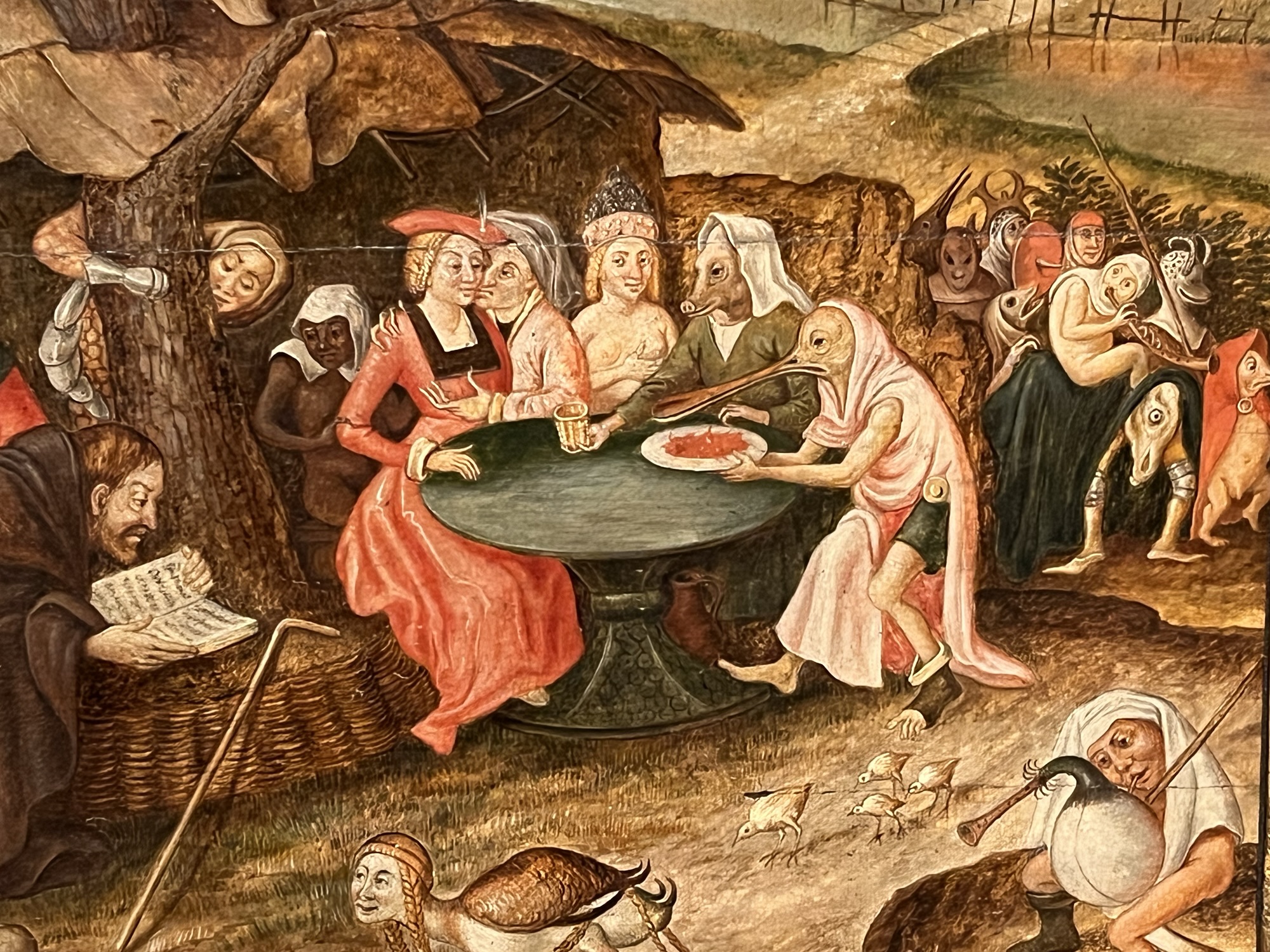
Detail from The Temptation of Saint Anthony, с. 1625 by Pieter Breughel the Younger (1564- 1637/1638)

Detail from The Temptation of Saint Anthony, с. 1625 by Pieter Breughel the Younger (1564- 1637/1638)

Maggie Umber calls the nine pieces collected in Chrysanthemum Under the Waves “comics,” so I will call them comics too. The term “comics” has long encompassed a wide range of visual storytelling techniques, resisting attempts to confine it to rigid structures, and Chrysanthemum Under the Waves shows the form’s expansive potential, blending horror, surrealism, and poetic fragmentation to tap into the alienation, paranoia, and repression that lurks under the surface of everyday life.
The stories here resist conventional narrative logic, which will likely confound any reader expecting something traditional. Umber eschews the common building blocks of the medium: there are no speech bubbles, no thought balloons, no panels stacking up into a coherent sequence. In fact, the few pages that use multiple panels feel like an anomaly. Most of the work in Chrysanthemum is confined to single, expansive images. Yet, these full-page spreads do not recall the bombastic splash pages of Jack Kirby or other Golden Age comics. Instead, they underscore the inherent incompleteness of storytelling. No artwork, no story, can ever present a full picture of reality—there are always gaps, always gutters. And in these gaps, dread and unease fester.

Umber’s comics aren’t so much about exploring the fragmentation of storytelling; rather, they showcase it as an aesthetic choice. It’s a choice that generates a palpable tension, a constant refusal to return to any resolution. There is no resolving tonic chord here. The uncanny permeates these pages—not in the sense of something foreign intruding upon the familiar, but as if the familiar itself has been subtly warped. Maybe this horror is “real,” maybe it’s not—but what is certain is its presence. The world Umber paints is one of perpetual strangeness, captured in black-and-white, shaded with grays. Pen and ink, printmaking, and watercolor all blur together in a form that makes us feel the unease before we can even articulate it.
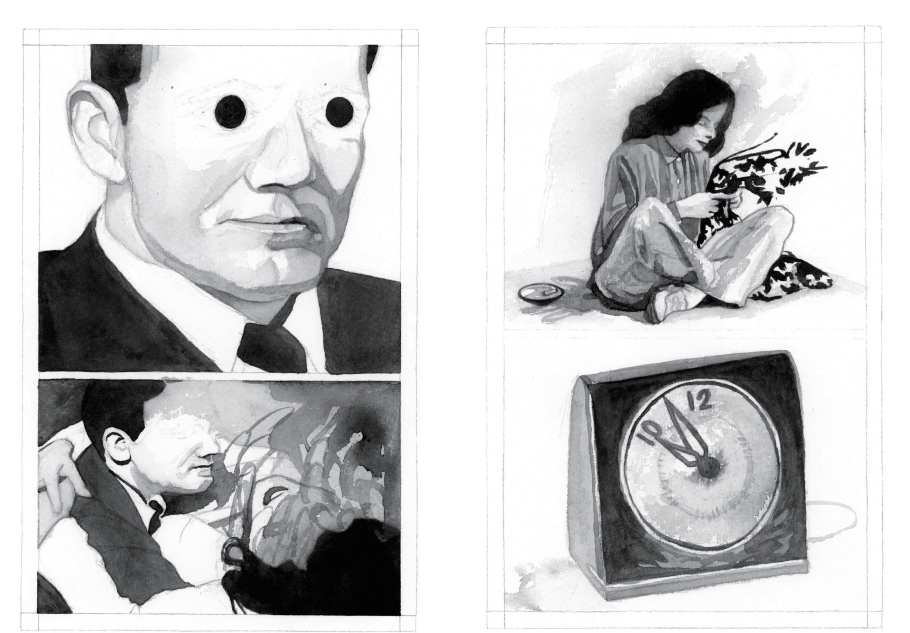
And while Umber’s work is refreshing in its uniqueness, it is by no means sui generis, but rather part of a clear tradition. As Umber notes in her introduction, Chrysanthemum started as a one-off “adaptation” of Shirley Jackson’s 1949 story “The Tooth.” If you have read “The Tooth” (and if you haven’t, do yourself a favor and resolve that problem) — if you have read “The Tooth,” you will likely recognize the uncanny unease that permeates Chrysanthemum. In her intro, Umber identifies James Harris as the agent of this unease: “James Harris snuck up on me when I was distracted by other things.” James Harris is a strange character who wanders in and out of not only “The Tooth,” but several of the other stories in Jackson’s The Lottery. Indeed, the original subtitle of The Lottery was not and Other Stories, but rather The Adventures of James Harris. This is the James Harris of the 17th century ballad “The Daemon Lover”; he is also the oblique star of Chrysanthemum Under the Waves. Look and you will find him in each of Umber’s tales, sliding like a shadow in and out of panels and gaps.
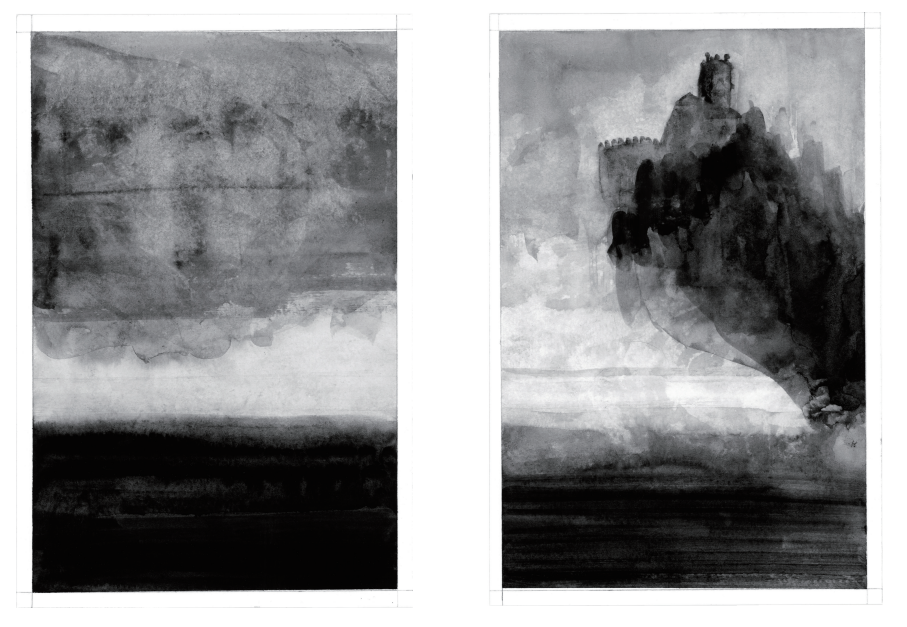
You will find so much more there as well–there are direct allusions to Goya’s Caprichos and Black Paintings, as well as nods to Toulouse-Lautrec and Sylvia Plath. There’s also a strong echo of Jackson’s American Gothic precursors and successors: Nathaniel Hawthorne, Edgar Allan Poe, Emily Dickinson, David Lynch, Kathy Acker — and, far less famously, Jason Schwartz. Chrysanthemum Under the Waves most reminded me of Schwartz’s prose-poem John the Posthumous, so much so that I read it again to confirm my notion.
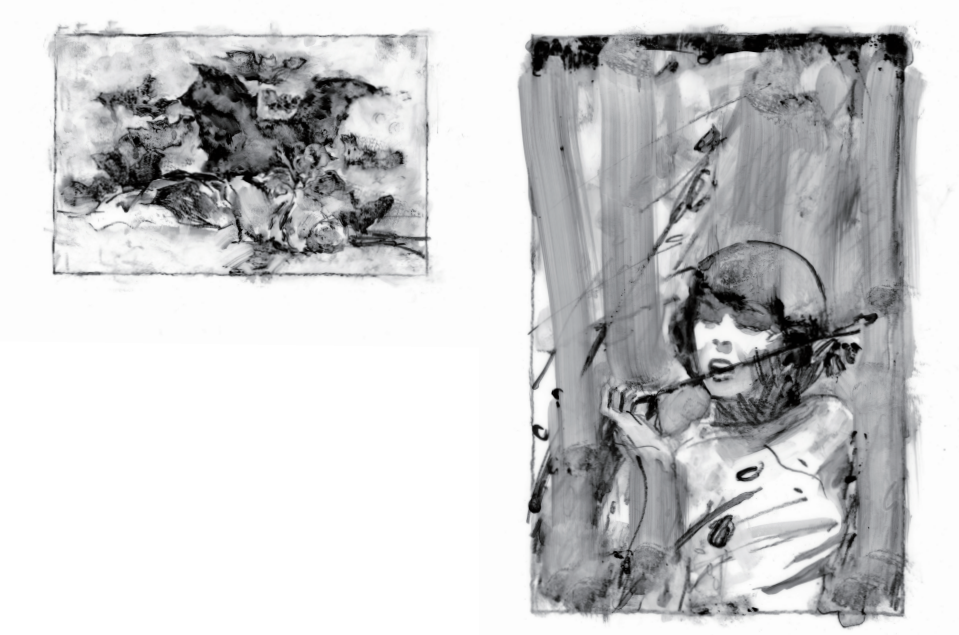
I’ve failed to remark so far on the apparent plots of the tales here. I found myself arrested by the ominous vibes in my first readings, and I still could not pin down a summary. At the same time, I feel that Umber clearly knows “what’s happening” in her stories, even if she keeps that information in the gaps and margins, out of the panel, but still, maybe, hidden in the pictures. The lead story, “Those Fucking Eyes,” is a collision of horror and beauty, twisting the artist’s gaze into something self-possessed and austere. “Rine” plays with fragmentation and distortion while evoking a ghostly presence. We get a gentleman caller, a broken bridge, a bouquet of flowers that flickers between reality and illusion. “Intoxicated” takes on a Gothic Toulouse-Lautrec aesthetic, unraveling into surreal rage and rejection. “The Devil Is a Hell of a Dancer” retells the “James Harris” ballad; it’s the first time written language infiltrates one of the stories.
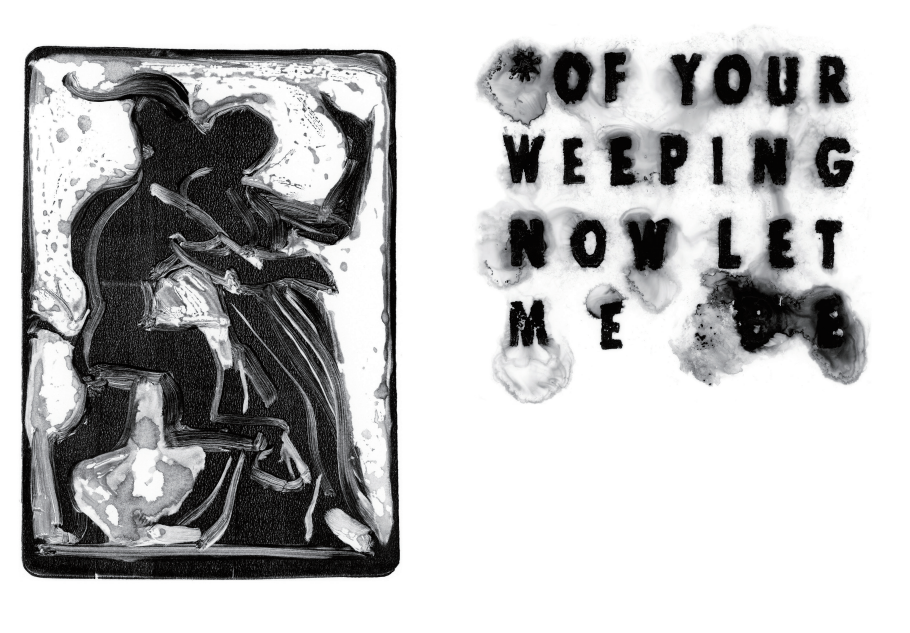 The title track, “Chrysanthemum” is a surreal noir fantasia punctured by a cup of coffee, with daemon lover James Harris hovering menacingly in the background. It seems to reinterpret Shirley Jackson as does the aforementioned “The Tooth” — itself a revision of Charlotte Perkins Gilman’s suffocating 1892 classic, “The Yellow Wall-Paper.” The shortest comic, “There Is Water” unfolds like a koan, enigmatic and meditative. Standout “The Witch” returns to Goya but also channels the American Gothic vein. The piece might be a nightmare one of Hawthorne’s characters endures. There are clouds, castles, dreams, doors, flickering horror. Is that a witch burning? And do the flames morph into a glimpse of Goya’s Saturn, only to resolve into the shadowed face of a woman? Shadows and erasures pulse through the imagery. It is both the strongest and longest piece in the collection. The book ends with “The Rock,” another riff on the the ballad “James Harris.” It’s a fitting end, conclusive but elusive. What remains rattles: unsettled, open, and always strange.
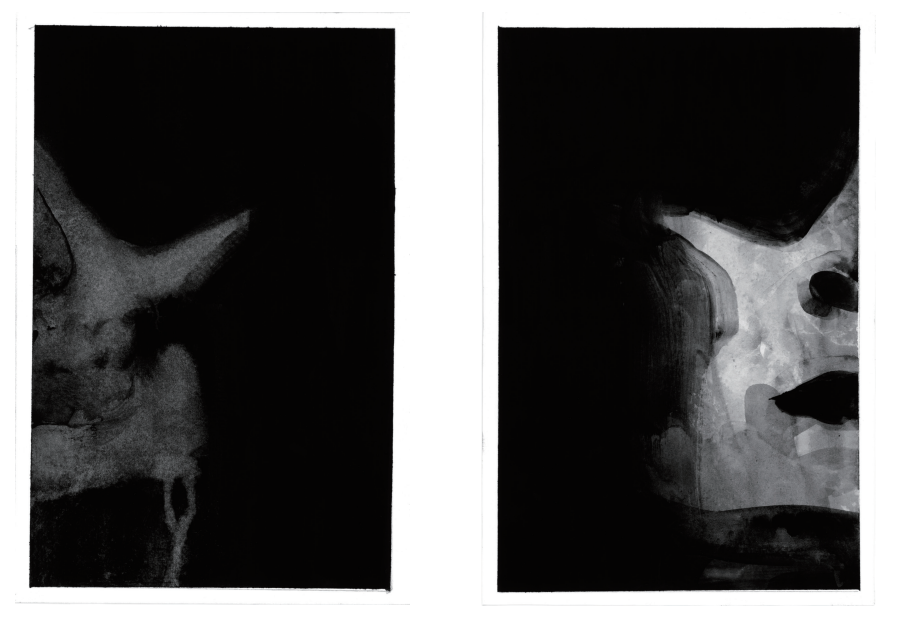
Chrysanthemum Under the Waves is a haunting, layered work that defies easy categorization. Umber’s pieces blend literary, artistic, and Gothic influences into a unique vision that expands the possibilities her chosen medium’s conventions. With its distinctive style and careful attention to space and detail, Chrysanthemum Under the Waves is a compelling read. Highly recommended.
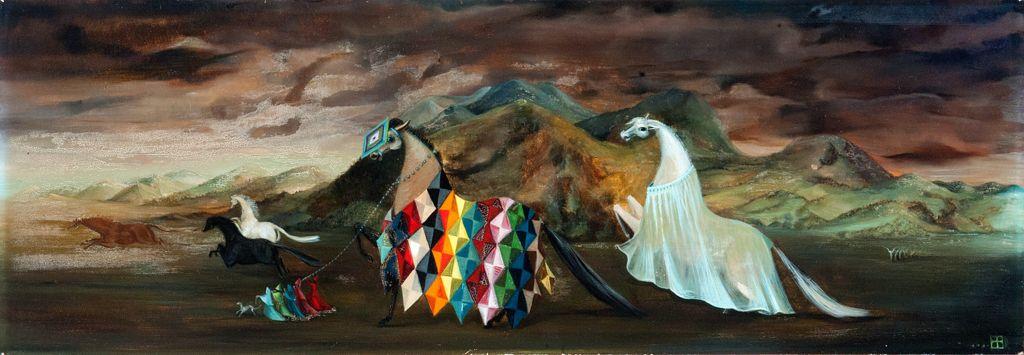
Megalomaniacs, 1967 by Bridget Tichenor (1917-1990)
I’ve been listening to William Friedkin read his 2013 memoir The Friedkin Connection on my daily commute and loving it so far. The first chapter, “Chicago,” details the making of his first film, a 1962 documentary called The People vs. Paul Crump. A chance meeting with a death row priest at a cocktail party leads Friedkin to make his documentary, despite having no real knowledge of how to make a film at all. (He even claims to have never have seen a documentary film at that point in his life.) From his memoir:
[Cinematographer Wilmer] Butler and I were editing the film each night as we got the dailies from the lab. Most of the time we worked at my apartment. My mother would make us lunch and dinner, and we’d work on weekends twelve or fifteen hours a day, with an old pair of rewinds and a 16 mm. viewer and splicer we had “liberated” from the WGN-TV newsroom. Splicing was done with glue, not clear cellophane tape, which came in several years later.
One evening, Ernie Lucas, a veteran TV director, happened to pass by on his way to pick up copy for the ten o’clock news. He was surprised to see us in a film editing bay in the newsroom, since we were involved exclusively with “live” telecasts. He expressed shock that we were editing our negative, and that we were not handling it carefully with white cotton gloves. “What are you guys doing?” he asked. We told him we were working on a short film for our own amusement. “But you’re cutting the negative; you’re not supposed to even touch it.”
“Why not?” We were confused.
Ernie was patient.
“Don’t you know that camera negative is never touched until you have a final edited work print?” he asked.
“What’s a work print?”
Ernie explained that a work print was made immediately after the negative was developed, and that it was this work print that you cut and recut, and only when you were finished was the negative conformed to the work print version. Neither did we know that the work print, negative, and 16 mm. sound track had to be edge-numbered simultaneously, so that picture and sound could be synchronized. Consecutive serial numbers were printed on the edges of these elements at intervals of a foot. Since we didn’t realize this, parts of our negative were scratched and torn, spliced and respliced, until we could belatedly apply edge-numbering. We had to “match” our synch-sound interviews by lip-reading, which took weeks, and we had no idea how to achieve a final print.

The Burial of the Sardine, c. 1812–19 by Francisco Goya (1746-1828)
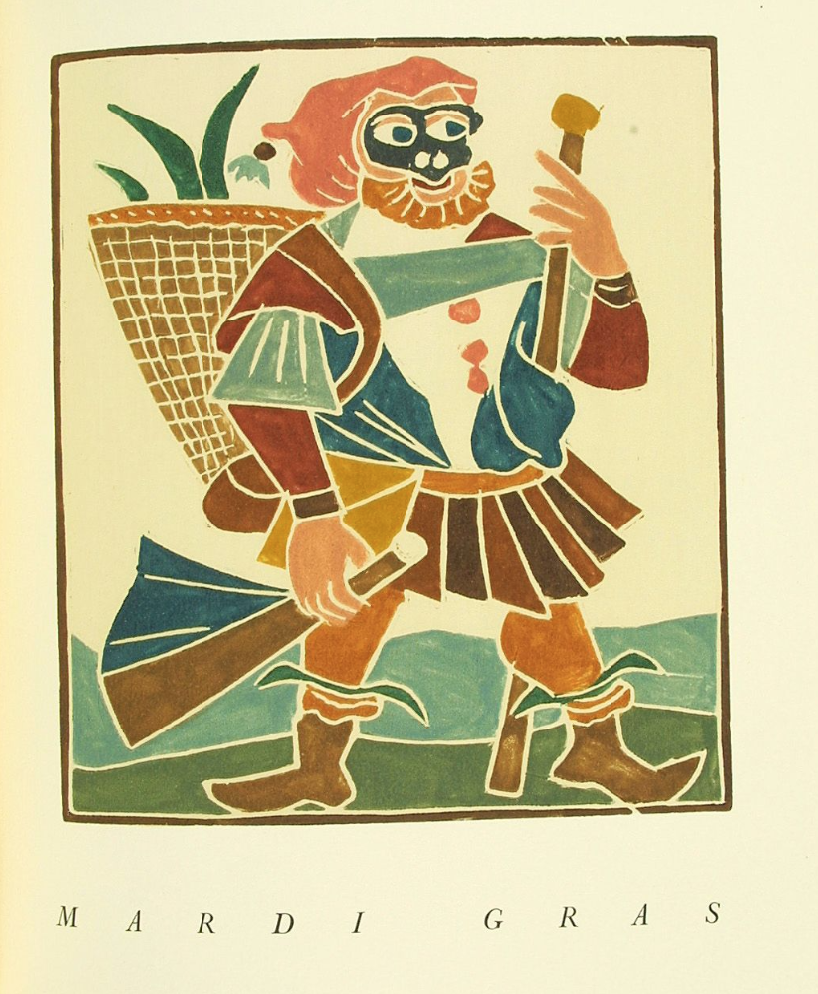
Mardi Gras, 1943 by André Derain (1880 – 1954).

Small Portrait, 1950 by Kay Sage (1898-1963)
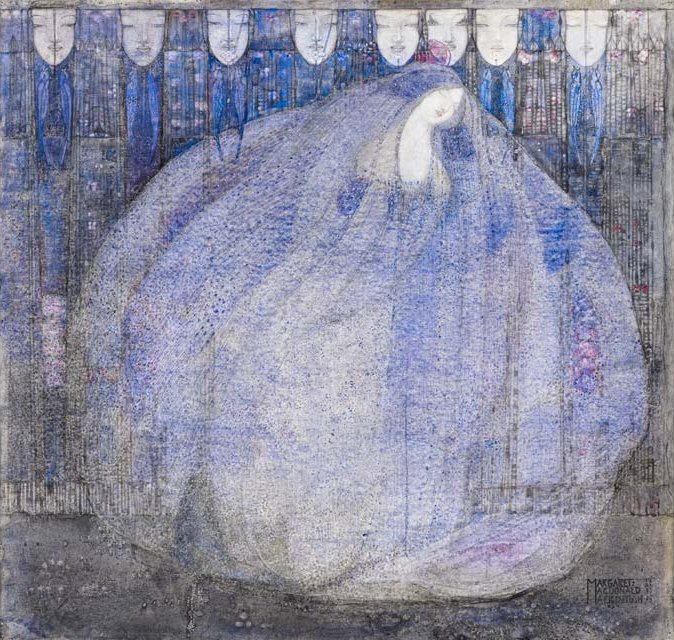
The Mysterious Garden, 1911 by Margaret Macdonald Mackintosh (1864–1933)


The Doors of Perception, 1955, Aldous Huxley. Perennial Library (1970). Cover design by Pat Steir. 79 pages.
Here’s Huxley on mescaline, marveling at the folds of cloth in Botticelli’s Judith:
Civilized human beings wear clothes, therefore there can be no portraiture, no mythological or historical storytelling without representations of folded textiles. But though it may account for the origins, mere tailoring can never explain the luxuriant development of drapery as a major theme of all the plastic arts. Artists, it is obvious, have always loved drapery for its own sake – or, rather, for their own. When you paint or carve drapery, you are painting or carving forms which, for all practical purposes, are nonrepresentational-the kind of unconditioned forms on which artists even in the most naturalistic tradition like to let themselves go. In the average Madonna or Apostle the strictly human, fully representational element accounts for about ten per cent of the whole. All the rest consists of many colored variations on the inexhaustible theme of crumpled wool or linen. And these non-representational nine-tenths of a Madonna or an Apostle may be just as important qualitatively as they are in quantity. Very often they set the tone of the whole work of art, they state the key in which the theme is being rendered, they express the mood, the temperament, the attitude to life of the artist. Stoical serenity reveals itself in the smooth surfaces, the broad untortured folds of Piero’s draperies. Torn between fact and wish, between cynicism and idealism, Bernini tempers the all but caricatural verisimilitude of his faces with enormous sartorial abstractions, which are the embodiment, in stone or bronze, of the everlasting commonplaces of rhetoric – the heroism, the holiness, the sublimity to which mankind perpetually aspires, for the most part in vain. And here are El Greco’s disquietingly visceral skirts and mantles; here are the sharp, twisting, flame-like folds in which Cosimo Tura clothes his figures: in the first, traditional spirituality breaks down into a nameless physiological yearning; in the second, there writhes an agonized sense of the world’s essential strangeness and hostility. Or consider Watteau; his men and women play lutes, get ready for balls and harlequinades, embark, on velvet lawns and under noble trees, for the Cythera of every lover’s dream; their enormous melancholy and the flayed, excruciating sensibility of their creator find expression, not in the actions recorded, not in the gestures and the faces portrayed, but in the relief and texture of their taffeta skirts, their satin capes and doublets. Not an inch of smooth surface here, not a moment of peace or confidence, only a silken wilderness of countless tiny pleats and wrinkles, with an incessant modulation – inner uncertainty rendered with the perfect assurance of a master hand – of tone into tone, of one indeterminate color into another. In life, man proposes, God disposes. In the plastic arts the proposing is done by the subject matter; that which disposes is ultimately the artist’s temperament, proximately (at least in portraiture, history and genre) the carved or painted drapery. Between them, these two may decree that a fete galante shall move to tears, that a crucifixion shall be serene to the point of cheerfulness, that a stigmatization shall be almost intolerably sexy, that the likeness of a prodigy of female brainlessness (I am thinking now of Ingres’ incomparable Mme. Moitessier) shall express the austerest, the most uncompromising intellectuality.
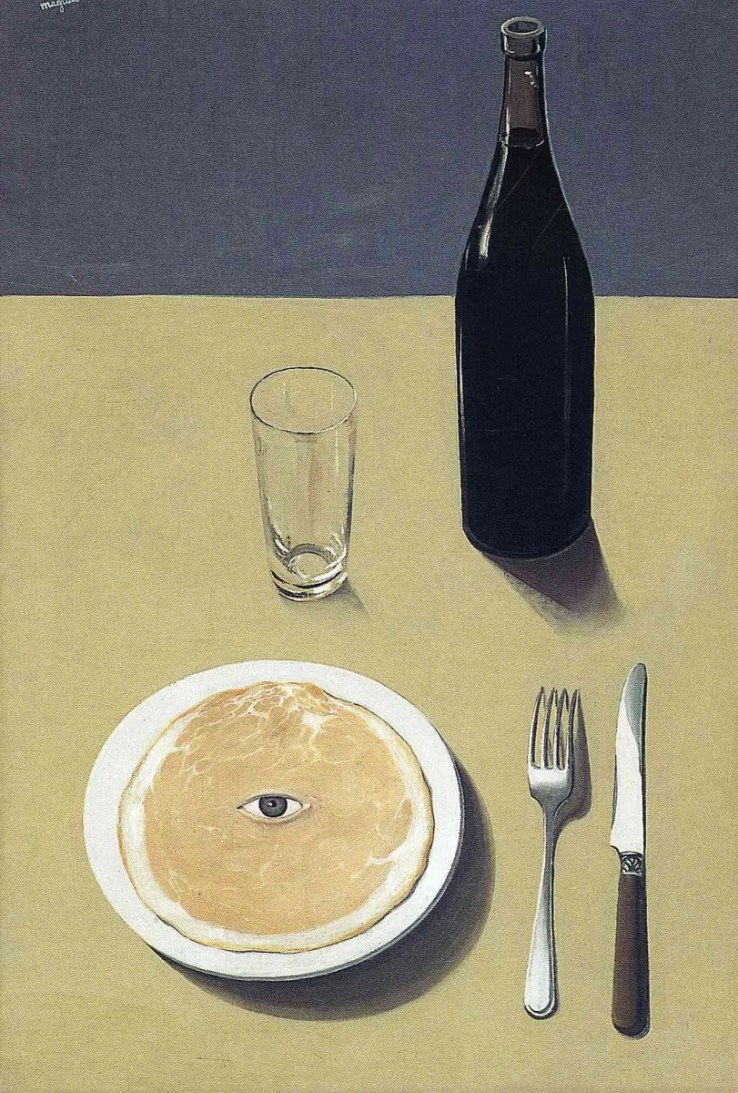
The Portrait, 1935 by Rene Magritte (1898-1967)

Rainbows: March, 1975 by Peter Lister (b. 1933)

March, 1979 by Alex Colville (1920-2013)
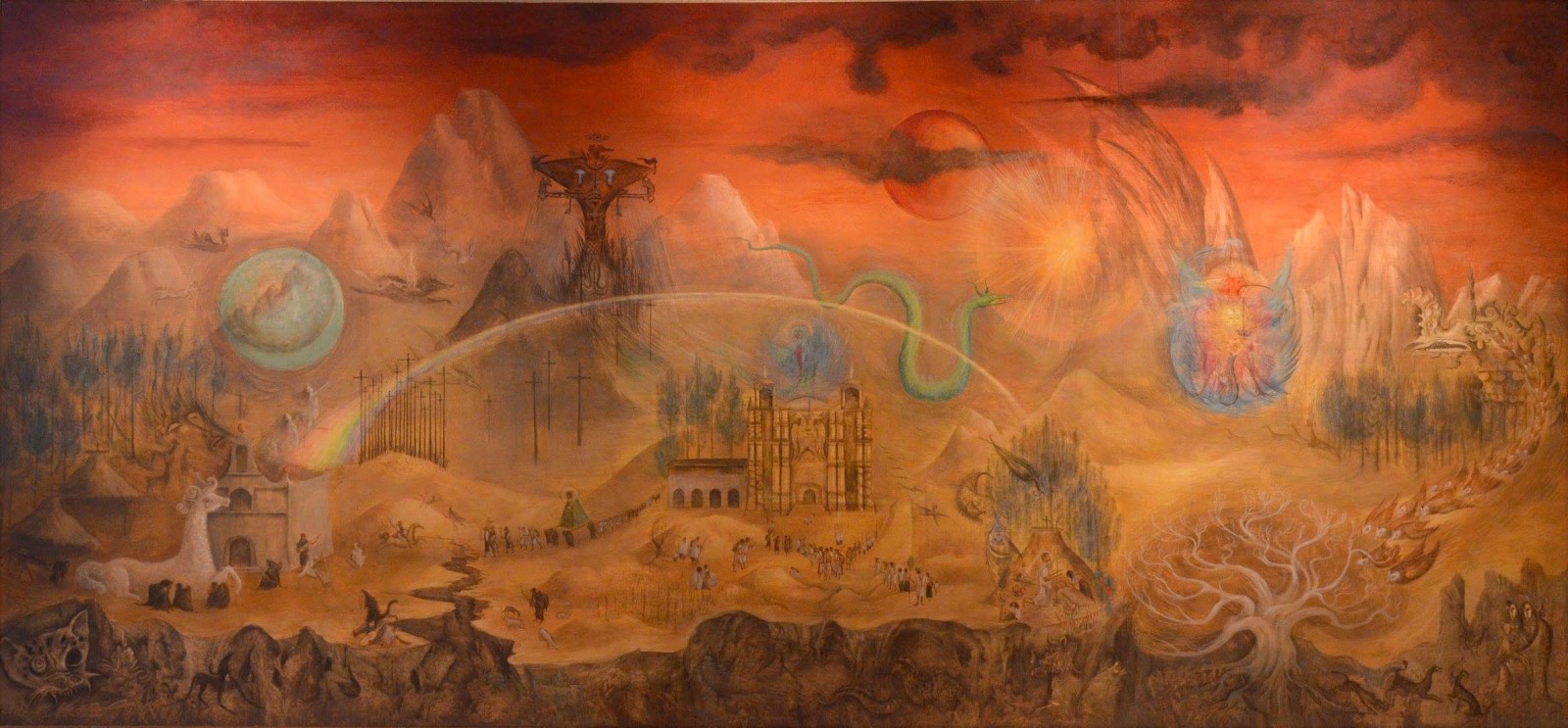
El mundo mágico de los mayas (The Magical World of the Mayas), 1964 by Leonora Carrington (1917-2011)


Pissing in the Snow & Other Ozark Folktales, collected and transcribed by Vance Randolph with annotations by Frank A. Hoffmann. Avon Bard (1977). No cover artist credited. 239 pages. A tale from the collection:
“Have You Ever Been Diddled?”
Told by J. L. Russell, Harrison, Ark., April, 1950. He heard this one near Berryville, Ark., in the 1890’s.
One time there was a town girl and a country girl got to talking about the boys they had went with. The town girl told what kind of a car her boyfriends used to drive, and how much money their folks has got. But the country girl didn’t take no interest in things like that, and she says the fellows are always trying to get into her pants.
So finally the town girl says, “Have you ever been diddled?” The country girl giggled, and she says yes, a little bit.
“How much?” says the town girl. “Oh, about like that,” says the country girl, and she held up her finger to show an inch, or maybe an inch and a half.
The town girl just laughed, and pretty soon the country girl says, “Have you ever been diddled?” The town girl says of course she has, lots of times. “How much?” says the country girl. “Oh, about like that,” says the town girl, and she marked off about eight inches, or maybe nine.
The country girl just set there goggle-eyed, and she drawed a deep breath. “My God,” says the country girl, “that ain’t diddling! Why, you’ve been fucked!”
[J1805.5]
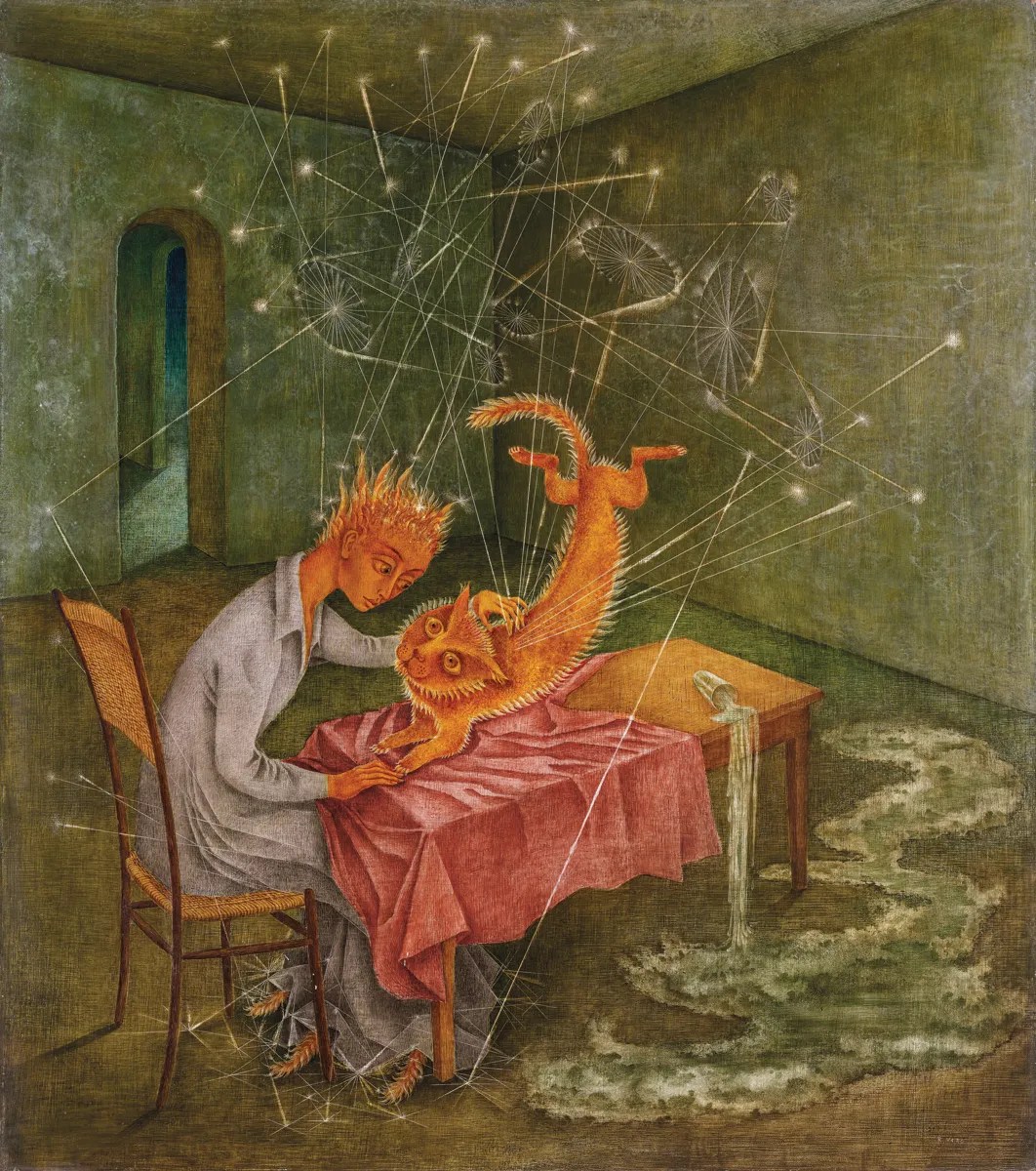
Simpatía (La rabia del gato) (Sympathy, the Cat’s Rage), 1955 by Remedios Varo (1908-1963)
“Legend”
by
Dorothea Tanning
From Surrealist Women: An International Anthology (ed. Penelope Rosemont). “Legend” first appeared in Max Ernst’s At Eye Level and Paramyths, the catalog of the “Max Ernst: 30 Years of His Work” exhibition in Beverly Hills in 1949.
A young sinner grew weary of Olympus. He went to the head of the stairs where the three graces sat knitting sweaters for their earthly sons. (Winter was at hand.) Each of them smiled secretly at the young sinner, each believing she was the only one whom he had provided with pleasant memories. But they wouldn’t let him pass.
“It’s a cruel place,” said one. “How will you nourish yourself?”
“On destinies,” he answered promptly. “Take the laughter of seven maidens, stir in several of the moonbeams that fall across their beds. Add the head of a procession, a few umbrella ribs and a tale of hilarious crime. Season it madly and serve on collection plates.”
“But,” said another, barring the way, “Where will you go?”
“To picnics,” said he, making a perfect triple pirouette.
The third grace laid her knitting in her lap where it formed a pretty, medium-sized figleaf. She turned her eyes up to him and said softly, “What will you do?”
She looked so charming that for a moment the young sinner hesitated. Perhaps he wouldn’t go after all. But he recovered himself and said:
“Please be advised that I will vaccinate the world with a desire for violent and perpetual astonishment. Disguised in my own presence, I will conduct a horde through the five aqueducts of knowledge, after which their guardians will ask the authorities for replacements. I will provoke prodigies. When I have built the torpid town, certain words will fall into disuse: eminent prominent peerless noble honorable lordly stately august princely majestic sacred and sublime. I will make rhapsodies from grains of sleep. I’ll wrap up a manmaking hat and drop it in the mailbox. I’ll hold a revolver up to nature. When professional critics lose themselves in the swamp I’ll arrange a delegation of chimeras with their own language and their own secrets. As for the night, I will discover all its phases. And I will fall in love.”
The three graces had been looking rather sleepy; but at the last words they opened their mouths in horror, then picked up their knitting and fled.
With his glittering blue eyes the young sinner sent lightning strokes after them—a parting gift. Then he ran down the steps, two at a time.
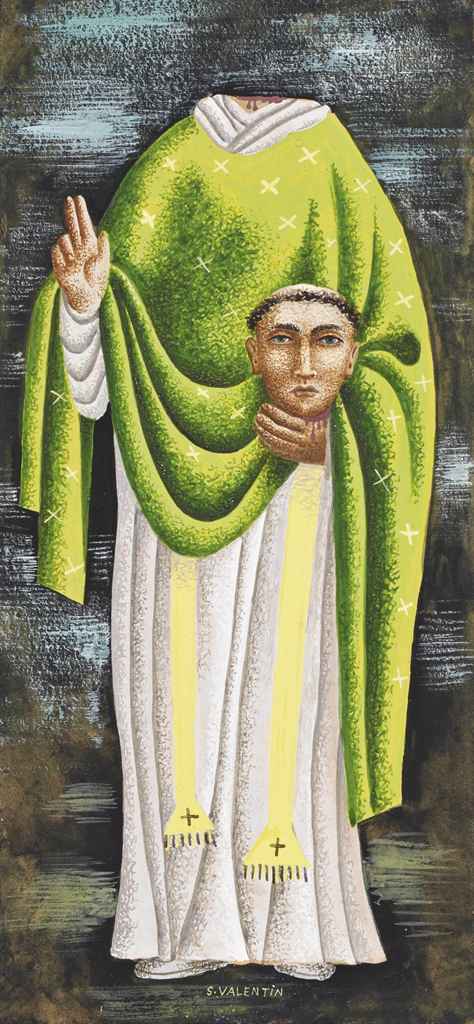
Saint Valentine, 1930 by Jean Hugo (1894-1984)
 Biblioklept