In February of 2002, three friends came to visit me and my girlfriend in our tiny apartment in Tokyo. We had been living there for just a few months, since September of 2001. I was ostensibly teaching English, but really just serving as a conversation partner for overworked salarymen, bored hobbyists, and hopeless teens. These folks were essentially being scammed by a national corporation pretending to be a school for language instruction. It was my first job out of college. I loved Tokyo and I had made a ton of friends and I was tired all the time. It was famous times for me, and I was thrilled that my friends came to share a week of it.
My friends brought with them a care package, bolstered with items from my parents and other friends. The care package included things that weren’t easy to get in Tokyo, like taco shells and NyQuil. There was a bottle of Jack Daniels that never made it to Japan. My friends drank it on the airplane, which I guess you could still do just a few months after 9/11. There was also the October 2001 issue of Harper’s Magazine.
*
Last month my dean called me into his office and explained that I would have to move out of my office. We would all have to move out of our offices; our beloved shabby building was to be gutted that summer, sooner than to be expected, and the college would not be able to store much beyond a few file cabinets and boxes of books. Take all that art home, etc. This was a stressful chore at the end of term, not just because it necessitated moving physical items at the same time I had finals to grade and students to meet with (students tend to show up to office hours a lot this time of year), but also because I had essentially been using my office as a proxy storage facility for the last decade, and it was crammed with stuff I probably needed to just, like, hell, go ahead and part with.
I filled boxes with old mass-market paperbacks that had migrated, triple-stacked, to my shelves over the years, and took them to classrooms, where students swooped on them with an eagerness that I found frankly shocking. I gave away posters and framed art, little plastic toys and boxes of permanent markers. I surrendered a green Underwood typewriter I’d lugged around for years to a student who promised to write poems on it. I ditched hard copies of over a decade of work I’d originated–lecture notes and quizzes and the like. And I shredded years and years of student work. All of this was cathartic and a little exhausting.
The materials in my office represented, in a way, more than a decade of my unwillingness to fully surrender the crap I’d accumulated over the years. My children needed their own space for their own things, and scores of cheap paperback books, a ribbonless typewriter, cheap ¥100-shop masks, Simpsons Lego figurines, and boxes and binders of papers had to go somewhere. There were shelves in my office though. Filing cabinets too. And I filled one of those filing cabinet drawers with around a hundred back issues of Harper’s Magazine that I could not bear to part with.
*
Beginning in 1998, I subscribed on and off to Harper’s for twenty years. The magazine’s journalism and short stories were a developmental influence on me, and its editorial position in the early years of Bush 2 were especially important to how I conceived of both politics and rhetoric. The book reviews—John Leonard’s in particular—were always a favorite, too, as was “Harper’s Index,” a monthly poem comprised of data.
But it was the “Readings” section of Harper’s that I loved the most. Short extracts—musings, art, poetry, petitions, found poetry, jokes, essays, letters, lists, rebukes, rejoinders, absurdities, profundities, hilarities. And art! Lots and lots of art–photography, oil painting, drawings, and so on. Harper’s “Readings” section was like a curated feed of the best content, before such a vile term as “curated feed of the best content” existed. (Please forgive me for typing “curated feed of the best content” and know that I will never forgive myself). “Readings” influenced this blog, Biblioklept, tremendously.
*
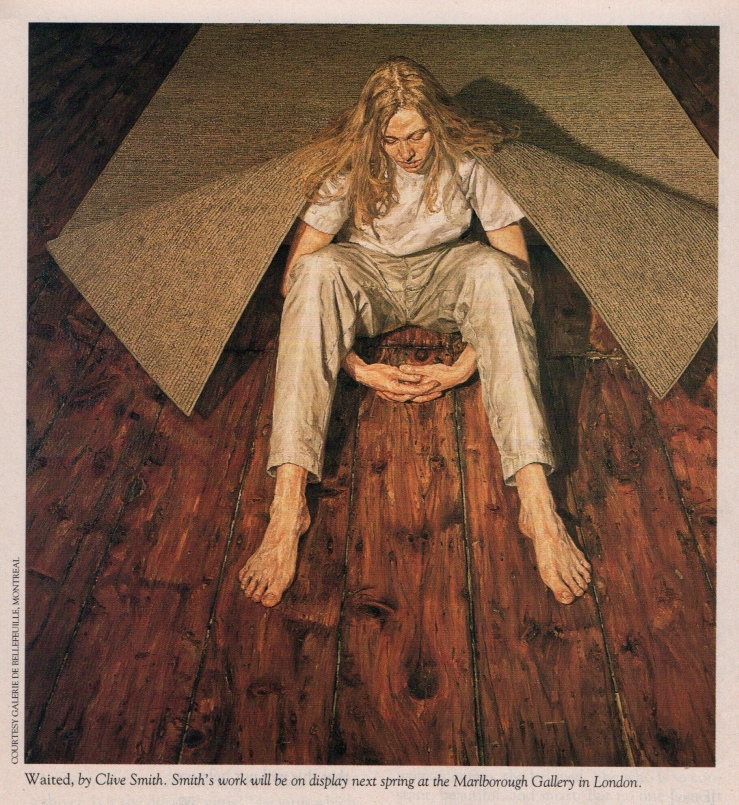
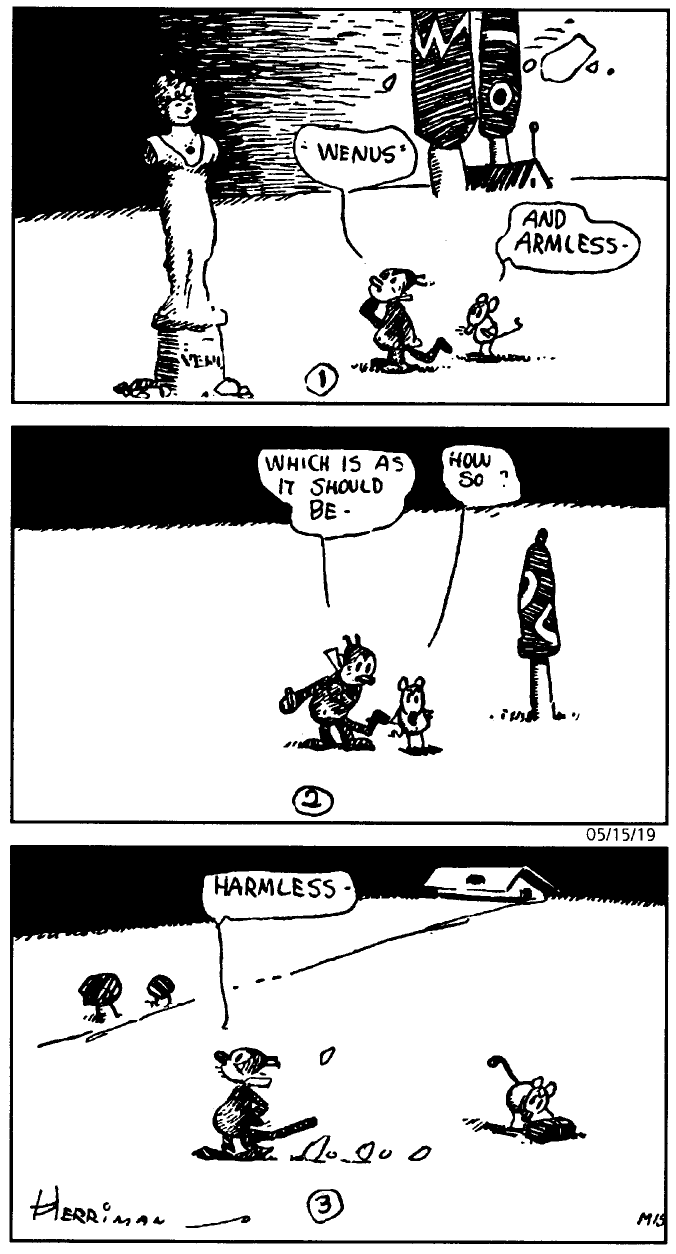
The “Readings” section of the October 2001 issue of Harper’s Magazine does not feature any big names, other than Lucian Freud. (His painting Leigh on Green Sofa is there, but is not as intriguing as Clive Smith’s Waited, which looks like it could be a Freud painting from a previous era). The most memorable bits of this “Readings” section are a selection of excerpts from fourth graders’ essays about their experiences with their school’s rat infestation (“I saw a rat in the classroom. It was big and weird and I saw it by Sierra’s shoes. I saw it by the trash”), and this riddle:

*
So I disposed of, by giving away or recycling or cutting up, almost every issue of Harper’s I’d accrued over the years. By “cutting up,” I mean that I cut sections out of certain issues—mostly bits from the “Readings” section, or essays, or short stories—stuff from Margaret Atwood, William Burroughs, Wells Tower, Ursula Le Guin.
I ended up keeping eleven issues, including the October 2001 issue.
*
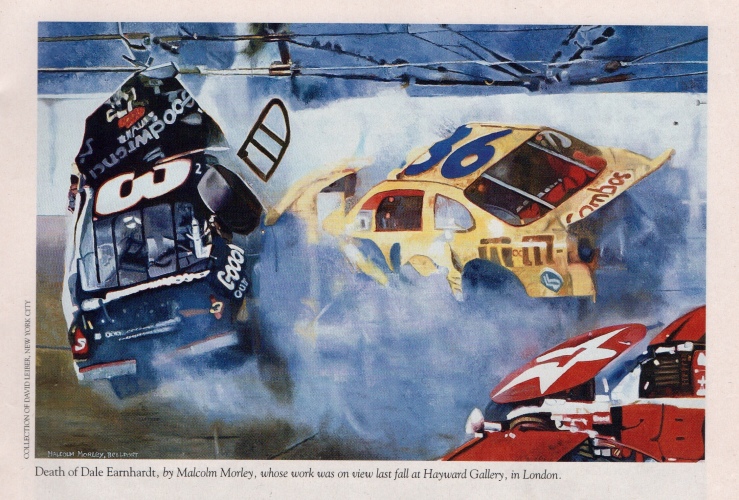
How did I decide what to keep? In some cases, I knew what I was looking for in some cases—a “Folio” section by William T. Vollmann that was later collected in Imperial, for instance, or stories and essays by old masters like William Gass and Robert Coover. Also, the double-sized June 2000 issue, the 150th Anniversary edition loaded with ringers, both in “Readings” (Barry Hannah, Gertrude Stein, Orson Welles, Mark, Twain, JL Borges) and in the magazine proper (Tom Wolfe, Russell Banks, Ha Jin, Annie Proulx). For the most part, my aim was to cut out stories or essays, but sometimes I’d end up with an issue to of-its-time to dispose of. The February 2008 of Harper’s was very 2008, for instance: David Foster Wallace, Slavoj Žižek, Malcolm Morley’s painting Death of Dale Earnhardt—
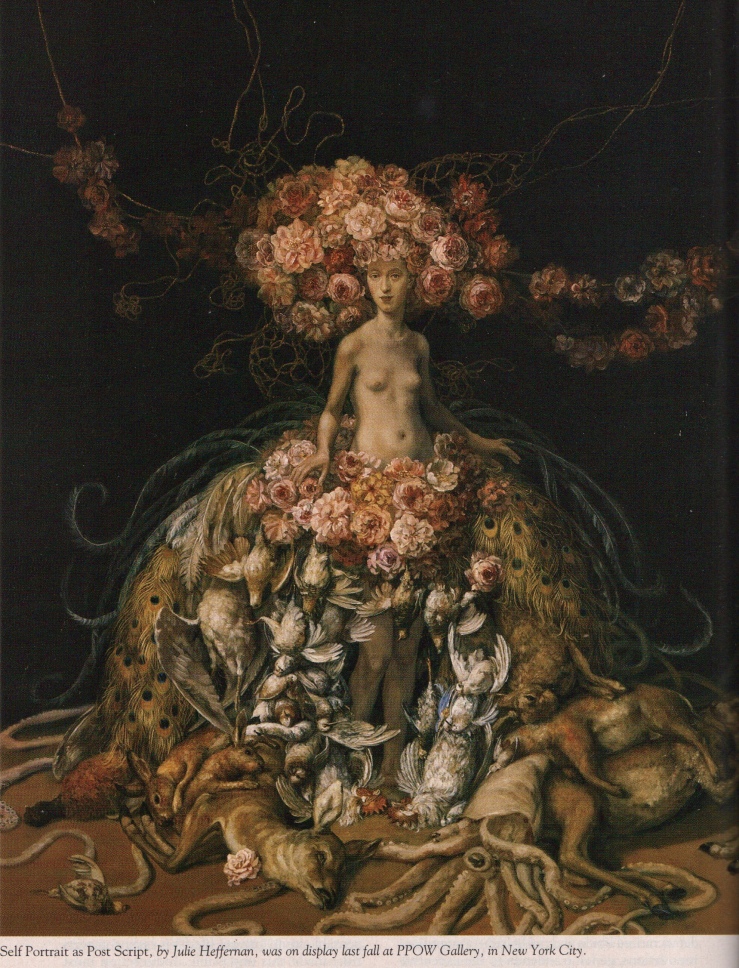
–and Ursula Le Guin’s essay “Staying Awake: Notes on the Alleged Decline of Reading.” As I went to cut out the William Gass essay on Malcolm Lowry from the January 2008 issue, I browsed the contents long enough to see a story by Ben Marcus and readings from Robert Walser and Grace Paley. There’s also a full-page image of Julie Heffernan’s painting Self Portrait as Post Script.
*
(I have stolen and skewed the title of Julie Heffernan’s painting for the title of my own silly blog post, which is, after all, simply my own postscript, my own unnecessary, sentimental, messy afterthought on throwing out years and years of papers, an afterthought bumbling about in the semblance of a crude self portrait, a little sketch about then and now).
*
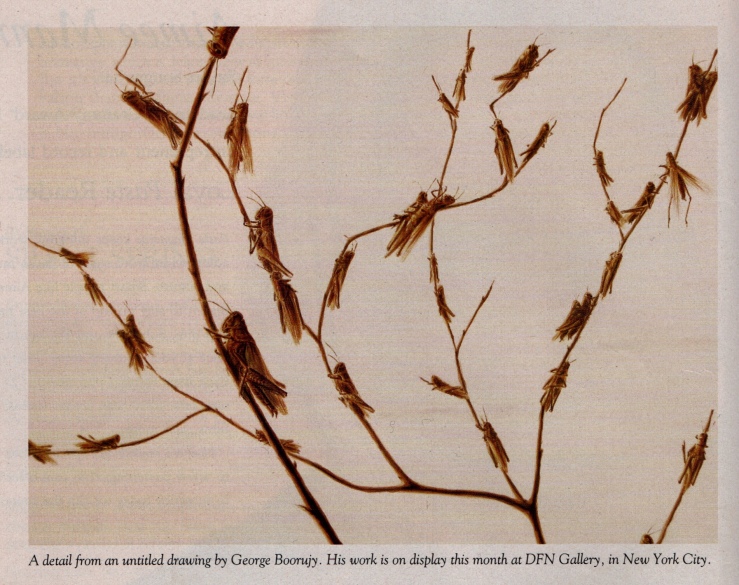
Gass’s name on the cover from an issue one year later, January 2009, saved a section memorializing David Foster Wallace, including selections from Zadie Smith, George Saunders, and Don DeLillo. (The issue also has an exhaustive triple-length “Harper’s Index” titled “A retrospective of the Bush era). A 2005 issue—again Bill Gass’s name on the cover—included a drawing by George Boorujy, who I interviewed on this site in 2012.
For the most part though, I threw issues away.
*
I did not throw out the October 2001 issue of Harper’s. I probably read it half a dozen times back in 2002. It would be a lie to say the issue is tattooed into my brain, but it’s there—like a kind of psychic residue, a blurry vibe of a weird time in my young life. I most remembered “All God’s Children Can Dance,” a short story by Haruki Marukami, an author I’ve never thought was particularly good—but I loved this story. It was the first Marukami I read and it opened with the line, “Yoshiya woke with the worst possible hangover,” and included details like riding the Marunouchi Line, the train I took every day or almost every day to work in Shinjuku to chat about my Florida lifestyle with sweating business guys and lonely housewives. The story is very Raymond Carver (it’s translated by Jay Rubin) and not especially good, I realize, as I stop to reread it now, but I love it.
The October 2001 issue of Harper’s Magazine also features a charming essay about dinosaurs as pop culture by Jack Hitt, a sad riff on Alzheimer’s by Eleanor Clooney, and a lead story about troubles in Palestine by Chris Hedges. None of these selections are particularly remarkable. What’s strange to me about the issue, I guess, is that it bears absolutely no trace whatsoever of the September 11th terrorist attacks. It’s as if the event simply had not happened yet, which it hadn’t, at least for a magazine already planned and executed weeks ahead of time. I’m guessing that the issue probably was on sale in September of 2001. So the October 2001 issue of Harper’s was already a relic when it came to me in February of 2002; the world had shifted at the time of its publication. By the time I read it the U.S. military had been in Afghanistan for four months already. They are still there today.
This publishing lag in the October 2001 issue of Harper’s seems utterly bizarre in retrospect, especially given the tenor of issues a few months later. I kept the January and March 2002 issues, both brought over by a friend who visited me in Tokyo (maybe the worst house guest I’ve ever had. We sang karaoke until 8am on my 23rd birthday). Both issues are suffused in the horror of the new normal, and both feature fantastic short fiction — “The New Female Head” by Ben Marcus in the January issue, and Adam Johnson’s “Teen Sniper,” a tale that could give George Saunders a run for his money.
*
I searched just now for links to free online versions of “The New Female Head” and “Teen Sniper,” but I couldn’t find any. If you have a subscription to Harper’s, you can read them there, online, as pdfs or as, uh, microfiche. I haven’t used the digital archive in a long time, but I recall its being clunky and somewhat hard to use. And even if it can lead you to a pdf version of, say, an old Steven Millhauser or Don DeLillo story, the online archive simply can’t replicate the stochastic reading experience of flipping through a magazine, tumbling from weird short readings to art to lists of statistics before settling down in a long feature essay (or skimming through one of Lapham’s lectures).
My subscription is lapsed now—I don’t think the magazine is as good as it used to be—but I’ll occasionally peruse an issue at the library or flick through it at the bookstore. I’m sure something on some future cover will tempt me to commit to purchasing the issue and rounding out my archive to a nice dozen issues. For now though, I’m content to skim through this old issue from October 2001, in which Lewis Lapham, in a “Notebook” column dated September 1, 2001, concludes, quite ironically, that “Fortunately we don’t live in times that try men’s souls.” And then maybe I’ll skim through some of the later issues I held on to and see how that assessment panned out.