Saul Steinberg Talks

Reclining Woman with Red Blouse — Egon Schiele

reclining-woman-with-red-blouse-1908

Reclining Woman with Red Blouse, 1908 by Egon Schiele (1890-1918)

Cover Girl — Frank Bowling

frank-bowling-cover-girl-1963-64-acrylic-on-canvas-149-6-x-101-4-cm

Cover Girl, 1964 by Frank Bowling (b. 1934)

Head of a Peasant (Study for the Potato Eaters) — Vincent van Gogh

head-of-a-peasant-study-for-the-potato-eaters-18851

Head of a Peasant (Study for the Potato Eaters), 1885 by Vincent van Gogh (1853-1890)


Blog about November reading (and blogging) goals

img_1447

For the past few days I’ve felt as if I would never put one word after another again, that I would never put together a sentence, string together clauses and sling them out into the world. This previous statement is hyperbole and I am silly—but even simple emails have seemed the acme of wretched futility to compose. Chalk it up to a mild head cold; chalk it up to too many essays to grade; chalk it up to anxiety of (fear of) writing. But I feel like I used to want to feel like I needed to write, right? On 1 Oct. 2018 I wrote a silly post on this weblog called “Blog about October reading (and blogging) goals,” in which I set a goal to blog “every day, even about nothing,” which I failed to achieve.

did actually achieve some of the reading goals expressed in that October goals blog though: I finished George Eliot’s Silas Marner; I made a bigger dent in Moderan, David R. Bunch’s cult dystopian novel; I finally read William Gaddis’s novel Carpenter’s Gothic; I actually returned and did not keep forever a book I borrowed from a friend; I did not gobble up Paul Kirchner’s Hieronymus & Bosch but rather limited myself to one or two cartoon strips a day (or sometimes, like, five).

So for November—

I’ve read the first two stories in Chris Power’s debut collection Mothers and they are good (the collection is available in the US in January 2019; I should have a full review then).

Tristan Foster’s collection Letter to the Author of the Letter to the Father is very much my weird cup of weird tea.

David Bunch’s Moderan deserves a big proper essay. I’ve suggested that our zeitgeist surpasses the parodic powers of postmodernism’s toolkit, but Moderan anticipates and slices up Our Bad Times.

Part of my anxiety about writing comes from having failed three times now to write a proper review of Conversations with Gordon Lish, which is the kind of self-deconstructing performance of writing about writing that is difficult to describe or analyze; it’s the sort of thing you simply want the reader to read.

I started the audiobook of William Gaddis’s novel The Recognitions, and have ended up not only reading my Penguin edition in tandem—a sort of re-rereading—but have also been flirting with The Gaddis Tapes1 and Letters of William Gaddis.  (This summer I said I’d reread The Recognitions: is this that?). I don’t really know what I want from this material, and I certainly don’t suggest it as anything approaching ancillary or auxiliary “help” with Gaddis’s project—I mean, in his Paris Review interview Gaddis paraphrases his hero and explains why we shouldn’t look for keys to art in the artist:

I’d go back to The Recognitions where Wyatt asks what people want from the man they didn’t get from his work, because presumably that’s where he’s tried to distill this “life and personality and views” you speak of. What’s any artist but the dregs of his work: I gave that line to Wyatt thirty-odd years ago and as far as I’m concerned it’s still valid.

—but hey look I know what I just did—took my cue from the artist in explaining the artist’s art. So. Oh, hey, here’s a great little segment from a letter Gaddis to his mama (from Mexico City) in April, 1947:

Could you then do this?: Send, as soon as it is conveniently possible, to me at Wells-Fargo:

My high-heeled black boots.

My spurs.

a pair of “levis”—those blue denim pants, if you can find a whole pair

the good machete, with bone handle and wide blade—and scabbard—if

this doesn’t distend package too much.

Bible, and paper-bound Great Pyramid book from H—Street.

those two rather worn gabardine shirts, maroon and green.

Incidentally I hope you got my watch pawn ticket, so that won’t be lost.

PS My mustache is so white and successful I am starting a beard.

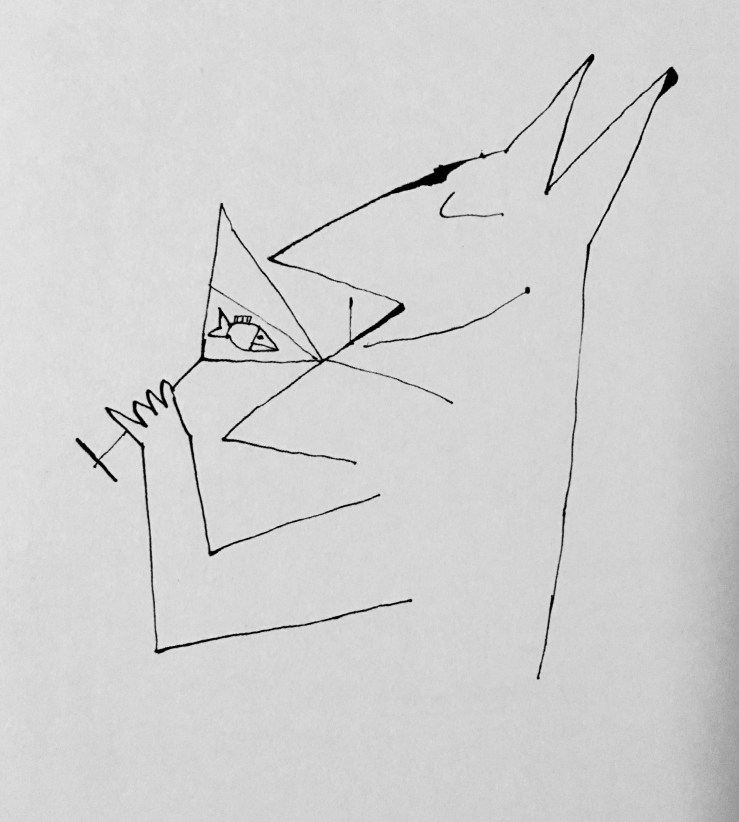
The same day I got The Labyrinth, a collection of mid-century cartooning by Saul Steinberg (new from NYRB, I read a passage in The Gaddis Tapes where Gaddis quotes his friend, Saul Steinberg. That same day my son, eight, went through the whole volume, and asked me what it was, how I was supposed to write about it, etc. Still not sure, but it’s great, heroic, etc. and I hope to post a review at The Comics Journal later this month. Here is Steinberg’s Quixote:

img_1444

And I like to pretend this is his illustration of some Gaddis character at a party in The Recognitions (even if I recognize it is not):
img_1445

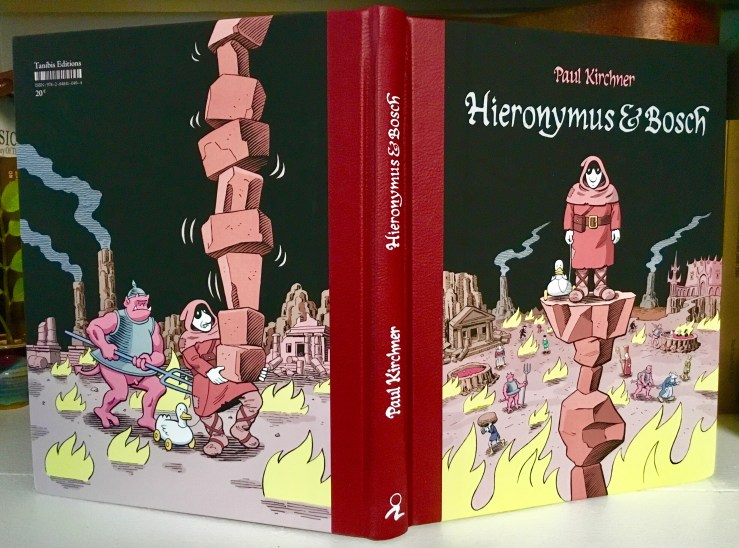
Bottom of the stack is Paul Kirchner’s latest Hieronymus & Bosch, a sort of MAD Magazine take on eternal damnation that puts the scatology in eschatology. Great stuff.

Not pictured in the stack is Angela Carter’s 1972 novel The Infernal Desire Machines of Doctor Hoffman, which is by my bed and which I keep falling asleep to. It deserves better from me; or maybe it’s a bit of evidence in the emerging truth that I can’t read before bed most of the time most of these days. (Separate blog post, perhaps—chalk it up to a head cold; chalk it up to too many essays to grade; chalk it up to two kids; chalk it up to too much read wine; chalk chalk chalk).

Hope to do better than this in the next 29 days.


Knight, Christopher J., William Gaddis, and Tom Smith. “The New York State Writers Institute Tapes: William Gaddis.” Contemporary Literature 42, no. 4 (2001): 667-93. doi:10.2307/1209049.

“Bogus Sausages” — Bram Stoker

“Bogus Sausages”

a chapter from

Famous Impostors (1910)

by

Bram Stoker


Two weary porters at the King’s Cross terminus of the Great Northern Railway were thinking about going home, when a breathless, simple-looking countryman rushed up to them with anxious enquiries for a certain train. It had gone. He was crushed. “Whatever was he to do? He had been sent up from Cambridge with a big hamper of those sausages for which the University town is celebrated—a very special order. Was there no other train?” “No.” The poor fellow seemed overwhelmed. “As it is too late to find another market,” he complained, “the whole lot will be lost.” Then a happy thought seemed to strike him as more of the railway men gathered round, and he inquired ingratiatingly, “Would you care to buy the sausages; if you would, you could have them for fourpence a pound? If I keep them, they will probably go bad before I can dispose of them.” The idea took—“Real Cambridge Sausages” at fourpence a pound was not to be sneezed at. The dainties, neatly packed in pounds, went like the proverbial hot cakes. Shouldering the empty basket, and bidding his customers a kindly goodnight, the yokel set off to find a humble lodging for the night. Grateful smiles greeted the purchasers when they got home. Frying pans were got out and the sausages were popped in, and never was such a sizzling heard in the railway houses—or rather never should such a sizzling have been heard. But somehow they didn’t sizzle. “They are uncommon dry; seem to have no fat in ’em,” said the puzzled cook. They were dry, very dry, for closer investigation showed that the “prime Cambridge” were nothing but skins stuffed with dry bread! The railway staff of King’s Cross were long anxious to meet that simple countryman from Cambridge.

Waves of November — Miles Cleveland Goodwin

waves_of_november

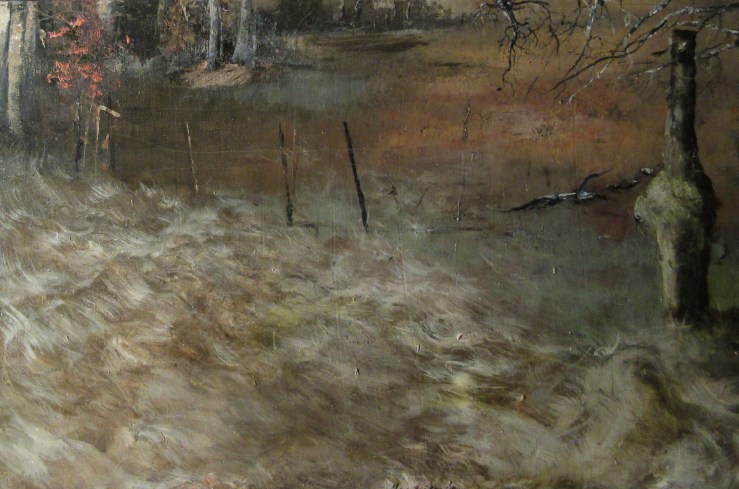
Waves of November, 2016 by Miles Cleveland Goodwin (b. 1980)

November — Alex Colville

november-1979large

November, 1979 by Alex Colville (1920-2013)

Jack O’ Lanterns 2018

img_1387

Happy Halloween!

Halloween — Julio Larraz

halloween

Halloween, 1973 by Julio Larraz (b. 1944)

Untitled (Mask) — William Eggleston

eggleston

Untitled (from Los Alamos), 1966-74 by William Eggleston (b. 1939)

Halloween Carnival — Henrik Martin Mayer

Screenshot 2018-10-11 at 7.15.22 PM

Halloween Carnival, 1938 by Henrik Martin Mayer (1909-1972)

Paul Kirchner’s Hieronymus & Bosch (Book acquired, 17 Oct. 2018)

img_1398

This afternoon, I started putting together a review of Biblioklept fave Paul Kirchner’s latest, Hieronymus & Bosch, and I realized that although I’d written a bit about it recently, I hadn’t put together one of these book acquired posts for it. So this is that post.

l

I really dig the book. It’s goofy and funny and has a lot of soul to it. Kirchner’s hapless hero Hieronymus seems like an extension—with difference—of the commuter, the hero of Kirchner’s bus strips. I hope to have a review up at The Comics Journal soon (where I reviewed Kirchner’s last collection, Awaiting the Collapse), but for now,  here’s publisher Tanibis’s blurb:

Meet the medieval miscreant Hieronymus and his wooden duck Bosch. When Hieronymus commits yet another petty crime, things go badly wrong and both are catapulted into a cartoonish version of Hell. There, lakes are made of lava (or, more often, poop) and an army of mischievous spiky-tailed devils bully the inmates and play impish pranks. Despite many gag-filled attempts at escaping this literal hell, Hieronymus and Bosch always end up being the butt of their trident-wielding guards’ most humiliating and painful jokes.

This book puts together about a hundred one-pagers filled with hilariously surrealistic and scatological gags by American comic book artist Paul Kirchner. Kirchner drew his inspiration from the medieval depictions of Hell by Dante and Hieronymus Bosch (duh!) as well as from the zany, almost sadistic humor of Warner Bros. cartoons like the Road Runner Show. Some of the stories published in this book originally appeared on the Adult Swim website.

Hieronymus & Bosch also evokes Kirchner’s famous comic strip series the bus. However, the bus‘ main character always got out from the practical jokes played on him unharmed, even if a bit confused. Hieronymus & Bosch‘s two heroes get burnt by lava, stabbed with tridents, used as a Q-tip by Satan himself, or just covered in a torrent of poop gushing down from above. Yet they carry on, finding fun where they can and refusing to abandon all hope.

The Happy Couple — Miles Cleveland Goodwin

3f6ae282-8341-4576-929b-4fee6bb3edaf

The Happy Couple, 2018 by Miles Cleveland Goodwin (b. 1980)

Halloween Carnival (detail) — Henrik Martin Mayer

Screenshot 2018-10-11 at 7.15.42 PM

Detail from Halloween Carnival, 1938 by Henrik Martin Mayer (1909-1972)

Haunted — Douglas Bourgeois

douglas-bourgeois-haunted2

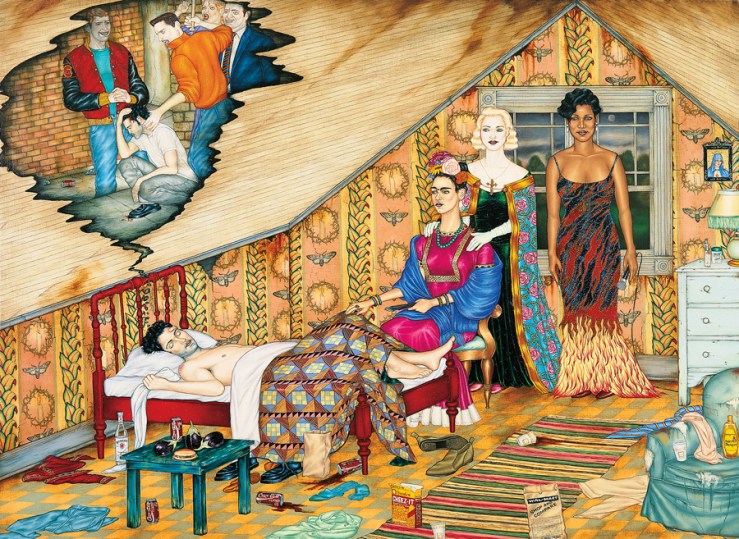
Haunted, 1990 by Douglas Bourgeois (b. 1951)

Haunted House — Morris Kantor

Screenshot 2018-10-28 at 11.59.29 AM

Haunted House, 1930 by Morris Kantor (1896-1974)