

Category: Art
Sunday Comics
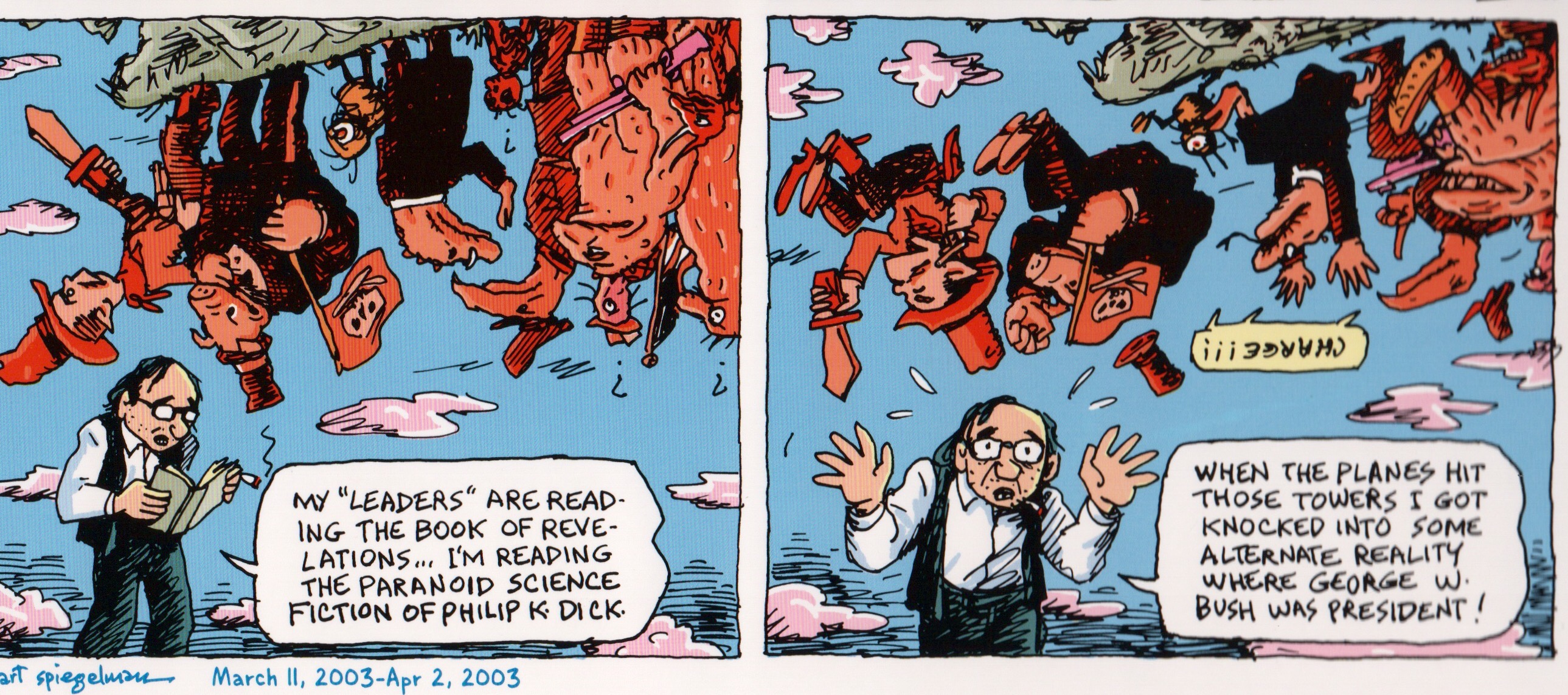
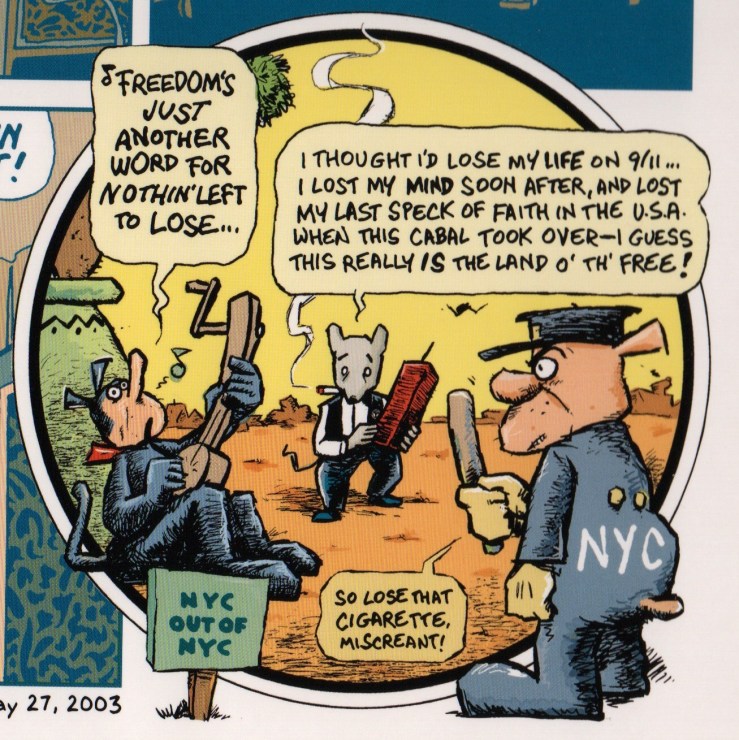

From In the Shadow of No Towers by Art Spiegelman, Pantheon, 2004.
Mental Complacency — Rene Magritte

Biblioklept is ten years old today, so ten sets of ten somethings
This blog is ten years old today. So here are ten sets of ten somethings.
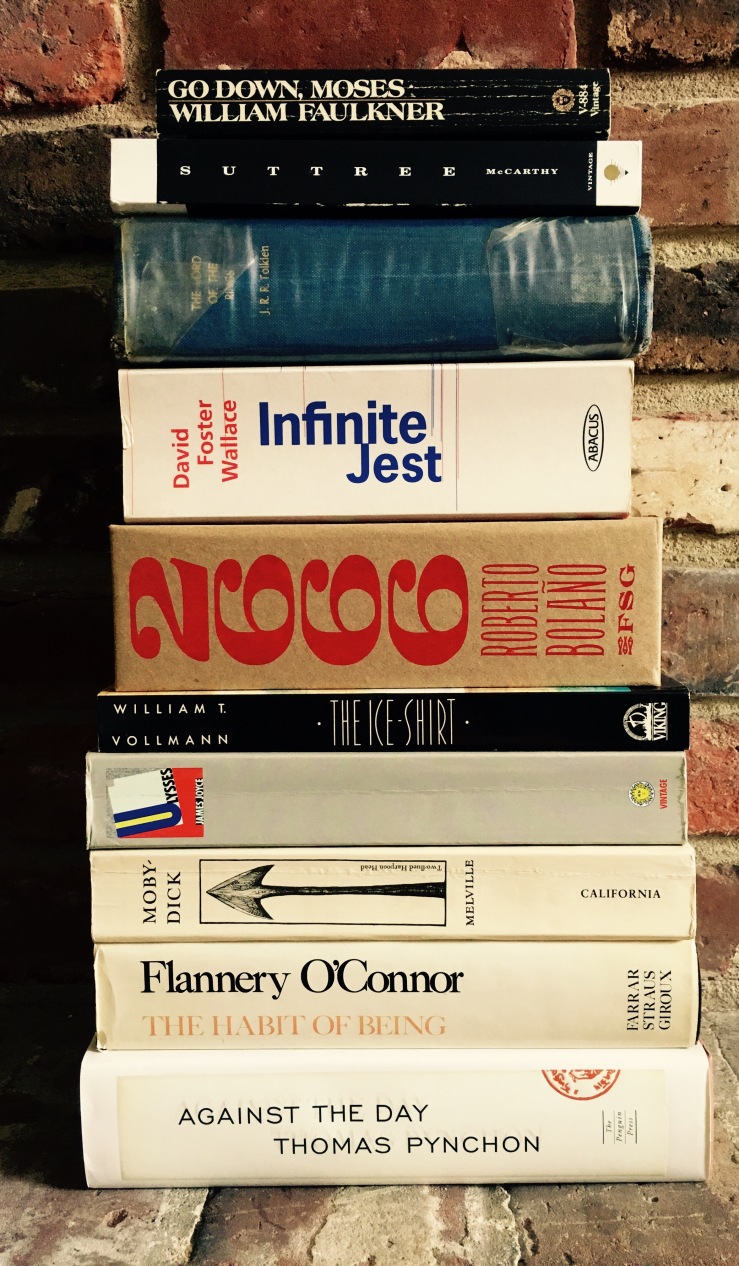
Just a picture of ten random books, which in no way should be thought of as a real list, okay?:
Ten great books I read in 2016:
- JR, William Gaddis–a reread that topped the list of nine books that I said I wanted to reread in the Biblioklept Ninth Anniversary Post Spectacular
- Collected Stories, William Faulkner
- A Temple of Texts, William Gass
- Quiet Creature on the Corner, João Gilberto Noll
- The Franchiser, Stanley Elkin
- The Dick Gibson Show, Stanley Elkin
- Marketa Lazarova, Vladislav Vančura
- A Manual for Cleaning Women, Lucia Berlin
- The Leopard, Giuseppe di Lampedusa
- Elena Ferrante’s Neapolitan Novel Quartet, which I guess actually counts as four novels, but whatever

Ten books I want to read soonish:
- There Is a Tree More Ancient Than Eden, Leon Forrest, a novel I’m actually reading now so I’m not sure if it counts
- Bear, Marian Engel
- The Tunnel, William Gass
- The Last Days of Louisiana Red, Ishmael Reed
- 99 Stories of God, Joy Williams
- Antigonick, Anne Carson
- Vineland, Thomas Pynchon
- The Lime Twig, John Hawkes
- The Magic Kingdom, Stanley Elkin
- The Passenger, Cormac McCarthy—drop the album, Cormac!

Ten reviews of books (perhaps underrated or under-remarked upon, at least–the books, I mean, not the reviews) by authors whose last names begin with B:
- U.S.!, Chris Bachelder
- Sandokan, Nanni Balestrini
- The Complete Short Stories of J.G. Ballard (specifically, “The Subliminal Man”) J.G. Ballard
- The Hospital Ship, Martin Bax
- Gargoyles, Thomas Bernhard
- 2666, Roberto Bolaño (hell yeah it’s underrated)
- Two Serious Ladies, Jane Bowles
- First Love and Other Sorrows, Harold Brodkey
- Lenz, Georg Büchner
- X’ed Out, Charles Burns


Ten books I aim to re-read sooner rather than later:
- Gravity’s Rainbow, Thomas Pynchon
- The Pale King, David Foster Wallace
- 2666, Roberto Bolaño
- Moby-Dick, Herman Melville
- The Confidence-Man, Herman Melville
- The House of Seven Gables, Nathaniel Hawthorne
- Autobiography of Red, Anne Carson
- Blood Meridian, Cormac McCarthy (2015 is the first time I didn’t reread it)
- Native Son, Richard Wright
- The Earthsea Cycle, Ursula K. Le Guin (hopefully with my daughter, who’s just a bit younger than this blog, and with whom I’ve been reading the Harry Potter books way.too.long.).

Thanks for reading/viewing/etc.
Samuel R. Delany’s Dhalgren: I quit
Samuel Delany’s 1975 novel Dhalgren:
I got to page 258 (of 801 pages, in the 2001 Vintage paperback edition).
On that page, the visiting poet (Visiting Poet?)—he’s visiting the post-apocalyptic city of Bellona, which is I guess the central character of Dhalgren (I guess?)—on that page, Ernest Newboy (go ahead and groan at that name), declares:
There’s no reason why all art should appeal to all people.
I took that as a sign that I could go ahead and quit Dhalgren.
Delany’s cult novel initially appealed to me, but: No.
I’m trying, right now, to think of a novel I’ve wanted to like more but didn’t like than Dhalgren. (Thomas Disch’s 334, maybe, which Dhalgren resembles? Ballard’s Millenium People, which suggests that somewhere out there there’s a better Delany novel I need to read—like I read the wrong one, the famous one?).
I wanted to like Dhalgren because it’s weird and messy and post-apocalyptic and discursive and shambling and tripping and plotless and vibe vibe vibe…but mostly I found it boring. And the prose was often, uh, bad.
(I just read William Gibson’s foreword to the thing, in which he declares it a “prose-city…a literary singularity…executed by the most remarkable prose stylist to have emerged from the culture of American science fiction.” Nah. (Gibson’s intro has this real awful Baby Boomer you-had-to-be-there-man tone to it too)).
There are bits and pieces of Dhalgren that were interesting enough to make me keep wading through the rubbish: tree sex, hologram gangs, the unnamed apocalypse, the specter of violence, the drugs, the weapons…but to give you an idea of this novel’s rhythm, the central protagonist, Kid, spends a sizable chunk of the novel’s third chapter moving furniture from one apartment to another.
The Kid also wants to be a poet, and Delany spends a lot of time dipping into our boy’s notebook. It’s bad stuff, cringeworthy, and not in an Isn’t-he-a-bad-writer? way. Delany’s own prose veers hippy dippy too—a mirror. (Mirrors and lenses and prisms and recursion images twist through the 250 pages I read. Reality’s an illusion, man. Or not. Or memory. Or something).
I’ve had every kind of warning that Delany’s novel is plotless and will refuse to cohere (Gibson: “Dhalgren does not answer”). I fucking love those kinds of novels. But they have to have something else: Good sentences, one after another. Humor that’s actually, uh, funny. A point of feeling or message beyond the kind of apocalypse vibe I absorbed by reading comics (and comix) when I was 11, 12, 13. Less furniture moving.
Anyway, I’m unconvinced that anything wonderful’s going to pop out in the next 550 or so pages. And I’m fine, at this point, of being wrong, and ready to move on to something else.
A Crouching Woman — Koloman Moser

What A Human Being Is — Hilma af Klint

Netherlandish Proverbs (detail) — Pieter Bruegel the Elder

Netherlandish Proverbs (detail) — Pieter Bruegel the Elder

Crossbowman Assisted by a Milkmaid — Jacques de Gheyn II

Circe — Gustav-Adolf Mossa

Pegasus Departing — Albert Pinkham Ryder

And that is how I have come to discover that I am not pure (Clarice Lispector)

Netherlandish Proverbs (detail) — Pieter Bruegel the Elder

(Last) Three Books (Sunday Comics)
This is the last Three Books post.
I had fun doing this every Sunday but a year seems like long enough. I do, however, like to do a themed post of some kind on Sundays, so I’ll do something with comics each Sunday for a year. Not just cover scans—panels, strips, etc. But this Sunday, three covers/three books:

The New Mutants Vol. 1, #22, December 1984. Marvel Comics. Issue by Chris Claremont and Bill Sienkiewicz. Cover painting by Sienkiewicz.
I got rid of most of my Marvel Comics collection when I was 13 but could never bear to part with Sienkiewicz’s run on The New Mutants, my favorite comic book. (I wish I had kept more of Claremont’s 1980s run on The Uncanny X-Men).

Cerebus #164, November 1992. Aardvark-Vanaheim. Issue (and cover) by Dave Sim and Gerhard. This is the second issue of Cerebus that I bought (issue #163’s cover is not nearly so good, so…not featured today). I had no idea what was going on but loved it. I caught up fairly quickly through Sim’s so-called “phonebooks” of the earlier books. I eventually quit reading Cerebus monthly, but still picked up the big collections, albeit more and more intermittently, until I almost forgot about it altogether. A few years ago I realized that Sim must’ve finished the damn thing (he’d always said it would be 300 issues long and conclude with Cerebus’s death), and I got the final volumes and read them. Let’s just say the first half of Cerebus is much, much better than the second half.
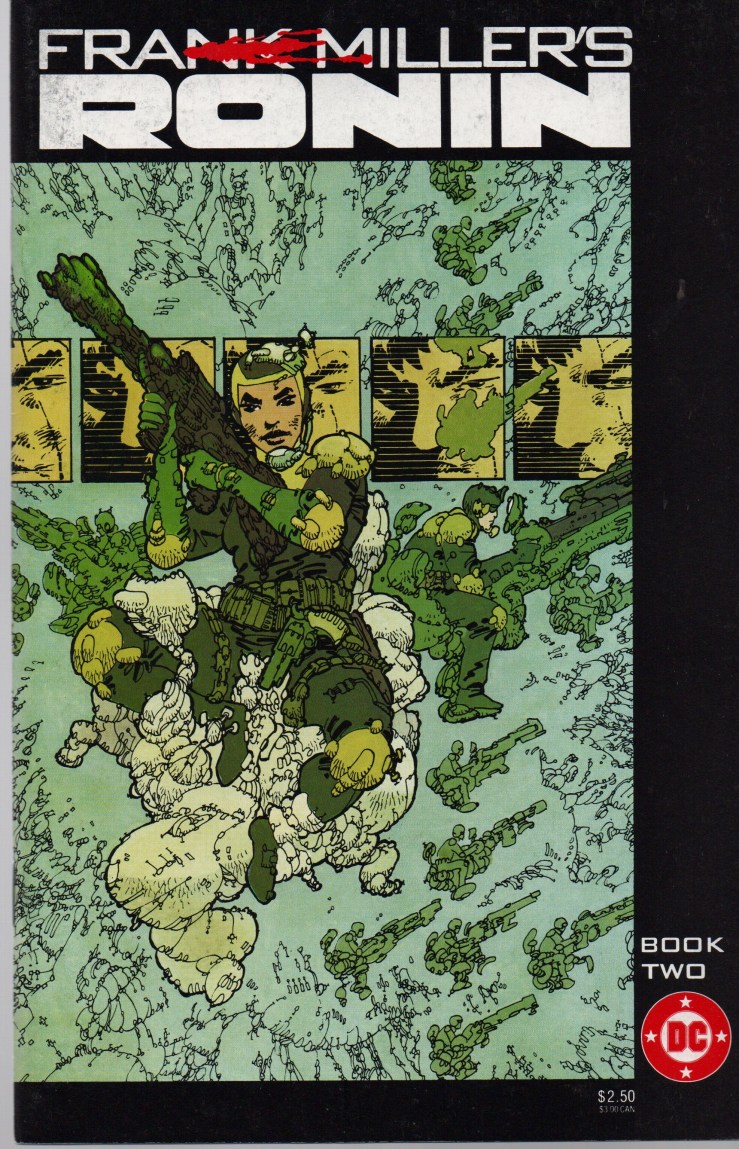
Ronin Vol. 1, #2, September 1983. DC Comics. Issue and cover by Frank Miller (colors by Lynne Varley).
Before Frank Miller became a cranky old fascist hack, he made some pretty good comic books. I’m pretty sure The Dark Knight Returns was the last really good thing he did, and that was thirty years ago, but my favorite Miller will likely always be Ronin.
The Wizard — Edward Burne-Jones

The Vision of St. Eustace — Pisanello

 Biblioklept