Our souls are like those orphans whose unwedded mothers die in bearing them | Moby-Dick reread, riff 32

Moby-Dick illustration by Barry Moser

I. I “finished” rereading Moby-Dick a few minutes before I started composing this riff.

I feel sad and a little deflated. Deflated here is maybe the wrong word. This is a novel of expansion and contraction, the physical and the metaphysical, the abstract exploding into the concrete. But the novel’s conclusion seems like an undoing to all of its elation—all of Ishmael’s evocation of brotherly-love, of the milk of human kindness, of finding transcendence through a reading of nature. (Maybe Ahab is a bad reader—maybe this is the point of Moby-Dick—that vengeance and pride lead to madness and death.)

II. It’s also possible that I feel deflated and sad because the last riff I wrote about Moby-Dick was on Ch. 112—a short minor chapter that I could’ve squared away in a sentence or two. Something like, Melville here parodies temperance-movement literature while at the same time anchoring the blacksmith’s backstory in an earnest core of fellow feeling and human sympathy—something like that. Only I didn’t; I wrote more fucking words on Ch. 112 than Melville wrote in Ch. 112.

III. Which is all a long way of saying that there’s something addictive about Melville’s rhetoric in Moby-Dick. It’s bombastic and purple and chews scenery; it twists metaphors and pokes at unresolved allegories; its a great big challenge of voices that repeatedly threatens to overwhelm the consciousness that seeks to apprehend it. Maybe comprehend it instead then. Maybe just go with its flow instead.

IV. (Blogging about Moby-Dick as I’ve reread it is an attempt to apprehend it, thus my feelings of deflated depression at the end.)

V. But let us move on; excuse my preamble.

VI. Ch. 113, “The Forge.”

We’ve met the blacksmith Perth and attended to his tale with sympathy. Anon. Let us to Ahab, who commands the poor fellow to smith him a new harpoon, “Fashioned at last into an arrowy shape.” Perth tells Ahab to bring a water cask by to temper the harpoon, but the mad captain insists instead on a satanic blood baptism:

“No, no—no water for that; I want it of the true death-temper. Ahoy, there! Tashtego, Queequeg, Daggoo! What say ye, pagans! Will ye give me as much blood as will cover this barb?” holding it high up. A cluster of dark nods replied, Yes. Three punctures were made in the heathen flesh, and the White Whale’s barbs were then tempered.

“Ego non baptizo te in nomine patris, sed in nomine diaboli!” deliriously howled Ahab, as the malignant iron scorchingly devoured the baptismal blood.

VII. Ch. 114, “The Glider.”

The Pequod glides upon the pacific Pacific. Ahab finds peace and torment in the pacified peace:

Oh, grassy glades! oh, ever vernal endless landscapes in the soul; in ye,—though long parched by the dead drought of the earthy life,—in ye, men yet may roll, like young horses in new morning clover; and for some few fleeting moments, feel the cool dew of the life immortal on them. Would to God these blessed calms would last. But the mingled, mingling threads of life are woven by warp and woof: calms crossed by storms, a storm for every calm. There is no steady unretracing progress in this life; we do not advance through fixed gradations, and at the last one pause:—through infancy’s unconscious spell, boyhood’s thoughtless faith, adolescence’ doubt (the common doom), then scepticism, then disbelief, resting at last in manhood’s pondering repose of If. But once gone through, we trace the round again; and are infants, boys, and men, and Ifs eternally. Where lies the final harbor, whence we unmoor no more? In what rapt ether sails the world, of which the weariest will never weary? Where is the foundling’s father hidden? Our souls are like those orphans whose unwedded mothers die in bearing them: the secret of our paternity lies in their grave, and we must there to learn it.

I mean like holy fuck, Ahab’s inner monologue here is like—I mean like I have no simile to work from here for that like. I guess you could attack it as purpleprosed Shakespeare aping, or a college sophomore who’s fastened himself to a volume of Nietzsche—but it’s not.

(I’ll move on for my own sanity.)

VIII. Ch. 115, “The Pequod meets the Bachelor.”

The Pequod meets The Bachelor in this chapter, the 115th chapter of Moby-Dick.

The Bachelor is a horny, celebratory ship, filled to its proverbial gills with sperm. “‘Come aboard, come aboard!’ cried the gay Bachelor’s commander, lifting a glass and a bottle in the air,” notes Ishmael, as the crew of The Pequod fails to come to the gay Bachelor’s commander.

Ahab’s rejoinder to joy:

“Thou art too damned jolly. Sail on.”

Let us sail on.

IX. Ch. 116, “The Dying Whale.”

The “next day after encountering the gay Bachelor, whales were seen and four were slain; and one of them by Ahab.”

Ahab is metaphysically-moved by the moment of the slaying:

Then hail, for ever hail, O sea, in whose eternal tossings the wild fowl finds his only rest. Born of earth, yet suckled by the sea; though hill and valley mothered me, ye billows are my foster-brothers!”

Hail, hail, whale, wail.

X. Ch. 117, “The Whale Watch.”

Another short chapter. Fedallah, Ahab’s erstwhile lieutenant and prognosticator prognosticates that “ere thou couldst die on this voyage, two hearses must verily be seen by thee on the sea; the first not made by mortal hands; and the visible wood of the last one must be grown in America.”

And, more foreshadowing–

Take another pledge, old man,” said the Parsee, as his eyes lighted up like fire-flies in the gloom—“Hemp only can kill thee.”

“The gallows, ye mean.—I am immortal then, on land and on sea,” cried Ahab, with a laugh of derision;—“Immortal on land and on sea!”

Again—Ahab is a bad reader. He cannot read through any lens but his monomaniacal monocle of revenge. He misreads Fedallah and trips over his own ego, even as the umbilical threads of his own fate wrap around him, shrouding him in the garments of his watery tomb.


Death is only a launching into the region of the strange Untried | Moby-Dick reread, riff 31

Moby-Dick illustration by Barry Moser

I. In this riff, Ch. 112 of Moby-Dick, “The Blacksmith.”

II. “The Blacksmith” chapter is neither especially long nor short, and a reader could skip over it without missing any of the “plot” of Moby-Dick (while also misunderstanding the “plot” of Moby-Dick).

And yet,

And yet reading the chapter again, I was struck by its terrible pathos (and ultimate irony). Ishmael’s tale is not just about whaling, but wailing. Poor Perth’s silent wailing is included here. Ishmael bears witness to the man’s disaster.

III. Ch. 112 focuses its camera on “Perth, the begrimed, blistered old blacksmith” of The Pequod, who, after working on Ahab’s leg, has “not removed his portable forge” from the ship’s deck. Thus, he is “now almost incessantly invoked by the headsmen, and harpooneers, and bowsmen to do some little job for them.”

Surrounded by a demanding “eager circle, all waiting to be served,” Perth is nevertheless “a patient hammer wielded by a patient arm.” Ishmael notes that, “No murmur, no impatience, no petulance did come from him,” and although he praises the old man’s fortitude, he nevertheless notes that Perth is “Most miserable!”

IV. Ishmael notes “A peculiar walk in this old man, a certain slight but painful appearing yawing in his gait.” Perth’s limp links him to Ahab, but the blacksmith is more forthcoming with his backstory. The crew of The Pequod persists in questioning him, “and so it came to pass that every one now knew the shameful story of his wretched fate.”

V. We learn that “one bitter winter’s midnight, on the road running between two country towns, the blacksmith half-stupidly felt the deadly numbness stealing over him, and sought refuge in a leaning, dilapidated barn.” In this halfway nonplace, his feet frozen, the blacksmith “at last came out the four acts of the gladness” and ushers in “the one long, and as yet uncatastrophied fifth act of the grief of his life’s drama.”

He falls into what “sorrow’s technicals called ruin,” despit his decades as “an artisan of famed excellence” with “a youthful, daughter-like, loving wife, and three blithe, ruddy children.”

Well so what happens, already, Ishmael?

Well so and anyway, “one night, under cover of darkness, and further concealed in a most cunning disguisement, a desperate burglar slid into his happy home, and robbed them all of everything.”

A burglar?! Tell more, Ish?

“And darker yet to tell, the blacksmith himself did ignorantly conduct this burglar into his family’s heart.”

Gasp!

“It was the Bottle Conjuror! Upon the opening of that fatal cork, forth flew the fiend, and shrivelled up his home.”

Egad!

VI. “The Blacksmith” begins to tiptoe along a strange line of earnestness and irony.

VII. On one hand, Melville’s bombastic language and the blacksmith’s preposterous story seems to skewer nineteenth-century temperance tracts. Are we to believe Perth when he tells us that he became an alcoholic one night because his feet were cold? Further, his (hyperbolic, in Ishmael’s relation) story is riddled with other gaps as it approaches its maudlin conclusion:

Why tell the whole? The blows of the basement hammer every day grew more and more between; and each blow every day grew fainter than the last; the wife sat frozen at the window, with tearless eyes, glitteringly gazing into the weeping faces of her children; the bellows fell; the forge choked up with cinders; the house was sold; the mother dived down into the long church-yard grass; her children twice followed her thither; and the houseless, familyless old man staggered off a vagabond in crape; his every woe unreverenced; his grey head a scorn to flaxen curls!

Just how is it that Perth’s young (“daughter-like”!) wife and young children die? Nevermind, Ish. After all, Why tell the whole? (This in a novel that tells more than the whole, and then tells it again a different way.)

The blacksmith’s tale, in Melville’s telling, seems to me an ironic puncturing of sentimentality and overt moralism, a subtle satire on the temperance movement’s blinded scope.

But the blacksmith’s tale in Ishmael’s telling—

VIII. In Ishmael’s telling, there is something of earnest sympathy in the blacksmith’s tale. Consider Ishmael’s subtle identification with Perth in the chapter’s penultimate paragraph:

Death seems the only desirable sequel for a career like this; but Death is only a launching into the region of the strange Untried; it is but the first salutation to the possibilities of the immense Remote, the Wild, the Watery, the Unshored; therefore, to the death-longing eyes of such men, who still have left in them some interior compunctions against suicide, does the all-contributed and all-receptive ocean alluringly spread forth his whole plain of unimaginable, taking terrors, and wonderful, new-life adventures; and from the hearts of infinite Pacifics, the thousand mermaids sing to them—“Come hither, broken-hearted; here is another life without the guilt of intermediate death; here are wonders supernatural, without dying for them. Come hither! bury thyself in a life which, to your now equally abhorred and abhorring, landed world, is more oblivious than death. Come hither! put up thy gravestone, too, within the churchyard, and come hither, till we marry thee!”

Ishmael, like Perth, has taken to the sea to avoid death, to avoid suicide—remember, whaling is Ish’s “substitute for pistol and ball.” He romanticizes the call to adventure by figuring it in the voices of a “thousand mermaids” singing, yet nevertheless understands the death-urge that underwrites this drive to the sea.

The chapter concludes with Ishmael telling us that,

Hearkening to these voices, East and West, by early sunrise, and by fall of eve, the blacksmith’s soul responded, Aye, I come! And so Perth went a-whaling.

Again, Moby-Dick is a novel about whaling–and wailing.

Judith Schalansky’s Pocket Atlas of Remote Islands (Book acquired, 5 Feb. 2021)

I have no idea how Judith Schalansky’s Atlas was not on my atlas until earlier this month when BLCKDGRD sent me a copy. (For reading the whale book again, I think?)

Anyway, god love him forever.

It’s a beautiful big little small expansive book, as Sadie Stein attests in The Paris Review:

There’s a book I’ve returned to again and again, ever since its clementine-orange cover first caught my eye at a museum bookstore: A Pocket Atlas of Remote Islands by Judith Schalansky, translated from the German by Christine Lo.

The subtitle is Fifty Islands I Have Not Visited and Never Will, but don’t worry: this book isn’t precious. At least, not too precious—despite the somewhat whimsical conceit, the author approaches her idiosyncratic task with seriousness. The book looks serious, until you read that quirky subtitle: it looks like a pocket atlas. But then you open it. And each remote island’s entry—St. Kilda in the Atlantic, the Carolines of Micronesia, the American Pagan—is a prose poem of sorts. Facts sit side-by-side with a kind of highly personal fiction; we are given latitudes and detailed maps, but also lore and speculation. Of the antipodes the author writes, “cattle that are brought here die quickly and quietly in the dun-colored steppes of grass. And the thunderous echo of waves breaking against the hollows of the jagged coastline never ceases.”


Schalansky’s Atlas is not-exactly history, not-exactly prose-poetry—it seems to evoke its own genre out of preexisting modes.

This guy on Amazon was dissatisfied though:

The line maps are beautiful, but I’m no sailor.

(When the little book showed up, my darling wife insisted we give it to our charmed friend who’s spent the past few years sailing around the globe on his goddamn charmed catamaran, winding up in New Zealand around the time of the Covid thing. I told her this book was mine. But in the big-spirited spiritedness of Mr. BLCKDGRD, I’ll send him his own copy.)

Millions of mixed shades and shadows, drowned dreams, somnambulisms, reveries | Moby-Dick reread, riff 30

I. In this riff, Chapters 109-111 of Moby-Dick.

II. Rereading these chapters—particularly Ch. 110, “Queequeg in His Coffin”—put me in a melancholy mood, a strange dark mood that I remember from previous rereads. I’m not sure why, but there’s something about Moby-Dick’s turn into its final third that’s a specific kind of sad that’s both bitter and sweet, but ultimately depressive. Maybe it’s because I know the apocalypse that’s coming. Or maybe it’s because a certain fatigue sets in. It’s a long book. Or maybe it’s because Ishmael’s expansiveness begins to fragment here, splitting off into splinters that burn down or drown. There are moments of joy and levity, but Ahab’s blasted consciousness looms over the novel. His bleak but bombastic psyche contrasts strongly with hopeful Ishmael, ushering us back to “Loomings,” to his blasted hypos.

III. Ch. 109, “Ahab and Starbuck in the Cabin.”

Moby-Dick illustration by Barry Moser

In this chapter, Starbuck suggests to Ahab that The Pequod stop to fix some leaky oil barrels; Ahab wants to keep pursuing Moby Dick. Starbuck reminds him of his duty to the stockholders and owners of the ship, but Ahab is already quite mad, and pulls a gun on his second in command:

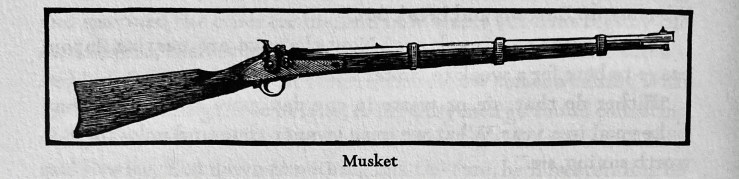
Ahab seized a loaded musket from the rack (forming part of most South-Sea-men’s cabin furniture), and pointing it towards Starbuck, exclaimed: “There is one God that is Lord over the earth, and one Captain that is lord over the Pequod.—On deck!”

Starbuck retreats, but still offers himself as First Mate. He is not one for mutiny, but seeks to help his maddened captain:

Thou hast outraged, not insulted me, sir; but for that I ask thee not to beware of Starbuck; thou wouldst but laugh; but let Ahab beware of Ahab; beware of thyself, old man.”

Despite his rage, Ahab finds “something” to Starbuck’s warning:

“He waxes brave, but nevertheless obeys; most careful bravery that!” murmured Ahab, as Starbuck disappeared. “What’s that he said—Ahab beware of Ahab—there’s something there!”

Here we might find Starbuck at his most powerful. He imprints his language into Ahab’s consciousness. But he smuggles his warning in through a rhetorical gesture that recapitulates Ahab as the great terror in this affair: Ahab beware. Of Ahab.

Ahab though capitulates to Starbuck here, and orders to the mending of the barrels—although our narrator (how is it that Ishmael inhabits the officer’s cabin?) warns that, “It were perhaps vain to surmise exactly why it was, that as respecting Starbuck, Ahab thus acted.”

IV. Ch. 110, “Queequeg in His Coffin.”

This chapter deserves more than I can give to it right now.

Basically, Queeg is pretty sure that he’ll die:

Poor Queequeg! …you should have stooped over the hatchway, and peered down upon him there; where, stripped to his woollen drawers, the tattooed savage was crawling about amid that dampness and slime, like a green spotted lizard at the bottom of a well

Ishmael finds the oversoul in Queequeg’s gaze:

And like circles on the water, which, as they grow fainter, expand; so his eyes seemed rounding and rounding, like the rings of Eternity. An awe that cannot be named would steal over you as you sat by the side of this waning savage, and saw as strange things in his face, as any beheld who were bystanders when Zoroaster died. For whatever is truly wondrous and fearful in man, never yet was put into words or books.

Ishamael tries to put that ineffable down in books.

V. Queequeg, feeling his death approach, calls the carpenter to build him to “canoe like those of Nantucket”—the kind in which Nantucketeers are buried at sea.

Both Pip and Starbuck attend Queeg’s dying (not-dying) hour; Pip sees the event as an echo of his own “death” earlier on the voyage, when he is abandoned at sea.

But then “Queequeg suddenly rallied,” and the crewmen about him

asked him, then, whether to live or die was a matter of his own sovereign will and pleasure. He answered, certainly. In a word, it was Queequeg’s conceit, that if a man made up his mind to live, mere sickness could not kill him: nothing but a whale, or a gale, or some violent, ungovernable, unintelligent destroyer of that sort.

There is some violent ungovernable unintelligent destroyer of that sort on the horizon.

VI. The chapter ends with Queequeg writing on his coffin:

Many spare hours he spent, in carving the lid with all manner of grotesque figures and drawings; and it seemed that hereby he was striving, in his rude way, to copy parts of the twisted tattooing on his body. And this tattooing had been the work of a departed prophet and seer of his island, who, by those hieroglyphic marks, had written out on his body a complete theory of the heavens and the earth, and a mystical treatise on the art of attaining truth; so that Queequeg in his own proper person was a riddle to unfold; a wondrous work in one volume; but whose mysteries not even himself could read, though his own live heart beat against them; and these mysteries were therefore destined in the end to moulder away with the living parchment whereon they were inscribed, and so be unsolved to the last.

The notation above is long, but I think it points to Melville’s central themes of reading and writing in Moby-Dick—this is a novel about the hieroglyphics of the body and the soul, the unreadable readable phenomenal world that set to ciphering daily.

VII. Ch. 111, “The Pacific.”

Another of Melville’s transitional chapters. We return to Ishamel’s bosomy-voice-bosom—but our narrator is, in Melvillian terms, not a touch untroubled: “were it not for other things, I could have greeted my dear Pacific with uncounted thanks.” Those other things? Well, we’ve filled the last few riffs with them.

For Ish, the Pacific is a pacifying terrifying entity: “There is, one knows not what sweet mystery about this sea, whose gently awful stirrings seem to speak of some hidden soul beneath; like those fabled undulations of the Ephesian sod over the buried Evangelist St. John.”

He compares it to a “Potters’ Fields of all four continents” populated by

millions of mixed shades and shadows, drowned dreams, somnambulisms, reveries; all that we call lives and souls, lie dreaming, dreaming, still; tossing like slumberers in their beds; the ever-rolling waves but made so by their restlessness.

Moby-Dick is not a novel about whales and whaling; Moby-Dick is a novel about ghosts and wailing.

VIII. Ish is intoxicated by the Pacific’s rhythms: “Lifted by those eternal swells, you needs must own the seductive god, bowing your head to Pan.”

Our Ishmael again calls all souls to his big bosom, his eternal ghostly swells. He’s a pantheistic mutherfucker.

IX. But, but,

But few thoughts of Pan stirred Ahab’s brain, as standing like an iron statue at his accustomed place beside the mizen rigging, with one nostril he unthinkingly snuffed the sugary musk from the Bashee isles (in whose sweet woods mild lovers must be walking), and with the other consciously inhaled the salt breath of the new found sea; that sea in which the hated White Whale must even then be swimming. Launched at length upon these almost final waters, and gliding towards the Japanese cruising-ground, the old man’s purpose intensified itself. His firm lips met like the lips of a vice; the Delta of his forehead’s veins swelled like overladen brooks; in his very sleep, his ringing cry ran through the vaulted hull, “Stern all! the White Whale spouts thick blood!”

And bloodlust and vengeance carries out over the pacified Pacific.

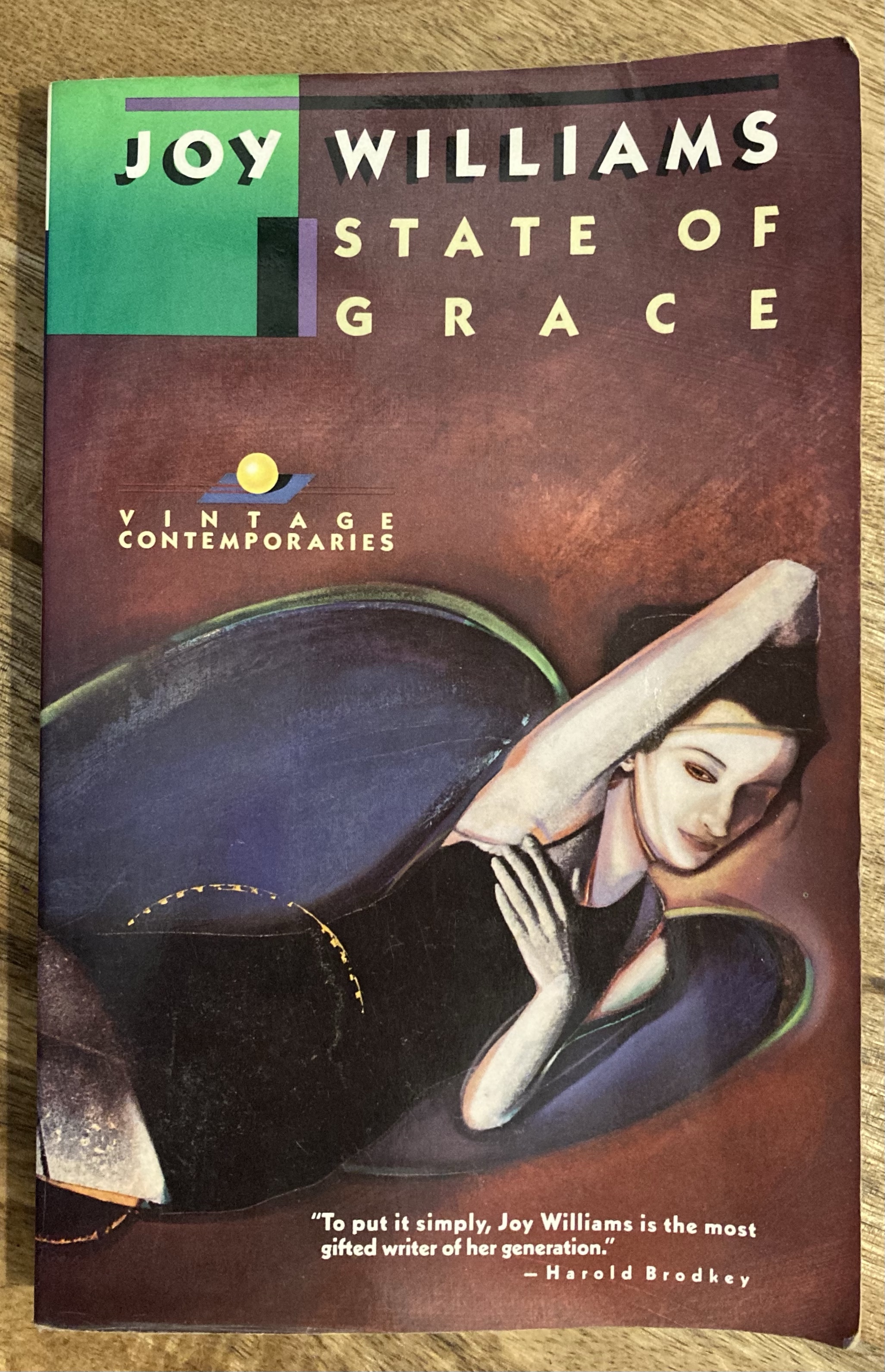
Joy Williams’s State of Grace (Book acquired, 22 Feb. 2021–and some covers of books unacquired)

I did a Big Clean a weekend or two past, including a thorough dusting of shelves. I always try to purge titles that I know I’ll never read, reread, or that I have no real attachment to. I filled a box with about 25 books, mostly novels, mostly paperbacks, and took it to my favorite used bookstore.

There, I found to my joy Joy Williams’s first novel State of Grace in my beloved preferred ugly Vintage Contemporaries edition. (I loved Williams’s collection Taking Care, which I read as a VC edition.) I’ve got a big stack of newly-published novels that I need to get to once I finish rereading Whale-Book, but who knows. Maybe I’ll get to it sometime before summer.

In the meantime, here’s the first graf of Gail Godwin’s 1973 NYT review:

The fated heroine of this bleak but beautifully‐crafted first novel may well be the final, perfected archetype of all the “sad ladies”: that formidably fashionable sorority which has impinged on the past decade or so of American fiction. But I’ll remember Kate Jackson; I’ll reread her stubbornly depressing story, picking out those cleverly‐hidden but ever‐present clues of grace. Kate is no simple “slice‐of‐despair” character; her sad story becomes, through the author’s skill and intention, transsubstantiated into significant myth. This book is neither a self‐indulgent journal of despair, nor journalism of despair. It is premeditated, articulate, artistic—a novel.

As always, I browsed. Here are some covers that caught my eye, but I did not leave with them–just these photos:

The ineffaceable, sad birth-mark in the brow of man, is but the stamp of sorrow in the signers | Moby-Dick reread, riff 29

I. In this riff, Chapters 106-108 of Moby-Dick.

This trio of chapters introduces the carpenter, who proves a strange foil to Ahab.

Moby-Dick illustration by Barry Moser

II. Ch. 106, “Ahab’s Leg.”

Moby-Dick is a phallic novel, full of thrusts, jabs, ejaculations, and sperm sperm sperm. “Ahab’s Leg” reinforces this theme through negation. Melville (or is it Ishmael?) underscores here the notion that Ahab has been symbolically castrated by Moby Dick; this symbolic castration leads to Ahab’s revenge quest—the monomaniacal captain seeks to reassert his power through domination. (It’s all a dick swingin’ contest.)

III. The symbolic castration repeats when Ahab quits The Samuel Enderby, and endures “some small violence to his own person.” We learn that in the jostling of the boat, “his ivory leg had received a half-splintering shock.” This second figurative castration actually follows a near-literal one though:

For it had not been very long prior to the Pequod’s sailing from Nantucket, that he had been found one night lying prone upon the ground, and insensible; by some unknown, and seemingly inexplicable, unimaginable casualty, his ivory limb having been so violently displaced, that it had stake-wise smitten, and all but pierced his groin; nor was it without extreme difficulty that the agonizing wound was entirely cured.

And yet it’s clear that the wound is still not entirely cured. Ahab seeks to repair his phallic wound by way of a phallic spearing of the White Whale.

IV. The chapter continues down a stranger path. Ishmael, with his all-access pass to consciousness, relates that Ahab, reflecting on his woes, decries that, “all miserable events do naturally beget their like.” The text continues, dwelling on sodomy, hell, and the perpetuation of grief:

Yea, more than equally, thought Ahab; since both the ancestry and posterity of Grief go further than the ancestry and posterity of Joy. For, not to hint of this: that it is an inference from certain canonic teachings, that while some natural enjoyments here shall have no children born to them for the other world, but, on the contrary, shall be followed by the joy-childlessness of all hell’s despair; whereas, some guilty mortal miseries shall still fertilely beget to themselves an eternally progressive progeny of griefs beyond the grave; not at all to hint of this, there still seems an inequality in the deeper analysis of the thing. For, thought Ahab, while even the highest earthly felicities ever have a certain unsignifying pettiness lurking in them, but, at bottom, all heartwoes, a mystic significance, and, in some men, an archangelic grandeur; so do their diligent tracings-out not belie the obvious deduction. To trail the genealogies of these high mortal miseries, carries us at last among the sourceless primogenitures of the gods; so that, in the face of all the glad, hay-making suns, and soft cymballing, round harvest-moons, we must needs give in to this: that the gods themselves are not for ever glad. The ineffaceable, sad birth-mark in the brow of man, is but the stamp of sorrow in the signers.

The depressive, fatalistic tone here is pure Ahab–if Ishmael’s expansive over-soul touches the paragraph, it does so in opposition. (What an amazing passage.)

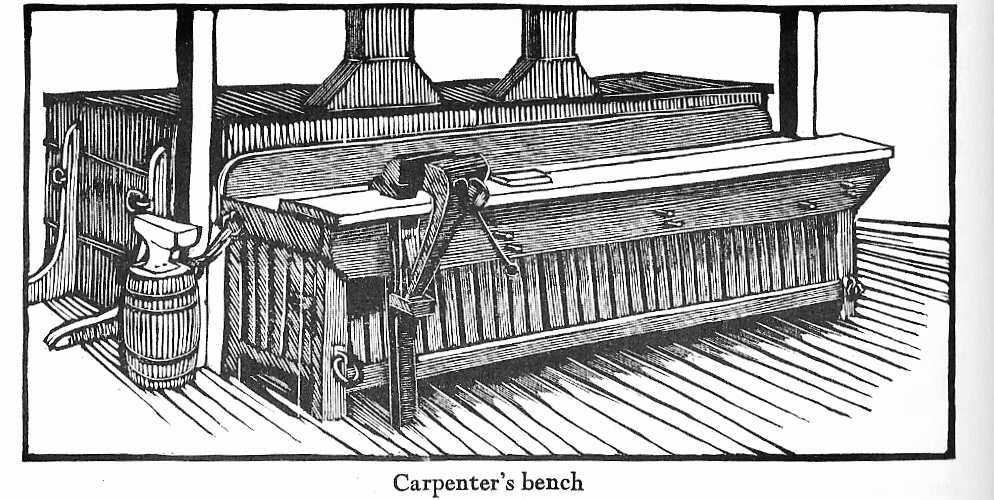
V. Ch. 107, “The Carpenter.”

A nice little chapter describing the ship’s carpenter, who is a sort of Swiss army knife of a man:

He was like one of those unreasoning but still highly useful, multum in parvo, Sheffield contrivances, assuming the exterior—though a little swelled—of a common pocket knife; but containing, not only blades of various sizes, but also screw-drivers, cork-screws, tweezers, awls, pens, rulers, nail-filers, countersinkers. So, if his superiors wanted to use the carpenter for a screw-driver, all they had to do was to open that part of him, and the screw was fast: or if for tweezers, take him up by the legs, and there they were.

He sets about crafting Ahab a new leg.

VI. Ch. 108, “Ahab and the Carpenter.”

Melville (Ishmael?) again turns his novel into a Shakespearian play, complete with stage directions. The carpenter files away at the ivory leg-to-be, while the blacksmith bangs about in the background. He sneezes as he files away at the crutch he creates.

Ahab enters, invoking the carpenter as a Promethean figure:

“Well, manmaker!”

The carpenter then sets about to measure for Ahab’s leg. Ahab sticks his stump into a vice (an implicitly sexual image). The carpenter warns him about the vice’s grip, but Ahab is malevolently jocular. He then directly invokes Prometheus;

No fear; I like a good grip; I like to feel something in this slippery world that can hold, man. What’s Prometheus about there?—the blacksmith, I mean—what’s he about?

V. Ahab essentially ignores the carpenter’s plain answers, and instead begins soliloquizing. Again, he’s monovocal in stereophonic world:

I do deem it now a most meaning thing, that that old Greek, Prometheus, who made men, they say, should have been a blacksmith, and animated them with fire; for what’s made in fire must properly belong to fire; and so hell’s probable.

VI. Ahab’s monomania crests: He sets about to become the Prometheus in the scene—but a commander Prometheus, an artistic director. His idealized “complete man” reveals more of Ahab’s singular vision—a vision that precludes all other perspectives. He conjures a heartless giant–an intellectual giant:

Hold; while Prometheus is about it, I’ll order a complete man after a desirable pattern. Imprimis, fifty feet high in his socks; then, chest modelled after the Thames Tunnel; then, legs with roots to ’em, to stay in one place; then, arms three feet through the wrist; no heart at all, brass forehead, and about a quarter of an acre of fine brains; and let me see—shall I order eyes to see outwards? No, but put a sky-light on top of his head to illuminate inwards. There, take the order, and away.

Ahab’s ideal man has no outward-seeing eyes–there is no perspective at all here except that which will “illuminate inwards.” He mentions no mouth.

VII. Ahab finally quits the carpenter’s shop, and the poor old man begins his own monologue. He repeats the key word queer ten times over in his evocation of Ahab:

Well, well, well! Stubb knows him best of all, and Stubb always says he’s queer; says nothing but that one sufficient little word queer; he’s queer, says Stubb; he’s queer—queer, queer; and keeps dinning it into Mr. Starbuck all the time—queer—sir—queer, queer, very queer.

And who is queer Ahab’s bedfellow?

Yes, now that I think of it, here’s his bedfellow! has a stick of whale’s jaw-bone for a wife!

“I look, you look, he looks; we look, ye look, they look” | Moby-Dick reread, riff 26

Moby-Dick illustration by Barry Moser

I. In this riff, Chapter 99 of Moby-Dick — “The Doubloon.”

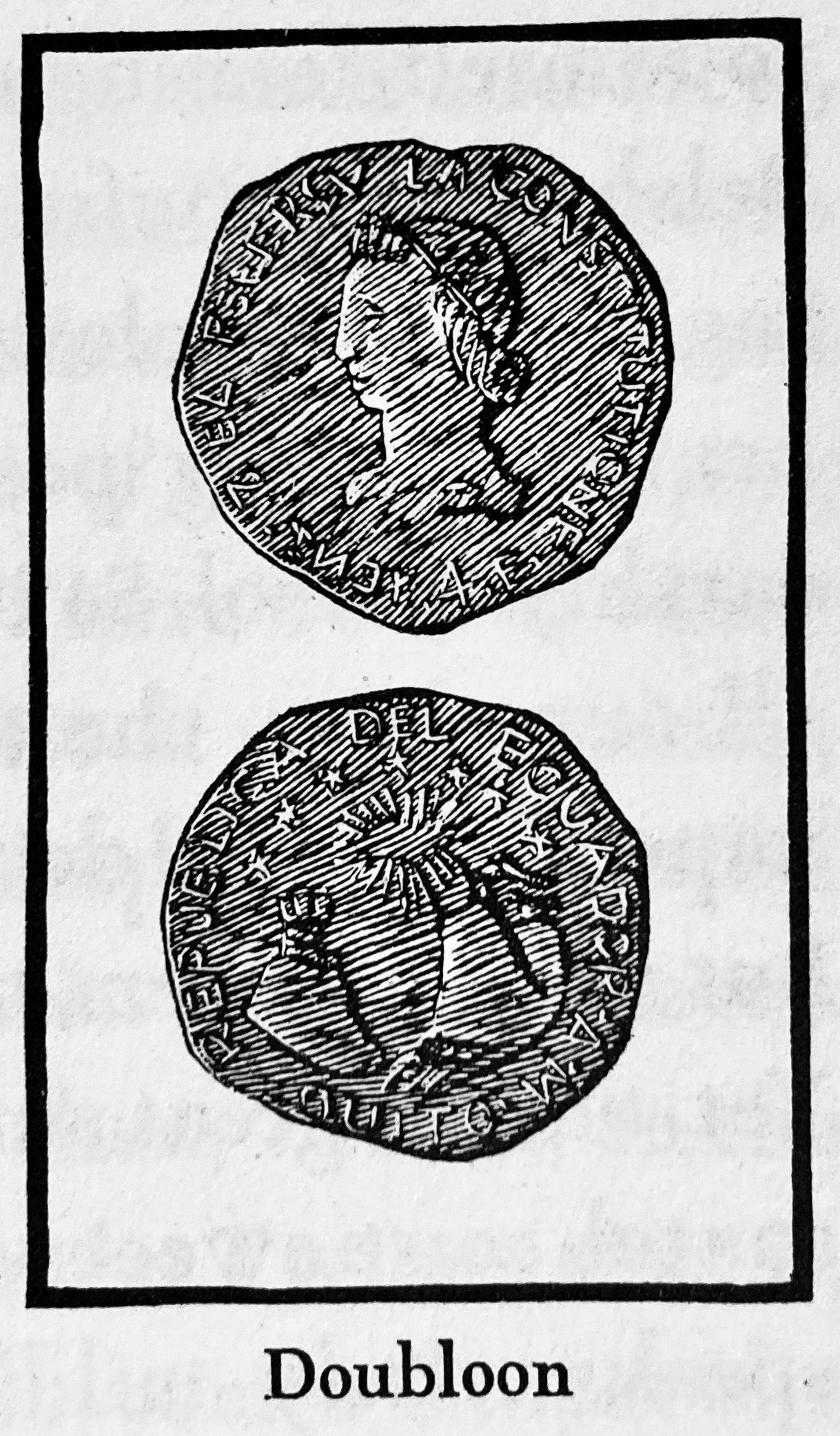
II. Moby-Dick is a big big book stuffed with big big themes. One of those themes is perspective and interpretation, and Ch. 99, “The Doubloon,” showcases that theme, as various characters stop to inspect and reflect on the coin that Ahab hammered to the masthead back in Ch. 36, “The Quarter-Deck.” This gold piece is the prize for the first man to sight Moby Dick, and thus already symbolically overdetermined in the narrative. It becomes a thing that the sailors translate into ideas, for, as Ishmael points out (again prefiguring William Carlos Williams), “some certain significance lurks in all things, else all things are little worth, and the round world itself but an empty cipher, except to sell by the cartload.”

III. Here is Ishmael’s description (not interpretation) of the coin:

On its round border it bore the letters, REPUBLICA DEL ECUADOR: QUITO. So this bright coin came from a country planted in the middle of the world, and beneath the great equator, and named after it; and it had been cast midway up the Andes, in the unwaning clime that knows no autumn. Zoned by those letters you saw the likeness of three Andes’ summits; from one a flame; a tower on another; on the third a crowing cock; while arching over all was a segment of the partitioned zodiac, the signs all marked with their usual cabalistics, and the keystone sun entering the equinoctial point at Libra.

IV. Enter Ahab, pacing the quarter-deck, as he often does. On this particular morning, “turning to pass the doubloon, [Ahab] seemed to be newly attracted by the strange figures and inscriptions stamped on it, as though now for the first time beginning to interpret for himself in some monomaniac way whatever significance might lurk in them.”

V. Ishmael repeatedly describes Ahab as a “monomaniac.” The crippled captain focuses only on the hated whale. Ahab’s perspective is limited and constrained. Ahab sees and interprets in mono, unlike the whale, who, as Ishmael reminds us in Ch. 74, “The Sperm Whale’s Head—Contrasted View,” sees in stereo. The whale’s eyes are on either side of its head. Ish wonders if the whale “can at the same moment of time attentively examine two distinct prospects, one on one side of him, and the other in an exactly opposite direction.” The passage again recalls Keats’s notion of Negative Capability—to hold two possibly contrasting views in one’s consciousness “without any irritable reaching after fact and reason.”

VI. But Ahab holds only one vision, one mania. He interprets the doubloon (“not unobserved by others,” Ishmael double-negatively observedly informs us):

“There’s something ever egotistical in mountain-tops and towers, and all other grand and lofty things; look here,—three peaks as proud as Lucifer. The firm tower, that is Ahab; the volcano, that is Ahab; the courageous, the undaunted, and victorious fowl, that, too, is Ahab; all are Ahab; and this round gold is but the image of the rounder globe, which, like a magician’s glass, to each and every man in turn but mirrors back his own mysterious self.

In his monomania, Ahab sees himself in the coin. It’s a mirror for a man on a Luciferian quest.

VII. Perspective shifts then to Starbuck, who states, “He goes below; let me read,” as Ahab descends. Starbuck, the good Christian counterbalance to Ahab’s satanic awe—

VIII. —but look, wait. I think I have to stop here a moment and point out again, amid this riff on a chapter of perspective and seeing and being seen and interpreting and outright voyeurism—I feel the need to point out again that Our Dear Ishmael is an Omnipresent Voyeur, a first-person consciousness who attends and interprets the private thoughts of his fellows. How? How? But anyway—

IX. So perspective shifts then to Starbuck, who first interprets Ahab’s interpretation: “The old man seems to read Belshazzar’s awful writing.” Christian Starbuck here refers to Chapter Five of The Book of Daniel, the main message of which has come to us colloquially as The writing on the wall. But it’s really Starbuck who reads the impending doom—he reads Ahab reading the coin.

X. And Starbuck reading the coin:

A dark valley between three mighty, heaven-abiding peaks, that almost seem the Trinity, in some faint earthly symbol. So in this vale of Death, God girds us round; and over all our gloom, the sun of Righteousness still shines a beacon and a hope. If we bend down our eyes, the dark vale shows her mouldy soil; but if we lift them, the bright sun meets our glance half way, to cheer. Yet, oh, the great sun is no fixture; and if, at midnight, we would fain snatch some sweet solace from him, we gaze for him in vain! This coin speaks wisely, mildly, truly, but still sadly to me. I will quit it, lest Truth shake me falsely.

Again, he reads and interprets the sign through his own lens of wisdom, mildness, truth, and, ultimately, sadness. But he elects to “quit it” before he stares too long into its abyss.

XI. Cruel conniving sardonic Stubb then enters the scene, spying his captain and first mate. “I’d not look at it very long ere spending it,” he says of the doubloon, adding, “Humph! in my poor, insignificant opinion, I regard this as queer.” Stubb riffs a bit on the many gold coins he’s seen, complaining that it’s odd—queer—that anyone would take the time to inspect this one: “What then should there be in this doubloon of the Equator that is so killing wonderful?”

XII. Stubb decides to “read it once,” and immediately discerns, “signs and wonders truly.” He gives the following Zodiac reading, which I can’t help but share in full. In the reading, Stubb converts the ideas, the avatars, the signs, into things—people, places, events—life:

Look you, Doubloon, your zodiac here is the life of man in one round chapter; and now I’ll read it off, straight out of the book. Come, Almanack! To begin: there’s Aries, or the Ram—lecherous dog, he begets us; then, Taurus, or the Bull—he bumps us the first thing; then Gemini, or the Twins—that is, Virtue and Vice; we try to reach Virtue, when lo! comes Cancer the Crab, and drags us back; and here, going from Virtue, Leo, a roaring Lion, lies in the path—he gives a few fierce bites and surly dabs with his paw; we escape, and hail Virgo, the Virgin! that’s our first love; we marry and think to be happy for aye, when pop comes Libra, or the Scales—happiness weighed and found wanting; and while we are very sad about that, Lord! how we suddenly jump, as Scorpio, or the Scorpion, stings us in the rear; we are curing the wound, when whang come the arrows all round; Sagittarius, or the Archer, is amusing himself. As we pluck out the shafts, stand aside! here’s the battering-ram, Capricornus, or the Goat; full tilt, he comes rushing, and headlong we are tossed; when Aquarius, or the Water-bearer, pours out his whole deluge and drowns us; and to wind up with Pisces, or the Fishes, we sleep.

XIII. Stubb then plays stage manager, ushering in the next interpreter, Flask, and declares that he will hide behind the boilers to audit the scene unseen: “here comes little King-Post; dodge round the try-works, now, and let’s hear what he’ll have to say. There; he’s before it; he’ll out with something presently. So, so; he’s beginning.”

Flask’s interpretation of the thing is purely economic and transactional—or really, what I want to say, thing based: “I see nothing here, but a round thing made of gold, and whoever raises a certain whale, this round thing belongs to him.” He interprets its thingness in terms of other things: “It is worth sixteen dollars, that’s true; and at two cents the cigar, that’s nine hundred and sixty cigars.”

XIV. Melville-Ishmael-narrator-voyeur-Flask in this moment announces the next player: “But, avast; here comes our old Manxman.” The old Manxman (a “hearse-driver, he must have been, that is, before he took to the sea,” ominously foreshadows Flask) reads the doubloon: “If the White Whale be raised, it must be in a month and a day, when the sun stands in some one of these signs. I’ve studied signs, and know their marks.”

The Manxman underscores the chapter’s theme of textual interpretation: “There’s another rendering now; but still one text. All sorts of men in one kind of world, you see.”

XV. Stubb then announces the next interpreter: “Dodge again! here comes Queequeg—all tattooing—looks like the signs of the Zodiac himself. What says the Cannibal?”

Here, the narrative voyeurism remains at a distance—we do not get into Queeg’s consciousness. Instead, whiteman Stubb reports the scenario: “As I live he’s comparing notes; looking at his thigh bone; thinks the sun is in the thigh, or in the calf, or in the bowels, I suppose, as the old women talk Surgeon’s Astronomy in the back country. And by Jove, he’s found something there in the vicinity of his thigh—I guess it’s Sagittarius, or the Archer.”

The I guess there is key—Melville gives us Ishmael giving us Stubb eading the inscrutable zodiac-tattooed other, Queequeg, reading the doubloon, the central sign of the chapter, nailed to the phallic mast.

XVI. Stubb also delivers his interpretation of the otherly-othered Fedallah’s inspection of the coin: “But, aside again! here comes that ghost-devil, Fedallah; tail coiled out of sight as usual, oakum in the toes of his pumps as usual. What does he say, with that look of his? Ah, only makes a sign to the sign and bows himself; there is a sun on the coin—fire worshipper, depend upon it.”

He cannot read Fedallah, who “only makes a sign to the sign” — but that in itself is a reading.

XVII. And then:

Ho! more and more. This way comes Pip—poor boy! would he had died, or I; he’s half horrible to me. He too has been watching all of these interpreters—myself included—and look now, he comes to read, with that unearthly idiot face. Stand away again and hear him. Hark!

Recall now that Stubb is the author, or at least co-author, of Pip’s “idiot face.” He’s “half horrible” to Stubb because Stubb abandoned him.

And mad sane wonderful abject Pip delivers a grammar of interpretation:

“I look, you look, he looks; we look, ye look, they look.”

Pip traces the mantra three times—this is interpretation, this is reading:

“I look, you look, he looks; we look, ye look, they look.”

This is what Melville nails to the mast in this chapter (the nail is a ghost nail)—perspective, perspective, perspective.

We look, we interpret, we read.

Let us squeeze ourselves universally into the very milk and sperm of kindness | Moby-Dick reread, riff 25

I. In this riff, Chapters 94-98 of Moby-Dick.

In these chapters, Ishmael (again) describes the business of rendering oil and etcetera from a whale’s corpse. The chapters show again Ishmael’s push-pull narration style, vacillating between the physical/commercial and the metaphysical/philosophical.

II. Ch. 94, “A Squeeze of the Hand.”

A perfect chapter in a perfectly imperfect book. Go ahead and read (it’s fine to read it on its own).

Look—I’m gonna quote the hell out of this chapter. Ish and his fellows set to a big ole tub of sperm, by which he means, of course, spermaceti, the vital stuff found in an organ in the sperm whale’s head; the vital stuff that energizes and lights Ishmael’s world. On that self-same sperm:

It had cooled and crystallized to such a degree, that when, with several others, I sat down before a large Constantine’s bath of it, I found it strangely concreted into lumps, here and there rolling about in the liquid part. It was our business to squeeze these lumps back into fluid. A sweet and unctuous duty! No wonder that in old times this sperm was such a favourite cosmetic. Such a clearer! such a sweetener! such a softener! such a delicious molifier! After having my hands in it for only a few minutes, my fingers felt like eels, and began, as it were, to serpentine and spiralise.

The next sentence—a full paragraph—is something else:

As I sat there at my ease, cross-legged on the deck; after the bitter exertion at the windlass; under a blue tranquil sky; the ship under indolent sail, and gliding so serenely along; as I bathed my hands among those soft, gentle globules of infiltrated tissues, woven almost within the hour; as they richly broke to my fingers, and discharged all their opulence, like fully ripe grapes their wine; as I snuffed up that uncontaminated aroma,—literally and truly, like the smell of spring violets; I declare to you, that for the time I lived as in a musky meadow; I forgot all about our horrible oath; in that inexpressible sperm, I washed my hands and my heart of it; I almost began to credit the old Paracelsan superstition that sperm is of rare virtue in allaying the heat of anger; while bathing in that bath, I felt divinely free from all ill-will, or petulance, or malice, of any sort whatsoever.

The sentence above: 161 words, eleven semicolons, fourteen commas, one dash, and of course, one final period. In these words and characters—halts and stops, connections and jumps—Ishmael converts his pain, his “horrible oath,” his drastic hypos, his desire to go about knocking the hats off men, his general misanthropy—he converts all of this into a moment of transcendence.

The moment of transcendence extends into a kind of spermy mindmeld:

Squeeze! squeeze! squeeze! all the morning long; I squeezed that sperm till I myself almost melted into it; I squeezed that sperm till a strange sort of insanity came over me; and I found myself unwittingly squeezing my co-laborers’ hands in it, mistaking their hands for the gentle globules. Such an abounding, affectionate, friendly, loving feeling did this avocation beget; that at last I was continually squeezing their hands, and looking up into their eyes sentimentally; as much as to say,—Oh! my dear fellow beings, why should we longer cherish any social acerbities, or know the slightest ill-humor or envy! Come; let us squeeze hands all round; nay, let us all squeeze ourselves into each other; let us squeeze ourselves universally into the very milk and sperm of kindness.

Here, I think is the the grand thesis of Moby-Dick.

III. But no. That’s not the thesis. That’s the grand ecstatic epiphany of joy, which Ishmael deflates in the next paragraph:

Would that I could keep squeezing that sperm for ever! For now, since by many prolonged, repeated experiences, I have perceived that in all cases man must eventually lower, or at least shift, his conceit of attainable felicity; not placing it anywhere in the intellect or the fancy; but in the wife, the heart, the bed, the table, the saddle, the fireside, the country; now that I have perceived all this, I am ready to squeeze case eternally. In thoughts of the visions of the night, I saw long rows of angels in paradise, each with his hands in a jar of spermaceti.

Locate the epiphany elsewhere than the intellect or the fancy then: wife, bed, saddle, etc.

—Say it, no ideas but in things—, wrote William Carlos Williams not quite a century later.

IV. Ishmael turns from ideas to things. He lists some of the other magic potions in the sperm whale’s body: white-horse, plum pudding, slobgollion, gurry, and nippers. 

The chapter ends with Ish describing the process by which a spademan and gaffman cut the whale into pieces. It’s a mechanical, thingy business, one that points back to the reason for Ahab’s revenge quest:

 This spade is sharp as hone can make it; the spademan’s feet are shoeless; the thing he stands on will sometimes irresistibly slide away from him, like a sledge. If he cuts off one of his own toes, or one of his assistants’, would you be very much astonished? Toes are scarce among veteran blubber-room men.

Toes are scarce, but perhaps not as vital as legs.

V. Ch. 95, “The Cassock.”

Another short chapter on a long subject. Ishmael describes-but-not-defines “a very strange, enigmatical object . . . lying along lengthwise in the lee scuppers.” His description is an accumulation of negations:

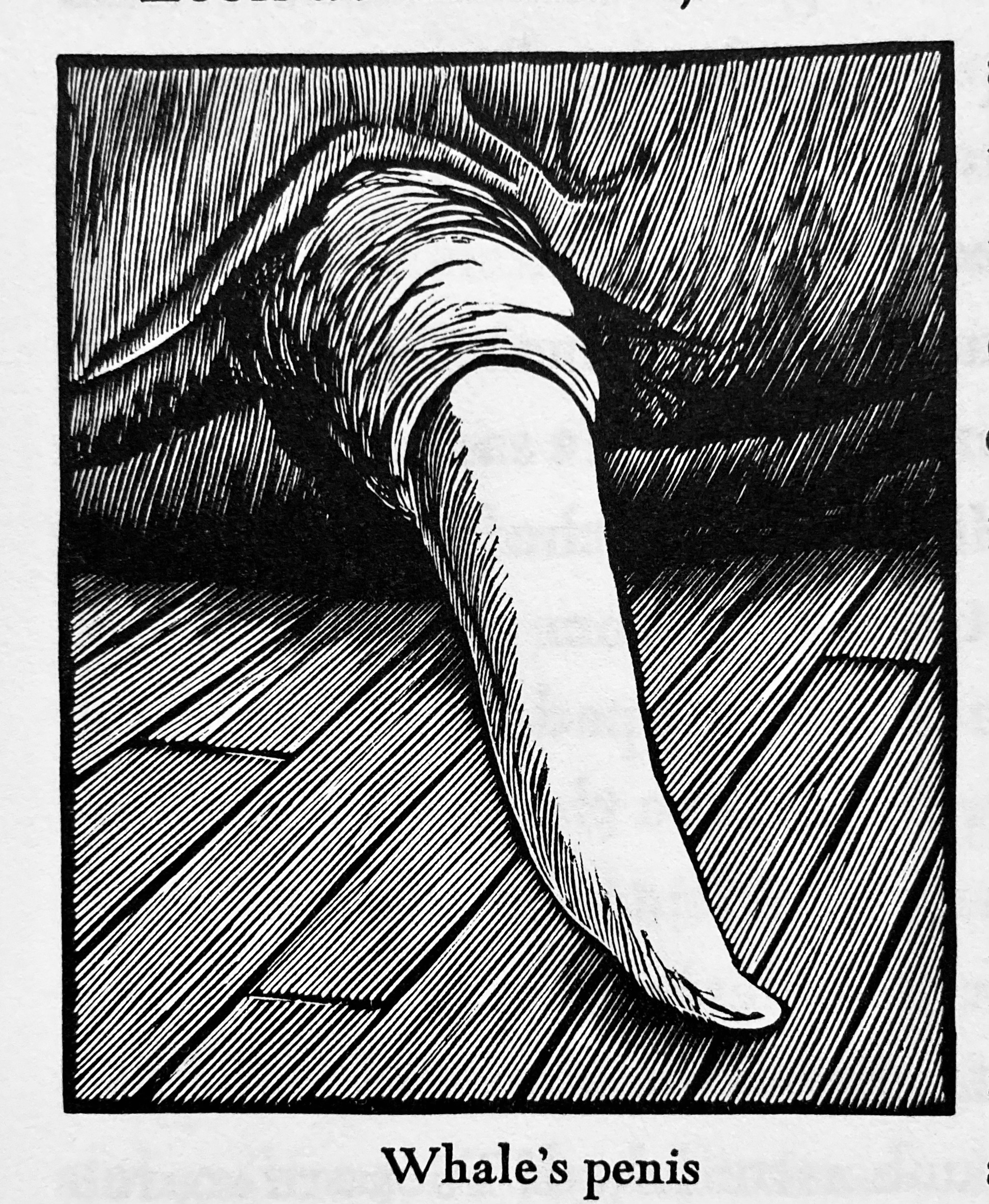
Not the wondrous cistern in the whale’s huge head; not the prodigy of his unhinged lower jaw; not the miracle of his symmetrical tail; none of these would so surprise you, as half a glimpse of that unaccountable cone,—longer than a Kentuckian is tall, nigh a foot in diameter at the base, and jet-black as Yojo, the ebony idol of Queequeg.

And what is that enormous jet black cone? A “grandissimus, as the mariners call it.”

It’s the whale’s dick, natch.

Moby-Dick illustration by Barry Moser

Ishmael compares it to the idol “found in the secret groves of Queen Maachah in Judea” — the Asherah pole — and points out that “King Asa, her son, did depose her, and destroyed the idol, and burnt it for an abomination.”

This is a phallic book full of castrations, cuttings off both figurative and literal.

VI. Ch. 96, “The Try-Works”

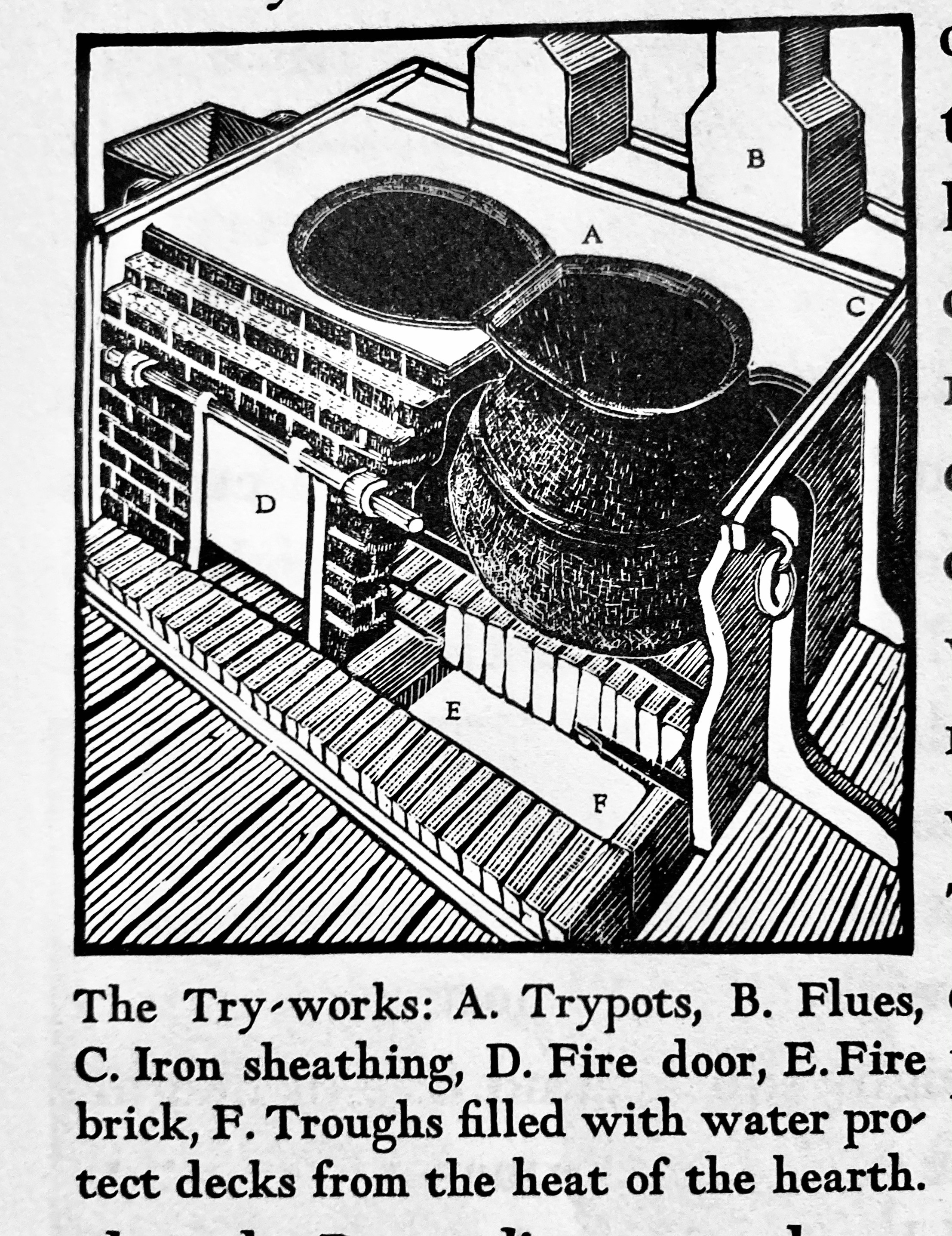
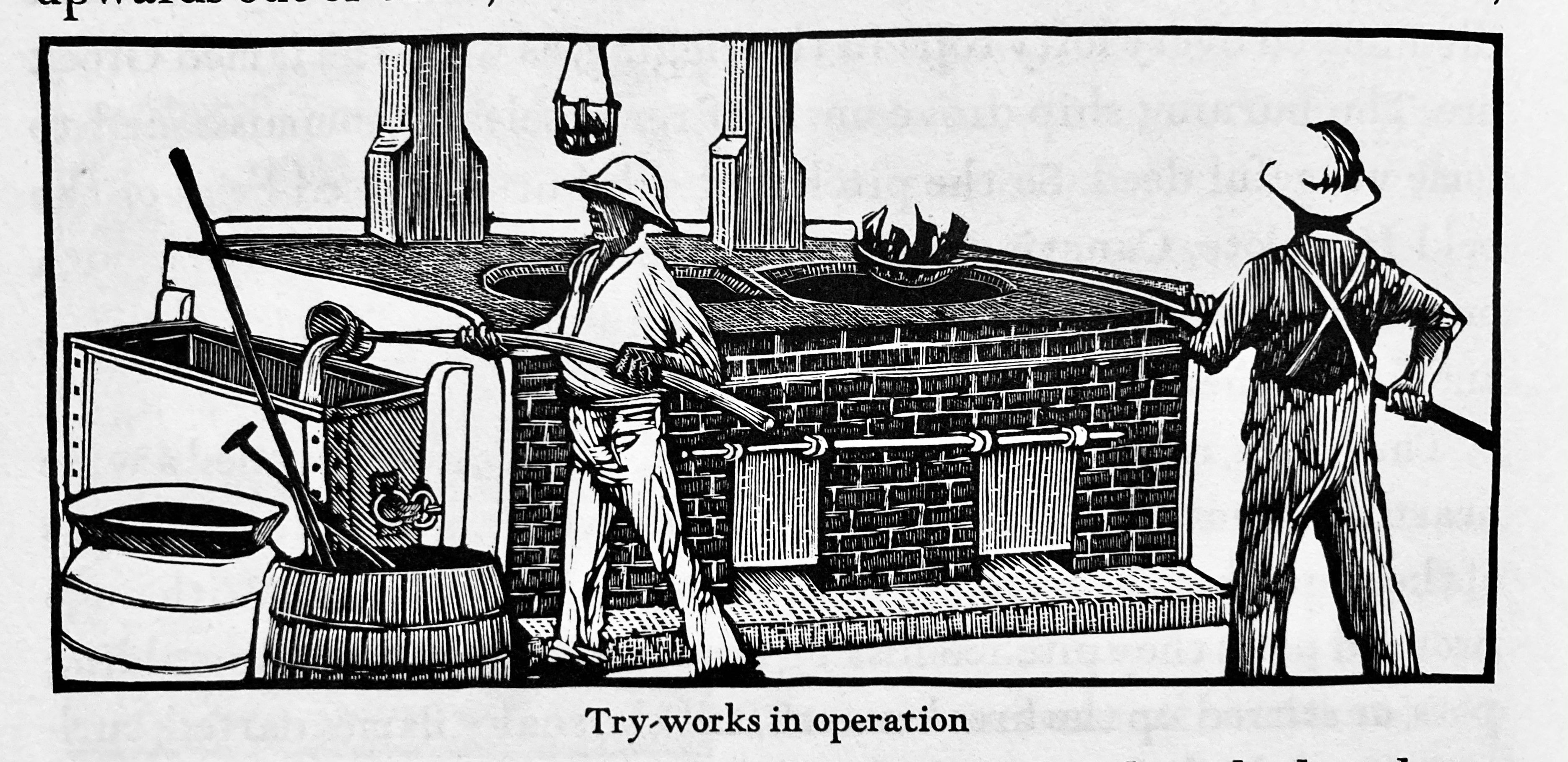
Another chapter initially focused on the practical business of whaling. In this case, we learn about the try-works, where blubber is cooked down to oil. I’ll let Moser’s illustration stand in here:

Moby-Dick illustration by Barry Moser

And here:

The chapter ends though in a great metaphysical rush, as Ish goes from things back to ideas:

The truest of all men was the Man of Sorrows, and the truest of all books is Solomon’s, and Ecclesiastes is the fine hammered steel of woe. “All is vanity.” ALL. This wilful world hath not got hold of unchristian Solomon’s wisdom yet. But he who dodges hospitals and jails, and walks fast crossing graveyards, and would rather talk of operas than hell; calls Cowper, Young, Pascal, Rousseau, poor devils all of sick men; and throughout a care-free lifetime swears by Rabelais as passing wise, and therefore jolly;—not that man is fitted to sit down on tomb-stones, and break the green damp mould with unfathomably wondrous Solomon.

The chapter concludes with a puzzling set of metaphors:

There is a wisdom that is woe; but there is a woe that is madness. And there is a Catskill eagle in some souls that can alike dive down into the blackest gorges, and soar out of them again and become invisible in the sunny spaces. And even if he for ever flies within the gorge, that gorge is in the mountains; so that even in his lowest swoop the mountain eagle is still higher than other birds upon the plain, even though they soar.

VII. Ch. 97, “The Lamp.”

In this very short (three-paragraph) chapter, Ishmael notes that whalemen light their lamps from the oil of the animals they hunt.

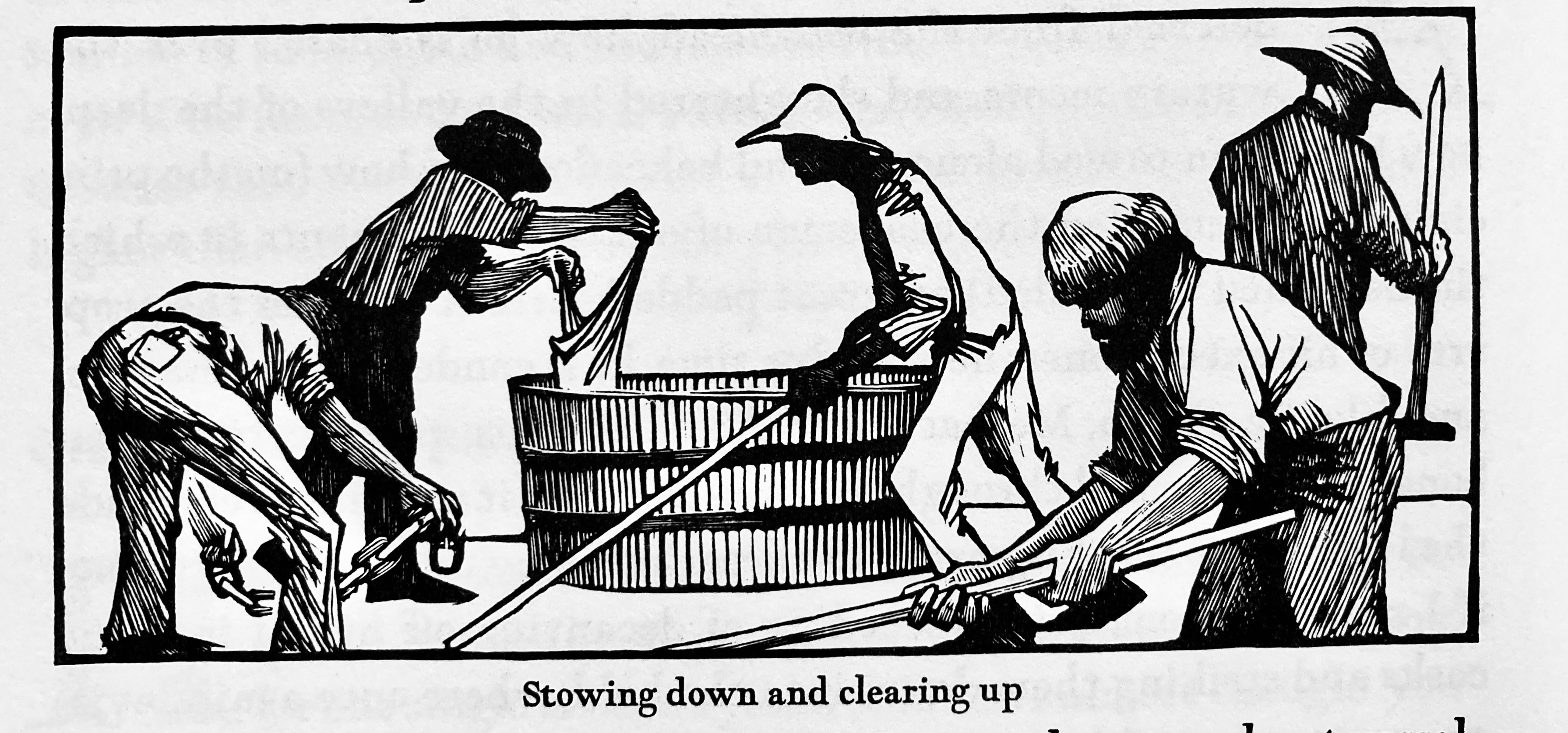
VIII. Ch. 98, “Stowing Down and Clearing Up.”

A chapter about cleaning up. Ish declares that, “were it not for the tell-tale boats and try-works, you would all but swear you trod some silent merchant vessel, with a most scrupulously neat commander. The unmanufactured sperm oil possesses a singularly cleansing virtue.” In other words, despite all the butchery, blood, and bits involved, there’s something in the whale itself that purifies the decks after a good scrub down.

The chapter ends with Ishmael recognizing the mechanical repetition of his business though—no wonder the Modernists revived Moby-Dick!

Yet this is life. For hardly have we mortals by long toilings extracted from this world’s vast bulk its small but valuable sperm; and then, with weary patience, cleansed ourselves from its defilements, and learned to live here in clean tabernacles of the soul; hardly is this done, when—There she blows!—the ghost is spouted up, and away we sail to fight some other world, and go through young life’s old routine again.

Oh! the metempsychosis! Oh! Pythagoras, that in bright Greece, two thousand years ago, did die, so good, so wise, so mild; I sailed with thee along the Peruvian coast last voyage—and, foolish as I am, taught thee, a green simple boy, how to splice a rope!

Moby-Dick illustration by Barry Moser

The intense concentration of self in the middle of such a heartless immensity, my God! who can tell it?  | Moby-Dick reread, riff 24

Moby-Dick illustration by Barry Moser

I. In this riff, Chapters 91, 92, and 93 of Moby-Dick.

II. Ch. 91, “The Pequod Meets The Rose-bud.”

Stubb stars in this humorous chapter in which The Pequod encounters a French vessel which is towing a pair of “what the fishermen call a blasted whale, that is, a whale that has died unmolested on the sea, and so floated an unappropriated corpse.” The smell from these two dead whales is awful. (Ish claims the odor is “worse than an Assyrian city in the plague, when the living are incompetent to bury the departed.”)

We soon learn the French ship bears an ironic name: “Bouton de Rose,”—Rose-button, or Rose-bud; and…this was the romantic name of this aromatic ship.”

Stubb hails the ship to ask Ahab’s famous question to all the ships The Pequod encounter, but the The Rose-bud has not seen the White Whale. Ahab leaves off, letting Stubb take over the chapter with his cruel comedy:

He now perceived that the Guernsey-man, who had just got into the chains, and was using a cutting-spade, had slung his nose in a sort of bag.

“What’s the matter with your nose, there?” said Stubb. “Broke it?”

“I wish it was broken, or that I didn’t have any nose at all!” answered the Guernsey-man, who did not seem to relish the job he was at very much. “But what are you holding yours for?”

“Oh, nothing! It’s a wax nose; I have to hold it on. Fine day, ain’t it? Air rather gardenny, I should say; throw us a bunch of posies, will ye, Bouton-de-Rose?”

“What in the devil’s name do you want here?” roared the Guernsey-man, flying into a sudden passion.

The Guernsey-man is irritated because his captain knows nothing of whales and refuses to discard the rotten animals, which his crew understand to be worthless. Stubb, however, thinks that one of the whales might be full of ambergris, a valuable substance, and he hatches a cunning plan to get the whale for himself. Stubb enlists the Gurnsey-man’s help in his plan: Stubb will appear as an expert witness on whales to The Rose-bud’s captain (ironically, a former perfumier)–only the captain speaks no English—so the Gurnsey-man will translate. However, the Gurnsey-man will simply say whatever he wants (namely, that they should cut the whales loose).

The scene plays out in comedy that I think still holds up today:

“What shall I say to him first?” said he.

“Why,” said Stubb, eyeing the velvet vest and the watch and seals, “you may as well begin by telling him that he looks a sort of babyish to me, though I don’t pretend to be a judge.”

“He says, Monsieur,” said the Guernsey-man, in French, turning to his captain, “that only yesterday his ship spoke a vessel, whose captain and chief-mate, with six sailors, had all died of a fever caught from a blasted whale they had brought alongside.”

Upon this the captain started, and eagerly desired to know more.

“What now?” said the Guernsey-man to Stubb.

“Why, since he takes it so easy, tell him that now I have eyed him carefully, I’m quite certain that he’s no more fit to command a whale-ship than a St. Jago monkey. In fact, tell him from me he’s a baboon.”

The scene continues in this line, with Stubb repeatedly insulting the captain who remains unaware of his abuse. When the captain offers Stubb a glass of wine to thank him for his advice, he replies thus:

“Thank him heartily; but tell him it’s against my principles to drink with the man I’ve diddled. In fact, tell him I must go.”

“He says, Monsieur, that his principles won’t admit of his drinking; but that if Monsieur wants to live another day to drink, then Monsieur had best drop all four boats, and pull the ship away from these whales, for it’s so calm they won’t drift.”

Stubb makes off with the whale and digs into it with his spade. He hits gold:

“I have it, I have it,” cried Stubb, with delight, striking something in the subterranean regions, “a purse! a purse!”

Dropping his spade, he thrust both hands in, and drew out handfuls of something that looked like ripe Windsor soap, or rich mottled old cheese; very unctuous and savory withal. You might easily dent it with your thumb; it is of a hue between yellow and ash colour. And this, good friends, is ambergris, worth a gold guinea an ounce to any druggist.

III. Stubb is the star of “The Pequod Meets The Rose-bud.” The chapter showcases his wit, and affords him all the best lines—lines a far cry from Ahab’s Shakespearean mode.

But this particular chapter also underlines my suspicion that Stubb is the villain of Moby-Dick. He’s cruel and greedy, duplicitous and hardhearted. He’s the opposite of largehearted Ishmael. Stubb has shown his double-edged comic cruelty earlier in the novel—most notably in the way he bullies his boat’s crew with sweethearted insults, but also in Ch. 64, “Stubb’s Supper,” when he plays cruel fun on Fleece, the Black cook of The Pequod. Stubb’s cruel avarice comes to a head in Ch. 93, “The Castaway.” But let’s first attend to Ch. 92, “Ambergris.”

IV. Ch. 92, “Ambergris.”

“Who would think, then, that such fine ladies and gentlemen should regale themselves with an essence found in the inglorious bowels of a sick whale!” Ishmael ponders near the beginning of this short chapter, which again riffs on a major theme of Moby-Dick; namely, how every thing earthly (and unearthly) finds its definition in its opposition.

V. Ch. 93, “The Castaway.”

Right.

So. Anyway. Per point III—I think I was arguing that Stubb is something of an asshole. He’s a bully, a bad boss, and despite the genial empathy in Ishmael’s voice (Melville’s voice?) that extends to all the horribles of The Pequod, he does not acquit himself well in “The Castaway.”

Ish sets the tragic scene from the outset:

It was but some few days after encountering the Frenchman, that a most significant event befell the most insignificant of the Pequod’s crew; an event most lamentable; and which ended in providing the sometimes madly merry and predestinated craft with a living and ever accompanying prophecy of whatever shattered sequel might prove her own.

In other words: The fate of poor Pip, the Black cabin boy, prefigures the fate of all the crew of the damned Pequod—-

and—

VI. (And, parenthetically—

I’ve been falling asleep to an audiobook of Cormac McCarthy’s novel Blood Meridian, which many many many folks have pointed out follows Moby-Dick, both rhetorically and thematically

(I mean hey, consider those opening lines:

“Call me Ishmael”

“See the child.

 )

And anyway, I sort of dip into Blood Meridian in random places, finding concurrent moments, motifs, intersections—

And in the Tarot scene of Blood Meridian, the Judge tells the Black Jackson that “In your fortune lie our fortunes all” — an echo here of the fate of poor Pip.

)

VII. And anyway,

—So, “in the ambergris affair Stubb’s after-oarsman chanced so to sprain his hand, as for a time to become quite maimed; and, temporarily, Pip was put into his place.”


Pip was put into his place.

Pip freaks out and jumps from the boat his first time, a jump that results in the loss of a whale. Sadistic Stubb is stern (and more than racist) in his rebuke:

“Stick to the boat, Pip, or by the Lord, I won’t pick you up if you jump; mind that. We can’t afford to lose whales by the likes of you; a whale would sell for thirty times what you would, Pip, in Alabama. Bear that in mind, and don’t jump any more.” Hereby perhaps Stubb indirectly hinted, that though man loved his fellow, yet man is a money-making animal, which propensity too often interferes with his benevolence.

(Old Ishmael (and Old Melville) — what’s with the verb hinted there?)

And so and well—

But we are all in the hands of the Gods; and Pip jumped again. It was under very similar circumstances to the first performance; but this time he did not breast out the line; and hence, when the whale started to run, Pip was left behind on the sea, like a hurried traveller’s trunk. Alas! Stubb was but too true to his word. It was a beautiful, bounteous, blue day; the spangled sea calm and cool, and flatly stretching away, all round, to the horizon, like gold-beater’s skin hammered out to the extremest. Bobbing up and down in that sea, Pip’s ebon head showed like a head of cloves. No boat-knife was lifted when he fell so rapidly astern. Stubb’s inexorable back was turned upon him; and the whale was winged. In three minutes, a whole mile of shoreless ocean was between Pip and Stubb. Out from the centre of the sea, poor Pip turned his crisp, curling, black head to the sun, another lonely castaway, though the loftiest and the brightest.

Ishmael understands the incredible existential loss of being castaway in the wide waste of the sea:

…the awful lonesomeness is intolerable. The intense concentration of self in the middle of such a heartless immensity, my God! who can tell it?

Poor Pip goes mad. His fate will be the fate of the company proper.

And if Ishmael’s sympathy sympathizes the victim, so too does it sympathize the villain—-

For the rest, blame not Stubb too hardly. The thing is common in that fishery; and in the sequel of the narrative, it will then be seen what like abandonment befell myself.

—and yet that sympathy is an empathetic prefiguring gust of our narrator Ish’s ultimate fate.