White Mythology (Book acquired, 6.17.2016)

img_2644

W.D. Clarke’s White Mythology comprises two novellas, Skinner Boxed and Love’s Alchemy. The physical book itself is beautiful, filled with epigraphs and images, occasional font shifts, and intriguing chapter titles (“The Pynchon Method,” for example).

Here’s the blurb:

Dr. Ed’s head should be spinning: a long-lost ‘son’ has just been sent over to his office by the temp agency, his shopping-addicted wife seems to have disappeared, and the clinical trial that he is running for a revolutionary new anti-depressant might well be going off the rails. But Dr. Ed is in control of everything, including himself.

Thus begins “Skinner Boxed”, the first of two thematically linked novellas that comprise White Mythology. In the second piece, “Love’s Alchemy”, five narrators deliver stories of betrayal that are nested like Russian dolls, stories that span an attempted seduction in Tokyo in 1987 back to a brotherly schism that erupts during a bottle rocket game of “war” in 1970s Massachusetts. From boys who poison their teacher’s plants to men who compulsively urinate into rivers, these strange (and strangely connected) monologues drop the reader into the pitch-black dunk tank of the soul.

You can preview White Mythology at Clarke’s site.

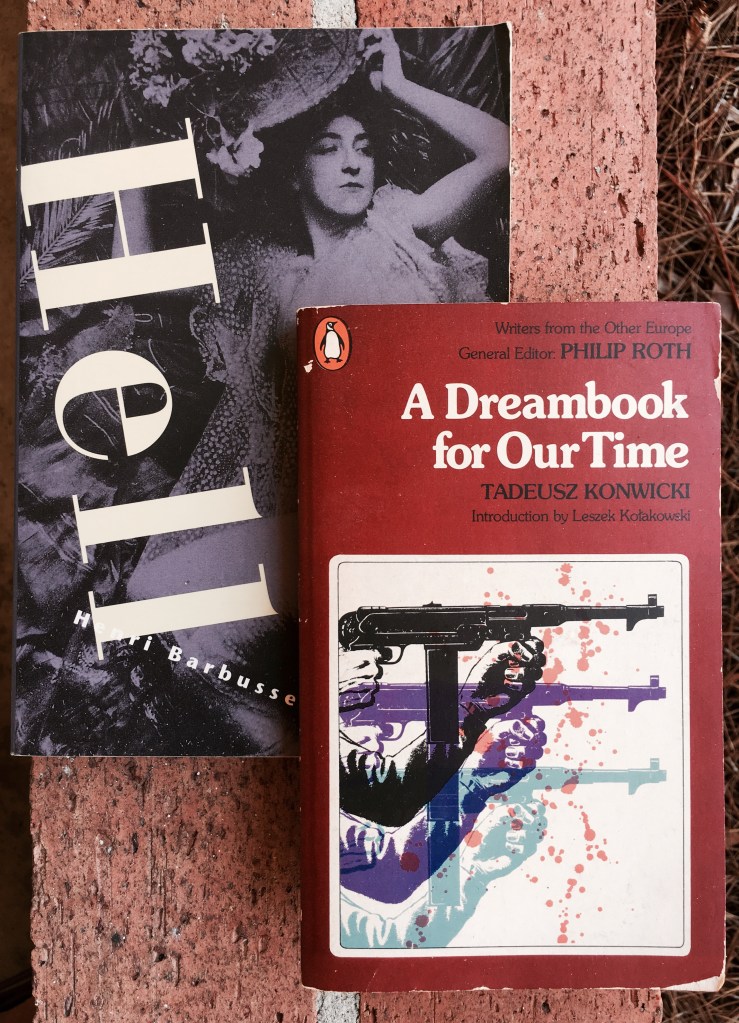
Hell/Dreambook (Books acquired, 6.07.2016)

img_2581

The Barbusse literally fell into my hands when I was pulling down a different book. I’d never heard of Hell until today but its title, cover, and blurb — “the most highly study of voyeurism” — sold me. Penguin’s Writers from Other Europe has always intrigued me and the cover alone on Tadeusz Konwicki’s A Dreambook for Our Time led to me picking it up.

Book Acquired 6.1.16

IMAG0163


Publisher (Repeater Books) sent me this intriguing first novel, The Aesthetics of Degradation, from translator Adrian Nathan West (Franz Werfel, Josef Winkler) the other day. Working on a review of Han Kang’s Human Acts right now (which is good, uh, really good), which will be up here soon (I hope!), but looking forward to this one from Mr. West. From the back:


Pornography keeps getting more extreme. Manufacturers, defenders and consumers of porn rely on a mix of wilful [sic] ignorance and bad faith to avoid serious discussion. When we do talk about violence against women in the porn world, the debate all too often becomes technical, complicated by legalities and outrage.

[…]

Collapsing distinctions between novel, memoir, and essay, this book will not make for light reading. But at its core is an extraordinarily brave and honest concern for the women and men who have been hurt in the name of sexual gratification.

There’s a blurb by Edmund White that I won’t reproduce. Is that important? I don’t know. Trying to be thorough.

New Villalobos (Book acquired, 5.24.2016)

img_2411

Juan Pablo Villalobos’s I’ll Sell You a Dog is forthcoming (this August) from And Other Books. English translation by Rosalind Harvey. Publisher’s blurb:

Long before he was the taco seller whose ‘Gringo Dog’ recipe made him famous throughout Mexico City, our hero was an aspiring artist: an artist, that is, till his would-be girlfriend was stolen by Diego Rivera, and his dreams snuffed out by his hypochondriac mother. Now our hero is resident in a retirement home, where fending off boredom is far more gruelling than making tacos. Plagued by the literary salon that bumps about his building’s lobby and haunted by the self-pitying ghost of a neglected artist, Villalobos’s old man can’t help but misbehave.

He antagonises his neighbours, tortures American missionaries with passages from Adorno, flirts with the revolutionary greengrocer, and in short does everything that can be done to fend off the boredom of retirement and old age . . . while still holding a beer.

A delicious take-down of pretensions to cultural posterity, I’ll Sell You a Dog is a comic novel whose absurd inventions, scurrilous antics and oddball characters are vintage Villalobos.

Brad Watson’s Miss Jane (Book acquired, 5.12.2016)

Brad Watson’s novel Miss Jane is forthcoming in hardback from W.W. Norton this July. Their blurb:

Astonishing prose brings to life a forgotten woman and a lost world in a strange and bittersweet Southern pastoral.

Since his award-winning debut collection of stories, Last Days of the Dog- Men, Brad Watson has been expanding the literary traditions of the South, in work as melancholy, witty, strange, and lovely as any in America. Inspired by the true story of his own great-aunt, he explores the life of Miss Jane Chisolm, born in rural, early-twentieth-century Mississippi with a genital birth defect that would stand in the way of the central “uses” for a woman in that time and place—namely, sex and marriage.

From the country doctor who adopts Jane to the hard tactile labor of farm life, from the highly erotic world of nature around her to the boy who loved but was forced to leave her, the world of Miss Jane Chisolm is anything but barren. Free to satisfy only herself, she mesmerizes those around her, exerting an unearthly fascination that lives beyond her still.

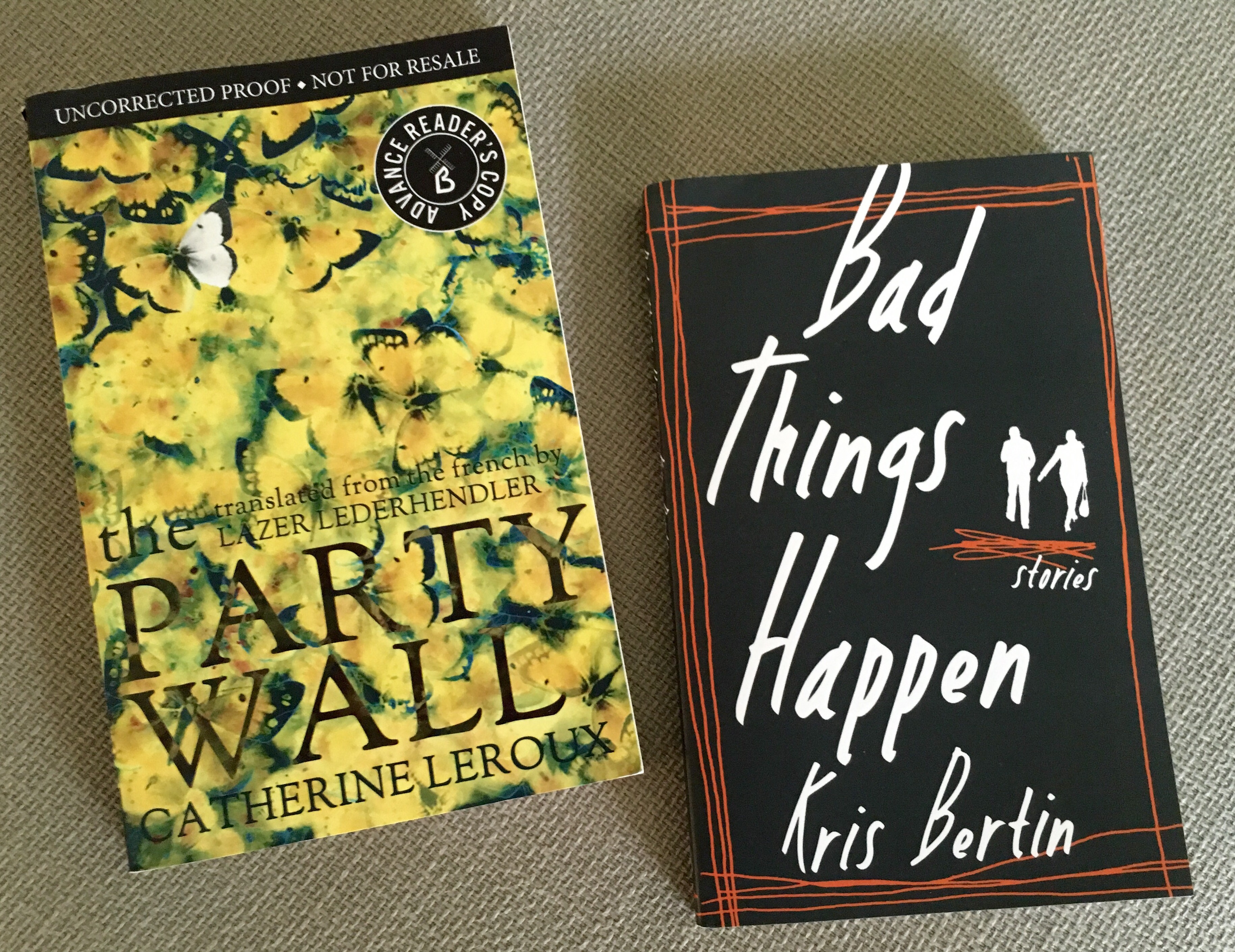
Party Wall/Bad Things Happen (Books acquired, 05.10.2016)

Two new ones from Biblioasis.

Party Wall is a novel by Catherine Leroux (English translation by Lazer Lederhendler). The blurb:

Catherine Leroux’s The Party Wall shifts between and ties together stories about pairs joined in surprising ways. A woman learns that she may not be the biological mother of her own son despite having given birth to him; a brother and sister unite, as their mother dies, to search for their long-lost father; two young sisters take a detour home, unaware of the tragedy that awaits; and a political couple—when the husband accedes to power in a post-apocalyptic future state—is shaken by the revelation of their own shared, if equally unknown, history.

Lyrical, intelligent, and profound, The Party Wall is luminously human, a surreally unforgettable journey through the barriers that can both separate us and bring us together.


And Bad Things Happen, a story collection by Kris Bertin. The blurb:

The characters in Bad Things Happen—professors, janitors, webcam models, small-time criminals—are between things. Between jobs and marriages, states of sobriety, joy and anguish; between who they are and who they want to be. Kris Bertin’s unforgettable debut introduces us to people at the tenuous moment before everything in their lives change, for better or worse.

Crews/DeLillo/Gardner/Murdoch (Books acquired, 5.12.2016)

img_2315

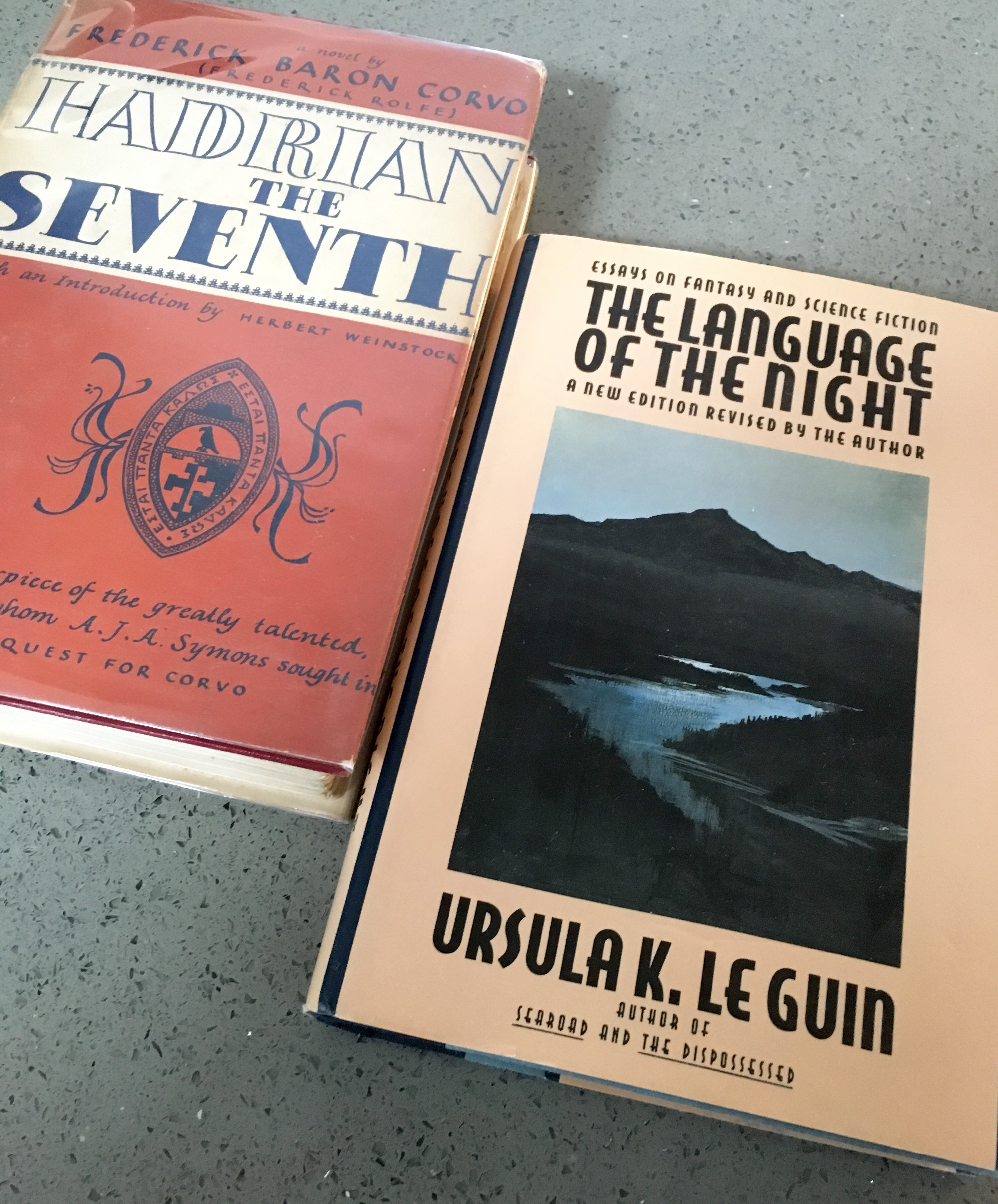
Le Guin/Corvo (Books acquired, 4.27.2016)


Thanks, Jon. 

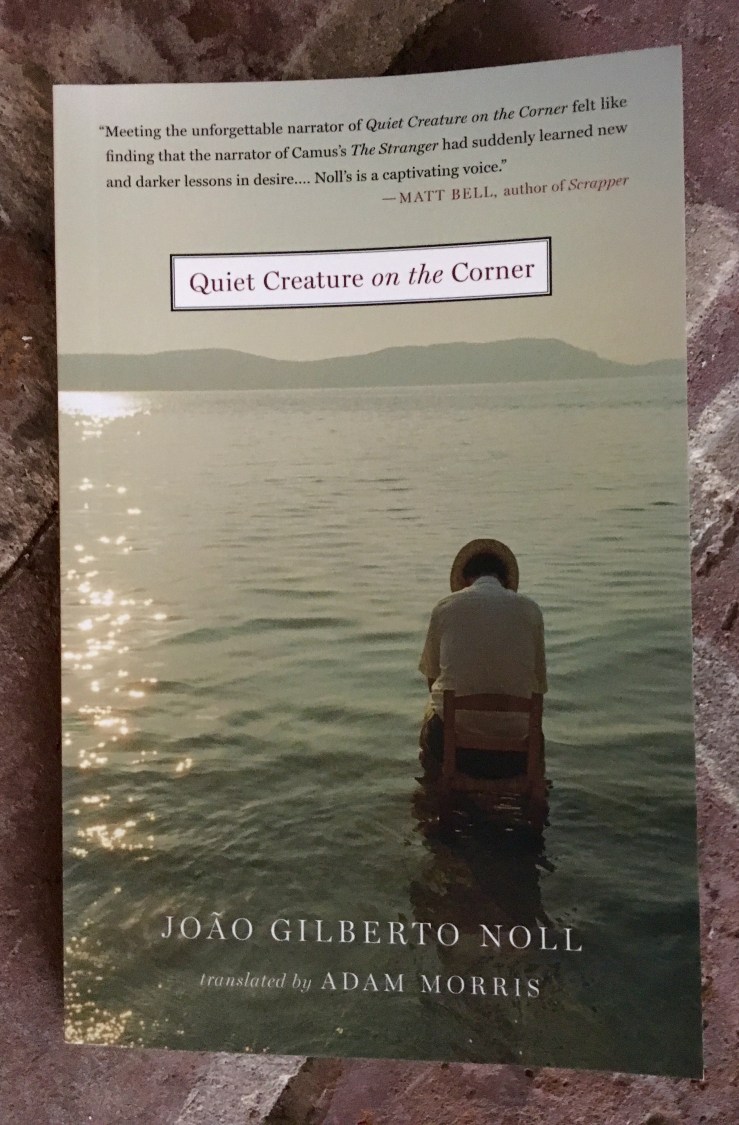
A quick riff on the first 30 pages of Quiet Creature on the Corner, João Gilberto Noll’s nightmare novella (Book acquired, 5.03.2016)

img_2169

In today’s mail I found a small package from Two Lines Press containing João Gilberto Noll’s 1991 novella Quiet Creature on the Corner, freshly translated into English from Portuguese by Adam Morris.

I started into the Noll. Each sentence made me want to read the next sentence. What is it about? you ask, perhaps. Well. I’m not sure. Let’s say the style, the tone, the mood are what matters here: Dark, nightmarish, abject, kinetic, surreal. There’s a picaresque bent to Quiet Creature: one damn thing happening after another. Dare I drop the K wordKafkaesque? Sure. (The opening pages remind me much of the opening sections of Alasdair Gray’s Lanark, for some reason—the dark dream logic). Okay, but what is it about? Gosh. Wait, there’s a blurb on the back of the book:

Quiet Creature on the Corner throws us into a strange world without rational cause and effect, where everyone always seems to lack just a few necessary facts. The narrator is an unemployed poet who is thrown in jail after inexplicably raping his neighbor. but then he’s abruptly taken to a countryside manor where all that’s required of him is to write poetry. What do his captors really want from him?

I’ve just gotten to the countryside manor part myself, so I can’t say. I know that in the 30 pages before that all kinds of weird dark disjointed shit happens. For example, on the third page, in the novella’s sixth paragraph, our poet narrator, leaving the public library, observes that “soot was falling, and nobody could really say where it came from—in certain places so thick that you couldn’t see the other side of the street.” This is like maybe an early little metaphor of the image-logic of Quiet Creature on the Corner (I love the crunch of the title). At the end of the paragraph, the narrator goes to a pornographic film which he describes to us.

Or another example—and here is where the book zapped me. Our narrator is taken from jail to a clinic, where he is given a nice clean bed and decides to sleep, finally:

I dreamed I was writing a poem in which two horses were whinnying. When I woke up, there they were, still whinnying, only this time outside the poem, a few steps a way, and I could mount them if I wanted to.

And then, for a few pages, Quiet Creature enters into a semi-bucolic reverie, as our hero lives another life, complete with farm, kids, a wife. Hay. I apply semi- to bucolic; sinister vibes underwrite every line so far of this novella. The poet doesn’t so much wake up out of this reverie as he leaves it to walk into another dream/nightmare.

More to come.

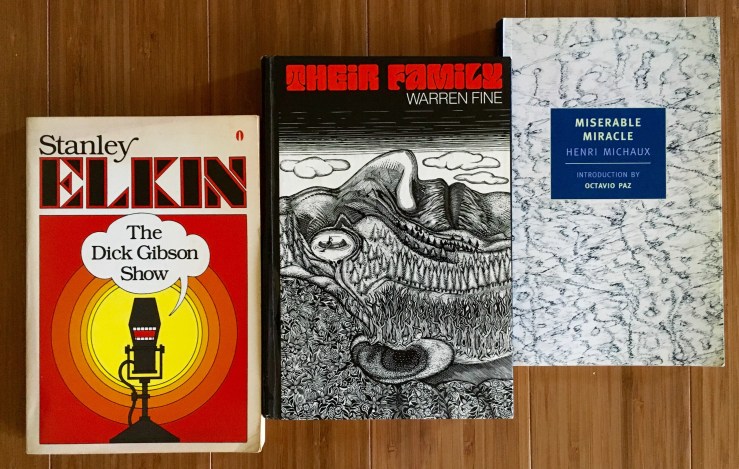
Books acquired, almost for their covers alone, 4.25.2016 (Elkin, Fine, Michaux)

img_2066

I swung by my favorite used bookstore this afternoon; it’s right near the grocery store and I needed to pick up some mint and some ricotta. I was hoping to pick up Elena Ferrante’s novel My Brilliant Friend at the bookstore. I started the audiobook of My Brilliant Friend today, after finishing the audiobook of Adrian Jones Pearson’s novel Cow Country  this weekend. (Full review of Cow Country forthcoming but a real quick review: great performance/reading of a very strange book which I enjoyed very much, but which I also suspect will have very limited appeal. Cow cult classic to come). But so anyway, I’m really digging the Ferrante, and decided I wanted to obtain a physical copy to reread passages (and maybe share some on this blog). My store had several copies of four of Ferrante’s novels–but no Friend. While scanning the section, my eye alighted (alit?) on a strange-looking hardback spine—Warren Fine’s Their Family. I turned it around and the cover…well, I knew I was gonna leave with it. Knopf, 1972—a few years before Gordon Lish was to become editor there, sure, but interesting bona fides I suppose. Fine does not seem to be beloved by anyone on the internet, and his books seem to have failed to go into second printings of any kind. The Fs are near the Es, and I glanced over the works of Mr. Stanley Elkin, who has his own section there, somehow. I finally broke through the second chapter of his novel The Franchiser this weekend (it’s all unattributed dialog, that chapter, sorta like Gaddis’s JR); I’m really digging The Franchiser now that I’ve tuned into the voice. (It also helps to not try reading it exclusively at night after too many bourbons or wines). Again, the spine of the novel looked interesting so I flipped The Dick Gibson Show around and, again, I knew I was gonna leave with it. Henri Michaux’s Miserable Miracle I found in the “Drugs” section—which I was not perusing (because I am no longer 19)—well I guess I was perusing it, but that’s only because it happens to be right next to this particular bookshop’s collection of Black Sparrow Press titles, which I always scan over. Anyway, the Michaux’s Miserable Miracle was turned face out; NYRB titles always deserve a quick scan, and the cover reminded me of a Cy Twombly painting. Flicking through it revealed a strange structure, full of marginal side notes and doodles and diagrams and drawings. And oh, it’s about a mescaline trip, I think. You can actually read it here, but this version is missing all the drawings and sidenotes.

Oh, and so then I forgot to go pick up the ricotta and the mint.

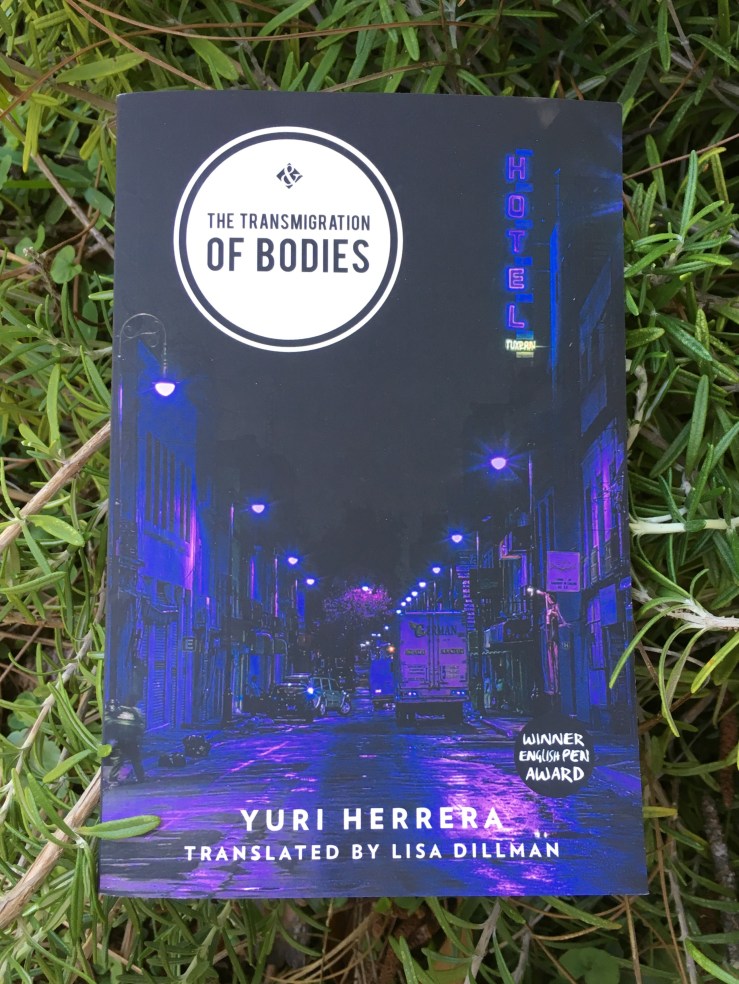
Yuri Herrera’s The Transmigration of Bodies (Book acquired, 4.16.2016; consumed 4.17.2016)

img_2013

I was a big fan of the last novella I read by Yuri Herrera, Signs Preceding the End of the World (also from publisher And Other Stories, and also translated by Lisa Dillman). So I was psyched when his newest offering (in English translation) The Transmigration of Bodies arrived at Biblioklept World Headquarters this weekend. I read the first half of Transmigration yesterday lying in the hammock, just enjoying the hell out of it. Herrera’s style condenses the mythic with the real; Transmigration begins with a surreal plague, flies buzzing over blood—or just some other filth?—and our (anti-)hero, a fixer who goes by The Redeemer. (Everyone in Transmigration gets a hardboiled name: The Dolphin, Three Times Blonde, Unruly, Neeyanderthal. Etc.). Anyway, the book isn’t out until July, so I’ll wait to do a full review until then, but here’s And Other Stories‘ blurb:

A plague has brought death to the city. Two feuding crime families with blood on their hands need our hard-boiled hero, The Redeemer, to broker peace. Both his instincts and the vacant streets warn him to stay indoors, but The Redeemer ventures out into the city’s underbelly to arrange for the exchange of the bodies they hold hostage.

Yuri Herrera’s novel is a response to the violence of contemporary Mexico. With echoes of Romeo and Juliet, Roberto Bolaño and Raymond Chandler, The Transmigration of Bodies is a noirish tragedy and a tribute to those bodies – loved, sanctified, lusted after, and defiled – that violent crime has touched.

Romeo and Juliet, Roberto Bolaño and Raymond Chandler” — yes, absolutely — and I would add Nicolas Winding Refn to that list. Herrera’s vivid neon noir is of a piece with Drive and Only God Forgives, and the grime here recalls his wonderful Pusher trilogy to me. I dig it.

Crossing the Sea with Syrians on the Exodus to Europe (Book acquired, 2.22.2016)

wimg_1652

Crossing the Sea with Syrians on the Exodus to Europe by Wolfgang Bauer (in English translation by Sarah Prybus) is new in hardback this month from And Other Stories. Their blurb:

Award-winning journalist Wolfgang Bauer and photographer Stanislav Krupař were the first undercover reporters to document the journey of Syrian refugees from Egypt to Europe. Posing as English teachers in 2014, they were direct witnesses to the brutality of smuggler gangs, the processes of detainment and deportation, the dangers of sea-crossing on rickety boats, and the final furtive journey through Europe. Combining their own travels with other eyewitness accounts in the first book of reportage of its kind, Crossing the Sea brings to life both the systemic problems and the individual faces behind the crisis, and is a passionate appeal for more humanitarian refugee policies.

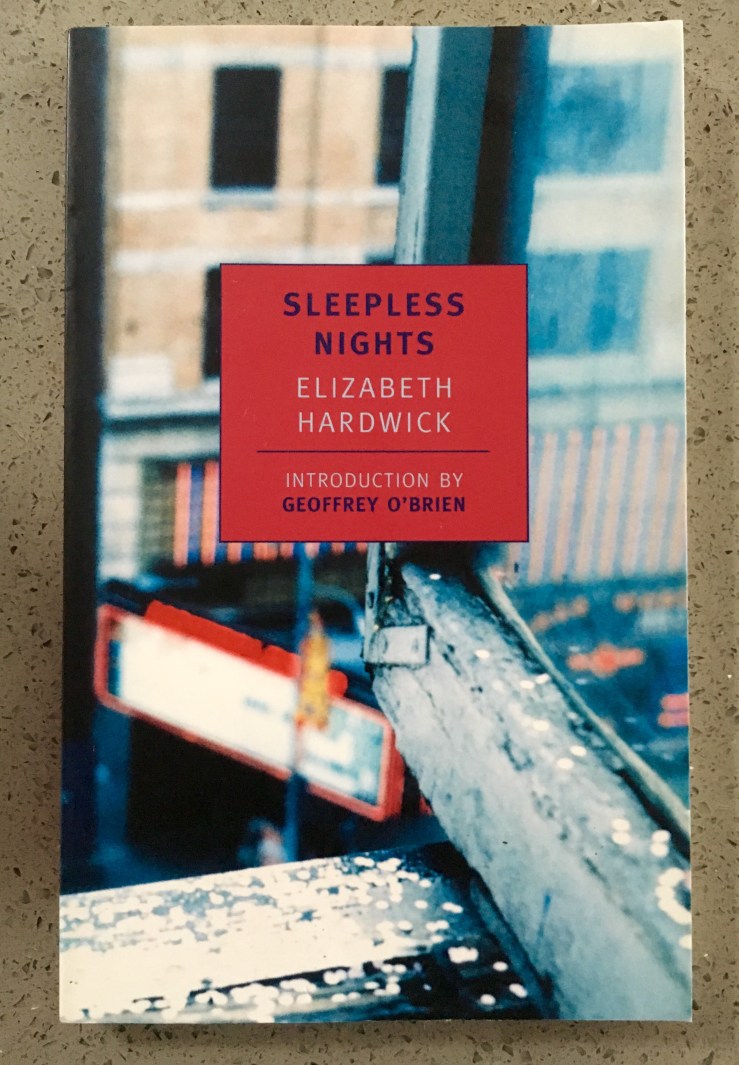
Elizabeth Hardwick’s Sleepless Nights (Book acquired, 3.07.2016)

img_1676

 I picked up Elizabeth Hardwick’s Sleepless Nights yesterday. (I was browsing the “H, classics” for something else, which I did not find, but I found this). Here’s the beginning of Joan Didion’s 1979 review in The New York Times:

“I have always, all of my life, been looking for help from a man,” we are told near the beginning of Elizabeth Hardwick’s subtle new book. “It has come many times and many more than not. This began early.” . . . “Sleepless Nights” is a novel, but it is a novel in which the subject is memory and to which the “I” whose memories are in question is entirely and deliberately the author: we recognize the events and addresses of Elizabeth Hardwick’s life not only from her earlier work, but from the poems of her husband, the late Robert Lowell. We study in another light the rainy afternoons and dyed satin shoes and high-school drunkenness of the Kentucky adolescence, the thin coats and yearnings toward home of the graduate years at Columbia, the households in Maine and Europe and on Marlborough Street in Boston and West 67th Street in New York. We are presented the entire itinerary, shown all the punched tickets and transfers. The result is less a “story about” or “of” a life than a shattered meditation on it, a work as evocative and difficult to place as Claude Levi-Strauss’s “Tristes Tropiques,” which it oddly recalls. The author observes of her enigmatic narrative: “It certainly hasn’t the drama of: I saw the old, white-bearded frigate master on the dock and signed up for the journey. But after all, ‘I’ am a woman.”

This strikes an interesting note, a balance of Oriental diffidence and exquisite contempt, of irony and direct statement, that exactly expresses the sensibility at work in “Sleepless Nights.” “But after all, ‘I’ am a woman.” Triste Tropique indeed. By way of suggesting his own intention, Levi-Strauss quoted Chateaubriand: “Every man carries within himself a world made up of all that he has seen and loved, and it is to this world that he returns, incessantly.” In certain ways, the mysterious and somnambulistic “difference” of being a woman has been, over 35 years, Elizabeth Hardwick’s great subject, the tropic to which she has returned incessantly: it colored both of her early novels, “The Ghostly Lover” in 1945 and “The Simple Truth” in 1955, as well as many of the essays collected in 1962 as “A View of My Own” and all of those published in 1974 as “Seduction and Betrayal: Women and Literature.”

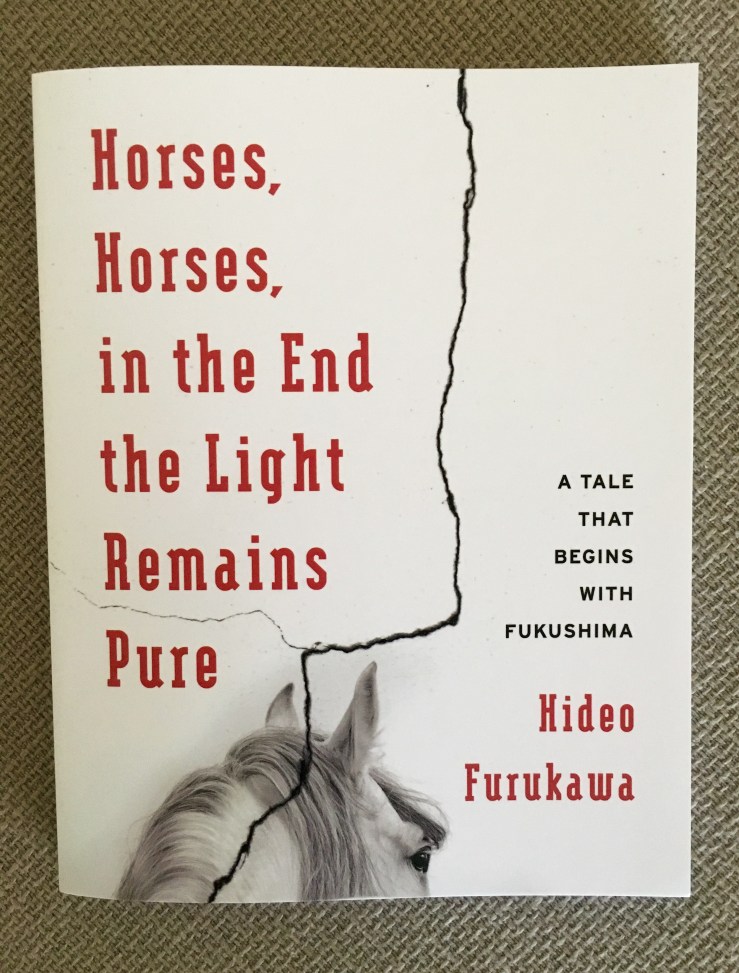
Horses, Horses, in the End the Light Remains Pure (Book acquired, 2.22.2016)

img_1653

I’m pretty excited about Hideo Furukawa’s Horses, Horses, in the End the Light Remains Pure (new this month from Columbia University Press in English translation by Doug Slaymaker with Akiko Takenaka). Columbia UP’s blurb:

Horses, Horses, in the End the Light Remains Pure is a multifaceted literary response to the earthquake, tsunami, and nuclear meltdown that devastated northeast Japan on March 11, 2011. The novel is narrated by Hideo Furukawa, who travels back to his childhood home near Fukushima after 3/11 to reconnect with a place that is now doubly alien. His ruminations conjure the region’s storied past, particularly its thousand-year history of horses, humans, and the struggle with a rugged terrain. Standing in the morning light, these horses also tell their stories, heightening the sense of liberation, chaos, and loss that accompanies Furukawa’s rich recollections. A fusion of fiction, history, and memoir, this book plays with form and feeling in ways reminiscent of Vladimir Nabokov’s Speak, Memory and W. G. Sebald’s The Rings of Saturn yet draws its own, unforgettable portrait of personal and cultural dislocation.

Read an excerpt here.

He Wants (Book acquired, some time in February 2016)

img_1651

British author Alison Moore’s novel He Wants is getting a release on this side of the Atlantic from Canadian publisher Biblioasis.

From novelist Rachel Cusk’s review of He Wants two years ago in The Guardian:

Following her Booker-shortlisted The Lighthouse, Alison Moore’s artistically pleasing second novel is a sort of Midlands Death in Venice, a story of ageing and thwarted desire in which a man drifts away from his moorings into Dionysian impulses, after a lifetime spent serving the values of the humdrum contemporary community in which he lives.

He Wants evokes a world that is purposefully pedestrian – the Dionysian impulses pertain to halves of shandy and the desire to taste a Swiss liqueur called Goldschläger – but its themes of self-realisation, identity and mortality are grand enough. Moore’s protagonist, a widower RE teacher who is approaching retirement, is intimately captured in the midst of a disintegration brought about by the loss of the structures that have thus far formed and maintained his personality: work, marriage and certain relationships that have created or reinforced his sense of existence.

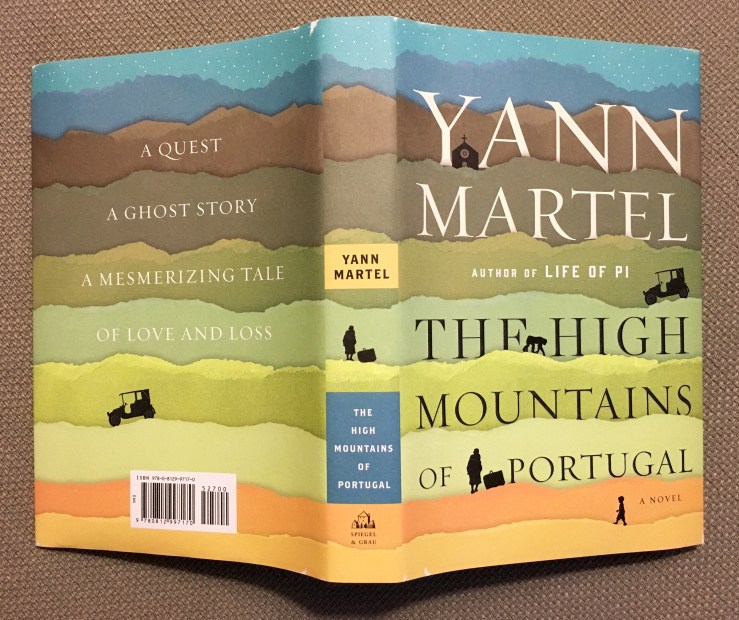
Yann Martel’s The High Mountains of Portugal (Book acquired, 1.28.2016)

img_1401

Yann Martel’s novel The High Mountains of Portugal is new in hardback in the U.S. from Speigel & Grau.

Here’s the first two paragraphs of Urusla K. Le Guin’s review of the novel in The Guardian:

The High Mountains of Portugal, in Yann Martel’s novel of that name, turn out to be grassy uplands rather than high mountains; and the book turns out to be three stories rather than a novel. The stories, connected ingeniously, vary greatly in tone and quality. The first two display so little of the author’s narrative skill that they may offer more temptation to stop reading than to go on. Liking the last part of the book much better, I could wish that it stood alone.

In Martel’s Booker-winning Life of Pi, the author within the story tells us that he went to India with the intention of writing a novel set in Portugal. Then he met the Indian who told him the tale of Pi, and Portugal was forgotten. It’s recollected in the first part of this book in great detail: “He heads off down Rue São Miguel on to Largo São Miguel and then Rua de São João da Praça before turning on to Arco de Jesus.” This sort of street-rosary may delight Lisbon initiates but to others is made interesting only by the fact that the protagonist, Tomas, is walking backwards, and that he always does so. After some elaborate rationales for walking backwards, and a farcical encounter with a lamppost, we learn that he walks with “his back to the world, his back to God”, not because he is grieving for the sudden, recent death of his wife, his child, and his father, but because “he is objecting”.

Read the rest of Le Guin’s review.

Frankie Styne and the Silver Man (Book acquired, 12.09.2015)

img_1013

Kathy Page’s 1992 novel Frankie Styne and the Silver Man is getting a North American debut thanks to publisher Biblioasis. Blurb from the author’s website:

Frankie Styne, the successful author of a series of gruesome killer novels,  has lived  at 125 Onley Street for many years. Meticulous and obsessive, he lives a life of isolation, managing to keep both future and past at bay.

Next door, live Liz Meredith and her new baby, Jim. Liz has been told by her social worker Mrs Purvis that Jim has a rare disorder, and will never be like other children. But Mrs Purvis can’t see, as Liz can, that Jim already knows things no ordinary person could. Besides, Liz doesn’t want any help from the social services or from Tom and Alice, the couple at number 129. She wants to be left in peace so that she can imagine her way out of how things are.

When Frank’s solitary anonymity is threatened, he hatches a real-life plot which, as he begins to enact it, unexpectedly changes not only his own life, but also those of Liz and Jim. Sifting through our collective nightmares, Kathy Page has written a novel that is powerful, humorous, tragic and thoroughly surprising.