Category: Books
“Vertical Motion” — Can Xue
We are little critters who live in the black earth beneath the desert. The people on Mother Earth can’t imagine such a large expanse of fertile humus lying dozens of meters beneath the boundless desert. Our race has lived here for generations. We have neither eyes nor any olfactory sense. In this large nursery, such apparatus is useless. Our lives are simple, for we merely use our long beaks to dig the earth, eat the nutritious soil, and then excrete it. We live in happiness and harmony because we have abundant resources in our home town. Thus, we can all eat our fill without a dispute arising. At any rate, I’ve never heard of one.
In our spare time, we congregate to recall anecdotes of our forebears. We begin by remembering the oldest of our ancestors and then run through the others. The remembrances are pleasurable, filled with outlandish salty and sweet flavours, as well as some crispy amber – the immemorial turpentine. In our recollections, there is a blank passage that is difficult to describe. Broadly speaking, as one of our elders (the one with the longest beak) was digging the earth, he suddenly crossed the dividing line and vanished in the desert above. He never returned to us. Whenever we remembered this, we fell silent. I sensed that everyone was afraid.
(via.)
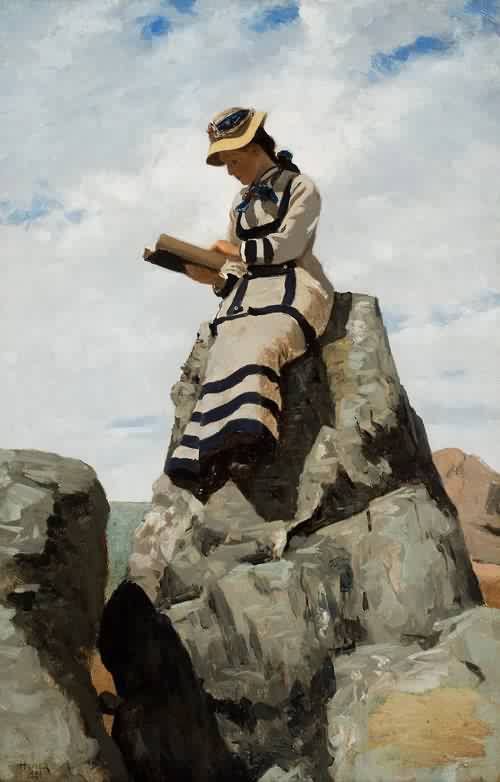
Reader — Giovanni Fattori
The Lotus and the Storm (Book Acquired, 07.25.2014)
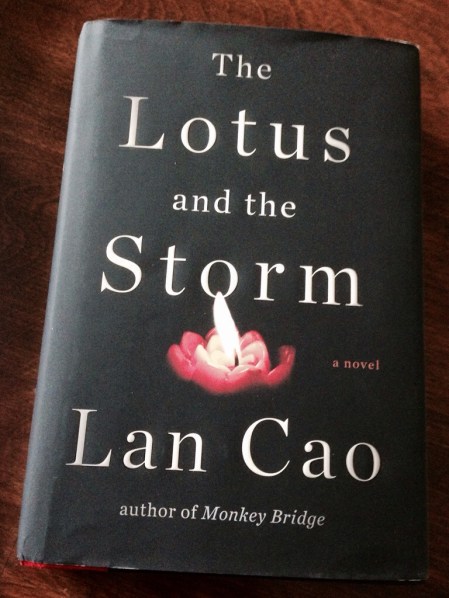
Lan Cao’s novel The Lotus and the Storm is out in hardback later this month. Here’s the Kirkus review:
Written with acute psychological insight and poetic flair, this deeply moving novel illuminates the ravages of war as experienced by a South Vietnamese family.
In a rewarding follow-up to her well-received debut, Monkey Bridge (1997), the author returns to the conflict that shaped her own destiny before she was airlifted from her native Saigon to live in Virginia. Here, she shows what happens to a family of four—a South Vietnamese airborne commander, his beautiful wife and their two young daughters—as the war challenges loyalties with betrayals. The story is narrated by two characters: Mai, the younger daughter, who recalls her girlhood as the war intensified from her current home in Virginia; and Minh, her father, who’s living with Mai and with his memories of what transpired in Vietnam 40 years earlier. “Saigon still wraps itself around me and squeezes me with sudden force,” he explains, though the traumatic effects on Mai prove stronger and even stranger. What’s plain from the setup, with its alternating voices, is that only half of this family will be telling the story, a story in which what happened to the other two proves crucial. The novel’s most complex figure is Quý, Mai’s mother and Minh’s wife, from whom the reader never hears but whose depth of character reveals itself through the perspectives of others. She made a sacrifice by marrying a man considered below her, and she continued to make sacrifices, some of which seemed like betrayals, to protect the lives of those she loved, including her Viet Cong brother as well as her husband. Mai can’t really comprehend through a child’s eyes what’s happening with her family and how threatened their future is, though she intuitively senses that something is wrong. Even Minh doesn’t realize until decades later what really happened, and the revelations will surprise the reader as well.
A novel that humanizes the war in a way that body counts and political analyses never will.
The Screen Porch — Fairfield Porter

Self-Portrait — Gerrit Dou

Bob Schofield Discusses The Inevitable June and His Sad-Cartoon-Apocalypse Aesthetic
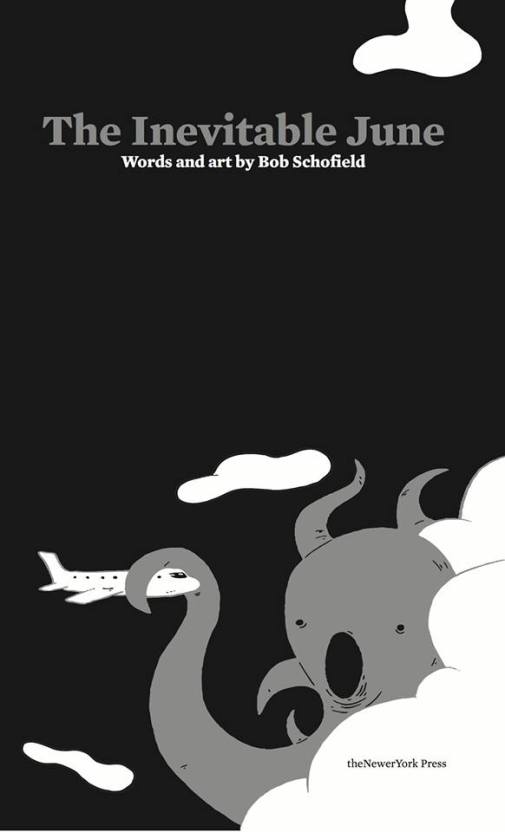
Bob Schofield is a writer and artist. He first showed up on my radar when theNewerYork sent me a digital file of his book The Inevitable June, which I described as “the kind of thing that we need more of; not a gimmick or a hybrid, but something new.” I’m still not sure what the book is, but I dig it. Bob was kind enough to talk to me over a series of emails about his work. Read some of Bob’s work at his website. Read my review of The Inevitable June here. Read our discussion below.
Biblioklept: What is The Inevitable June?
Bob Schofield: The Inevitable June is a collection of 30 surreal short prose pieces, one for every day in June, intercut with black and white illustrations. The drawings don’t always correspond to the text, and there isn’t really much of a coherent “story” per se, but there is certainly momentum and direction. The book definitely goes somewhere, though I’m not sure where exactly that “somewhere” is.
I kind of just wanted to build a little world that mirrored my imagination. A kind of scale-model. So I wanted it to be a little cold and sad and spooky and, hopefully, also fun. Like some kind of weird, floppy theme park made of bound paper squares.
Biblioklept: How did you compose that “scale-model”? Did you have an outline from the outset?
Schofield: There were a few structural “rules” I came up with, and the rest I sort of made up as I went. Like I knew I’d have thirty pieces total, and they’d all be titled for successive days in June. It’s funny, a lot of the momentum in the book just comes from that progression of calendar days. I guess we’re just culturally wired to feel like we’re going somewhere when we see those days slide by. But in the book it’s all relatively arbitrary, and if you were to take the days away as titles, things would feel a lot more meandering.

My other big structural decision was to start every piece with “This morning,” which would become a kind of refrain throughout the book. I kind of thought of it a bit like a dinner bell, indicating one course of the meal was over, and we were moving on to the next.
Then as I was writing all the individual pieces, I’d cherry pick certain images and phrases I liked, and then be sure to repeat them later on. That way the reader’s brain would kind of light up as they recognized parts of a pattern, even though the pattern wasn’t really saying anything specific. I think that kind of thing is important when you don’t have a more familiar storytelling structure to rely on. You need to give the reader something to hold on to.
And for myself as writer, all these patterns and rules gave me just as much of an anchor. It meant I wasn’t just spinning off into some sort of insane, incomprehensible word soup. I’d always be aware that I’d have to wrap things up at some point, and move on to the next “day.”
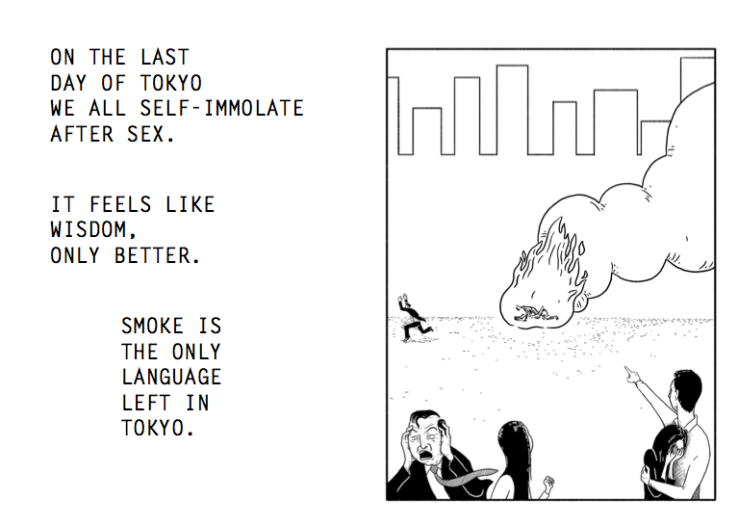
Biblioklept: Your book The Last Days of Tokyo shares some of the anchoring features you mention—beginning each page with the phrase “On the last day of Tokyo,” for example, and the image of a salaryman fleeing in horror, his face an echo of Munch’s The Scream.
Book and Guitar — Juan Gris

Roberto Bolaño’s Fiction (Book Acquired, 07.24.2014)
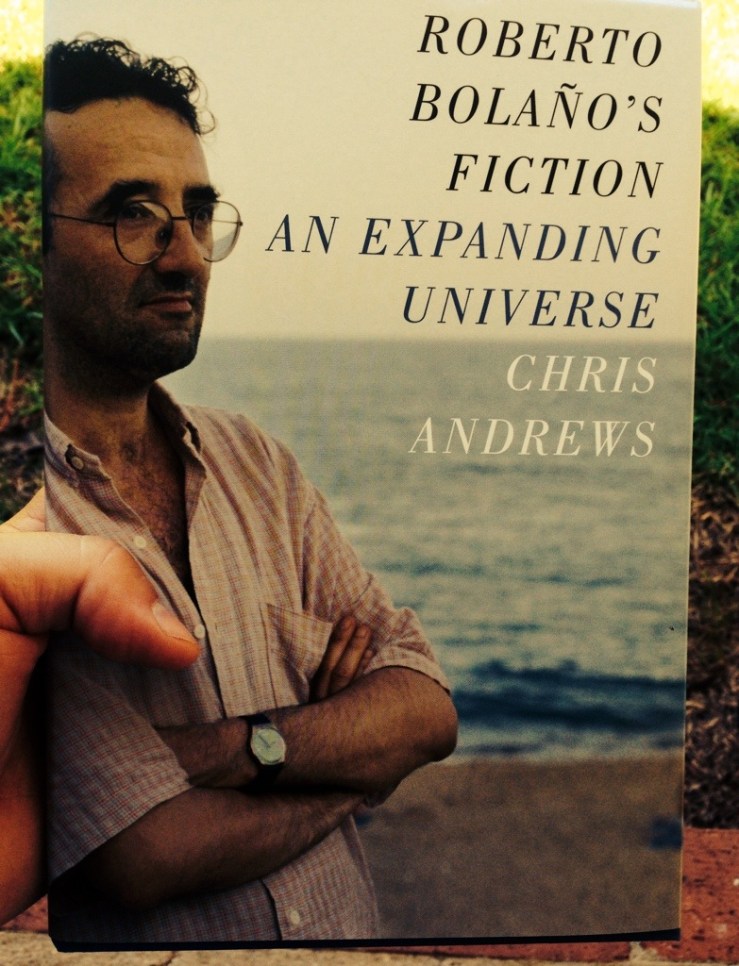
So of course I’ve been eating up Roberto Bolaño’s Fiction: An Expanding Universe, a new critical study by Bolaño’s translator Chris Andrews. I’ve read the introduction and the first three chapters so far, and the study, far from being dry and academic, compels me to dig deeper.
The book really starts with the second chapter, with Andrews simply trying to situate Bolaño-as-publishing-phenomenon in the first chapter. The introduction—which you can read at publisher Columbia UP’s site—offers a clear overview of what Andrews aims to do.
Andrews writes that:
…the interconnected series of narratives that begins with Nazi Literatures in the Americas (originally published in 1996) and ends with the stories that appeared posthumously in The Secret of Evil … can be regarded as forming a single, openly structured edifice whose two sustaining pillars are The Savage Detectives and 2666, and for which Woes of the True Policeman served as a preparatory model.
Andrews’s description recalls Javier Moreno’s geometry of Bolaño’s fictions:
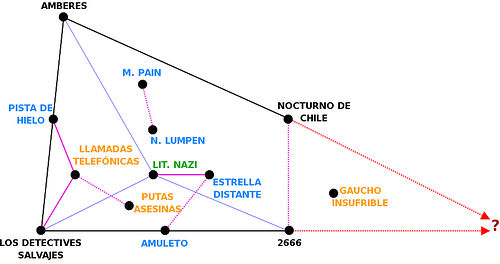
This model has greatly influenced my own reading of Bolaño over the years, leading to my conceptualization of Bolaño’s later work existing in a self-creating, self-deconstructing Bolañoverse.
Andrews’s description of the Bolañoverse (he doesn’t use the term):
Bolaño expanded or “exploded” his own published texts, blowing them up by adding new characters and episodes as well as circumstantial details. He also allowed characters to circulate or migrate from text to text, sometimes altering their names and properties. Within his novels and stories, he inclded representations of imagined texts and artworks, that is, metarepresentations. Finally, some of his characters and narrators are over-interpreters: they seize on details, invest them with significance, and invent stories to connect and explain them.
More to come; for now, the publisher’s blurb:
Since the publication of The Savage Detectives in 2007, the work of Roberto Bolaño (1953–2003) has achieved an acclaim rarely enjoyed by literature in translation. Chris Andrews, a leading translator of Bolaño’s work into English, explores the singular achievements of the author’s oeuvre, engaging with its distinct style and key thematic concerns, incorporating his novels and stories into the larger history of Latin American and global literary fiction.
Andrews provides new readings and interpretations of Bolaño’s novels, including 2666, The Savage Detectives, and By Night in Chile, while at the same time examining the ideas and narrative strategies that unify his work. He begins with a consideration of the reception of Bolaño’s fiction in English translation, examining the reasons behind its popularity. Subsequent chapters explore aspects of Bolaño’s fictional universe and the political, ethical, and aesthetic values that shape it. Bolaño emerges as the inventor of a prodigiously effective “fiction-making system,” a subtle handler of suspense, a chronicler of aimlessness, a celebrator of courage, an anatomist of evil, and a proponent of youthful openness. Written in a clear and engaging style, Roberto Bolano’s Fiction offers an invaluable understanding of one of the most important authors of the last thirty years.
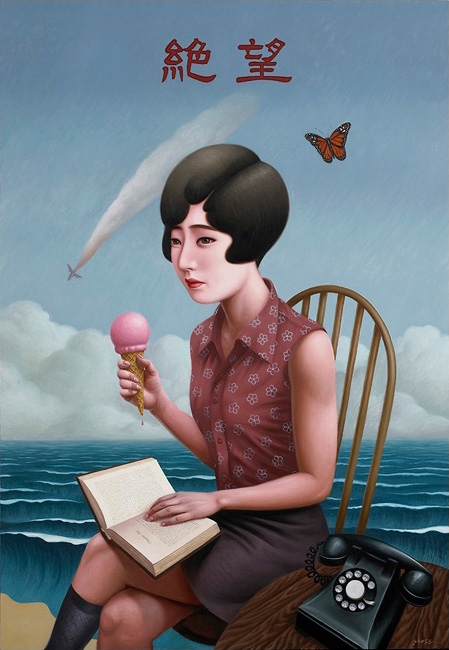
Ice Cream Cone (Despair) — Alex Gross
“The Brawl” — Michelangelo Antonioni

Dan McPharlin’s Miniatures




Repairable Men (Book Acquired, 7.21.2014)
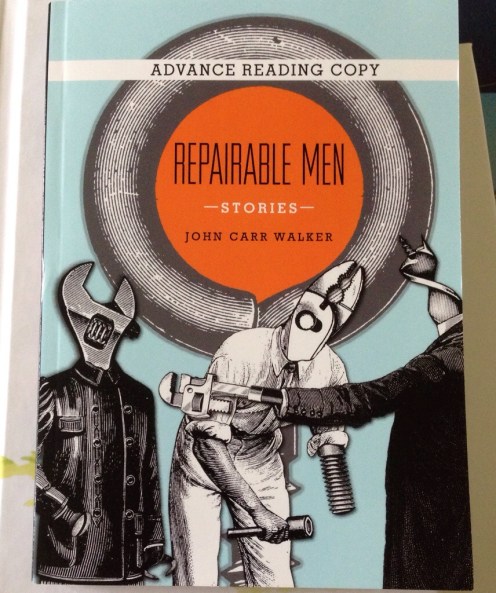
John Carr Walker’s collection Repairable Men is new from Sunnyoutside. Blurb from the author’s website:
The stories in Repairable Men look at the small towns and rural farms where families stay for generations and newcomers never quite feel at home. Whether trapped by dead-end work, hostile relatives, or the troubling legacies of their forebears, John Carr Walker’s characters are seeking escape, forgiveness, and redemption in the dusty corners of the new American West.
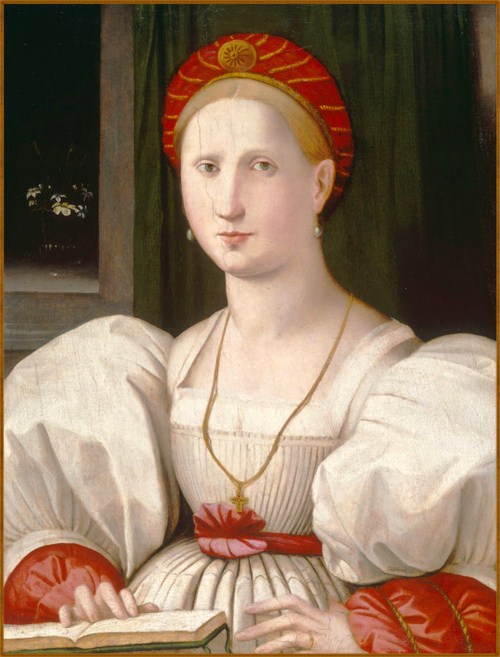
Portrait of a Woman with a Book — Paolo Zacchia il Vecchio the Elder
Competent and informative novels (Doris Lessing’s The Golden Notebook)
During that period of three months when I wrote reviews, reading ten or more books a week, I made a discovery: that the interest with which I read these books had nothing to do with what I feel when I read-let’s say—Thomas Mann, the last of the writers in the old sense, who used the novel for philosophical statements about life. The point is, that the function of the novel seems to be changing; it has become an outpost of journalism; we read novels for information about areas of life we don’t know-Nigeria, South Africa, the American army, a coal-mining village, coteries in Chelsea, etc. We read to find out what is going on. One novel in five hundred or a thousand has the quality a novel should have to make it a novel—the quality of philosophy. I find that I read with the same kind of curiosity most novels, and a book of reportage. Most novels, if they are successful at all, are original in the sense that they report the existence of an area of society, a type of person, not yet admitted to the general literate consciousness. The novel has become a function of the fragmented society, the fragmented consciousness. Human beings are so divided, are becoming more and more divided, and more subdivided in themselves, reflecting the world, that they reach out desperately, not knowing they do it, for information about other groups inside their own country, let alone about groups in other countries. It is a blind grasping out for their own wholeness, and the novel-report is a means towards it. Inside this country, Britain, the middle-class has no knowledge of the lives of the working-people, and vice-versa; and reports and articles and novels are sold across the frontiers, are read as if savage tribes were being investigated. Those fishermen in Scotland were a different species from the coalminers I stayed with in Yorkshire; and both come from a different world than the housing estate outside London. Yet I am incapable of writing the only kind of novel which interests me: a book powered with an intellectual or moral passion strong enough to create order, to create a new way of looking at life. It is because I am too diffused. I have decided never to write another novel. I have fifty ‘subjects’ I could write about; and they would be competent enough. If there is one thing we can be sure of, it is that competent and informative novels will continue to pour from the publishing houses. I have only one, and the least important of the qualities necessary to write at all, and that is curiosity. It is the curiosity of the journalist. I suffer torments of dissatisfaction and incompletion because of my inability to enter those areas of life my way of living, education, sex, politics, class bar me from. It is the malady of some of the best people of this time; some can stand the pressure of it; others crack under it; it is a new sensibility, a half-unconscious attempt towards a new imaginative comprehension. But it is fatal to art.
From Doris Lessing’s The Golden Notebook.
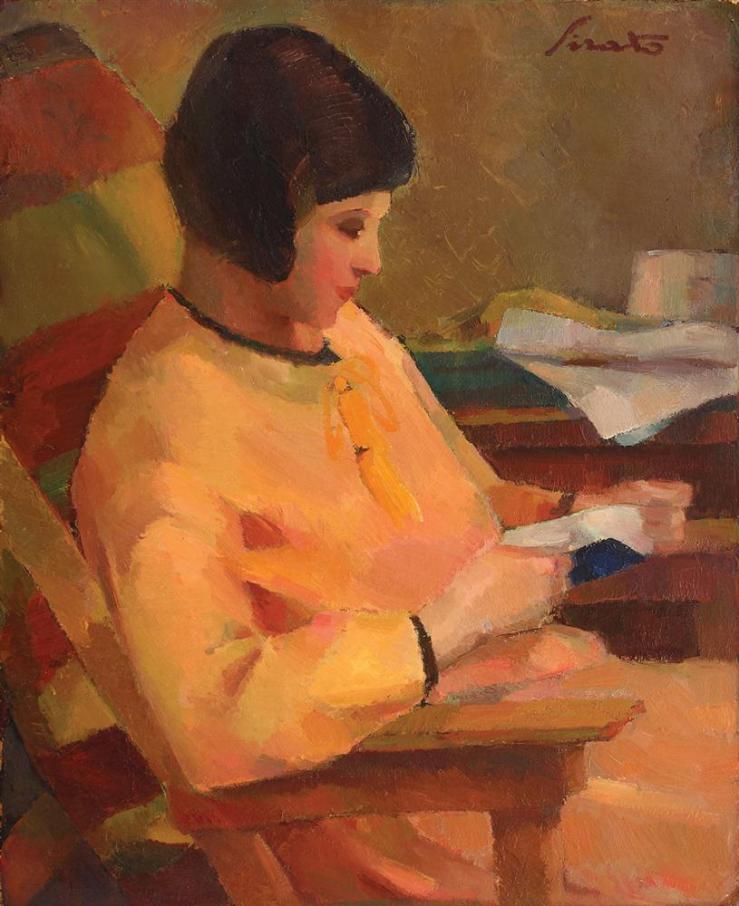
Woman Reading — Francisc Sirato
Moby-Dick (Alasdair Gray’s Lanark)
It is a relief to turn to the honest American book about the whale. A captain wants to kill it because the last time he tried to do that it bit off his leg while escaping. He embarks with a cosmopolitan crew who don’t like home life and prefer this way of earning money. They are brave, skilful and obedient, they chase the whale round the world and get themselves all drowned together: all but the storyteller. He describes the world flowing on as if they had never existed. There are no women or children in this book, apart from a little black boy whom they accidentally drive mad.
From Alasdair Gray’s unwieldy cult classic Lanark. In this particular episode, a version of the author of the novel Lanark itself (a conjurer-king, not named Gray) discusses and describes the great national epics; he chooses Moby-Dick as the American epic. There is no listing of a Scottish national epic; presumably Gray intends his novel to fill that slot.
 Biblioklept