The Cranky Brilliance of Dwight Macdonald | Masscult and Midcult Reviewed

20140625-134004-49204118.jpg
Masscult and Midcult: Essays Against the American Grain
 (NYRB) collects ten pieces by cultural critic Dwight Macdonald. First published between the late 1950s and the early 1970s, the essays here feature varied subjects, always attacked through the same critical lens. Whether he’s excoriating late-period Hemingway, deriding structural linguistics, lamenting the Revised Standard Version of the Bible, or chewing up a now-forgotten bestseller, Macdonald centers the brunt of his attack on the creeping “impostures and vulgarizations” of what he called Masscult and Midcult.

In “Masscult and Midcult,” the longest and perhaps most effective essay in the collection, Macdonald defines, illustrates, and analyzes his neologisms against the historical backdrop of a rising commercial culture. “Masscult is bad in a new way,” he tells us,” it doesn’t even have the theoretical possibility of being good . . . It is not just unsuccessful art. It is non-art. It is even anti-art.” He continues:

Masscult offers its customers neither an emotional catharsis nor an aesthetic experience, for these demand effort. The production line grinds out a uniform product whose humble aim is not even entertainment, for this too implies life and hence effort, but merely distraction. It may be stimulating or narcotic, but it must be easy to assimilate. It asks nothing of its audience, for it is “totally subjected to the spectator. And it gives nothing.

Macdonald views Masscult as the unfortunate inevitability of capitalism and the burgeoning middle class—or, more appropriately, Middlebrow class. Macdonald is deeply concerned with the location of brows, referring to himself as Highbrow throughout the collection (even once casually dropping We highbrows, a little bone to the reader, perhaps). He repeatedly points out that the virtue of Lowbrowness is that the Lowbrow know where their brows are in relation to higher brows. Folk art is not just acceptable, it’s good stuff, important in its hierarchical relationship to High Art. It’s those damn Middlebrows that cause confusion. For Macdonald, Midcult is thus the real threat:

…the danger to High Culture is not so much from Masscult as from a peculiar hybrid bred from the latter’s unnatural intercourse with the former. A whole middle culture has come into existence and it threatens to absorb both its parents. This intermediate form—let us call it Midcult—has the essential qualities of Masscult—the formula, the built-in reaction, the lack of any standard except popularity—but it decently covers them with a cultural figleaf. In Masscult the trick is plain—to please the crowd by any means. But Midcult has it both ways: it pretends to respect the standards of High Culture while in fact it waters them down and vulgarizes them. 

Macdonald uses case samples from Hemingway, Thornton Wilder, Archibald MacLeish, and Stephen Vincent Benet to demonstrate the creeping vulgarity of Midcult posing as High Art.  

Indeed, Macdonald almost always focuses on negative examples, perhaps taking for granted that his audience will be guided to a better understanding of High Culture through…I don’t know? Osmosis? He clearly shows a strong affection for the Modernists (up through Faulkner, with a special love for Joyce and Picasso), but the essays in the collection rarely explore in detail exactly why the good stuff is so good. He comes closest in “Updating the Bible” when he points out that the Revised Standard Version strips too much of the King James Version’s poetic strangeness, poetic strangeness that startles, engages, and demands the attention—the work—of the reader. Elsewhere, he connects the avant-garde of the Modernists to an aesthetic tradition going back to the Renaissance (and Periclean Greece before it), and while these moments are satisfying, they are hardly explored with the same vigor Macdonald applies to pulling away Midcult’s figleaf.

Neither does Macdonald prescribe medicine to go along with his devastating diagnoses. To a reader who felt his criticism should be more constructive, Dwight Macdonald replies: “I’ve always specialized in negative criticism—literary, political, cinematic, cultural—because I’ve found so few contemporary products about which I could be ‘constructive’ without hating myself in the morning.” A succinct summary of the entire book, that.

Something of the force of Macdonald’s personality evinces in that reply, a combative, cranky, brilliant personality that asserts the nuances of its own subjectivity as if they were Aesthetic Law. And Macdonald is so, so, so perceptive, building each case thoroughly on textual grounds—citation, history, context—that make me blush here for not attempting his thoroughness in kind. But that would take more space and time than We Postmoderns should like to allot, no? (Maybe this review would gain more rhetorical force were I to simply make it a list of cat gifs).

Macdonald’s diagnoses remain prescient. His 1958 annihilation of James Gould Cozzens’s novel By Loved Possessed takes to task not just the author, but also the Masscult audience that made the book a best seller and the Midcult critics who sanctified the book’s artistic merits. With a few simple substitutions, the essay might be updated to critique Jonathan Franzen’s Freedom. In “The String Untuned,” ostensibly a review of the Third Edition of Webster’s New International Dictionary, Macdonald complains that the influence of structuralism, whatever merits it may have, has crumbled the authority of lexicography to the point that they “have untuned the string, made a sop of the solid structure of English, and encouraged the language to eat up” previous authorities. Essays like “The Book-of-the-Millennium Club” and “The Triumph of Fact” critique the increasing American tendency to look only for self-improvement in Art—to look for not just the digested form, but the predigested form. A footnote to “Masscult and Midcult” puts it plainly: “the Midcult audience always wants to be Told.” Ours is a time of explainer sites, listicles, speed-reading apps, and “curators” who boil entire works of philosophy down to feel-good quotes aimed at the reader’s desire for self-improvement and self-satisfaction.

Some gaps and miscalculations mar Masscult and Midcult. There’s no reckoning with the approach of postmodernism—or if there is, such a reckoning only evinces in the denial that an artful synthesis of the High and Low might be possible. (It’s worth noting here that Macdonald views Ulysses as a critique of vulgar culture, not a synthesis of vulgar culture. What would he make of Pynchon?). And while Macdonald beats up on poor Norman Rockwell, there’s nothing in the collection that deals with the nascent Pop Art movement. (Perhaps Warhol was too Midcult to merit mention; perhaps Macdonald did write about Pop Art somewhere else). His hatred for rock and roll feels purely reactionary, and his insistence that rock’s superior jazz is a folk art (and not a High Art) is just plain wrong. Also, Macdonald, for all his talk of the avant-garde and challenging comfortable conventions, writes exclusively about white men. There are few mentions of persons of color or women in the collection. I wonder what Macdonald thought of Flannery O’Connor, say, who succinctly echoed his own views when she wrote: “Art never responds to the wish to make it democratic; it is not for everybody; it is only for those who are willing to undergo the effort needed to understand it.”

At the core of these essays though is a cranky brilliance, a burning, engaging intelligence that seeks to upend simple, comfortable assumptions about how we view, interact with, and think about art. Are we to be mere consumers—and not just consumers, but infantilized consumers, baby birds gulping down material that’s already been predigested for us? Or are we willing to put in the work, to dare strong strangeness—to be confused, to not know, to feel discomfort, alienation, newnessMasscult and Midcult doesn’t just evoke these questions, it formally answers them by challenging and provoking, offering a critical rubric for winnowing the wheat from the chaff, or, to use Macdonald’s metaphor, escaping “not only from the Masscult depths but also from the agreeable ooze of the Midcult swamp.” For all the apparent bitterness, there’s something nourishing here. Macdonald’s essays retain a critical power that transcends their ostensible subjects, a power that rips the poseur’s figleaf away. Great stuff.    


German Cases — Jörg Immendorff

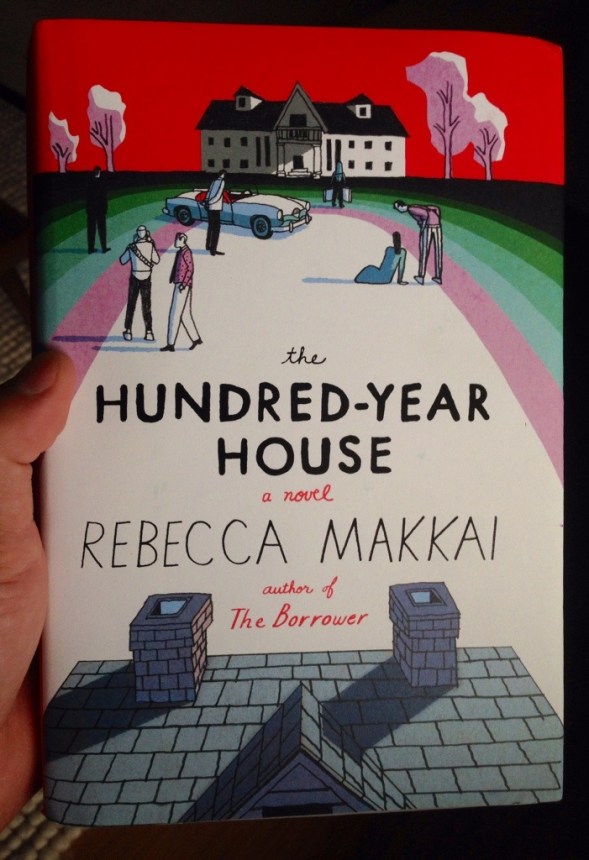
The Hundred-Year House (Book Acquired, 6.19.2014)

20140621-192942-70182350.jpg

Wonderful cover on Rebecca Makkai’s The Hundred-Year House, new in hardback from Penguin this summer. Blurb from the author’s site:

When Doug’s mother-in-law offers up the coach house at Laurelfield, her hundred-year-old estate north of Chicago, Doug and his wife Zee accept. Doug is fascinated by the house’s previous life as an artists’ colony, and hopes to find something archival there about the poet Edwin Parfitt, who was in residence at Laurelfield in the twenties (and whose work happens to be Doug’s area of scholarship). When he learns that there are file cabinets full of colony materials in the attic, Doug is anxious to get to work and save his career—but his mother-in-law refuses him access. With help from friends, Doug finally does access the Parfitt file—only to find far stranger and more disturbing material than he bargained for.

Doug may never learn all the house’s secrets, but the reader does, as the narrative zips back in time from 1999 to 1955 and 1929. We see the autumn right after the colony’s demise, when its newlywed owners are more at the mercy of the place’s lingering staff than they could imagine; and we see it as a bustling artists’ community fighting for survival in the last, heady days of the 1920s.

Through it all, the residents of Laurelfield are both plagued and blessed by the strange legacy of Laurelfield’s original owners: extraordinary luck, whether good or bad.


Girl Reading (Thinking of Edward Hopper) — Kiko Esperilla

kiko esperilla

Books Acquired (Second Week of June, 2014)

20140621-192932-70172308.jpg

Two historicalish fictions.

First, Merivel: A Man of His Time by Rose Tremain, which is new in trade paperback; the hardback received good reviews last year. Pub’s blurb:

The wonderful new historical novel set in seventeenth-century England from Rose Tremain, author of Restoration (shortlisted for the Booker Prize), The Road Home (winner of the Orange Prize) and Trespass (a Richard & Judy pick). Merivel has been called ‘wonderfully entertaining’ (Guardian Books of the Year) and ‘an unadulterated delight’ (Independent) and has been shortlisted for the Walter Scott Prize for Historical Fiction.

The gaudy years of the Restoration are long gone and Robert Merivel, physician and courtier to King Charles II, sets off for the French court in search of a fresh start. But royal life at the Palace of Versailles – all glitter in front and squalor behind – leaves him in despair, until a chance encounter with the seductive Madame de Flamanville, allows him to dream of a different future.
But will that future ever be his? Summoned home urgently to attend to the ailing King, Merivel finds his loyalty and skill tested to their limits.

20140621-192930-70170223.jpg

Also: Peter Tremayne’s The Seventh Trumpet:

When a murdered corpse of an unknown young noble is discovered, Fidelma of Cashel is brought in to investigate, in Peter Tremayne’s The Seventh Trumpet

Ireland, AD 670. When the body of a murdered young noble is discovered not far from Cashel, the King calls upon his sister, Fidelma, and her companion Eadulf to investigate. Fidelma, in addition to being the sister of the king, is a dailaigh—an advocate of the Brehon Law Courts—and has a particular talent for resolving the thorniest of mysteries.

But this time, Fidelma and Eadulf have very little to work with—the only clue to the noble’s identity is an emblem originating from the nearby kingdom of Laign. Could the murder be somehow related to the wave of violence erupting in the western lands of the kingdom? The turmoil there is being stirred up by an unknown fanatical figure who claims to have been summoned by “the seventh angel” to remove the “impure of faith.” Fidelma and Eadulf, once again grappling with a tangled skein of murder and intrigue, must somehow learn what connects the dead noble, a murdered alcoholic priest, and an abbot who has turned his monastery into a military fortress. When it appears that things cannot get more complex, Fidelma herself is abducted, and Eadulf must rescue her before the mystery can be solved.

The Art of Joy (Book Acquired, 6.16.2014)

20140621-192944-70184406.jpg

This is pretty cool: Goliarda Sapienza’s huge novel The Art of Joy, in English translation for the first time by Anne Milano Appel and published by Picador.

Their blurb:

Rejected by a series of publishers, abandoned in a chest for twenty years, Goliarda Sapienza’s masterpiece, The Art of Joy, survived a turbulent path to publication. It wasn’t until 2005, when it was released in France, that this novel received the recognition it deserves. At last, Sapienza’s remarkable book is available in English.

The Art of Joy centers on Modesta, a Sicilian woman born in 1900 whose strength and character are an affront to conventional morality. Impoverished as a child, Modesta believes she is destined for a better life. She is able, through grace and intelligence, to secure marriage to an aristocrat without compromising her own deeply felt values, and revels in upsetting the rules of her fascist, patriarchal society. This is the history of the twentieth century seen through the perspective of one extraordinary woman.

Got into a bit of it this weekend and it looks like good stuff; if your interest is piqued, you might want to check out Emily Cooke’s New Yorker piece for more. From Cooke’s essay:

What exactly the art of joy consists of isn’t immediately evident. At the outset, the novel reads less like a handbook on happiness than like a sadomasochistic Italian novelization of “The Joy of Sex.” It opens with a girl, called Modesta, who is born in 1900, in Sicily, to modest circumstances and immodest predilections, masturbating to the screams of a resented disabled sister, whom Modesta fantasizes is deliberately rending her own flesh. Masturbation gives way to cunnilingus by a tall neighbor boy, which gives way to intercourse, with Modesta’s deflowering, at the age of nine, by a stranger who claims to be her father. Perhaps the “joy” part hasn’t begun yet. But, wait, she rather likes it, at least until he sticks “something hard … into the hole where the pee-pee came out.” Immediately after the rape, the family’s hut goes up in flames, the casualty of a fire that Modesta has lit accidentally/on purpose. The worst casualties are Modesta’s sister and mother, locked in a bedroom by the prodigal father. Modesta has a chance to unlock them; she does not take it. The father is gone for good. Dispatched to a convent, this “poor tormented child,” as the nuns gullibly call her, fakes seizures in order to secure the comforting bosom of the Mother Superior, Leonora, who likes to titillate herself and her charge with stories of the persecuted Saint Agatha. Her bosom, St. Agatha’s was torn from her chest with “red-hot forceps” and “arranged … warm and tremulous, on a silver tray.” The lurid description gives Modesta “a thrill of pleasure” “so intense and protracted” that she has to grit her teeth to avoid a cry. When she discovers that the nun won’t put out—Leonora ventures only a “few timid caresses” and punishes Modesta for having witnessed her masturbating—infatuation turns to anger. “I hate her, I hate her,” she shrieks, alone in her cell, then brings herself to orgasm. All this before Modesta has reached the age of eighteen, and the book a tenth of its length.


Portrait of a Bishop — Pontormo

Portraits of Serafino and Francesco Falzacappa — Pier Leone Ghezzi

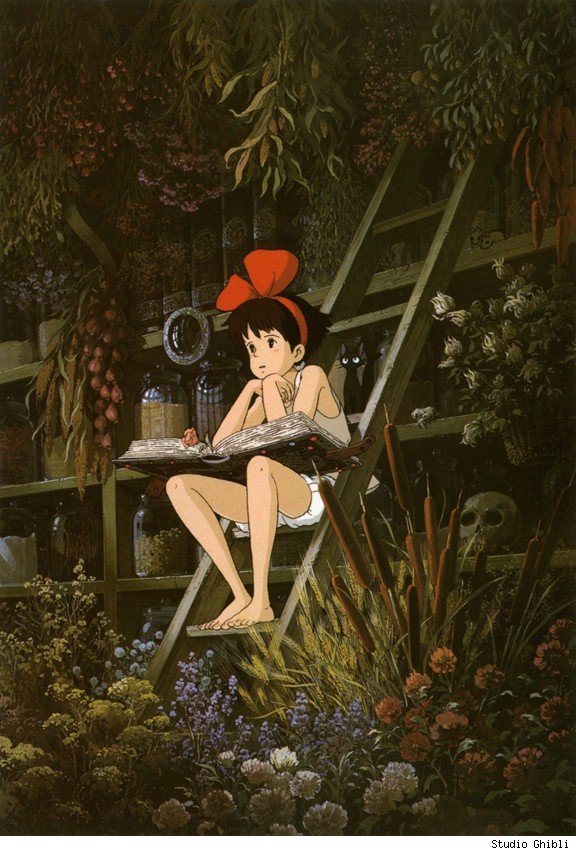
Kiki Reading — Hayao Miyazaki/Studio Ghibli

kiki

The BFG — Quentin Blake

20140619-203914-74354216.jpg

Beauty, grace, truth of the first water, I knew they were all beyond me.

20140619-160536-57936873.jpg

Gaby and Luciano — Franz Gertsch

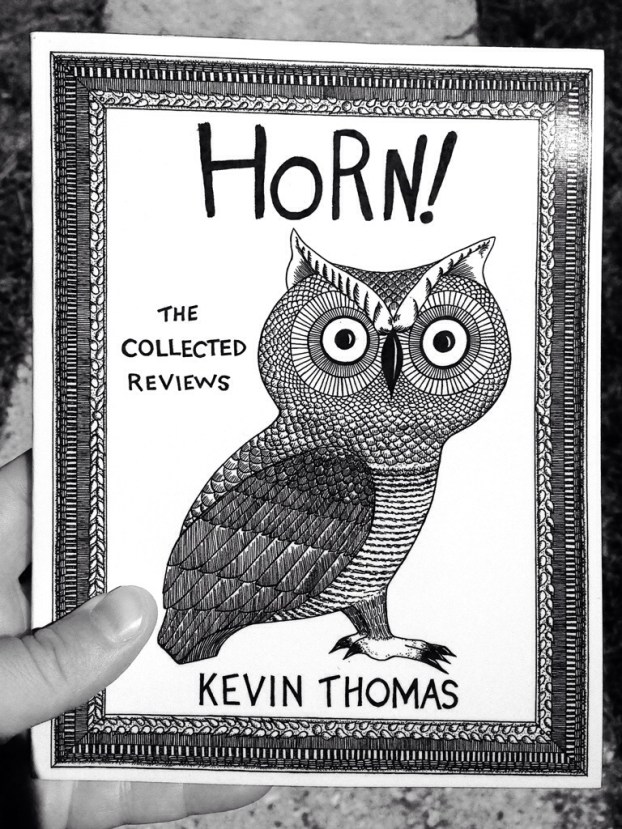
Horn! — Kevin Thomas’s Collected Reviews (Book Acquired, 6.14.2014)

20140618-113731-41851102.jpg

Kevin Thomas has been doing illustrated reviews of contemporary books for The Rumpus for a few years now. Now, the good people of OR Books have published the reviews in one volume—HORN! The Collected Reviews.

I’d read a few of Thomas’s reviews in the past and always been a bit jealous at his control of his medium—of his ability to go past or through or beyond the language under discussion to provoke with a sequence of images. Reviews is maybe not the right term—commentaries seems more fitting. Take his review of George Saunders’s Tenth of December for example, which manages to condense an overview of the collection’s themes along with a viewpoint on those themes into nine small panels. (I needed over 2000 words for my own review of the Saunders book).

Thomas’s technique works especially well with novels that are very difficult to write about/after, like one of my favorite recent titles, Jason Schwartz’s John the Posthumous. I stammered and hiccuped through my essay; Thomas explicates, illustrates, and piques reader interest—again, in just nine panels.

20140618-113733-41853283.jpg

I’ve been trying to limit myself to just a few strips a day from the collection, but more often than not I’ve failed, curious to see Thomas’s takes on Levin’s The Instructions (a novel I couldn’t finish), Peter Hook’s memoir, Renata Adler’s Speedboat (yes!) and more. Great stuff.

Fray Jerónimo Pérez — Francisco de Zurbarán

Dictionary — Liu Dan

Selections from One-Star Amazon Reviews of Joyce’s Ulysses

[Ed. note: The following citations come from one-star Amazon reviews of James Joyce’s Ulysses. To be clear, I think Ulysses is a marvelous, rewarding read. While one or two of the reviews are tongue-in-cheek, most one-star reviews of the book are from very, very angry readers who feel duped]

I can sum this book up in two words: “Ass Beating”.

What an awful book this is?

I bought this having been a huge fan of the cartoon series, but Mr Joyce has taken a winning formula and produced a prize turkey. After 20 pages not only had Ulysses failed to even board his spaceship, but I had no idea at all what on earth was going on. Verdict: Rubbish.

When an English/American writer try to explain his/her ideas about life(I mention ideas about meaning,purpose and philosophy of life)and when he/she try to do this with complicated ideas and long sentences(or like very short ones especially in this particular book);what his/her work become to is:A tremendous nonsense!!!

Thi’ got to be the worst, I- I – I mean the worst ever written book ever. Know why? ‘Cause he’ such a showoff, know what I MEAN? He’s ingenious I’ll giv’ ’em that, but ingenuity my friends tire and enervate. Get to the point and stick to it ‘s my motto.

This is one of those books that “smart” people like to “read.”

The grammar is so disjointed as to make it nearly impossible to read.

Ulysses is basically an unbridled attack on the very ideas of heroism, romantic love and sexual fulfillment, and objective literary expression.

What’s with all the foreign languages?

It has no real meaning.

It is a blasphemy that it ever was published.

Anyone who tells you they’ve read this so-called book all the way through is probably lying through their teeth.It is impossible to endure this torture.

A babbling, senseless tome upheld by “literary luminaries” who fear being cast into the tasteless bourgeois darkness for dissent? Yes, that’s the gist.

I discovered that the novel was not what I though it would be.

Joyce is an aesthetic bother of Marcel Duchamp (known for The Fountain, a urinal, now a museum piece) and John Cage (the composer of pieces for prepared piano, where the piano’s strings are mangled with trash.

Two positive things I can say about James Joyce is that he has a great sounding name and he gives wonderful titles to his works.

Ask yourself – are you going to enjoy a book that neccesitates your literature teacher lie next to you and explain its ‘sophistication’ to you ?

It’s the worst book which has ever been written.

Unless you really hate yourself, do not attempt to read this book.

The truth is this book stinks. For one thing it is vulgar, which, I hate to disappoint anyone, requires no talent at all. This is a talent any six year-old boy possesses.

The book is not so good, it is boring, it is a colection of words and a continuous experimentation of styles that, unhappily, do not mean anything to the meaning of the story; that is, the book’s language is snobbish and useless. Those who say that “love” such a writing are to be thought about as non-readers or as victims of a literary abnormality.

…the single most destructive piece of Literature ever written…

I’m all for challenging reads, but not for gibberish which academics persist in labeling erudition.

This book is extremely dull!!! My book club decided to read this book after one of the members visited the James Joyce tower in Ireland, which the author supposedly wrote part of the book in.

Ulysses is a failed novel because Joyce was a bad writer (shown by his other works).

In conclusion, Don’t read the book. Burn it hard. Do not let your children read the book—it will mutilate their brain cells.

June 16, 1838 (Nathaniel Hawthorne)

Tremont, Boston, June 16th.–Tremendously hot weather to-day. Went on board the Cyane to see Bridge, the purser. Took boat from the end of Long Wharf, with two boatmen who had just landed a man. Row round to the starboard side of the sloop, where we pass up the steps, and are received by Bridge, who introduces us to one of the lieutenants,–Hazard. Sailors and midshipmen scattered about,–the middies having a foul anchor, that is, an anchor with a cable twisted round it, embroidered on the collars of their jackets. The officers generally wear blue jackets, with lace on the shoulders, white pantaloons, and cloth caps. Introduced into the cabin,–a handsome room, finished with mahogany, comprehending the width of the vessel; a sideboard with liquors, and above it a looking-glass; behind the cabin, an inner room, in which is seated a lady, waiting for the captain to come on board; on each side of this inner cabin, a large and convenient state-room with bed,–the doors opening into the cabin. This cabin is on a level with the quarter-deck, and is covered by the poop-deck. Going down below stairs, you come to the ward-room, a pretty large room, round which are the state-rooms of the lieutenants, the purser, surgeon, etc. A stationary table. The ship’s main-mast comes down through the middle of the room, and Bridge’s chair, at dinner, is planted against it. Wine and brandy produced; and Bridge calls to the Doctor to drink with him, who answers affirmatively from his state-room, and shortly after opens the door and makes his appearance. Other officers emerge from the side of the vessel, or disappear into it, in the same way. Forward of the wardroom, adjoining it, and on the same level, is the midshipmen’s room, on the larboard side of the vessel, not partitioned off, so as to be shut up. On a shelf a few books; one midshipman politely invites us to walk in; another sits writing. Going farther forward, on the same level, we come to the crew’s department, part of which is occupied by the cooking-establishment, where all sorts of cooking is going on for the officers and men. Through the whole of this space, ward-room and all, there is barely room to stand upright, without the hat on. The rules of the quarterdeck (which extends aft from the main-mast) are, that the midshipmen shall not presume to walk on the starboard side of it, nor the men to come upon it at all, unless to speak to an officer. The poop-deck is still more sacred,–the lieutenants being confined to the larboard side, and the captain alone having a right to the starboard. A marine was pacing the poop-deck, being the only guard that I saw stationed in the vessel,–the more stringent regulations being relaxed while she is preparing for sea. While standing on the quarter-deck, a great piping at the gangway, and the second cutter comes alongside, bringing the consul and some other gentleman to visit the vessel. After a while, we are rowed ashore with them, in the same boat. Its crew are new hands, and therefore require much instruction from the cockswain. We are seated under an awning. The guns of the Cyane are medium thirty-two pounders; some of them have percussion locks.

At the Tremont, I had Bridge to dine with me: iced champagne, claret in glass pitchers. Nothing very remarkable among the guests. A wine-merchant, French apparently, though he had arrived the day before in a bark from Copenhagen: a somewhat corpulent gentleman, without so good manners as an American would have in the same line of life, but good-natured, sociable, and civil, complaining of the heat. He had rings on his fingers of great weight of metal, and one of them had a seal for letters; brooches at the bosom, three in a row, up and down; also a gold watch-guard, with a seal appended. Talks of the comparative price of living, of clothes, etc., here and in Europe. Tells of the prices of wines by the cask and pipe. Champagne, he says, is drunk of better quality here than where it grows.–A vendor of patent medicines, Doctor Jaques, makes acquaintance with me, and shows me his recommendatory letters in favor of himself and drugs, signed by a long list of people. He prefers, he says, booksellers to druggists as his agents, and inquired of me about them in this town. He seems to be an honest man enough, with an intelligent face, and sensible in his talk, but not a gentleman, wearing a somewhat shabby brown coat and mixed pantaloons, being ill-shaven, and apparently not well acquainted with the customs of a fashionable hotel. A simplicity about him that is likable, though, I believe, he comes from Philadelphia.–Naval officers, strolling about town, bargaining for swords and belts, and other military articles; with the tailor, to have naval buttons put on their shore-going coats, and for their pantaloons, suited to the climate of the Mediterranean. It is the almost invariable habit of officers, when going ashore or staying on shore, to divest themselves of all military or naval insignia, and appear as private citizens. At the Tremont, young gentlemen with long earlocks,–straw hats, light, or dark-mixed.–The theatre being closed, the play-bills of many nights ago are posted up against its walls.

From Nathaniel Hawthorne’s American Note-Books.