William Faulkner Reviews Ernest Hemingway’s The Old Man and The Sea

His best. Time may show it to be the best single piece of any of us, I mean his and my contemporaries. This time, he discovered God, a Creator. Until now, his men and women had made themselves, shaped themselves out of their own clay; their victories and defeats were at the hands of each other, just to prove to themselves or one another how tough they could be. But this time, he wrote about pity: about something somewhere that made them all: the old man who had to catch the fish and then lose it, the fish that had to be caught and then lost, the sharks which had to rob the old man of his fish; made them all and loved them all and pitied them all. It’s all right. Praise God that whatever made and loves and pities Hemingway and me kept him from touching it any further.

William Faulkner’s review of Ernest Hemingway’s The Old Man and The Sea was first published in the Autumn 1952 issue of Shenandoah. The review is collected in Faulkner’s Essays, Speeches & Public Letters.

The Syndics — Rembrandt

Taking Stock — Hans Haacke

A Riff on Stuff I Wish I’d Written About In the First Half of 2014

1. Leaving the Sea, Ben Marcus: A weird and (thankfully) uneven collection that begins with New Yorkerish stories of a post-Lish stripe (like darker than Lipsyte stuff) and unravels (thankfully) into sketches and thought experiments and outright bizarre blips. Abjection, abjection, abjection. The final story “The Moors” is a minor masterpiece.

2. Novels and stories, Donald Barthelme: A desire to write something big and long on Barthelme seems to get in the way of my writing anything about Barthelme. Something short then? Okay: Barthelme is all about sex. He posits sex as the solution (or at least consolation) for the problems of language, family, identity, etc.

3. Enormous Changes at the Last Minute and The Little Disturbances of Man by Grace Paley: I gorged on these precise, sad, funny stories, probably consuming too many at once (by the end of Little Disturbances I had the same stomach ache I got after eating too much of Barthelme’s Sixty Stories at once).

4. Concrete by Thomas Bernhard: Unlike the other novels I’ve read by Bernhard, Concrete seems to offer some kind of vision of moral capability, one which the narrator is unable to fully grasp, but which is nevertheless made available to the reader in the book’s final moments, accessible only through the novel’s layers of storytelling. Continue reading “A Riff on Stuff I Wish I’d Written About In the First Half of 2014”

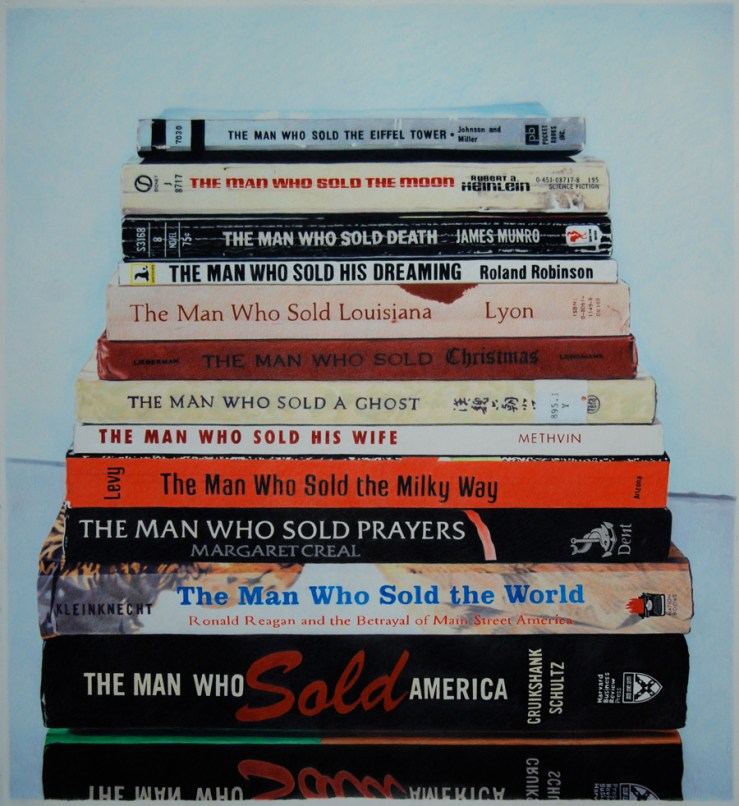
The Sell Out — Eric Yahnker

2012_TheSellOut_79x72

The Hammock — Thomas Theodor Heine

Where the artist is still trusted, he will not be looked to for assurance (Flannery O’Connor)

Unless we are willing to accept our artists as they are, the answer to the question, “Who speaks for America today?” will have to be: the advertising agencies. They are entirely capable of showing us our unparalleled prosperity and our almost classless society, and no one has ever accused them of not being affirmative. Where the artist is still trusted, he will not be looked to for assurance. Those who believe that art proceeds from a healthy, and not from a diseased, faculty of the mind will take what he shows them as a revelation, not of what we ought to be but of what we are at a given time and under given circumstances; that is, as a limited revelation but revelation nevertheless.

From Flannery O’Connor’s essay “The Fiction Writer and His Country,” collected in Mystery and Manners.


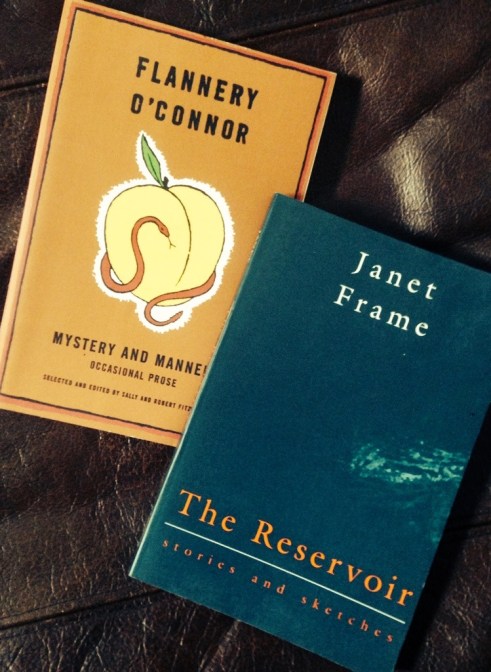
Flannery O’Connor/Janet Frame (Books Acquired, 6.27.2014)

20140628-161808-58688350.jpg

Language (Ambrose Bierce)

20140628-110428-39868603.jpg

Batman ’66 Meets the Dark Knight Returns — Marco D’Alfonso

batma

The dictionary is as disturbing as the world (William H. Gass)

The worship of the word must be pagan and polytheistic. It cannot endure one god. The Scots use blue brilliantly, for instance, and have their own term, blae, for gray blue, lead blue, and livid. The hedge-chanter is better known to them as the blue hafit, and if we pursue their names for the lumpsucker or sea owl, a fish of uncouth appearance, we come upon bluepaidle, or the even more common cockpaidle. The dictionary is as disturbing as the world, full of teasing parallels and misleading coincidence. The same fish is called a paddlecock on account of the tubercular skin which envelopes its dorsal ridge and which resembles the comb of that barnyard lord.

From William H. Gass’s On Being Blue.

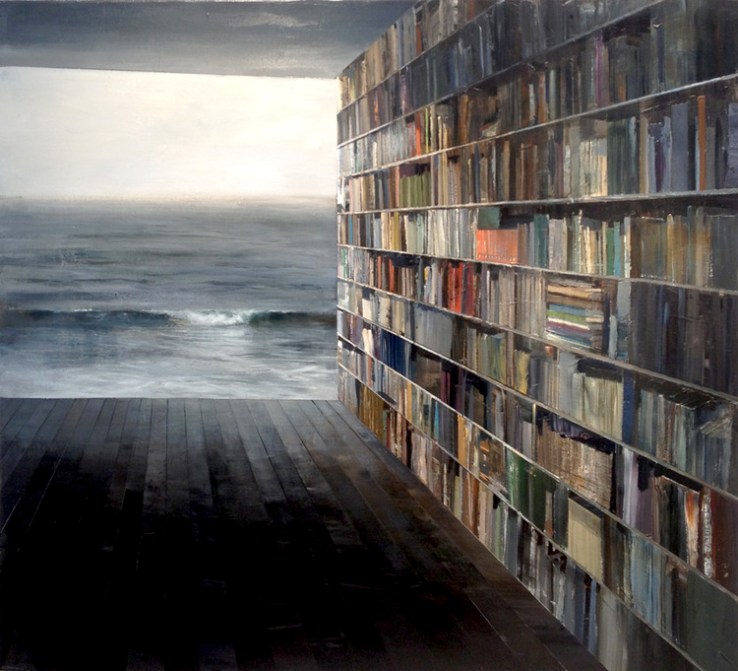
Library with Grey Sea — Jeremy Miranda

library with grey sea

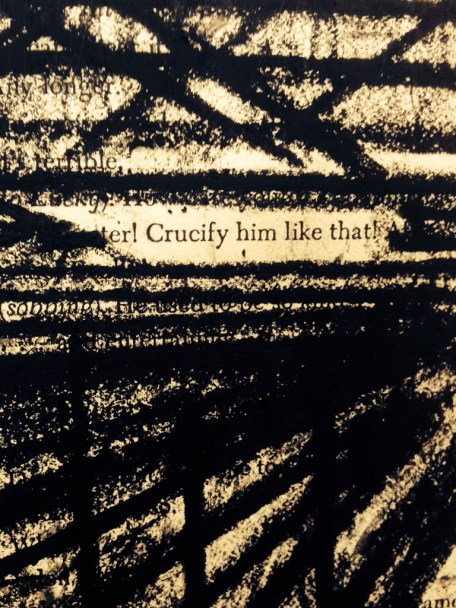
Crucify him like that!

20140626-162657-59217614.jpg

Strange Gods (Book Acquired, 6.02.2014)

20140621-200451-72291745.jpg

Annamaria Alfieri’s novel Strange Gods. Author’s site blurb:

In early 20th century British East Africa, there are rules for the British and rules for the Africans. Vera McIntosh, the daughter of Scottish missionaries, doesn’t feel she belongs to either group; having grown up in Africa, she is not interested in being the well-bred Scottish woman her mother would like her to be. More than anything she dreams of seeing again the handsome police officer she’s danced with. But more grisly circumstances bring Justin Tolliver to her family’s home.

The body of Vera’s uncle, Dr. Josiah Pennyman, is found with a tribesman’s spear in his back. Tolliver, an idealistic Assistant District Superintendent of Police, is assigned to the case. He first focuses on Gichinga Mbura, a Kikuyu medicine man who has been known to hatefully condemn Pennyman because Pennyman’s cures are increasingly preferred over his. But the spear belonged to the Maasai tribe, not Kikuyu, and it’s doubtful Mbura would have used it to kill his enemy. Tolliver’s superior wants him to arrest the medicine man and be done with it, but Tolliver pleads that he have the chance to prove the man’s guilt. With the help of Kwai Libazo, a tribal lieutenant, Tolliver discovers that others had reasons to hate Pennyman as well, and the list of suspects grows.
This is a romantic and engaging mystery that captures the beauty and the danger of the African wild and the complexities of imposing a culture on a foreign land

A kind of literary cinema where the roles of audience and reader are collapsed by a hybrid prosaic-filmic lens: a sentence

A fiction whose mission is to stage the journey of a woman fighting her way out of male-directed gazes and discourses cannot even feel like a “novel” and the established definitions that the term evokes. Maybe the novel as a form, as a genre of literary being, is a fantasy too. Perhaps the personage who creates must also come undone. Employing essayistic and filmic techniques, Zambreno implies an author as narrator-character first before Ruth’s entrance into frame. “I try to sketch her face, over and over and all I come up with is a furious pencil cloud. … She forms. Yet she is an indistinct blur. … My wonder child, wandering child. I am trying to push her out into the world.” An attempt to write the green girl eschews linear plot in favor of the anxious thrill of the present tense of writing (I think of Robert Walser’s The Walk); Zambreno places an implied author as the lens through which we perceive Ruth at the center of the narrative. The epigraphs that begin each scene also frame the shot we will witness — this is someone’s projection of an ego, a kind of literary cinema where the roles of audience and reader are collapsed by a hybrid prosaic-filmic lens: a sentence.

Frequent Biblioklept contributor Ryan Chang reviews Kate Zambreno’s novel Green Girl at Berfrois.

Interior (Model Reading) — Edward Hopper

edward-hopper-interior-model1