I would be delighted to feel my flesh tingling under your hand. Do you know what I mean, Nora dear? I wish you would smack me or flog me even. Not in play, dear, in earnest and on my naked flesh. I wish you were strong, strong, dear, and had a big full proud bosom and big fat thighs. I would love to be whipped by you, Nora love! I would love to have done something to displease you, something trivial even, perhaps one of my rather dirty habits that make you laugh: and then to hear you call me into your room and then to find you sitting in an armchair with your fat thighs far apart and your face deep red with anger and a cane in your hand. To see you point to what I had done and then with a movement of rage pull me towards you and throw me face downwards across your lap. Then to feel your hands tearing down my trousers and inside clothes and turning up my shirt, to be struggling in your strong arms and in your lap, to feel you bending down (like an angry nurse whipping a child’s bottom) until your big full bubbies almost touched me and to feel you flog, flog, flog me viciously on my naked quivering flesh!!
Category: Books
Summary of Bloom’s Day in Ulysses — Evan Lavender-Smith (From Old Notebooks)
Makes breakfast for his wife. Goes to the butcher. Goes to the post office. Goes to church. Goes to a chemist. Goes to a public bath. Goes to a funeral. Goes to a newspaper press. Goes to a locksmith to canvass an ad. Feeds some seagulls. Goes to a bar. Helps a blind man cross the street. Goes to the museum. Goes to to the library. Visits a bookseller. Window-shops. Goes to a restaurant. Listens to some live music. Writes a love letter. Goes to another bar. Nearly gets in a fight. Masturbates to a beautiful eighteen-year-old exhibitionist giving him a private show. Takes an alfresco nap. Takes up a collection for a widow. Goes to a hospital to visit a pregnant woman. Flirts with a nurse. Feeds a stray dog. Goes to a whorehouse. Helps avert a row with the police. Goes to a cabman’s shelter and listens to a sailor tell stories. Breaks into his own house. Urinates under the stars with another man. Watches the sunrise. Kisses his wife on her arse.
It would have been the single busiest, most adventurous day of my life.
From Evan Lavender-Smith’s From Old Notebooks.
Young Woman Dreaming of The Ise Stories — Hosoda Eishi

“Patricide: Patricide is a bad idea” (Donald Barthelme)
Patricide: Patricide is a bad idea, first because it is contrary to law and custom and second because it proves, beyond a doubt, that the father’s every fluted accusation against you was correct: you are a thoroughly bad individual, a patricide! — member of a class of persons universally ill-regarded. It is all right to feel this hot emotion, but not to act upon it. And it is not necessary. It is not necessary to slay your father, time will slay him, that is a virtual certainty. Your true task lies elsewhere. Your true task, as a son, is to reproduce every one of the enormities touched upon in this manual, but in attenuated form. You must become your father, but a paler, weaker version of him. The enormities go with the job, but close study will allow you to perform the job less well than it has previously been done, thus moving toward a golden age of decency, quiet, and calmed fevers. Your contribution will not be a small one, but “small” is one of the concepts that you should shoot for. If your father was a captain in Battery D, then content yourself with a corporalship in the same battery. Do not attend the annual reunions. Do not drink beer or sing songs at the reunions. Begin by whispering, in front of a mirror, for thirty minutes a day. Then tie your hands behind your back for thirty minutes a day, or get someone else to do this for you. Then, choose one of your most deeply held beliefs, such as the belief that your honors and awards have something to do with you, and abjure it. Friends will help you abjure it, and can be telephoned if you begin to backslide. You see the pattern, put it into practice. Fatherhood can be, if not conquered, at least “turned down” in this generation — by the combined efforts of all of us together.
From Donald Barthelme’s novel The Dead Father.
My Father — Carlos Botelho

Book with Wavy Pages — Abelardo Morell

Daniel’s — Kenton Nelson

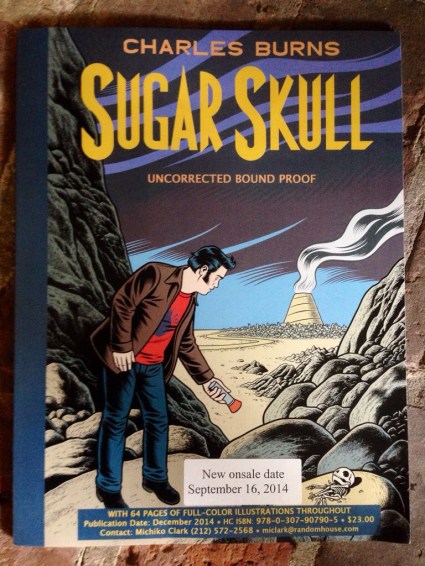
Charles Burns’s Sugar Skull (Book Acquired, 6.06.2014)

Got a bound black and white proof of Sugar Skull, the final book in Charles Burns’s Tintin-punk-rock-Interzone trilogy. Out from the good people of Pantheon this September.
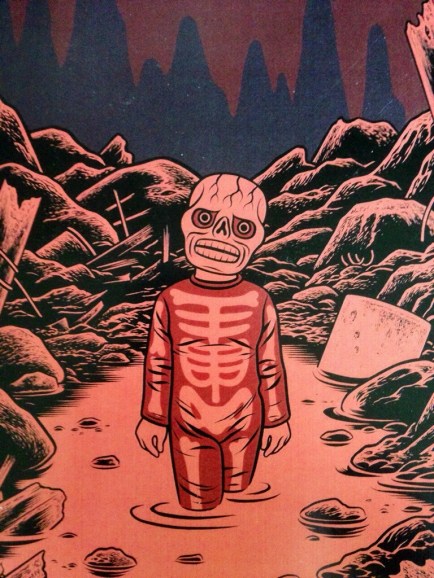
Back cover image:

So I went back and reread X’ed Out and The Hive and then yeah I read Sugar Skull. I’m going to wait to read a finished color copy to do a full review but, good great weird stuff.
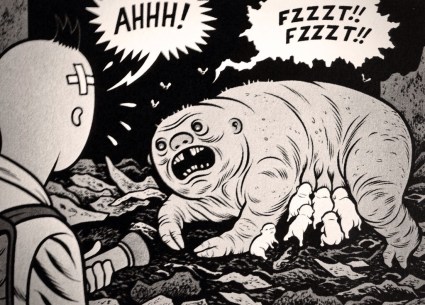
A tender moment:

That Bofa on the Sofa — Dr. Seuss

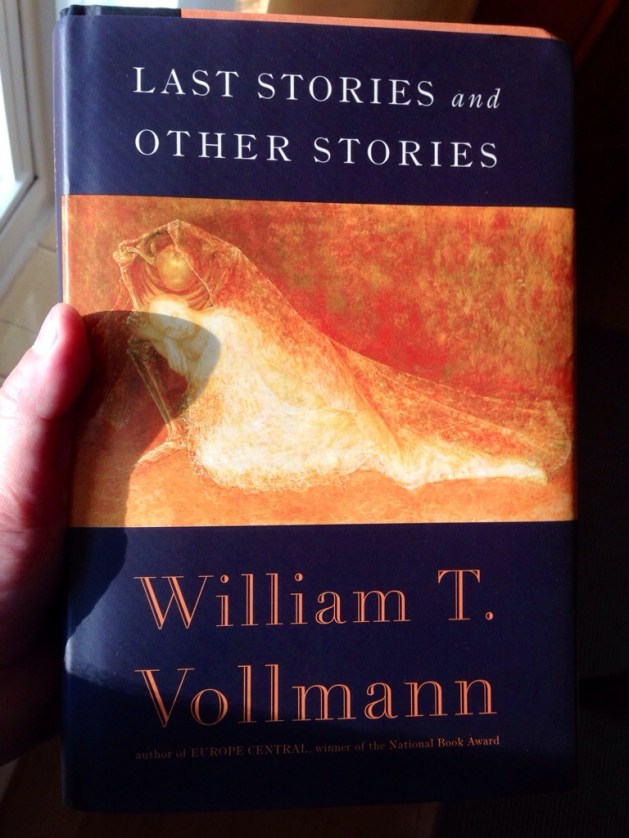
Vollmann’s Last Stories and Other Stories (Book Acquired, 6.09.2014)

William T. Vollmann’s Last Stories and Other Stories is new in hardback from Penguin this July. I’ll have a review then, but for now, publisher’s blurb:
Supernaturally tinged stories from William T. Vollmann, author of the National Book Award winner Europe Central
In this magnificent new work of fiction, his first in nine years, celebrated author William T. Vollmann offers a collection of ghost stories linked by themes of love, death, and the erotic.
A Bohemian farmer’s dead wife returns to him, and their love endures, but at a gruesome price. A geisha prolongs her life by turning into a cherry tree. A journalist, haunted by the half-forgotten killing of a Bosnian couple, watches their story, and his own wartime tragedy, slip away from him. A dying American romances the ghost of his high school sweetheart while a homeless salaryman in Tokyo animates paper cutouts of ancient heroes.
Are ghosts memories, fantasies, or monsters? Is there life in death? Vollmann has always operated in the shadowy borderland between categories, and these eerie tales, however far-flung their settings, all focus on the attempts of the living to avoid, control, or even seduce death. Vollmann’s stories will transport readers to a fantastical world where love and lust make anything possible.
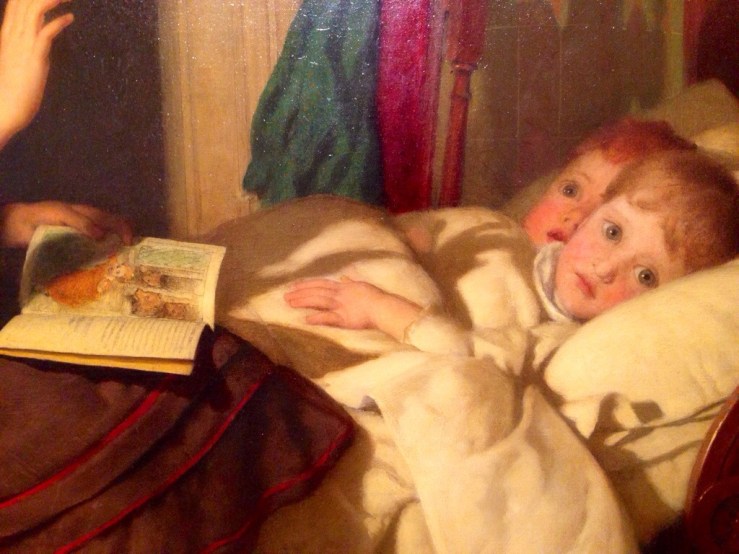
A Bedtime Story (Detail) — Seymour Joseph Guy

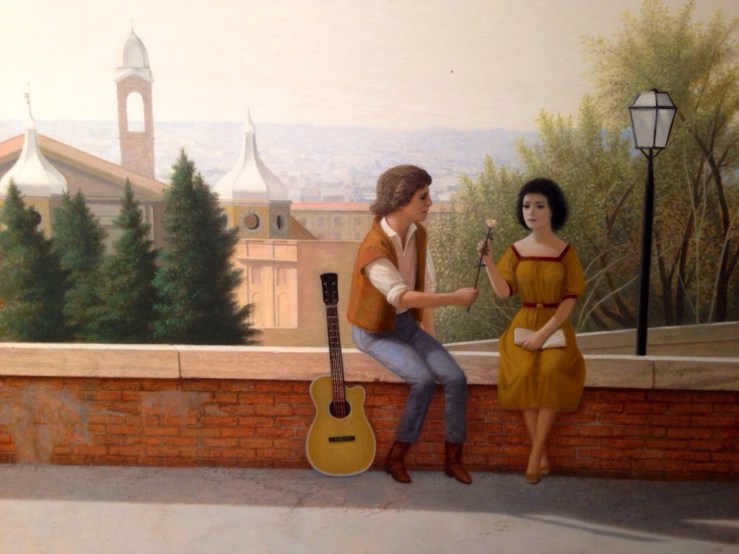
View of Rome — Joseph Jeffers Dodge

“Go to hell, Roberto” | Roberto Bolaño’s The Unknown University

The Unknown University, Roberto Bolaño’s poetry collection—his complete poems, a bilingual edition, lovely, beautiful, over 800 pages—has been shifted all over my messy house this past month, wedged into ad hoc shelves, even conspicuously, for a time, fatly weighing down another Bolaño text, The Insufferable Gaucho (which I’ve been reading in tandem with/against The Unknown University), swollen and warped with saltwater from the gray Atlantic ocean.
I pecked at The Unknown University discursively, avoiding end notes, taking the rest of the Bolañoverse as my guide or frame or map or background for these poems. I read randomly, trying one poem at a time in no special order, taking crude stabs at the Spanish text on the left hand pages, clumsily matching them against Laura Healy’s fine translation, a poetics that matches the tone and rhythm and cadence and vibe of Bolaño’s other translators, Natasha Wimmer and Chris Andrews.
Then last night, a tale from The Insufferable Gaucho compelled me to read from The Unknown University straightwise, linear, 1-2-3, non-discursively, to take a stab at an orderly trajectory, reading it like a novel in fragments, perhaps.
The book is divided into three parts, each comprised of their own chapters or individual books. Last night I read, or reread, the first half of the first part: The Snow-Novel; Guirat de Bornelh; Streets of Barcelona; In the Reading Room of Hell.
The examples and citations in this riff come from those books, but I’d suggest that the images, motifs, and themes of these early poems—switchblades, hell, abysses, poets, girls, detectives, assassins, hunchbacks, genitals, sex, madness, blood—resonate throughout the entire volume (and throughout Bolaño’s oeuvre).
Perhaps the most central theme is Bolaño himself; The Unknown University often reads like a diffuse autobiography, with Bolaño’s concern for his own place in literature at the fore.
We see that anxiety in the first poem shared by the editors, a piece from 1990 included in the book’s intro:

Even a decade earlier, Bolaño prophesied that he would be carried to hell, a primal setting of the Bolañoverse. Bolaño’s romantic ancestor Jorge Luis Borges famously imagined Paradise as a kind of library. Bolaño inverts that image:
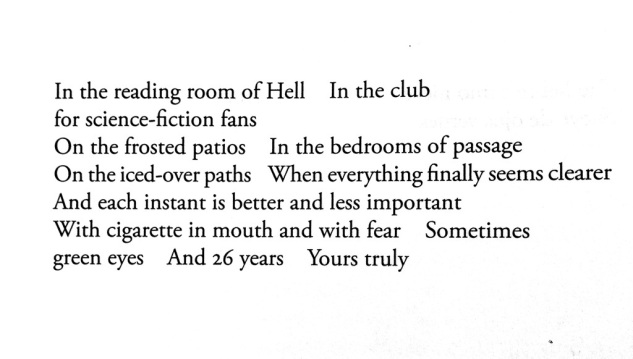
In another poem, Bolaño seems to obliquely address Borges again (“Dear, this isn’t Paradise”), while also name-checking the heroes of that “club / for science-fiction fans” (including some perhaps-unlikely figures):
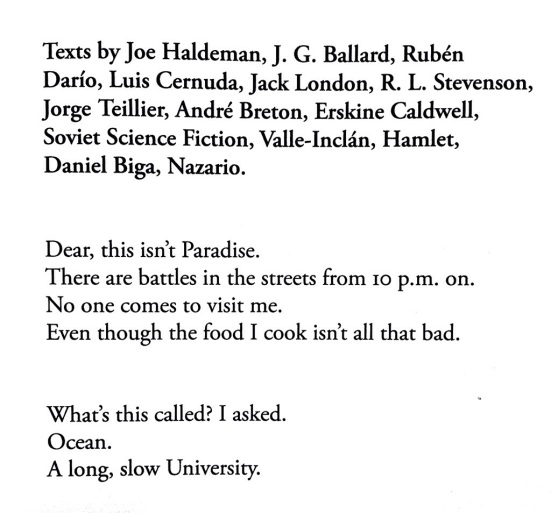
“A long, slow University.” Yes.
But how could Bolaño leave his hero Edgar Allan Poe from the curriculum? Oh, never mind. Here he is:
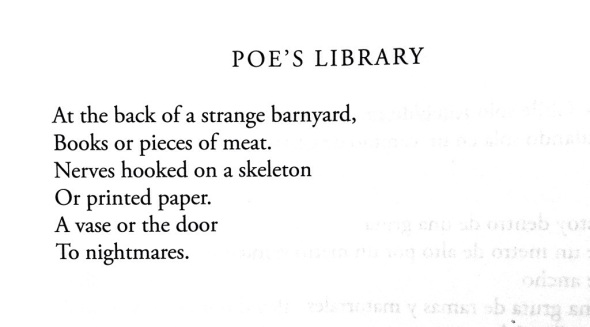
The vase—Pandora’s box, Keats’s urn?—is a central image in these early poems. Dark, beautiful, and transformative, Bolaño seems to posit the vase—an object rendered somewhat mundane in its traditional place as an aesthetic object—as a portal to the abyss:

Elsewhere our poet warns/invites us: “The nightmare begins over there, right there. / Further up, down, everything’s part of the / nightmare. Don’t stick your hand in that urn. Don’t / stick your hand in that hellish vase.” Reading the poem forces us to stick our hand in the vase.
If Bolaño seems occasionally melodramatic in his poems, a thrall to Baudelaire, he’s also keenly aware of it, even this early in his career. A twinning of irony and earnestness characterizes Bolaño’s writing, a savage self-reflexive humor that doesn’t necessarily reveal itself on first reading. When he begins a poem about a lost love, “Go to hell, Roberto, and remember you’ll never stick it in again,” the sentiment is simultaneously tragic and comic, the kind of personal confession that connects to the reader’s own experiences. “To be honest I don’t remember much now,” our narrator confides near the end, before the devastating conclusion, “She loved me forever / She crushed me.”
For Bolaño though, what’s perhaps most crushing is the loss of literature:
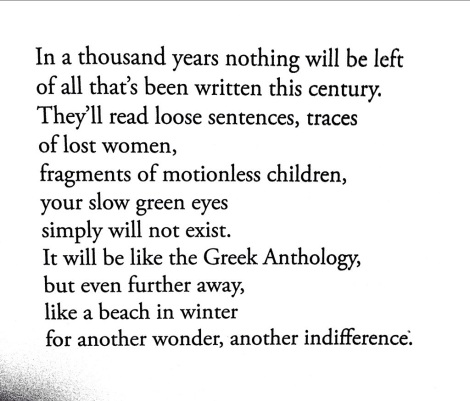
And yet Bolaño sticks his arm into the vase, walks out over the chasm, dares for his poems to perhaps earn the right to be one of those “loose sentences, traces . . . fragments” that may survive.
In the very early poem “Work,” Bolaño romanticizes his own literary posterity:
Poetry that might champion my shadow in days to come
when I’ll be just a name not the man who wandered
with empty pockets, worked in slaughterhouses
on the old and on the new continent.
I seek credibility not durability for the ballads
I composed in honor of very real girls.
And mercy for my years before 26.
Seems like a reasonable request.
I don’t know if these poems are good or bad or excellent or what. I do know that I loved reading them and that they are of a piece with everything else I’ve read by Bolaño. The best moments recall his best writing, that strange mix of plain, even understated language, set against romantic violence and terrible madness. The poems here don’t distill the best of Bolaño into burning kernels of visceral realism; rather, they feel like the liquid filament of the Bolañoverse. Fantastic.
More to come.
The Unknown University is available now from New Directions.
“WAR IS PEACE” (Orwell Manuscript)
Spring in Zimme — Emil Nolde

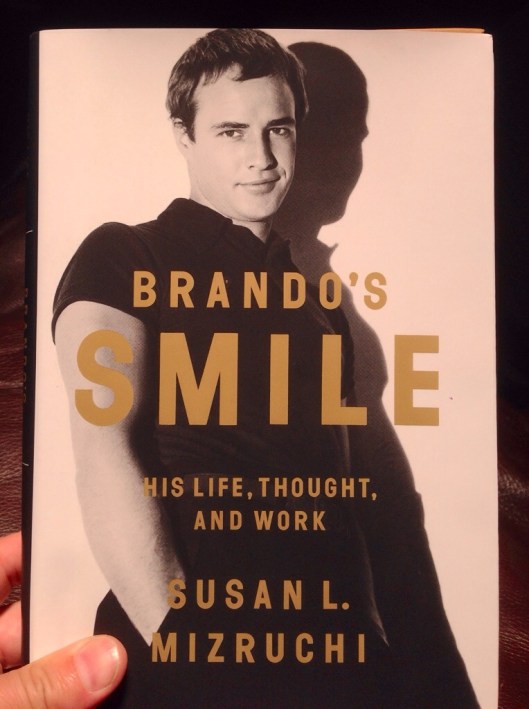
Brando’s Smile (Book Acquired, 6.02.2014)

Brando’s Smile, a biography by Susan L. Mizruchi. Publisher’s blurb:
Susan Mizruchi presents the Marlon Brando you’ve never met.
When people think about Marlon Brando they think of the movie star; the hunk; the scandals. Susan L. Mizruchi finds the Brando others have missed: the man who collected four thousand books; the man who rewrote scripts, trimming his lines to make them sharper; the man who consciously used his body and employed the objects around him to create believable characters; the man who used his fame to foster Indian and civil rights. From Brando’s letters, audiotapes, and annotated screenplays and books—many never before available—Mizruchi gives us a complex person whose intelligence belies the high-school dropout. She shows how Brando’s embrace of foreign cultures and outsiders led to brilliant performances in unusual roles—a gay man, an Asian, and a German soldier—to foster empathy on a global scale and to test himself. In portraying a fuller Brando, Mizruchi portrays an even more fascinating man.
Woman Reading — Dana Levin