1. William T. Vollmann’s Europe Central, 811 pages in my Penguin trade paperback edition (including end notes), is a virtuoso attempt to describe or measure or assess or explain or analyze the Eastern front of WWII, a part of the war that in my American ignorance I know, or knew (no, know) so little about.
2. The book covers 1914-1975, most of the composer Dmitri Dmitriyevich Shostakovich’s life. If Europe Central has a hero, it is Shostakovich.
From the book’s last end note, “An Imaginary Love Triangle: Shostakovich, Karmen, Konstantinovaskya”:
When I think of Shostakovich, and when I listen to his music, I imagine a person consumed by fear and regret, a person who (like Kurt Gerstein) did what little he could to uphold the good—in this case, freedom of artistic creation, and the mitigation of other people’s emergencies. He became progressively more beaten down, and certainly experienced difficulty saying no—a character trait which may well have kept him alive in the Stalinist years. In spite of the fact that he joined the Party near the end, to me he is a great hero—a tragic hero, naturally.
That’s Vollmann’s own authorial voice, of course, and there we have perhaps the most concise condensation of Europe Central.
3. Maybe a clarification though: Europe Central is not (just) a fictional biography of Shostakovich: There are many, many other characters that Vollmann uses to power his beast: the Soviet director Roman Karmen and the translator Elena Konstantinovskaya, those other points in the book’s central love triangle; German artist Käthe Kollwitz; Samizdat poet Anna Akhmatova; Generals Paulus (German) and Vlasov (Soviet)—similarly disgraced; SS man Kurt Gerstein, who oversees death camps; there’s Lenin, there’s Stalin. There’s “the Sleepwalker,” one Adolf Hitler. And many, many more.
4. Is Europe Central too big?
No. I don’t think so.
5. I lazily suggested that the book uses Shostakovich as an organizing principle. We could also argue for Operation Barbarossa (Germany’s disastrous invasion of the USSR) as the book’s main thrust. Or, we might say that the book reframes Wagner’s Ring Cycle. Or that it somehow restages Shostakovich’s Opus 40 and Opus 110. (Back to Shostakovich!).
6. Or the telephone! Yes, that totem of modernity, communication, power—the telephone!—the telephone is the central image of Europe Central. Indeed, it initiates the novel: “A squat black telephone, I mean an octopus, the god of our Signal Corps…” That octopus, those tendrils, those lines of communication snake throughout Europe Central.
7. Another description of Europe Central, perhaps, from one of its earliest chapters—
Most literary critics agree that fiction cannot be reduced to mere falsehood. Well-crafted protagonists come to life, pornography causes orgasms, and the pretense that life is what we want it to be may conceivably bring about the desired condition. Hence religious parables, socialist realism, Nazi propaganda. And if this story likewise crawls with reactionary supernaturalism, that might be because its author longs to see letters scuttling across ceilings, cautiously beginning to reify themselves into angels. For if they could only do that, then why not us?
8. Was that enough of Vollmann’s language for this short riff?
No?
I shared various citations from Europe Central on Biblioklept as I read it, even riffing a bit now and then. Check out some of Vollmann’s strange, wonderful prose—it’s far more convincing than anything I can write about his book.
10. I left off from the list above one of the finest passages in the book, a section where the unnamed “I” narrator of some of the Soviet sections of Europe Central shifts into Shostakovich’s consciousness, and then, perhaps, into Vollmann’s own authorial voice—and then back. The narratological dimensions here are too big to suss out in my lazy riff, but I find the passage’s main thrust one of the most compelling issues of modern art (or Modern Art, if you prefer): Can art use irony to conceal its true feelings? Can love be self-ironic? And if so, how does this complicate the truth of the expression?
I think this matters because Vollmann thinks this matters—put another way, Vollmann believes in Art and Truth and, significantly, in Love, and the power of love against the backdrop of totalitarianism, despotism, murder, privation, starvation, rape, maiming, gas chambers, mass graves, infanticide, total war…
11. What Vollmann achieves in Europe Central, through the reality and fictionality (and reality of the fictionality of the reality) of his characters, is a language of love. Vollmann posits love, or the possibility of love, or the possibility of imagining the possibility of love, as a response to despair.
12. Point 11 is maybe a way of saying that Europe Central is about so much more than central Europe during WWII—but if you’re at all familiar with Vollmann, gentle reader, of course you’d expect that. Still, I learned a lot about a subject which I thought I knew something about.
Whether or not Vollmann is a generous writer depends on your perspective—you’re swimming in the deep end here, and many of the connections between the different sections don’t cohere until you’ve got the hang of the book. But once you get the hang of it—once you learn to read it—Vollmann’s generosity is almost overbearing in its profundity. How did he research it, do all the reading that went into it, and still make all the voices sing? How?
13. Europe Central is probably not the best starting place for Vollmann, but I think it will appeal to fans of certain giant polyglossic postmodern novels. I’ll admit to a predilection for WWII metafictions, too, but I can’t really anticipate how readers of historical fiction might regard what Vollmann does here. Can I end by writing Highly recommended? I don’t know. I’m not sure who this book is for… but I loved it.
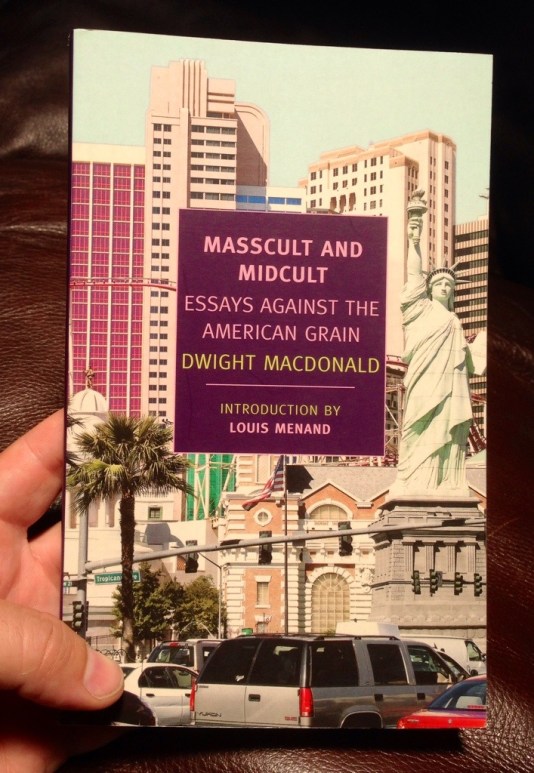
Hadn’t heard of Dwight Macdonald or his cranky essay “Masscult and Midcult” until I saw the NYRB edition in my local bookshop. Picked it up, didn’t put it down. The title essay here is on middlebrow culture, on how mass culture is not culture at all but a manufactured, predigested product. It was written in a prepostmodern era (if such a thing exists)—no Warhol, no reckoning with Pop Art, etc. Despite its elitist tone, it’s fantastic stuff, very insightful, and if I disagree with a lot of Macdonald’s criticism (his picking on Norman Rockwell is especially mean), I love his methods.
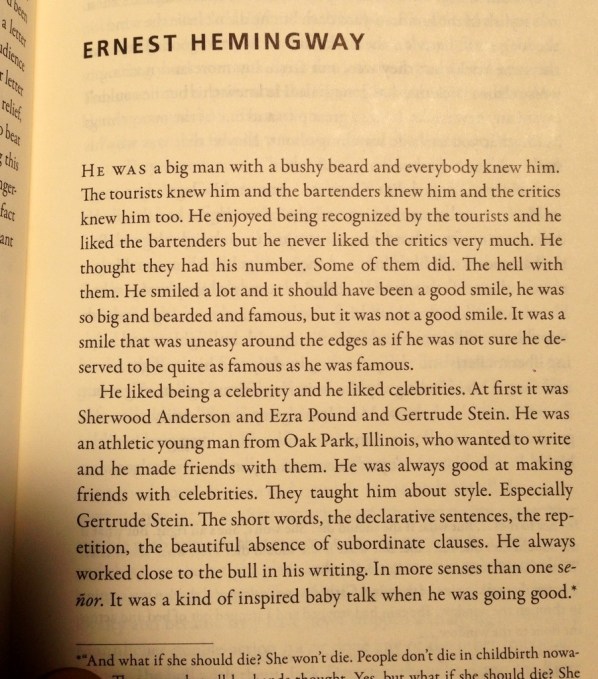
Haven’t gotten to any of the other essays yet, with the exception of his short skewering of Ernest Hemingway. It begins with a parody (below), and ends with a thoughtful rebuttal by George Plimpton. Macdonald doing Hemingway:
My critique of American society remains fundamentally incoherent. Would I really have preferred my grandfather’s time, when Pinkertons were cracking Wobblies over the head, or my father’s, when Joe McCarthy could ruin anyone by calling him Red? All I know is that although I live a freer life than many people, I want to be freer still; I’m sometimes positively dazzled with longing for a better way of being. What is it that I need?
From William T. Vollmann’s essay-memoir Riding Toward Everywhere.
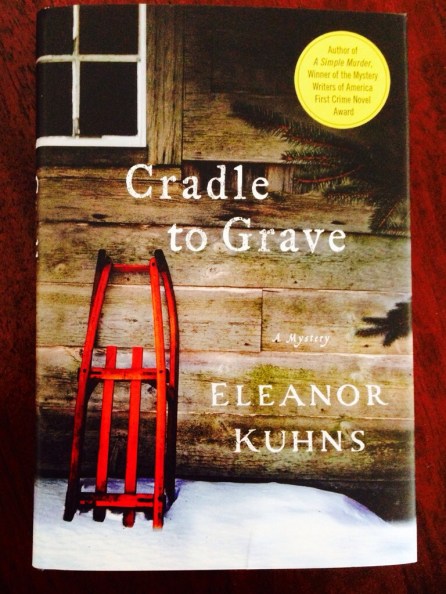
Cradle to Grave by Eleanor Kuhns. Publisher’s blurb:
Will Rees is adjusting to life on his Maine farm in 1797, but he’s already hungering for the freedom of the road, and his chance to travel comes sooner than he expects. Lydia has just received a letter from her old friend Mouse, a soft-spoken and gentle woman who now lives in the Shaker community in Mount Unity, New York. To Lydia and Rees’s astonishment, she’s in trouble with the law. She’s kidnapped five children, claiming that their mother, Maggie Whitney, is unfit to care for them.
Despite the wintry weather and icy roads, Rees and Lydia set out for New York, where they sadly conclude that Mouse is probably right and the children would be better off with her. There’s nothing they can do for Mouse legally, though, and they reluctantly set out for home. But before they’ve travelled very far, they receive more startling news: Maggie Whitney has been found murdered, and Mouse is the prime suspect.
In Cradle to Grave, Eleanor Kuhns returns with the clever plotting, atmospheric historical detail, and complexly drawn characters that have delighted fans and critics in her previous books.
Since taking to writing as a profession I have lost most of the interest I had in literature as literature pure and simple. That interest gradually faded and “Art for Art’s sake,” in the sense the simple in studios are wont to dilate upon, touches me no more, or very, very rarely. The books I love now are those which teach me something actual about the living world; and it troubles me not at all if any of them betray no sense of beauty and lack immortal words. Their artistry is nothing, what they say is everything. So on the shelf to which I mostly resort is a book on the Himalayas; a Lloyd’s Shipping Register; a little work on seamanship that every would-be second mate knows; Brown’s Nautical Almanacs; a Channel Pilot; a Continental Bradshaw; many Baedekers; a Directory to the Indian Ocean and the China Seas; a bigfolding map of the United States; some books dealing with strategy, and some touching on medical knowledge, but principally pathology, and especially the pathology of the mind.
Yet in spite of this utilitarian bent of my thoughts there are very many books I know and love and sometimes look into because of their associations. As I cannot understand (through some mental kink which my friends are wont to jeer at) how anyone can return again and again to a book for its own sake, I do not read what I know. As soon would I go back when it is my purpose to go forward. A book should serve its turn, do its work, and become a memory. To love books for their own sake is to be crystallised before old age comes on. Only the old are entitled to love the past. The work of the young lies in the present and the future. Continue reading ““Books in the West” — Morely Roberts”→
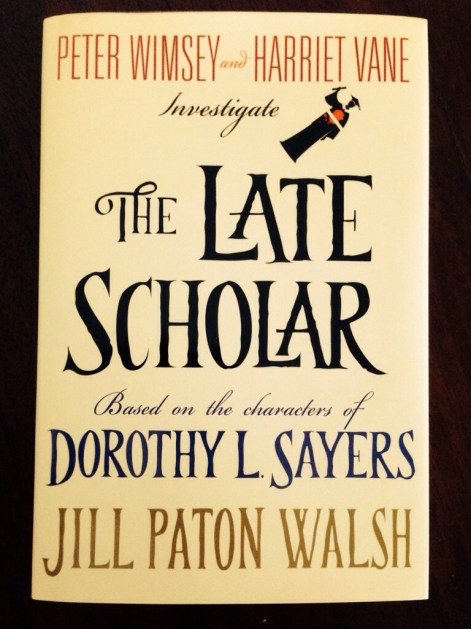
The Late Scholar is a new Peter Wimsey/Harriet Vane mystery. Publisher’s blurb:
When a dispute among the Fellows of St. Severin’s College, Oxford University, reaches a stalemate, Lord Peter Wimsey discovers that as the Duke of Denver he is “the Visitor”—charged with the task of resolving the issue. It is time for Lord Peter and his detective novelist wife, Harriet, to revisit their beloved Oxford, where their long and literate courtship finally culminated in their engagement and marriage.
At first, the dispute seems a simple difference of opinion about a valuable manuscript that some of the Fellows regard as nothing but an insurance liability, which should be sold to finance a speculative purchase of land. The voting is evenly balanced. The Warden would normally cast the deciding vote, but he has disappeared. And when several of the Fellows unexpectedly die as well, Lord Peter and Harriet set off on an investigation to uncover what is really going on at St. Severin’s.
With this return in The Late Scholar to the Oxford of Gaudy Night, which many readers regard as their favorite of Sayers’s original series, Jill Paton Walsh at once revives the wit and brilliant plotting of the Golden Age of detective fiction.





 Biblioklept