“All I have left in the end is my present pathetic existence” (Thomas Bernhard)

But what am I really like? Once more I was caught up in speculations about myself. I don’t know why, but suddenly I recalled that twenty-five years ago, when I was just over twenty, I’d been a member of the Socialist Party. What a joke! I wasn’t a member for long. As with everything else, I resigned my membership after a few months. And to think that I once wanted to become a monk! That I once thought of becoming a Catholic priest! And that I once donated eight hundred thousand schillings for the starving in Africa! To think that that’s all true! At the time it all seemed logical and natural enough. But now I’ve completely changed. To think that I once believed I would marry! And have children! I even thought at one time of going into the army, of becoming a general or a field-marshal like one of my ancestors! Absurd. There’s nothing I wouldn’t once have given everything for, I told myself. But all these speculations added up, if not to nothing, then to ludicrously little. Poverty, wealth, the church, the army, parties, welfare institutions — all ludicrous. All I have left in the end is my present pathetic existence, which no longer has very much to offer. But that’s how it should be. No doctrine holds water any longer; everything that is said and preached is destined to become ludicrous. It doesn’t even call for my scorn any longer. It doesn’t call for anything, anything at all. When we really know the world, we see that it is just a world full of errors. But we are reluctant to part from it, because in spite of everything we’ve remained fairly naive and childlike, I thought. What a good thing that I had my eye-pressure measured. Thirty-eight! We mustn’t pretend to ourselves. We may keel over at any moment.

From Thomas Bernhard’s novel Concrete.

Milton When a Boy Instructed by His Mother — Henry Fuseli

True Detective, Bolaño’s 2666, Werewolves, Etc.

03-true-detective-1

1. A couple of years ago I wrote a pretty long essay about rereading Roberto Bolaño’s novel 2666, a dark, compelling, violent, mysterious book that I’ve reread in full three times now, a book that I frequently return to, a book that seems to leer from the shelf too often, Hey, you’re not done with me, you know that, right? 

2. Anyway, this long essay about rereading 2666 was also about another book: Sabine Baring-Gould’s 1865 folklore-horror hybrid, The Book of Were-Wolves (download it here). I argued that

What Bolaño and Baring-Gould do in these books is explore madness and violence and the ways that our world tries to (or fails to) contain madness and violence.

—and suggested that

Bolaño’s werewolves are, in line with Baring-Gould’s, people fated to madness and violence, but also relatively normal people. These werewolves contain within them a dreadful capacity for violence.

3. (What I want to say is that any speculation I might offer about the forthcoming conclusion of season one of True Detective I have already offered, at some length, in an essay (about two other texts) which I composed a few years before True Detective aired).

4. Well so and anyway: “After You’ve Gone,” the penultimate episode of True Detective.

In some ways the most straightforward episode to date, even disappointingly so, a bit of a police procedural, serving mostly to realign Cohle and Hart, demonstrating that despite their fight and their differences, they are also very similar. But you already know that, you know what happened in the episode, right? The obsession then is for an answer: Where does this all go? Who did the crimes? Who is The King in Yellow? How does it end?

5. I now lazily link to an article that rounds up some of the conjecture — the “theories” — about how the show will end. You’ve read some of these, right?

6. This kind of conjecture is fun, or maybe “fun” isn’t the right word—maybe what I want to say instead is:

True Detective compels many of its viewers to obsessively hunt down clues in each frame. There’s a thickness to the show’s repetition of key images and phrases—spirals, stars, sets of five figures, antlers, crowns, crosses that dissolve into targets, etc.—a seeming preciseness that invites us to impose our own order, our own narrative.

(This is the kind of conjecture that Hart repeatedly warns Cohle not to indulge in).

7. I’m reminded here of Juan Antonio Masoliver Ródenas’s prologue to Roberto Bolaño’s unfinished novel Woes of the True Policeman:

What matters is the active participation of the reader, concurrent with the act of writing. Bolaño makes this very clear in his explanation of the title: “The policeman is the reader, who tries in vain to decipher this wretched novel.” And in the body of the book itself there is an insistence on this conception of the novel as a life: we exist—we write, we read—so long as we’re alive, and the only conclusion is death.

True Detective, like True Policeman—and, like Bolaño’s masterpiece 2666—all invite the active participation of the reader. But also the woe.

8. There is no supernatural solution to the mysteries of True Detective. From the outset, True Detective has posited (the illusion of) human consciousness as a part of nature that seeks to define itself against naturethe real.

In True Detective, the supernatural is the product of terror and fantasy. It is imaginary. (And of course therefore no less real than the natural, the real, thanks to human consciousness).
audrey

9. From the beginning of Baring-Gould’s The Book of Were-Wolves:

It will then be seen that under the veil of mythology lies a solid reality, that a floating superstition holds in solution a positive truth.

This I shall show to be an innate craving for blood implanted in certain natures, restrained under ordinary circumstances, but breaking forth occasionally, accompanied with hallucination, leading in most cases to cannibalism. I shall then give instances of persons thus afflicted, who were believed by others, and who believed themselves, to be transformed into beasts, and who, in the paroxysms of their madness, committed numerous murders, and devoured their victims.

The emphasis is mine.

10. In the sixth episode of True Detective, Cohle says to Hart: “You, these people, this place … you’ll eat your fucking young as long as you have something to salute.” The indictment is broad, dark, and perhaps paranoid, but it serves to highlight the series’s keen attenuation to infanticide, to the infinite loss and dramatic mourning that underpins begetting.

11. Cohle has lost his daughter, and her death at such a young age, he says, spared him “the sin of fatherhood.”

Hart has essentially lost his daughters, ruined his life, ruined his (illusion of the) status as a family man. The thing that mattered—his family—was “right under his nose” the whole time.

On the job, both Cohle and Hart—separately—witness the awful deaths of infants; in both cases, the men snap, disconnect, quit.

12. (At this time, the reader is invited to sift through his or her own recollections of True Detective (if he or she so desires) and set aside examples of infanticidal violence).

13. Many fans of the show have speculated that Martin Hart is the King in Yellow, a notion fueled by the show’s stores of symbolic images, as well as Hart’s own actions.

The theory is intriguing, but I seriously doubt that Hart will be revealed as a perpetrator in the crimes of the Tuttle case. However, he is capable of slipping into werewolf mode: Threatening his lover Lisa’s new beau with horrific violence and then declaring, “I’m not a psycho–I wouldn’t have done those things” (the past perfect tense there is so strange); slipping on gloves to assault the boys who had consensual sex with his daughter Audrey; etc. etc. etc.

Hart’s actions are the strange double bind of the patriarchal lawman who sets to rule with sanctioned order—and, specifically, to rule and control the sexualized female body, which is oh-so-important to begettingDoes he serve and protect? Does he terrorize and menace? Both and at the same time.

But I’d argue that Hart is illusioned, that his identity is constituted in maintaining an illusion, an illusion that Cohle is too keenly aware of (“…you’ll eat your fucking young as long as you have something to salute”).

14. There’s a heap of corpses at the core of Bolaño’s 2666—women who are raped, murdered, discarded. Bolaño sends various detectives—many of them good detectives, true policeman—to find the killers, but there’s no satisfying answer: Just plenty of killers, plenty of werewolves. As the novel reaches its (non)end, we await the promise of a Giant (The Tall Man), a Big Answer. But the answer is inadequate, incomplete.

15. The capacity to transform into a killer, a werewolf is always there. Just put on some gloves. Just slip on a mask.

Or maybe take your mask off.
jpJvNrI

“The King of Jazz” — Donald Barthelme

“The King of Jazz”

by

Donald Barthelme

Well, I’m the king of jazz now, thought Hokie Mokie to himself as he oiled the slide on his trombone. Hasn’t been a ‘bone man been king of jazz for many years. But now that Spicy MacLammermoor, the old king, is dead, I guess I’m it. Maybe I better play a few notes out of this window here, to reassure myself.

“Wow!” said somebody standing on the sidewalk. “Did you hear that?”

“I did,” said his companion.

“Can you distinguish our great homemade American jazz performers, each from the other?”

“Used to could.”

“Then who was that playing?”

“Sounds like Hokie Mokie to me. Those few but perfectly selected notes have the real epiphanic glow.”

“The what?”

“The real epiphanic glow, such as is obtained only by artists of the caliber of Hokie Mokie, who’s from Pass Christian, Mississippi. He’s the king of jazz, now that Spicy MacLammermoor is gone.”

Hokie Mokie put his trombone in its case and went to a gig. At the gig everyone fell back before him, bowing.

“Hi Bucky! Hit Zoot! Hi Freddie! Hi George! Hi Thad! Hi Roy! Hi Dexter! Hi Jo! Hi Willie! Hi Greens!”

“What we gonna play, Hokie? You the king of jazz now, you gotta decide.”

“How ’bout ‘Smoke’?”

“Wow!” everybody said. “Did you hear that? Hokie Mokie can just knock a fella out, just the way he pronounces a word. What an intonation on that boy! God Almighty!” Continue reading ““The King of Jazz” — Donald Barthelme”

St. Augustine Reading — Marco Zoppo

The London Jungle Book (Book Acquired, 2.28.2014)

20140303-140624.jpg

Bhajju Shyam’s The London Jungle Book arrived a few days ago: Beautiful stuff. Full review to come, but blurb for now:

Hailed as a book that reverses the anthropological gaze, ‘The London Jungle Book’ is the personal story of Indian tribal artist Bhajju Shyam’s first encounter with a western city. Revised & fully updated to mark the 10th anniversary of that momentous journey, Bhajju’s rich art and poignant reflections are as relevant today as they ever were.

20140303-140645.jpg

Portrait of Maffeo Barberini — Caravaggio

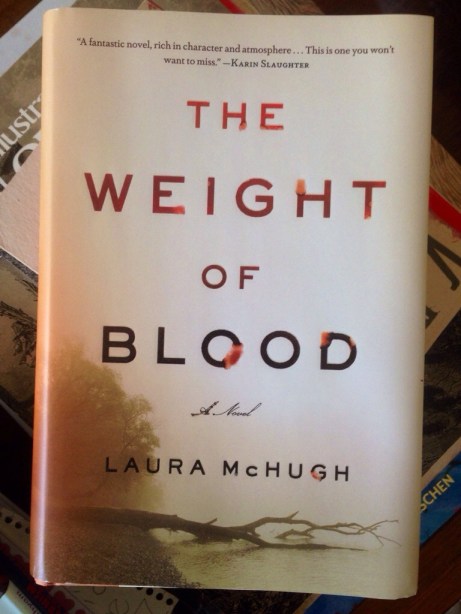
The Weight of Blood (Book Acquired, 2.24.2014)

20140303-140605.jpg

Laura McHugh’s novel The Weight of Blood is new in trade hardback next week from Random House. Their blurb:

The town of Henbane sits deep in the Ozark Mountains. Folks there still whisper about Lucy Dane’s mother, a bewitching stranger who appeared long enough to marry Carl Dane and then vanished when Lucy was just a child. Now on the brink of adulthood, Lucy experiences another loss when her friend Cheri disappears and is then found murdered, her body placed on display for all to see. Lucy’s family has deep roots in the Ozarks, part of a community that is fiercely protective of its own. Yet despite her close ties to the land, and despite her family’s influence, Lucy—darkly beautiful as her mother was—is always thought of by those around her as her mother’s daughter. When Cheri disappears, Lucy is haunted by the two lost girls—the mother she never knew and the friend she couldn’t save—and sets out with the help of a local boy, Daniel, to uncover the mystery behind Cheri’s death.

What Lucy discovers is a secret that pervades the secluded Missouri hills, and beyond that horrific revelation is a more personal one concerning what happened to her mother more than a decade earlier.

The Weight of Blood is an urgent look at the dark side of a bucolic landscape beyond the arm of the law, where a person can easily disappear without a trace. Laura McHugh proves herself a masterly storyteller who has created a harsh and tangled terrain as alive and unforgettable as the characters who inhabit it. Her mesmerizing debut is a compelling exploration of the meaning of family: the sacrifices we make, the secrets we keep, and the lengths to which we will go to protect the ones we love.

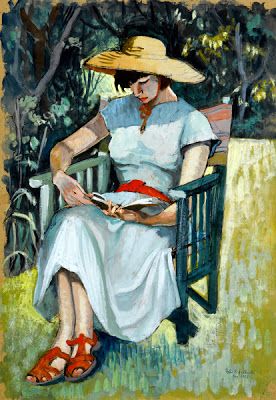
The Artist’s Wife Reading — Fyffe Christie

15e4ee3675c7fb1ea51457d4963e1cc3

“Kafka himself is known to have distrusted all utopianism” (Sebald)

trippkafka

Kafka himself is known to have distrusted all utopianism. Not long before his death he said that he had been exiled from Canaan for forty years, and even the community which he sometimes longed for was basically suspect to him; he wanted only to dissolve away by himself, as the water runs into the sea. Few people ever seem to have been as much alone as Kafka appears in the last pictures of him, to which we may add one extrapolated from them, so to speak, and painted by Jan Peter Tripp. It shows Kafka as he might have looked had he lived eleven or twelve years longer. That would have been in 1935. The Reich party rally would have been held, just as Riefenstahl’s film shows it. The race laws would have come into force, and Kafka, if he had had his photograph taken again, would have looked at us as he does from Tripp’s ghostly picture—from beyond the grave.

From W.G. Sebald’s essay “Kafka Goes to the Movies,” collected in Campo Santo.

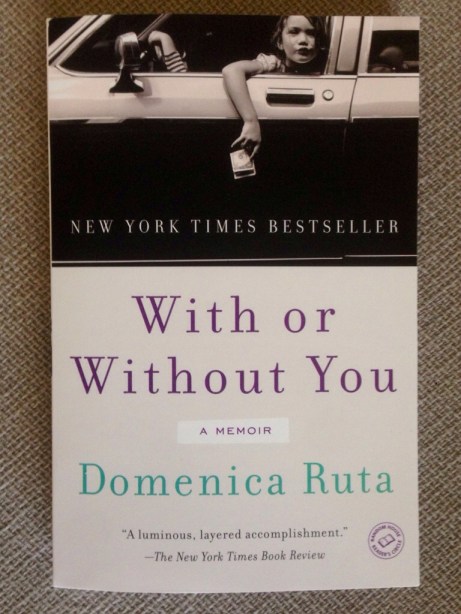
With or Without You (Book Acquired, 2.24.2014)

20140303-140548.jpg

Domenica Ruta’s memoir With or Without You is new in trade paperback next week from Random House. Their blurb:

Domenica Ruta grew up in a working-class, unforgiving town north of Boston, in a trash-filled house on a dead-end road surrounded by a river and a salt marsh. Her mother, Kathi, a notorious local figure, was a drug addict and sometimes dealer whose life swung between welfare and riches, and whose highbrow taste was at odds with her hardscrabble life. And yet she managed, despite the chaos she created, to instill in her daughter a love of stories. Kathi frequently kept Domenica home from school to watch such classics as theGodfather movies and everything by Martin Scorsese and Woody Allen, telling her, “This is more important. I promise. You’ll thank me later.” And despite the fact that there was not a book to be found in her household, Domenica developed a love of reading, which helped her believe that she could transcend this life of undying grudges, self-inflicted misfortune, and the crooked moral code that Kathi and her cohorts lived by.
 
With or Without You is the story of Domenica Ruta’s unconventional coming of age—a darkly hilarious chronicle of a misfit ’90s youth and the necessary and painful act of breaking away, and of overcoming her own addictions and demons in the process. In a brilliant stylistic feat, Ruta has written a powerful, inspiring, compulsively readable, and finally redemptive story about loving and leaving.

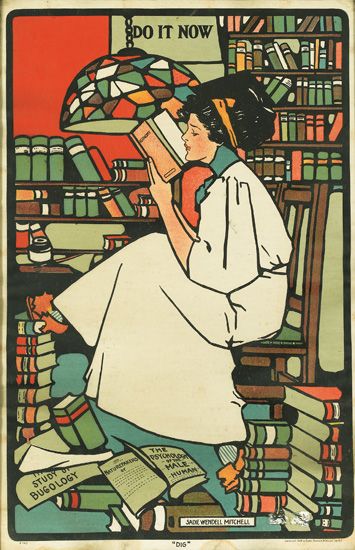
Dig — Sadie Wendell Mitchell

readinglady

“I like the delete key best” (William H. Gass)

When Skizzen first became aware of it, he laughed, for he had miss-spelled “spell.” Well, not exactly. The additional l was a typo. “Spelll.” It was a machine-mad error, but the extra l could be easily deleted. That was one of the great virtues of this new invention. If words magically appeared on the screen (he was often unaware he was typing his fingers flew so fast, so briefly did they need to light upon the keys), they could be sent away just as readily. Not like a note that would leave of its own accord yet could not be erased and could not be said to have disappeared. He had been saying that a spell had been put upon mankind. Writing, not saying. He had been writing that a spell had been put upon our race. As if Circe had changed us into swine so that our little noses were wrinkled by concealed snouts, and inside those of us who possessed a male member a hog’s reproductive implement curled—a pig’s … sexual implement—a memoir of the moment of enchantment. Anyway, we did not see how foolish, how absurd, how wicked we were being. That was the gist.

Joseph had pursued a request for some books that he had asked the library to acquire as far as the library entrance, where a smilling young man had greeted him with this suitcase fulll of magic. We ordered some of these computers, he said with some excitement, and they just came. Want to play? The Music Department had been threatened with digitization, but their three-person claim on modernity was weak. So Professor Skizzen dutifullly sat at one end of a long library table and began pecking away: It is as if a spelll had been put upon mankind. How quickly the spelll enveloped the screen. We oinked and thought it singing, he wrote. The young man approached bearing his grin like a tidbit on a salver, so Skizzen hit DELETE and saw nothing more, neither his practice sentence nor the grin. Go on, the young man said, take it for a spin. Our new system will make it easy for us to keep records, he boasted. The bursar is out of his mind with delight. We rolled in the mud and believed we were bathing, Skizzen wrote, with his best hunt-and-peck. He knew Grin was grinning again, over his shoulder. Let the piker peek, Skizzen thought, I shall complete my edifying lines about the spelll that been put upon mankind. “We fought one another and afterward celebrated the carnage” soon materialized. With writing, he said aloud, the writing inscribes the letters, letters build the words, and, subsequently, the thought arrives—handmade like kneaded bread. With typewriting, you get letters by hammering them into existence. Or out, with x’s, if you don’t like them. With this sweet machine here, you issue a requisition. Well, now, I hadn’t thought about it that way, the Grinner said. With pen and ink, before we write, we think, because we hate the sight of corrections. With the computer we write first and think later, corrections are so easy to perform. I like the delete key best; it has a good appearance, Skizzen said, typing furiously. “We ate our farrow and supposed it was a splendidly healthy, indeed toothsome, way to dine.” Joseph determined to leave something behind as an animal might to signal its presence, so he keyed: “We eagerly awaited our own slaughter, as though we were receiving an award.” Now he spoke it as he played it. “Our haunch would hang in the smokehouse to season, and those of us who remained to feel would feel, like parvenus, that we had Arrived.” I’m glad you got these, he said to the Grin, though the young man didn’t seem to have any more grins to spend. I wonder how many unordered books these cost me. He slid his words the length of the long table where they disappeared over its edge into delete. Then Skizzen took his goatee away where it would be better appreciated.

From William H. Gass’s  novel Middle C.

The Complete Short Stories of J.G. Ballard (Eleventh Riff: The Nineties)

jgb_complete_ss4003111

PREVIOUSLY:

Introductions + stories 1956-1959

Stories of 1960

Stories of 1961

Stories of 1962

“The Subliminal Man,” Black Friday, and Consumerism

Stories of 1963-1964

Stories of 1966

Closing out the sixties

The seventies

The eighties

IN THIS RIFF:

“Dream Cargoes” (1990)

“A Guide to Virtual Death” (1992)

“The Message from Mars” (1992)

“Report from an Obscure Planet” (1992)

“The Secret Autobiography of J G B” (1981/2009)

“The Dying Fall” (1996)

1. “Dream Cargoes” (1990)

By the 1990s Ballard had written essentially the same stories over and over—with diminishing returns. Some of the weakness in the later entries in the Complete Short Stories can be attributed to Ballard’s prescience. The world caught up to him at some point, blunting his satire into something goofier, more cartoonish, but also sharpening the reactionary streak that always glowed under the surface of his writing. At his peak, Ballard used his stories to provoke readers into looking at their culture in a new way, and the best of those stories still retain a futurist power. However, many of the late period stories blazon their moral outrage in a wearisome didactic streak.

1990’s “Dream Cargoes” is paint-by-numbers Ballard: Themes of time, sleep, mutation, ecological disaster, birds, etc. The plot anticipates one of Ballard’s weaker novels, Rushing to Paradise (1994), a day-glo nightmare about misguided attempts to steward the forces of nature. And like Rushing to Paradise, the prose here is weak—Ballard relies on the stock phrases that litter his earliest stories.

2. “The Message from Mars” (1992) / “Report from an Obscure Planet” (1992) / “A Guide to Virtual Death” (1992)

“The Message from Mars” anticipates public disinterest in astronomy (and science in general), the end of NASA’s space shuttle program, and China’s emerging dominance as a world power with space flight capability. So there you go. (It also posits the horror of a President Quayle!). Ballard sends a group of astronauts on a Mars mission, refuses to share their findings with us, and then leaves them, once they land, in their space shuttle, where they live on for decades, silent, incommunicado, alienated from humanity in their self-imposed exile. Ballard’s cynicism is balanced by his refusal to overstate any kind of moral here—the story succeeds in its evocation of mystery.

“Report from an Obscure Planet” is another riff on millennial anxieties, written in the perspective of a “we” condemning the human race for its shortsighted, disastrous treatment of the planet. Ballard doesn’t seem to keen on the future wonders promised by computers:

Driven by the need for a more lifelike replica of the scenes of carnage that most entertained them, the people of this unhappy world had invented an advanced and apparently interiorised version of their television screens, a virtual replica of reality in which they could act out their most deviant fantasies. These three–dimensional simulations were generated by their computers, and had reached a stage of development in the last years of the millennium in which the imitation of reality was more convincing than the original. It may even have become the new reality to the extent that their cities and highways, their fellow citizens and, ultimately, themselves seemed mere illusions by comparison with the electronically generated amusement park where they preferred to play. Here they could assume any identity, create and fulfill any desire, and explore the most deviant dreams.  

While “Report from an Obscure Planet” uses a didactic narrator and a heavy hand to telegraph its message, its companion piece “A Guide to Virtual Death” is far more fun, wicked, and shockingly accurate (if wildly hyperbolic). Sure, yes, okay—another list from Ballard, and okay, yes, sure—I tend to be keen on his lists (“The Index,” “The Assassination of John Fitzgerald Kennedy Considered as a Downhill Motor Race”)—but they also tend to be his strongest pieces. As usual with his list-stories, Ballard feels obligated to begin with a note:

For reasons amply documented elsewhere, intelligent life on earth became extinct in the closing hours of the 20th Century. Among the clues left to us, the following schedule of a day’s television programmes transmitted to an unnamed city in the northern hemisphere on December 23, 1999, offers its own intriguing insight into the origins of the disaster.

6.00 am Porno–Disco. Wake yourself up with his–and–her hard–core sex images played to a disco beat.

7.00 Weather Report. Today’s expected micro–climates in the city’s hotel atriums, shopping malls and office complexes. Hilton International promises an afternoon snow–shower as a Christmas appetiser.

7.15 News Round–up. What our news–makers have planned for you. Maybe a small war, a synthetic earthquake or a famine–zone! charity tie–in.

7.45 Breakfast Time. Gourmet meals to watch as you eat your diet cellulose.

Brief but Essential. Go ahead and read the whole thing.

3. “The Dying Fall” (1996) / “The Secret Autobiography of J G B” (1981/2009)

The American edition of Complete Stories is more complete than the British volume, including two extra stories. “The Dying Fall” (read it here if you like) is an unfortunate last entry, a weak note in a grand tome. It’s not bad; it’s simply not good, yet another revenge tale with a bad wife, etc. It feels like a frame for Ballard to riff on architecture and psychoanalysis.

“The Secret Autobiography of J G B” is much stronger (you can read it here), although it was also composed at his peak and republished (“rediscovered”) after his death. The final lines would have made a fitting end for the entire collection:

When the summer was followed by a mild autumn, B had established a pleasant and comfortable existence for himself. He had abundant stocks of tinned food, fuel, and water with which to survive the winter. The river was nearby, clear and free of all pollution, and petrol was easy to obtain, in unlimited quantities, from the filling stations and parked cars. At the local police station, he assembled a small armory of pistols and carbines, to deal with any unexpected menace that might appear.

But his only visitors were the birds, and he scattered handfuls of rice and seeds on his lawn and on those of his former neighbors. Already he had begun to forget them, and Shepperton soon became an extraordinary aviary, filled with birds of every species.

Thus the year ended peacefully, and B was ready to begin his true work.

4. On the horizon:

I am done! Sort of. One more post—I’ll revisit these riffs and select the tales that I would include in a collection I would call The Essential Short Stories of J.G. Ballard.

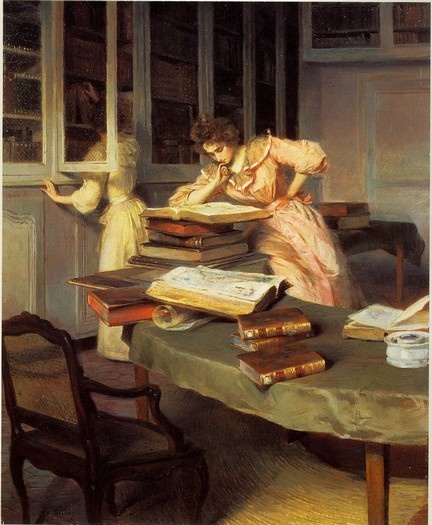
Elegant Woman in Library — Edouard Gelhay

9b59115eab0cb7f2b248b0568d77a948

“Martyrdom of Saint Erasmus” (William H. Gass)

week11-0064

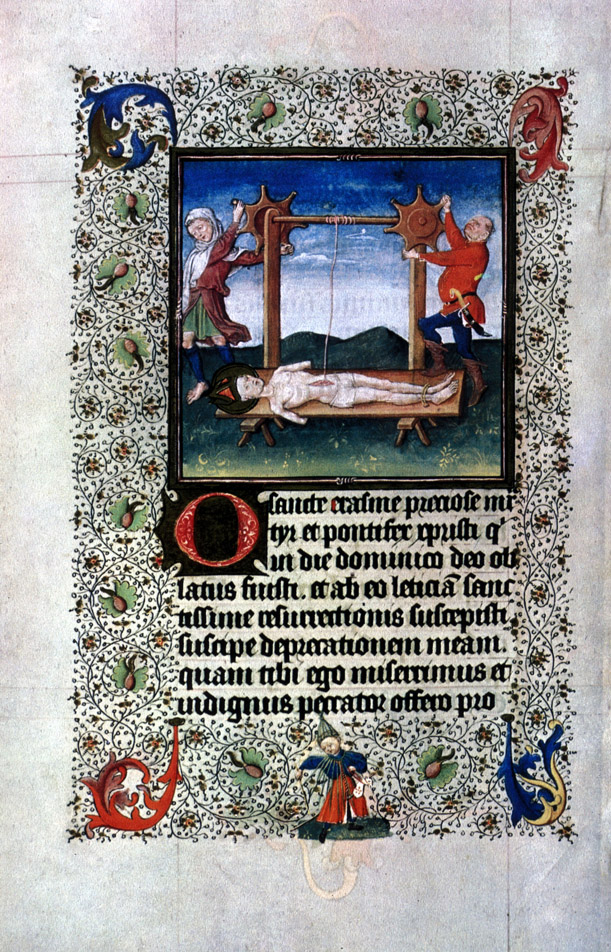
There were images that had nowhere to hang but in his head, images he remembered from books but of which he had no other copy; particularly one, from a strangely beautiful illuminated manuscript called The Hours of Catherine of Cleves, that depicted the martyrdom of Saint Erasmus. The presumptive saint lies on a raised plank, naked except for a loincloth. His abdomen has been opened and his intestines attached to a windlass erected above him. Thereupon, like a length of sausage or a length of rope, his innards are being wound by two figures, one male, one possibly female, each working hard to turn the spokes, their faces, however, averted from the scene. The saint does not appear to have wrists or hands. Eight turns have already been taken. The sky is empty except for a few clouds; the earth is empty except for two hills and some small yellow flowers. Around this painting, framed like a picture, is a delicate thin line made of curlicues and a field of tiny petals stalked by imaginary butterflies. At the bottom a small boy wearing a collar of thin sticks is riding a hobbyhorse.

His curiosity aroused by this calamitous vision, Skizzen sought more bio concerning Saint Erasmus. One source simply said that “although he existed, almost nothing is known about him.” This sentence stayed with Skizzen as stubbornly as the piteous illumination. What a blessed condition Erasmus must have enjoyed! Although he existed, almost nothing was known of him. Although nothing was known of him, as a saint, he existed. He existed, yet he had lived such a saintly life there was nothing of him to be known. Still another authority was not as sanguine. It claimed that the cult of Erasmus spread with such success that twelve hundred years later the martyr was invoked as one of the Fourteen Holy Helpers, whoever they were, and had become patron saint of sailors as well as kids who had colic. What was known, during those hundreds of years, was not known of the saint but of some figure he had thrown about himself as you would a ghostly garment or a costume for the dance. Proudly, Professor Skizzen pasted Erasmus in his memory book. A.d. 300. He was sprayed with tar and set alight. He was jailed, rescued by an angel, disemboweled. On a day in a.d. He died for me.

From William H. Gass’s novel  Middle C.

Silence — Tantiana Deiry

631e6a6db45c6b3232f1561d55cb4258