

Category: Books
“Childhood is still running along beside us like a little dog” (Thomas Bernhard)
“Childhood is still running along beside us like a little dog who used to be a merry companion, but who now requires our care and splints, and myriad medicines, to prevent him from promptly passing on.” It went along rivers, and down mountain gorges. If you gave it any assistance, the evening would construct the most elaborate and costly lies. But it wouldn’t save you from pain and indignity. Lurking cats crossed your path with sinister thoughts. Like him, so nettles would sometimes draw me into fiendish moments of unchastity. As with him, my fear was made palatable by raspberries and blackberries. A swarm of crows were an instant manifestation of death. Rain produced damp and despair. Joy pearled off the crowns of sorrel plants. “The blanket of snow covers the earth like a sick child.” No infatuation, no ridicule, no sacrifice. “In classrooms, simple ideas assembled themselves, and on and on.” Then stores in town, butchers’ shop smells. Façades and walls, nothing but façades and walls, until you got out into the country again, quite abruptly, from one day to the next. Where the meadows began, yellow and green; brown plowland, black trees. Childhood: shaken down from a tree, so much fruit and no time! The secret of his childhood was contained in himself. Growing up wild, among horses, poultry, milk, and honey. And then: being evicted from this primal condition, bound to intentions that went way beyond himself. Designs. His possibilities multiplied, then dwindled in the course of a tearful afternoon. Down to three or four certainties. Immutable certainties. “How soon it is possible to spot dislike. Even without words, a child wants everything. And attains nothing.” Children are much more inscrutable than adults. “Protractors of history. Conscienceless. Correctors of history. Bringers-on of defeat. Ruthless as you please.” As soon as it could blow its own nose, a child was deadly to anything it came in touch with. Often—as it does me—it gives him a shock, when he feels a sensation he had as a child, provoked by a smell or a color, but that doesn’t remember him. “At such a moment you feel horribly alone.”
From Thomas Bernhard’s novel Frost.
Facts, Questions, and Images from Nathaniel Hawthorne’s Note-Books
- The Abyssinians, after dressing their hair, sleep with their heads in a forked stick, in order not to discompose it.
- At the battle of Edge Hill, October 23, 1642, Captain John Smith, a soldier of note, Captain Lieutenant to Lord James Stuart’s horse, with only a groom, attacked a Parliament officer, three cuirassiers, and three arquebusiers, and rescued the royal standard, which they had taken and were guarding. Was this the Virginian Smith?
- Stephen Gowans supposed that the bodies of Adam and Eve were clothed in robes of light, which vanished after their sin.
- Lord Chancellor Clare, towards the close of his life, went to a village church, where he might not be known, to partake of the Sacrament.
- In the tenth century, mechanism of organs so clumsy, that one in Westminster Abbey, with four hundred pipes, required twenty-six bellows and seventy stout men. First organ ever known in Europe received by King Pepin, from the Emperor Constantine, in 757. Water boiling was kept in a reservoir under the pipes; and, the keys being struck, the valves opened, and steam rushed through with noise. The secret of working them thus is now lost. Then came bellows organs, first used by Louis le Débonnaire.
- After the siege of Antwerp, the children played marbles in the streets with grape and cannon shot.
- A shell, in falling, buries itself in the earth, and, when it explodes, a large pit is made by the earth being blown about in all directions,–large enough, sometimes, to hold three or four cart-loads of earth. The holes are circular.
- A French artillery-man being buried in his military cloak on the ramparts, a shell exploded, and unburied him.
- In the Netherlands, to form hedges, young trees are interwoven into a sort of lattice-work; and, in time, they grow together at the point of junction, so that the fence is all of one piece.
From Nathaniel Hawthorne’s American Note-Books.
Cockaigne — Vincent Desiderio

Biblioklept Is Seven Today, So Here are Seven Sets of Seven Somethings
*
Seven Reviews of Seven Books I Love
The Rings of Saturn — W.G. Sebald
Denis Johnson’s Train Dreams Is a Perfect Novella
The Pale King — David Foster Wallace
The Collected Stories of Lydia Davis
Intertexuality and Structure in Roberto Bolaño’s 2666
*
Seven Hands (Van Gogh)

*
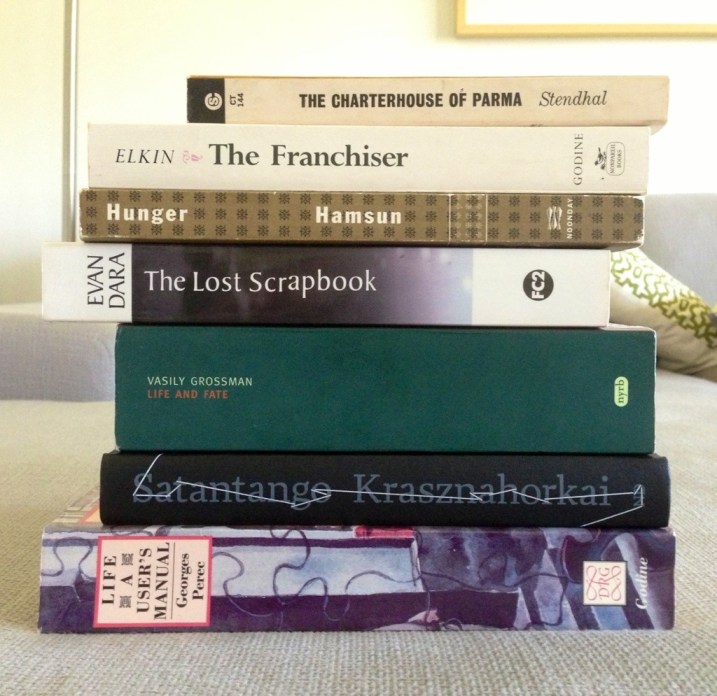
Seven Books I’d Like to Read Sometime in the Next Seven Years
*
Seven Negative Reviews
Why I Abandoned Chad Harbach’s Over-Hyped Novel The Art of Fielding After Only 100 Pages
Jonathan Lethem’s Bloodless Prose
I Super Hated Gary Shteyngart’s Super Sad True Love Story
The Sot-Weed Factor — John Barth
*
Seven Ballerinas (Picasso)

*
Seven Perfect Short Stories
“The Death of Me” — Gordon Lish
“A Good Man Is Hard to Find” — Flannery O’Connor
“The School” — Donald Barthelme
“Wakefield” — Nathaniel Hawthorne
“Good Old Neon” — David Foster Wallace
*
Seven Deadly Sins (Bosch)

*
KB with Art in America — Alex Kanevsky

Biblioklept’s Dictionary of Literary Terms
APHORISM
A concise, often witty, turn of phrase that should be shared out of context on Twitter or Pinterest.
BILDUNGSROMAN
Novel where someone (preferably male) matures into the ideal state of bitter disillusionment.
CATHARSIS
Evocation of fear and pity. Best exemplified in modern storytelling by Lifetime Network original movies.
DECONSTRUCTION
A form of textual analysis. No one knows what it means. Apply liberally.
EXISTENTIALIST
Use to describe any French novel of the 20th century. Serve with coffee and cigarettes.
FOIL
First, Outer, Inner, Last.
GENRE FICTION
Deride genre fiction at all times. If a writer uses genre tropes, praise her for genre bending. (See LITERARY FICTION).
HYSTERICAL REALISM
Use to describe any big ambitious novel that does not meet your aesthetic and/or moral needs.
IAMBIC PENTAMETER
All poetry is composed in iambic pentameter.
JUVENILIA
A writer’s immature work, which she usually (wisely) withholds from publication. After the writer dies, every scrap should be published, scrutinized, and passed around the internet out of context.
KAKFAESQUE
Synonym for “odd.” Apply freely.
LITERARY FICTION
A genre of fiction that pretends not to be a genre. What your book club is reading this month.
MAGICAL REALISM
Use to describe any novel by a South American writer.
NARRATOLOGY
Use structuralist techniques to analyze narrative plots—and watch the kids go wild! Narratology is the number one thing the audience of a book review is interested in.
ORPHAN
All heroes must be orphans.
PANOPTICON
Use this term liberally in any discussion of modern politics. Pairs well with film studies courses.
QUEER THEORY
A form of literary analysis that conveniently begins with the letter “Q,” making it ideal for silly alphabetized lists like this one.
ROUND CHARACTER
A character portrayed in psychological and emotional depth to the degree that she comes alive in your imagination. Round characters provide an excellent alternative to making meaningful human relationships.
SOUTHERN GOTHIC
Use to describe the style of any writer from the Southern part of the United States.
TAUTOLOGY
A tautology is a tautology.
UTOPIA
Synonym for dystopia. Argue about its pronunciation, indicating that you understand the complexities of Greek prefixes.
VERISIMILITUDE
Literary trickery.
WHODUNNIT
A genre of books that sells well in airports.
XENA
Beloved warrior princess. Look, x is hard, okay?
YOUNG WERTHER
The original sad bastard; he invented emo.
ZEITGEIST
Time’s ghost. You’re soaking in it, which makes it hard to see.
Interior with a Young Man Reading — Vilhelm Hammershøi

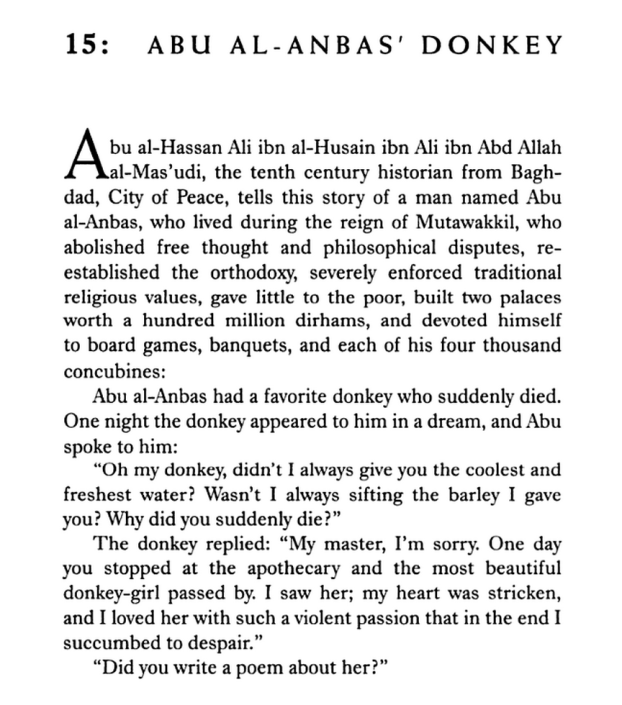
“Abu Al-Anbas’ Donkey” – Eliot Weinberger

“—you see you were always lost” (Thomas Bernhard)
“You just arrive in a place,” said the painter,“ and then you leave it again, and yet everything, every single object you take in, is the sum of its prehistory. The older you become, the less you think about the connections you’ve already established. Table, cow, sky, stream, stone, tree, they’ve all been studied. Now they just get handled. Objects, the harmonic range of invention, completely unappreciated, no more truck with variation, deepening, gradation. You just try to work out the big connections. Suddenly you look into the macro-structure of the world, and you discover it: a vast ornament of space, nothing else. Humble backgrounds, vast replications—you see you were always lost. As you get older, thinking becomes a tormenting reference mechanism. No merit to it. I say ‘tree,’ and I see huge forests. I say ‘river,’ and I see every river. I say ‘house,’ and I see cities with their seas of roofs. I say ‘snow,’ and I see oceans of it. A thought sets off the whole thing. Where it takes art is to think small as well as big, to be present on every scale …”
From Thomas Bernhard’s novel Frost.
Lesender Knabe — Frans Hals

World of Pains and Troubles (John Keats)
—The common cognomen of this world among the misguided and superstitious is ‘a vale of tears’ from which we are to be redeemed by a certain arbitrary interposition of God and taken to Heaven–What a little circumscribed straightened notion! call the world if you Please ‘The vale of Soul-making’ Then you will find out the use of the world (I am speaking now in the highest terms for human nature admitting it to be immortal which I will here take for granted for the purpose of showing a thought which has struck me concerning it) I say “Soul making” Soul as distinguished from an Intelligence– There may be intelligences or sparks of the divinity in millions–but they are not Souls till they acquire identities, till each one is personally itself. Intelligences are atoms of perception–they know and they see and they are pure, in short they are God–how then are Souls to be made? How then are these sparks which are God to have identity given them–so as ever to possess a bliss peculiar to each ones individual existence? How, but by the medium of a world like this? This point I sincerely wish to consider because I think it a grander system of salvation than the chrystain religion–or rather it is a system of Spirit-creation–This is effected by three grand materials acting the one upon the other for a series of years–These Materials are the Intelligence–the human heart (as distinguished from intelligence or Mind) and the World or Elemental space suited for the proper action of Mind and Heart on each other for the purpose of forming the Soul or Intelligence destined to possess the sense of Identity. I can scarcely express what I but dimly perceive–and yet I think I perceive it–that you may judge the more clearly I will put it in the most homely form possible–I will call the world a School instituted for the purpose of teaching little children to read–I will call the Child able to read, the Soul made from that school and its hornbook. Do you not see how necessary a World of Pains and troubles is to school an Intelligence and make it a soul? A Place where the heart must feel and suffer in a thousand diverse ways! Not merely is the Heart a Hornbook, it is the Minds Bible, it is the Minds experience, it is the teat from which the Mind or intelligence sucks its identity–As various as the Lives of Men are–so various become their Souls, and thus does God make individual beings, Souls, Identical Souls of the sparks of his own essence–“
—From a letter John Keats wrote to his brother George, dated April 21, 1810. (More excerpts from Keats’s letters with commentary).
Woman Reading — Utagawa Kuniyoshi

Susan Sontag’s List of Novels with Cinematic Structure
Novels with cinematic structure:
Hemingway, In Our Time
Faulkner,
[Horace] McCoy, They Shoot Horses, Don’t They?
Robbe-Grillet, Les Gommes [The Erasers]
[Georges] Bernanos, M. Ouine
I[vy] Compton-Burnett,
V Woolf, Between the Acts
Philip Toynbee, Tea with Mrs. Goodman
des Forêts, Les Mendiants
his first novel—multiple pov [points of view]
[Barnes,] Nightwood
Reverzy, Le Passage
Burroughs,
[John] Dos Passos
Firbank, Caprice; Vainglory; and [Inclinations] (trilogy)
Jap[anese] writer [Yasunari Kawabata] (N.B. visual sense, suppleness of changing scenes)—Snow Country, etc.
Dickens (cf. Eisenstein)—
There are people who thought with camera eye (a unified p-o-v that displaces itself) before the camera
N[athaniel] West,
Blechman
“new novelists”: Claude Simon, Le Palace
Claude Ollier, La Mis-en-Scène
(all based on organization of a decor (N[orth] Africa)
–From an entry dated 6/26/66 Paris in Susan Sontag’s notebook, published as part of As Consciousness Is Harnessed to Flesh. (I’ve maintained the bracketed editorial intrusions of the published text, even with they did not seem necessary).
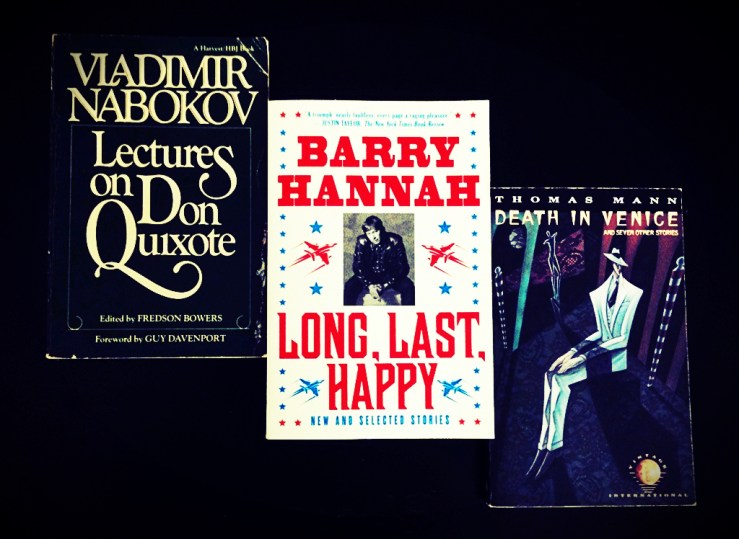
Hannah/Nabokov/Mann (Books Acquired, 8.30.2013)
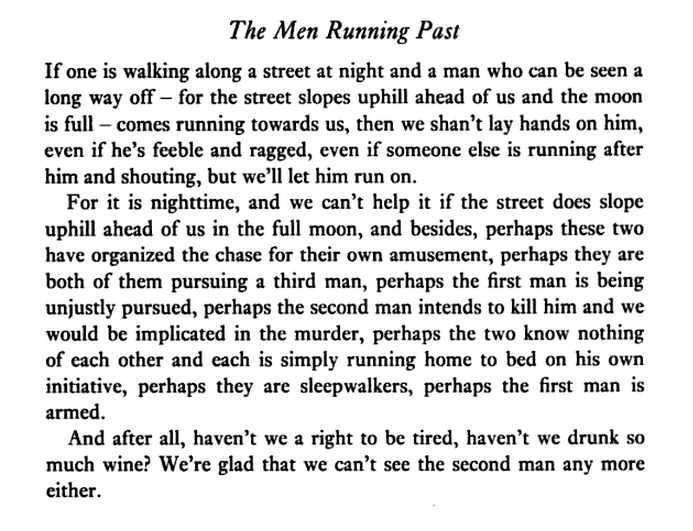
“The Men Running Past” — Franz Kafka
Two Arabs Reading — Edwin Lord Weeks

 Biblioklept