

Category: Books
A Dirty Lapdog Joke from Thomas Pynchon’s Against the Day
Ruperta Chirpingdon-Groin and her party had descended by way of the St.Gotthard Tunnel from league after league of peaks like ocean waves frozen in place, fading into merciless light, tending to eternity—a circuit of Alpine hotels and hydropathics so remote the hotels had to print up their own postal stamps just to get mail as far as a regular Swiss post office, full of giggling nitwits, quite a number of them British actually, running about the corridors, jumping off balconies into the snowdrifts, hiding in servingpantries and falling down dumbwaiter shafts. They had detrained at Bellinzona, where the motordiligence from the Sanatorium was waiting for them, and so up to the famed institution overlooking the Swiss shores of Lago Maggiore. Goats grazing by the roadside turned their heads to watch them pass, as if long familiar with Böpfli-Spazzoletta clientele. From somewhere came a repeated figure being played on an alpenhorn.
Though he was not ready to share it with his brother, not even Reef had been exempt from the folly up there.
“What kind of a dog’s that?” he asked Ruperta at one point.
“Mouffette? She’s a papillon . . . a sort of French ladies’ lapdog.”
“A—You say,” gears in his mind beginning to crank, “ ‘lap’—French . . . lapdog?” Somehow gathering that Ruperta had trained her toy spaniel to provide intimate “French” caresses of the tongue for the pleasure of its mistress. “Well! you two are . . . pretty close then, I guess?”
“I wuv my ickle woofwoof, ess I doo!” Squeezing the animal tightly, one would think painfully, except for the apparent enjoyment with which Mouffette was fluttering her eyelids.
“Hmm,” said Reef.
“And today I must go across the lake, and the mean old people there won’t allow my ickle pwecious to come with Mummy, and we were both wondering if her good Uncle Reef would look after her for the day, see that she gets her chopped filet and her boiled pheasant, as she’s so particular.”
“Sure, you bet!” His thoughts taking wing. The day alone with a French “lap” dog! who might be more than happy to do for Reef what she was obviously already doing for old ’Pert here! who in fact, mmaybe all this time’s been just droolin’ for onethem penises for a change, and will turn out to know plenty of tricks! Aand—
It took a while for Ruperta to get her toilette perfect and her bustle out the door. Reef found himself pacing and smoking, and whenever he took a look over at Mouffette could’ve sworn she was fidgeting too. The dog, it seemed to Reef, was giving him sidewise looks which if they’d come from a woman you would have had to call flirtatious. Finally after an extended farewell notable for its amount of saliva exchange, Mouffette slowly padded over to the divan where Reef was sitting and jumped up to sit next to him. Jumping on the furniture was something Ruperta seldom allowed her to do, and her gaze at Reef clearly assumed that he would not get upset. Far from it, what he actually got was an erection. Mouffette looked it over, looked away, looked back, and suddenly jumped up on his lap.
“Oboy, oboy.” He stroked the diminutive spaniel for a while until, with no warning, she jumped off the couch and slowly went into the bedroom, looking back now and then over her shoulder. Reef followed, taking out his penis, breathing heavily through his mouth. “Here, Mouffie, nice big dog bone for you right here, lookit this, yeah, seen many of these lately? come on, smells good don’t it, mmm, yum!” and so forth, Mouffette meantime angling her head, edging closer, sniffing with curiosity. “That’s right, now, ooopen up . . . good girl, good Mouffette now let’s just put this—yaahhgghh!”
Reader, she bit him. After which, as if surprised at the vehemence of his reaction, Mouffette jumped off the bed and while Reef went looking for an ice bucket, ran off somehow into the vast hotel. Reef chased her for a while but found it was getting him funny looks from the staff.
In the days that followed, Mouffette took every occasion to jump up in Reef’s lap and gaze into his eyes—sarcastically, it seemed to Reef—opening her mouth suggestively, sometimes even drooling. Each time Reef tried not to flinch. Each time Ruperta, exasperated, would cry, “Honestly, it isn’t as if she means to bite you.”
–A sophomoric, dirty joke from Thomas Pynchon’s novel Against the Day.
Cardinal, Reading a Letter — Jehan Georges Vibert

Fairy Tails — Konstantin Makovsky

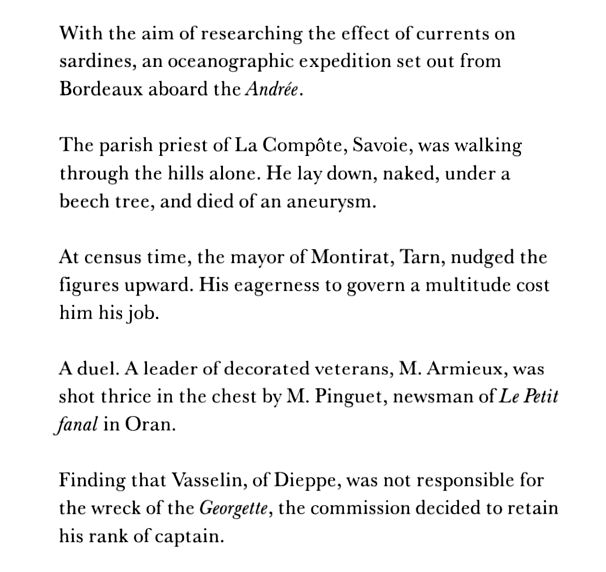
Five from Félix Fénéon
New Issue of Asymptote Features David Mitchell, László Krasznahorkai, Fady Joudah and More
The July issue of Asymptote, a journal devoted to literary translation, is chock-full of goodies, including a long interview with David Mitchell, a shorty from László Krasznahorkai translation, and an essay by Fady Joudah with the marvelous title “Dear God, Your Message Was Received in Error.” Here’s the beginning of that essay:
In Borges’ story, “Averroës’ Search,” Averroës interrupts his long day of contemplating the problem that confronts him in Aristotle’s Poetics (how to translate ‘tragedy’ and ‘comedy’ into Arabic) and joins friends for dinner. The Andalusian philosopher seems to be listening (against hope or “without conviction” as Borges put it) for a solution to his problem in something that any of his guests might say. Maybe the answer is “near at hand” or, as in Lydia Davis’ “The Walk,” right “across the street.”
As the conversation meanders through various subjects about writing, God, and art, one of Averroës’ guests brings up the account of the seven sleepers:
“Let us imagine that someone shows a story instead of telling it—the story of the seven sleepers of Ephesus, say.* We see them retire into the cavern, we see them pray and sleep, we see them sleep with their eyes open, we see them grow while they are asleep, we see them awaken after three hundred nine years, we see them hand the merchant an ancient coin, we see them awaken with the dog.”
Borges’ mention of the seven sleepers comforts me, perhaps because I know the story from the Koran. Or perhaps because it serves as yet another cornerstone of what translation work can perform: transforming telling into seeing. Telling a story through seeing is also a gesture at what Averroës could not grasp when he encountered Aristotle’s ‘tragedy’ and ‘comedy’: theatre.
Lots of great stuff–check it out.
Coco Reading — Pierre-Auguste Renoir

“—boys to your bellybone and chuck a chum a chance!” — Pynchon Riff + Joyce + Moebius + Chloral Hydrate Party

1. Here is a rambling riff if ever I rambled and riffed:
2, First, look, that lovely image—it’s by Jean Giraud, aka Moebius. I came across it a week or two ago and digitally nabbed it.
I love Moebius’s work in general and something about the image reminds me of Thomas Pynchon’s Against the Day, although maybe I’m too immersed in the thick novel to not have much of what I see recall it in some ways.
Something about the airship and the horseman recalls an early passage where Reef Traverse, in the American West, dream-reads the airship adventures of The Chums of Chance into existence. (There are parts of Against the Day that recall to me Cormac McCarthy’s westerns (sometimes—often—called anti-westerns, but come, let’s be adults)…where was I going here? It’s Friday and I’ve consumed the better part (aka “all”) of a bottle of rosé and now I’m circling round some odd notes here—yes—the western/Western thing: Manifest Destiny, etc. — I see it in the Moebius illustration, but of course I bring it with me like a sickness. I move on).
3. ” . . . boys to your bellybone and chuck a chum a chance!” — This is from James Joyce’s Finnegans Wake (85.8). Pointed out to me by Roman Tsivkin, this seems like a most reasonable/splendid source for the namesake of our aeronaut adventurers (who seem rather, uh, absent of late in the final moments of the Bilocations book I’m in right now).
4. Data, perhaps imperfect (again, digitally nabbed)—
In Against the Day:
—Some form of the word invisible appears 173 times—
—The word inconvenience or inconvenient — 84 times—
—The phrase the day — 213 times (usually in a cadence suggestive of the book’s title—some kind of rhythm to it, anyway)—
—The phrase against the day — once (unless you count the chapter (book, really) called “Against the Day,” or the colophon, or what-have-you)—
5. I’m a few sections past this, but a nice passage to end on of a Friday night:
Among students of mathematics here, chloral hydrate was the preferred drug. Sooner or later, whatever the problem being struggled with, having obsessed themselves into nightly insomnia, they would start taking knockout drops to get to sleep—Geheimrat Klein himself was a great advocate of the stuff—and next thing they knew, they were habitués, recognizing one another by the side-effects, notably eruptions of red pimples, known as “the dueling scars of chloralomania.” On Saturday nights in Göttingen, there was always sure to be at least one chloral party, or Mickifest.
It was a peculiar gathering, only intermittently, as you’d say, brisk. People were either talking wildly, often to themselves and without seeming to pause for breath, or lounging draped in pleasurable paralysis across the furniture or, as the evening went along, flat on the floor in deep narcosis.
A Woman Reading — Claude Monet

“How to survive a household fire, 1905” (Jason Schwartz)
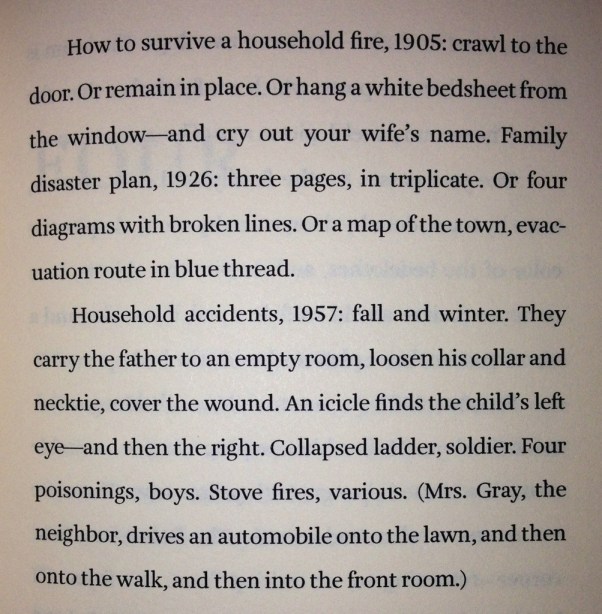
From Jason Schwartz’s forthcoming novel John the Posthumous, which I am trying to write about at present.
Woman Reading — Henri Matisse

Made-up Flowers from Boris Vian’s Novel Heartsnatcher
In the order they appear:
Amizaltzes
Powaroses
Marienbud
Yellowplush
Dreamrape
Fenellacas
Ninastangas
Astrakhan
Marazardins
Seacrocus
Bruinzozos
Bazabobos
Petaleaves
Translated from the French by Stanley Chapman.
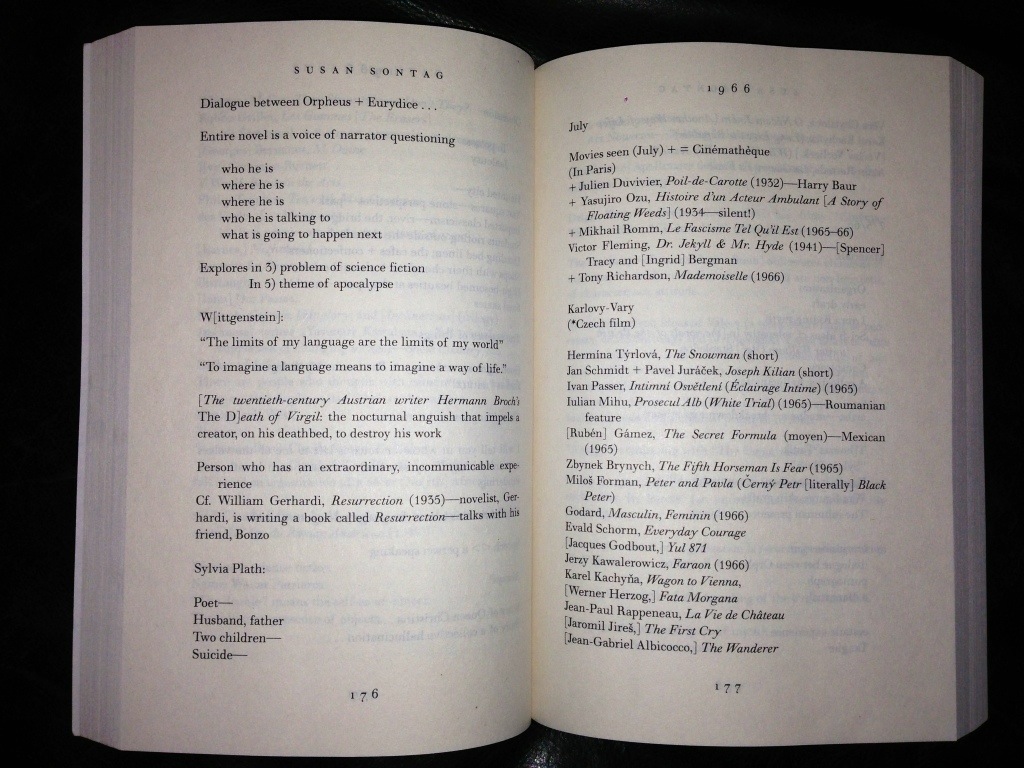
Susan Sontag’s Notebooks, 1964-1980 (Book Acquired, 7.09.2013)

I’ve been—I don’t know—strolling through Susan Sontag’s journals and notebooks this past week. Collected as As Consciousness Is Harnessed to Flesh and new from Picador, this volume picks up where Reborn left off. I’ll be doing a full write up some time this month—really more about writer notebooks (I love Hawthorne’s in particular). Until then—a sample spread from the summer of ’66:
“Scandal” — Willa Cather
“Scandal” by Willa Cather
Kitty Ayrshire had a cold, a persistent inflammation of the vocal cords which defied the throat specialist. Week after week her name was posted at the Opera, and week after week it was canceled, and the name of one of her rivals was substituted. For nearly two months she had been deprived of everything she liked, even of the people she liked, and had been shut up until she had come to hate the glass windows between her and the world, and the wintry stretch of the Park they looked out upon. She was losing a great deal of money, and, what was worse, she was losing life; days of which she wanted to make the utmost were slipping by, and nights which were to have crowned the days, nights of incalculable possibilities, were being stolen from her by women for whom she had no great affection. At first she had been courageous, but the strain of prolonged uncertainty was telling on her, and her nervous condition did not improve her larynx. Every morning Miles Creedon looked down her throat, only to put her off with evasions, to pronounce improvement that apparently never got her anywhere, to say that tomorrow he might be able to promise something definite.
Her illness, of course, gave rise to rumours—rumours that she had lost her voice, that at some time last summer she must have lost her discretion. Kitty herself was frightened by the way in which this cold hung on. She had had many sharp illnesses in her life, but always, before this, she had rallied quickly. Was she beginning to lose her resiliency? Was she, by any cursed chance, facing a bleak time when she would have to cherish herself? She protested, as she wandered about her sunny, many-windowed rooms on the tenth floor, that if she was going to have to live frugally, she wouldn’t live at all. She wouldn’t live on any terms but the very generous ones she had always known. She wasn’t going to hoard her vitality. It must be there when she wanted it, be ready for any strain she chose to put upon it, let her play fast and loose with it; and then, if necessary, she would be ill for a while and pay the piper. But be systematically prudent and parsimonious she would not. Continue reading ““Scandal” — Willa Cather”
Mufti Reading in His Prayer Stool — Jean-Leon Gerome

Mother Daughter Me (Book Acquired, 7.08.2013)
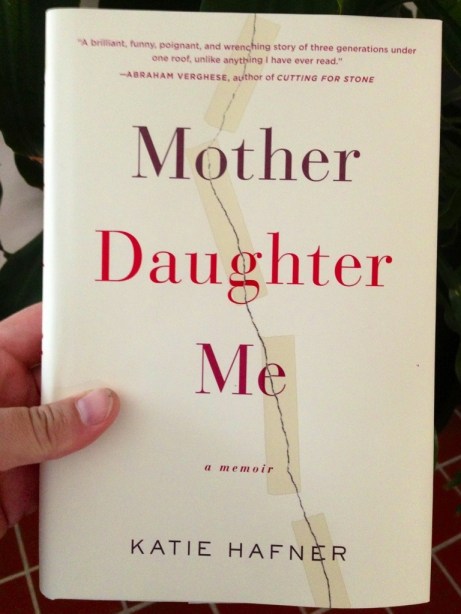
Mother Daughter Me is Katie Hafner’s memoir, new in hardback from Random House. Their blurb:
The complex, deeply binding relationship between mothers and daughters is brought vividly to life in Katie Hafner’s remarkable memoir, an exploration of the year she and her mother, Helen, spent working through, and triumphing over, a lifetime of unresolved emotions.
Dreaming of a “year in Provence” with her mother, Katie urges Helen to move to San Francisco to live with her and Zoë, Katie’s teenage daughter. Katie and Zoë had become a mother-daughter team, strong enough, Katie thought, to absorb the arrival of a seventy-seven-year-old woman set in her ways.
Filled with fairy-tale hope that she and her mother would become friends, and that Helen would grow close to her exceptional granddaughter, Katie embarked on an experiment in intergenerational living that she would soon discover was filled with land mines: memories of her parents’ painful divorce, of her mother’s drinking, of dislocating moves back and forth across the country, and of Katie’s own widowhood and bumpy recovery. Helen, for her part, was also holding difficult issues at bay.
How these three women from such different generations learn to navigate their challenging, turbulent, and ultimately healing journey together makes for riveting reading. By turns heartbreaking and funny—and always insightful—Katie Hafner’s brave and loving book answers questions about the universal truths of family that are central to the lives of so many.
“Elegy with Surrealist Proverbs as Refrain” — Dana Gioia
“Elegy with Surrealist Proverbs as Refrain” by Dana Gioia—
“Poetry must lead somewhere,” declared Breton.
He carried a rose inside his coat each day
to give a beautiful stranger—“Better to die of love
than love without regret.” And those who loved him
soon learned regret. “The simplest surreal act
is running through the street with a revolver
firing at random.” Old and famous, he seemed démodé.
There is always a skeleton on the buffet.Wounded Apollinaire wore a small steel plate
inserted in his skull. “I so loved art,” he smiled,
“I joined the artillery.” His friends were asked to wait
while his widow laid a crucifix across his chest.
Picasso hated death. The funeral left him so distressed
he painted a self-portrait. “It’s always other people,”
remarked Duchamp, “who do the dying.”
I came. I sat down. I went away.Dali dreamed of Hitler as a white-skinned girl—
impossibly pale, luminous and lifeless as the moon.
Wealthy Roussel taught his poodle to smoke a pipe.
“When I write, I am surrounded by radiance.
My glory is like a great bomb waiting to explode.”
When his valet refused to slash his wrists,
the bankrupt writer took an overdose of pills.
There is always a skeleton on the buffet.Breton considered suicide the truest art,
though life seemed hardly worth the trouble to discard.
The German colonels strolled the Île de la Cité—
some to the Louvre, some to the Place Pigalle.
“The loneliness of poets has been erased,” cried Éluard,
in praise of Stalin. “Burn all the books,” said dying Hugo Ball.
There is always a skeleton on the buffet.
I came. I sat down. I went away.
 Biblioklept