Thomas Pynchon Reviews Oakley Hall’s Novel Warlock

Tombstone, Arizona, during the 1880’s is, in ways, our national Camelot: a never-never land where American virtues are embodied in the Earps, and the opposite evils in the Clanton gang; where the confrontation at the OK corral takes on some of the dry purity of the Arthurian joust. Oakley Hall, in his very fine novel Warlock (Viking) has restored to the myth of Tombstone its full, mortal, blooded humanity. Wyatt Earp is transmogrified into a gunfighter named Blaisdell who, partly because of his blown-up image in the Wild West magazines of the day, believes he is a hero. He is summoned to the embattled town of Warlock by a committee of nervous citizens expressly to be a hero, but finds that he cannot, at last, live up to his image; that there is a flaw not only in him, but also, we feel, in the entire set of assumptions that have allowed the image to exist. It is Blaisdell’s private abyss, and not too different from the town’s public one. Before the agonized epic of Warlock is over with — the rebellion of the proto-Wobblies working in the mines, the struggling for political control of the area, the gunfighting, mob violence, the personal crises of those in power — the collective awareness that is Warlock must face its own inescapable Horror: that what is called society, with its law and order, is as frail, as precarious, as flesh and can be snuffed out and assimilated back into the desert as easily as a corpse can. It is the deep sensitivity to abysses that makesWarlock one of our best American novels. For we are a nation that can, many of us, toss with all aplomb our candy wrapper into the Grand Canyon itself, snap a color shot and drive away; and we need voices like Oakley Hall’s to remind us how far that piece of paper, still fluttering brightly behind us, has to fall.

Thomas Pynchon’s 1965 review of Oakley Hall’s novel Warlock. Via/more.


“Wakefield” — Nathaniel Hawthorne

“Wakefield” by Nathaniel Hawthorne

In some old magazine or newspaper, I recollect a story, told as truth, of a man – let us call him Wakefield – who absented himself for a long time, from his wife. The fact, thus abstractedly is not very uncommon, nor – without a proper distinction of circumstances – to be condemned either as naughty or nonsensical. Howbeit, this, though far from the most aggravated, is perhaps the strangest instance, on record, of marital delinquency; and, moreover, as remarkable a freak as may be found in the whole list of human oddities. The wedded couple lived in London. The man, under presence of going a journey, took lodgings in the next street to his own house, and there, unheard of by his wife or friends, and without the shadow of a reason for such self-banishment, dwelt upwards of twenty years. During that period, he beheld his home every day, and frequently the forlorn Mrs. Wakefield. And after so great a gap in his matrimonial felicity – when his death was reckoned certain, his estate settled, his name dismissed from memory, and his wife, long, long ago, resigned to her autumnal widowhood – he entered the door one evening, quietly, as from a day’s absence, and became a loving spouse till death.

This outline is all that I remember. But the incident, though of the purest originality, unexampled, and probably never to be repeated, is one, I think, which appeals to the general sympathies of mankind. We know, each for himself, that none of us would perpetrate such a folly, yet feel as if some other might. To my own contemplations, at least, it has often recurred, always wonder, but with a sense that the story must be true, and a conception of its hero’s character. Whenever any subject so forcibly affects the mind, time is well spent in thinking of it. If the reader choose, let him do his own meditation; or if he prefer to ramble with me through the twenty years of Wakefield’s vagary, I bid him welcome; trusting that there will be a pervading spirit and a moral, even should we fail to find them, done up neatly, and condensed into the final sentence. Thought has always its efficacy, and every striking incident its moral. Continue reading ““Wakefield” — Nathaniel Hawthorne”

Some Books I Plan to Read in 2013

20121228-105736.jpg

There are only a handful of forthcoming titles that I know about right now that I’m looking forward to reading next year: story collections from Sam Lipsyte (The Fun Parts) and George Saunders (Tenth of December), and a new novel from William Gass called Middle C. I’m also hoping Keith Ridgway’s Hawthorn and Child will finally get a US release, because I’d like to read it too.

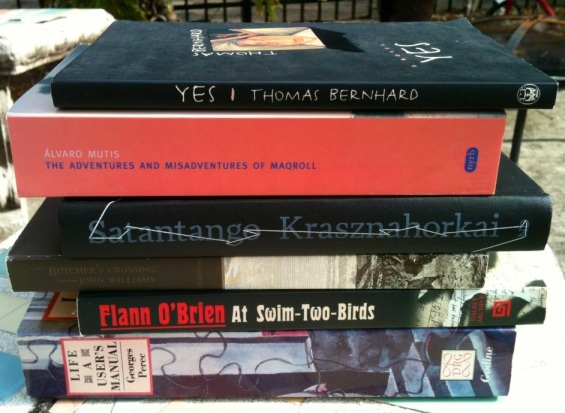
There are a few newish books that I didn’t read in 2012 that I’ll try to catch up to this year—Ben Marcus’s The Flame Alphabet, László Krasznahorkai’s Satantango, and Laurent Binet’s HHhH.

I do not currently possess any of these books.

I also look forward to reading Evan Lavender-Smith’s From Old Notebooks, back in print again from Dzanc (who I am sure will get the copy I ordered to me any day now).

At the top of my list though are the books I’m currently reading: Alvaro Mutis’s Maqroll novellas and Flann O’Brien’s At Swim-Two-Birds.

Stuff I’ve been saying I’ll read for a few years now that I hope to get to:

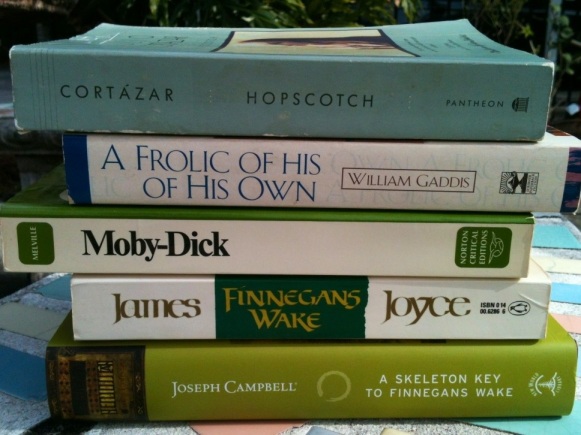
Cortazar’s Hopscotch, John Williams’s Butcher’s Crossing, Gombrowicz’s Ferdydurke, and, at the top of the heap, Georges Perec’s Life A User’s Manual.

20121228-111213.jpg

I have a few books by Thomas Bernhard that I’ll probably get into this year (when I feel called to a misanthropic monologue), and I’ll gobble up anything else by Barry Hannah that I can get my mitts on. I read William Gaddis’s “big books” last year, but I still haven’t read A Frolic of His Own, which I’ve heard is superior to Carpenter’s Gothic.

I’ll reread Moby-Dick this year (or at least listen to William Hootkins’s brilliant audio version) and I’ll probably end up rereading some book that I hadn’t planned to at all (this happened with 2666 and The Savage Detectives this year—who knows? I haven’t read Gravity’s Rainbow since college, and I haven’t reread Infinite Jest in full, and I’d love to go through Suttree again . . . ).

I dipped my toe into Finnegans Wake this year—I’ve found reading it on the Kindle late at night and then going through Joseph Campbell’s Skeleton Key the next morning is rewarding—and I’ll probably keep at it in 2013. Maybe I’ll make it to chapter 3.

But enough of my rambling—What books do you, dear reader, look forward to in 2013?

“Literary Indecencies” — H.L. Mencken

The low, graceless humor of names! On my shelf of poetry, arranged by the alphabet, Coleridge and J. Gordon Cooglar are next-door neighbors! Mrs. Hemans is beside Laurence Hope! Walt Whitman rubs elbows with Ella Wheeler Wilcox; Robert Browning with Richard Burton; Rossetti with Cale Young Rice; Shelly with Clinton Scollard; Wordsworth with George E. Woodberry; John Keats with Herbert Kaufman!

Ibsen, on the shelf of dramatists, is between Victor Hugo and Jerome K. Jerome. Sudermann follows Harriet Beecher Stowe. Maeterlinck shoulders Percy Mackaye. Shakespeare is between Sardou and Shaw. Euripides and Clyde Fitch! Upton Sinclair and Sophocles! Aeschylus and F. Anstey! D’Annunzio and Richard Harding Davis! Augustus Thomas and Tolstoi!

More alphabetical humor. Gerhart Hauptmann and Robert Hichens; Voltaire and Henry Van Dyke; Flaubert and John Fox, Jr.; Balzac and John Kendrick Bangs; Ostrovsky and E. Phillips Oppenheim; Elinor Glyn and Théophile Gautier; Joseph Conrad and Robert W. Chambers; Zola and Zangwill!…

Midway on my scant shelf of novels, between George Moore and Frank Norris, there is just room enough for the two volumes of “Derringforth,” by Frank A. Munsey.

“Literary Indecencies,” a chapter from H.L. Mencken’s collection Damn!