

Category: Books
I’m Dreaming of a Black Christmas — Richard Hamilton

Book Shelves #51, 12.16.2012
Book shelves series #51, fifty-first Sunday of 2012
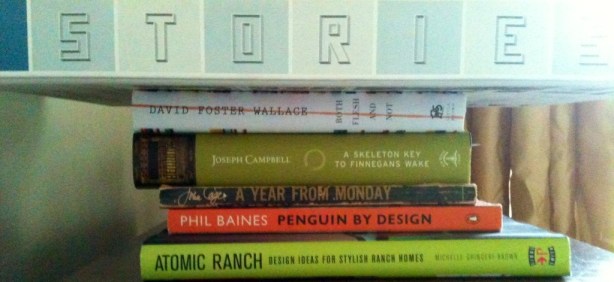
I am very ready for this project to be over. Two more weeks.
At this point, I’ve photographed all book shelves (and other bookbearing surfaces) in the house, but clearly the book shelves aren’t stable.
I mean, structurally, sure, they’re stable.
But their content shifts.
So this week (having three weeks left to fill), I go back to a sitting room in the front of the house where I like to read.
Above, resting on this cabinet, some current reading, including the latest DFW collection and Chris Ware’s Building Stories.
Below, a coffee table (first photographed in #7 of this series):
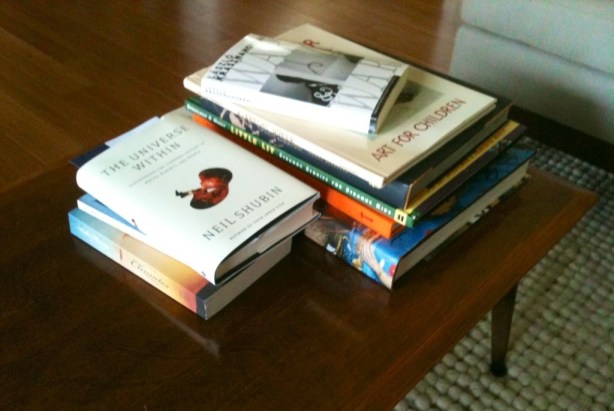
As usual, a few coffee table books, plus several review copies that I need to look at sometime next week:

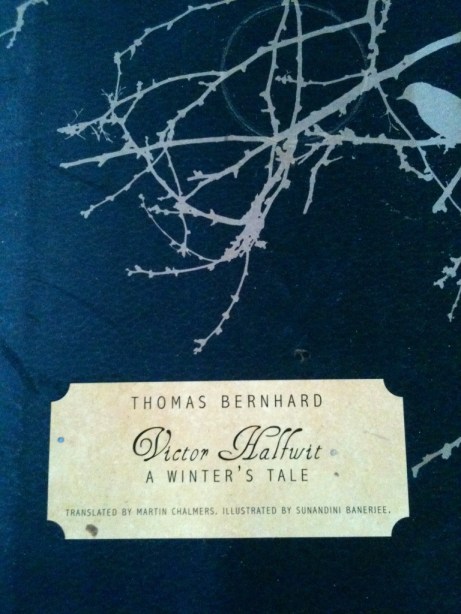
One of the coffee table books is by Thomas Bernhard:
To the right of the case, a bin of books—mostly review copies that come in that I plan to write more about:

Reading in the Forest — Eva Gonzales

Mourning — Umberto Boccioni

Watch A Day in the Afterlife, a Documentary on Philip K. Dick (BBC, 1994)
Noel — Salvador Dali

Reading a Story — James Tissot

Sorrow — Vincent van Gogh

This Is Probably the Best Thing We Ran in 2012

The Bride’s Last Encounter with Her Lovers — Kristine Moran

Reading Chris Ware’s Building Stories / It All Happened So Fast

As seems to be the case more often than not in this series of write-ups on reading Chris Ware’s Building Stories, I’ve taken the title from the first line of the first panel (below); you can see the scale of this chapter in folded broadside in the pic above (which also reveals the heart of this episode).
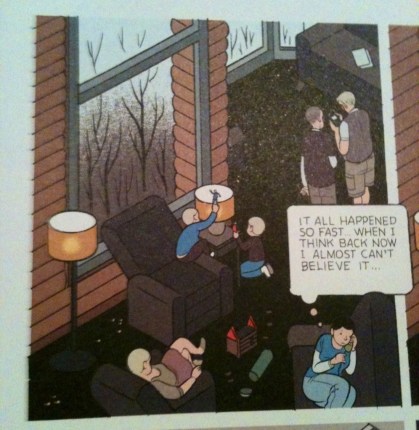
This particular episode focuses again on Lonely Girl/Married Mom/The Amputee, who has slowly emerged as the protagonist of Ware’s novel. Here, she deals with the news of her father’s illness, an event that brings her back to her childhood home repeatedly. The motif of homes and buildings evinces again too, of course—it’s a subtle but omnipresent device in Building Stories:


And as always, Ware’s genius shows in the way he conveys so much truth in the smallest detail. Below he illustrates Lonely Girl’s disconnected relationship with her architect husband in just a panel:

“It All Happened So Fast” is a fair name for this chapter—Ware’s panels illustrate the way that our lives (and the narrativizing of those lives) can become radically compressed, how our memories fail us, how seemingly trivial details anchor themselves to the emotional strata of our personalities even as concrete fact slips away. Still, another title could come from this panel:
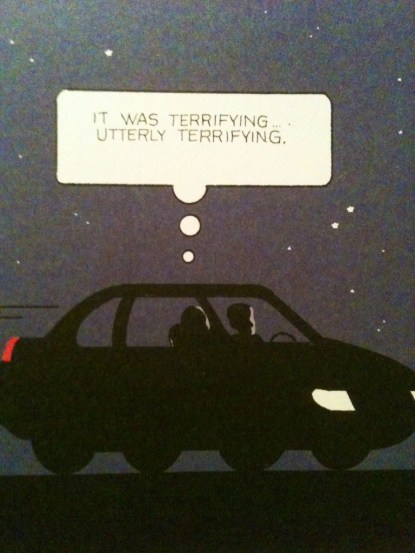
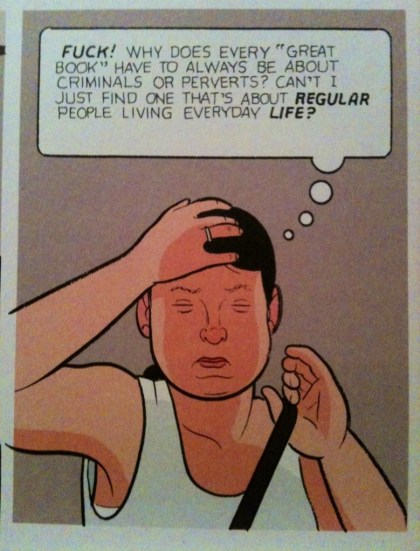
I’ll close this out by offering three panels that strike me as so utterly real, so wonderfully truthful, that I won’t bother to comment further:


Books #3 — Dmitry Samarov

Anthony Burgess (and Others) on Charles Dickens
Christmas Card — MC Escher

JG Ballard on on Psychoactive Drugs and William Burroughs
From JG Ballard’s interview with The Paris Review; the Martin Bax novel he mentions, The Hospital Ship, is worth your time if you can find it:
INTERVIEWER
Speaking of stimulation, did any of the psychoactive drugs of the sixties give you any clues for your writing?
BALLARD
I suppose I’m a medium-to-heavy drinker, but I haven’t taken any drugs since one terrifying LSD trip in 1967. A nightmarish mistake. It opened a vent of hell that took years to close and left me wary even of aspirin. Visually it was just like my 1965 novel, The Crystal World, which some people think was inspired by my LSD trip. It convinced me that a powerful and obsessive enough imagination can reach, unaided, the very deepest layers of the mind. (I take it that beyond LSD there lies nothing.) Imagination is the shortest route between any two conceivable points, and more than equal to any physical rearrangement of the brain’s functions.
INTERVIEWER
Back in the sixties, Martin Bax and yourself, as editors of Ambit magazine, ran a drug competition.
BALLARD
Dr. Bax and I ran a competition in Ambit for the best prose or poetry written under the influence of drugs, and it produced a lot of interesting material. In general, cannabis was the best stimulant, though some good pieces came out of LSD. In fact, the best writing of all was done by Ann Quin, under the influence of the contraceptive pill.
INTERVIEWER
Dr. Bax is a novelist as well, isn’t he?
BALLARD
Martin is a physician, a research pediatrician, and consultant to a London hospital, and his book The Hospital Ship (published in the States by New Directions) is the most remarkable and original novel I’ve come across since reading William Burroughs.
INTERVIEWER
Burroughs wrote an eccentric and laudatory, in its way, introduction to the American edition of Atrocity Exhibition. Do you know him?
BALLARD
Burroughs, of course, I admire to the other side of idolatry, starting with Naked Lunch, then Ticket, Soft Machine, and Nova Express. I’m less keen on his later books. In his way he’s a genius. It’s a pity that his association with drugs and homosexuality has made him a counterculture figure, but I suppose his real links are with Jack Kerouac, Allen Ginsberg, and the Beats. Still, I think he’s much more of an establishment figure, like Dean Swift, with a despairing disgust for the political and professional establishments of which he is a part. I have met Burroughs quite a few times over the last fifteen years, and he always strikes me as an upper-class Midwesterner, with an inherent superior attitude towards blacks, policemen, doctors, and small-town politicians, the same superior attitude that Swift had to their equivalents in his own day, the same scatological obsessions and brooding contempt for middle-class values, thrift, hard work, parenthood, et cetera, which are just excuses for petit-bourgeois greed and exploitation. But I admire Burroughs more than any other living writer, and most of those who are dead. It’s nothing to do with his homosexual bent, by the way. I’m no member of the “homintern,” but a lifelong straight who prefers the company of women to most men. The few homosexual elements in Crash and Atrocity Exhibition, fucking Reagan, et cetera, are there for reasons other than the sexual—in fact, to show a world beyond sexuality, or, at least beyond clear sexual gender.
Reading in the Garden — Nikolay Bogdanov-Belsky

 Biblioklept