

Category: Books
Take Vladimir Nabokov’s “Good Reader” Quiz
One evening at a remote provincial college through which I happened to be jogging on a protracted lecture tour, I suggested a little quiz—ten definitions of a reader, and from these ten the students had to choose four definitions that would combine to make a good reader. I have mislaid the list, but as far as I remember the definitions went something like this.
Select four answers to the question what should a reader be to be a good reader:
1. The reader should belong to a book club.
2. The reader should identify himself or herself with the hero or heroine.
3. The reader should concentrate on the social-economic angle.
4. The reader should prefer a story with action and dialogue to one with none.
5. The reader should have seen the book in a movie.
6. The reader should be a budding author.
7. The reader should have imagination.
8. The reader should have memory.
9. The reader should have a dictionary.
10. The reader should have some artistic sense.The students leaned heavily on emotional identification, action, and the social-economic or historical angle. Of course, as you have guessed, the good reader is one who has imagination, memory, a dictionary, and some artistic sense–which sense I propose to develop in myself and in others whenever I have the chance.
—Vladimir Nabokov. Collected in Lectures on Literature.
“The Exemplary Happiness That Surely Never Comes Again” — Alvaro Mutis
A woman’s body under the rush of a mountain waterfall, her brief cries of surprise and joy, the movement of her limbs in the brief cries of surprise and joy, the movement of her limbs in the rapid foam that carries red coffee berries, sugar cane pulp, insects struggling to escape the current: this is the exemplary happiness that surely never comes again.
From Alvaro Mutis’s novella The Snows of the Admiral, collected in The Adventures and Misadventures of Maqroll.
The Reader — Federico Zandomeneghi

Feast of the Prodigal Son — Vasily Polenov

Book Shelves #48, 11.25.2012
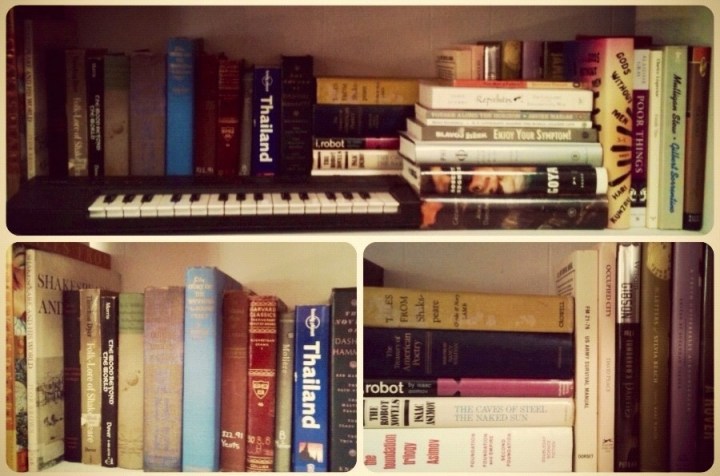
Book shelves series #48, forty-eighth Sunday of 2012
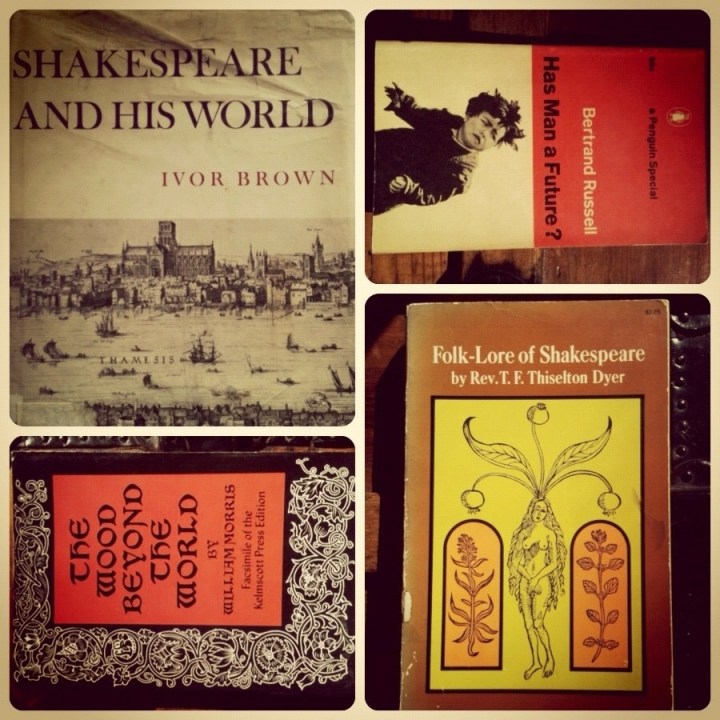
Another doublestocked shelf: The front stack (on the right) are all books I’ve been intending to read at some point, or been reading slowly or piecemeal. Behind and to the left: Lots of old hardbacks—some Yeats, some H.G. Wells, Arthurian legends, and Shakespeare-related texts. A totally misshelved and out-of date Lonely Planet guide (why is it there?). Some Asimov. A few faves:
Walt Whitman: American Experience (Full Documentary)
“I’m Searching” — Clarice Lispector

The opening paragraph to Clarice Lispector’s novel The Passion According to G.H.
Reading Aloud — Ilya Repin

Victory Boogie Woogie — Piet Mondrian

As Yet Nothing Has Happened (Kafka on Revolution)

Jeanne Reading — Camille Pissarro

Poker Night — Thomas Hart Benton

A Floating Life (Book Acquired, 11.09.2012)
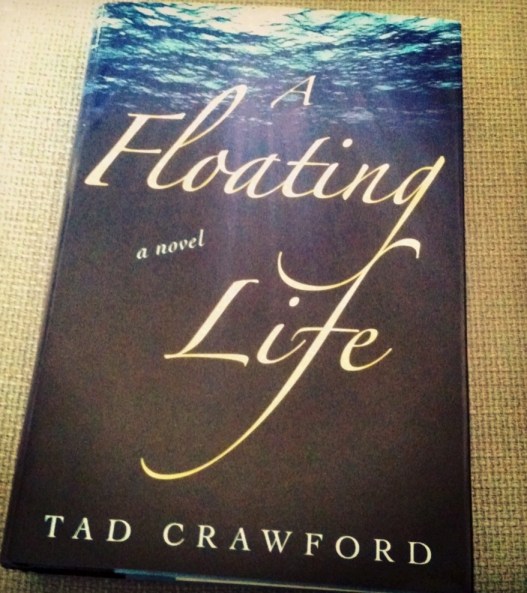
A Floating Life by Tad Crawford. Here’s PW‘s review, which is a bit-too-unkind in my estimation:
A nameless narrator bumbles through a series of bewildering nightmares linked only by the flimsiest narrative thread in Crawford’s disjointed debut. The protagonist ricochets between two realities: in one, he is addled by mundane afflictions (e.g., erectile dysfunction) and finds work as an assistant in a shop called the Floating World, which specializes in model boats and miniature canal systems. The store’s owner, Pecheur, dreams of using these models to harness the destructive power of the ocean for the good of humanity. The narrator’s other reality is a shifting landscape wherein he awakes time and again from horrifying fantasies—from a cage suspended above a bottomless pit to a ravenous family of talking bears. This is Crawford’s approximation of the floating world, “the Buddhist concept of a world filled with pain [that] came to mean the transient and unreliable nature of our world, how fleetingly it floats in the illusion of time,” but the execution is buoyed more by concept than plot. It is an experiment in storytelling, but without motivated characters and dramatic tension, it fails to tell a story at all.
I think it’s more likely that Crawford fails to tell the story that the editors of PW want (or rather, expect) to read. Crawford’s got an ear for dialogue, and much of the book is propelled by conversations—dialogue that sometimes carries on for pages at a time. Kirkus seems to better understand what Crawford is attempting in their review:
In Crawford’s world, boundaries, especially those between people, are semipermeable membranes with tenuous connections to reality.
At times, Crawford seems to be channeling Kafka or Borges, a feeling reinforced when, at a party his unnamed narrator engages a vaguely familiar woman in conversation. She informs her interlocutor that she’s written a letter to her husband, outlining his deficiencies and the hopelessness of their marriage. The narrator finally figures out whom he’s talking to—his wife. Equally dreamlike sequences emerge from this one. The couple decides to live in separate bedrooms in their apartment, but when this turns out to be unfeasible, the narrator goes to look for a new place to live. The real estate agent he talks to firmly rejects some of the narrator’s choices and eventually tells him he’d be happy in a small efficiency, but the building is being constructed under this apartment, deep in the ground, so in a surreal way, the apartment is actually a penthouse. One of the most important connections the narrator makes is to The Floating World, a weird and elusive shop where one can buy model ships, something the narrator starts to develop an intense interest in. The shop is located in a brownstone with no identifying marks, and its proprietor is a Dutchman who goes by the nautical name of Pecheur. Over time, the narrator and the shopkeeper become quite close, the latter taking on the narrator as an assistant. In addition to the death of Pecheur, the narrator ultimately must also confront his erectile dysfunction as well as the dilemma of waking up in an infirmary where he breastfeeds an infant, rather unusual since the narrator is a man.
Odd, offbeat and strangely shimmering.
Interior at Arcachon — Edouard Manet

Dead Turkey — Goya

Absinthe — Vincent van Gogh

 Biblioklept