(Read the entirety of John Keats’s supernatural long poem Lamia as a free illustrated ebook).


Continuing kinda sorta where we left off—
Not sure of the name of this episode, but I’ll refer to it as I just met, a phrase that repeats twice in a huge headlinish font that seems to suggest, y’know, title:

I just met uses a few pages to tell the story of a deteriorating relationship—what happens when two twenty-somethings turn into two mid-to-late-thirtysomethings?
The comic opens with an establishing shot of what I take to be the building in Building Stories; we also get a glimpse of what I assume will be another character, the beehive, and a few other details that surely will attach themselves to these panels in future readings. We also get the general bitter tone of the couple’s relationship:
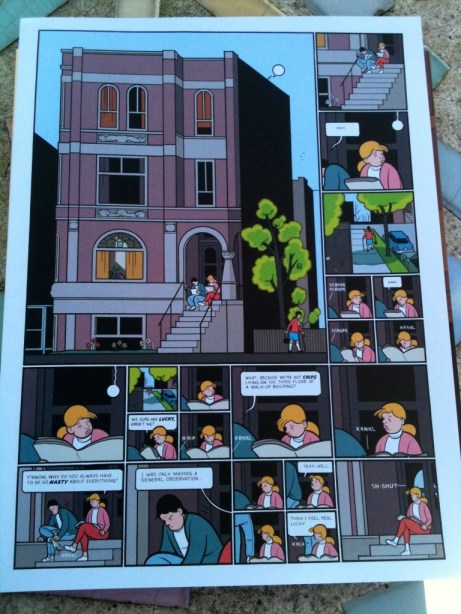
He was one of those dudes who was once in a band; she was one of those chicks who thought guys in bands were cool.
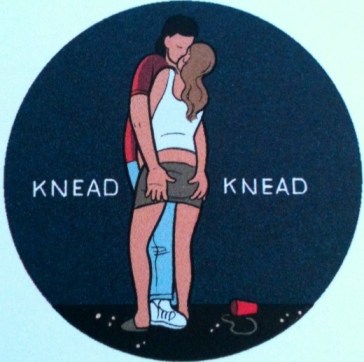
The romance of their initial hookup is summed up neatly in the pic below; knowing Ware’s spare, precise style, the trash on the floor seems to scream symbolic detail!
The hurt and disappointment in I just met unfolds over just a few painful pages—painful mostly in their concrete reality.
We know who these people are, even if we’re lucky enough not to be them.
Just as in Branford, the Best Bee in the World , which I read earlier (although, to be clear again, there are no reading directions or prescriptions for Building Stories), there’s a theme of eternal recurrence, of mistakes playing out again and again in a painful, recursive loop.
Just when Ware threatens to overstate the mundane repetitions his principals suffer, he pulls off a daring and effective move, transposing his characters into the psychic collective memory of a future that’s in many ways already familiar. The effect is simultaneously jarring and oddly reassuring—the promise that our capacity for human connection and deep empathy will never buckle under the threat of drastic technological change, but also suggesting that the cost of maintaining this emotional constant is deep, ugly pain.


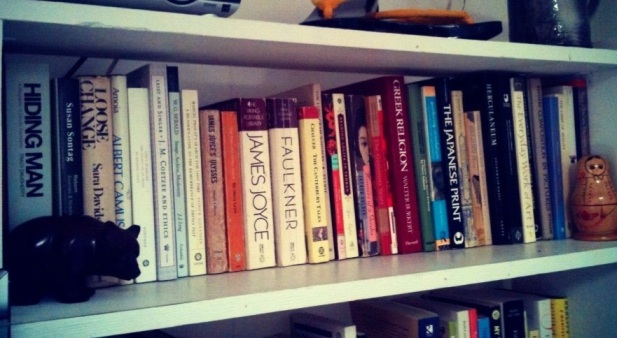
Book shelves series #43, forty-third Sunday of 2012
Kind of a hodgepodge shelf—some literary biography, a few now-redundant collections, some literary criticism, art books, etc.
Tracy Daugherty’s Donald Barthelme biography Hiding Man is on the far left; I reviewed it a few years ago, taking note of my favorite part, the so-called postmodernists’ dinner.
Next to it is Susan Sontag’s Reborn, a collection of early journals that I also reviewed.
Next to these two is Sara Davidson’s Loose Change. My aunt gave me a box of books years ago (lots of Asimov and Octavia Butler) and this was in here.
I knew about it because of a long essay in a 2007 issue of The Believer.

I picked up Penguin’s The Essential James Joyce in Jimbocho, an area in Tokyo known for used bookstores.
I recall paying maybe ¥100 for it. It comprises a few selections from Ulysses and Finnegans Wake, some of Joyce’s (totally unessential) poetry, and the entirety of Dubliners, Exiles, and Portrait. I’ve kept it because of sentiment (and I like the cover).


“Robinson Crusoe” by Franz Kafka:
Had Robinson Crusoe never left the highest, or more correctly the most visible point of his island, from desire for comfort, or timidity, or fear, or ignorance, or longing, he would soon have perished; but since without paying any attention to passing ships and their feeble telescopes he started to explore the whole island and take pleasure in it, he managed to keep himself alive and finally was found after all, by a chain of causality that was, of course, logically inevitable.


We couldn’t endure a life in nature, necessarily always a free nature, without respite, so we always step outside nature, for no reason but survival, and take refuge in our reading, and live for a long time in our books, a more undisturbed life. I’ve lived half my life not in nature but in my books as a nature-substitute, and the one half was made possible only by the other half. Or else we exist in both simultaneously, in nature and in reading-as-nature, in this extreme nervous tension which as a form of consciousness is endurable only for the shortest possible time span. The question can’t be whether I live in nature as nature, or in reading-as-nature, or in nature-as-reading, in the nature of nature-as-reading andsoforth, so Roithamer. To everything that we think and fill our own life and that we hear and see, perceive, we always have to add: the truth, however, is … as a result, uncertainty has become a chronic condition with us. Those abrupt transitions from one nature into the other, from one form of awareness into the other, so Roithamer. When we think, we know nothing, everything is open, nothing, so Roithamer.
From Thomas Bernhard’s novel Correction.


Robert Hutchinson’s Young Henry: The Rise of Henry VIII is new in hardback from Thomas Dunne/Macmillan. Their blurb:
Immortalized as a domineering king, notorious philanderer, and the unlikely benefactor of a new church, Henry VIII became a legend during his own reign. Who, though, was the young royal who would grow up to become England’s most infamous ruler? Robert Hutchinson’s Young Henry examines Henry Tudor’s childhood beginnings and subsequent rise to power in the most intimate retelling of his early life to date.
While Henry’s elder brother Arthur was scrupulously groomed for the crown by their autocratic father, the ten-year-old “spare heir” enjoyed a more carefree childhood, given prestige and power without the looming pressures of the throne. Everything changed for the young prince, though, when his brother died. Henry was nine weeks shy of his eighteenth birthday when he inherited both his brother’s widow and the crown.
As King, Henry preferred magnificence and merriment to his royal responsibilities, sweeping away the musty cobwebs of his father’s court with feasting, dancing, and sport. Frustrated, too, by the seeming inability of his wife, Katherine of Aragon, to produce an heir, Henry turned his attention to a prospective second queen whose name would endure as long as his: Anne Boleyn. With the king still lacking a successor by the age of 35, however, the time for youthful frolic had come to an end.
Divorcing his wife and the Catholic Church, executing his lover and his violent will, Henry charged forward on a scandalous path of terrifying self-indulgence from which there was no turning back. Young Henry is an illuminating portrait of this tyrannical yet groundbreaking king—before he transformed his country, and the face of the monarchy, irrevocably.

 Biblioklept