

Category: Books
“Bachelor’s Ill Luck” — Franz Kafka
Bachelor’s Ill Luck
It seems so dreadful to stay a bachelor, to become an old man struggling to keep one’s dignity while begging for an invitation whenever one wants to spend an evening in company, to lie ill gazing for weeks into an empty room from the corner where one’s bed is, always having to say good night at the front door, never to run up a stairway beside one’s wife, to have only side doors in one’s room leading into other people’s living rooms, having to carry one’s supper home in one’s hand, having to admire other people’s children and not even being allowed to go on saying: ‘I have none myself,’ modeling oneself in appearance and behavior on one or two bachelors remembered from one’s youth.
That’s how it will be, except that in reality, both today and later, one will stand there with a palpable body and a real head, a real forehead, that is, for smiting on with one’s hand.
“Bachelor’s Ill Luck” by Franz Kafka.
In Which I Review the Cloud Atlas Film Trailer
I liked David Mitchell’s novel Cloud Atlas.
I reviewed it here in some detail, but here’s a brief overview:
Mitchell’s Cloud Atlas comprises six sections, each interrupted by the next section (with the exception of the sixth section), and then commenced again in reverse order (a simpler way to think of this might be a schema: 1-2-3-4-5-6-5-4-3-2-1). Sections 1-6 move forward chronologically and, significantly, each section represents a new literary trend. (Again, perhaps a schema with illustrating examples would work better here; for more detail, check out my review: 1: Melville-2: Modernism-3: Airport novel-4: Contemporary novel (Roth?)-5: Dystopian sci-fi (post-Orwell, shades of PKD)-6: Post-apocalyptic (language games, à la Russell Hoban’s Riddley Walker)). In short, Cloud Atlas is an exercise in several genre styles, glommed onto a few ideas cribbed from Nietzsche: eternal recurrence, master/slave relationships, will to power, all that jazz. Ultimately—and more interestingly, I think—Cloud Atlas is an exercise in postmodernism-as-genre, a sort of critique perhaps (intentional or not), brought into even greater relief when one examines Mitchell’s novels Black Swan Green (a coming of age story) and The Thousand Autumns of Jacob de Zoet (a straight-up historical romance), which are, again, genre exercises.
This leads me up to the film adaptation of Cloud Atlas, the long trailer for which dropped today.
I would embed the goddamn trailer, but it’s been blocked on YouTube and other similar sites by Warner Brothers, who apparently have absolutely no idea how publicity works.
You can watch the trailer here.
[Update] Here’s the trailer:
Did you watch it? Okay. I’m gonna riff a little:
I know that trailers have to advertise films to a wide range of potential audience members, and that often leads to overwrought musical cues and lines pulled out of context and big flashing words in all caps, but damn, this is cheeseball stuff. Mitchell’s Cloud Atlas is a subtle book (at times), one that works best when the readers are allowed to do most of the work. The trailer suggests spectacle over nuance, bombast over substance. But again—just a trailer.
Not that the Wachowskis—who are directing and writing and producing (along with Tom Tykwer, whose films Run Lola Run and Perfume I recall enjoying)—-are known for restraint.
And, while I’m bringing up the Wachowskis: They are most famous for their visual inventiveness (these are the guys who did The Matrix), but great looking films don’t necessarily mean much. I mean, the last film they did was Speed Racer (okay, Cloud Atlas looks a lot more restrained than that fiasco, but still, these guys have major problems with storytelling).
Now, based on the trailer, the filmmakers seem to have done some significant rewrites. In Mitchell’s novel, each section (or sections 1-5, at least), exists as a narrative of some kind—fictional narratives, in a few cases. Each protagonist comes to find him or herself echoing or tracing or otherwise repeating or prefiguring the protagonist of another narrative—but there’s always the recognition of the textuality (and hence, metatextuality) to this patterning. Put another way, these are all characters in stories that are awfully familiar to us, and Mitchell strives to make the reader aware of this textuality: it’s a thoroughly postmodern move.
The film seems to connect the characters in two ways: 1, it seems to use actors across separate roles (this could work) and 2, it seems to have characters from previous segments interact with each other across segments. I might be misreading the trailer when it comes to point 2 here, but I think that having characters actively puncture the nested narratives of Cloud Atlas is a bad idea. And, even if I am misreading this, the film clearly imposes a unifying style across the narratives—sure the dystopian sci-fi scenes will have different set dressing, etc., than the Pacific journal narrative scenes—but take note of how all the scenes seem to follow a unified visual sensibility. The joy of Mitchell’s novel is the way he plays with, parodies, adores (etc.) the narrative styles he’s reworking. For example, Half-Lives: The First Luisa Rey Mystery reads like a bad airport mystery (or at least a mediocre one). I was hoping that the filmmakers would attempt to do something similar with the film—actually play with the concept of genre, actually manipulate and amplify the distinct genre conventions at work in Mitchell’s book. Which, maybe they do. Again, I know: it’s just a trailer.
But it’s an awfully slick, shiny trailer.
Okay, perhaps I’m griping too much. All the characters seem to be there, and the casting doesn’t seem terrible. My curiosity is piqued, admittedly, but mostly because I want to know how the filmmakers will handle the nested narratives (also: how long will the movie be?). In any case, I’m sure this will be one of those movies where people sigh and say, “Yeah, the book is way better.”
Anger — Erik Thor Sandberg
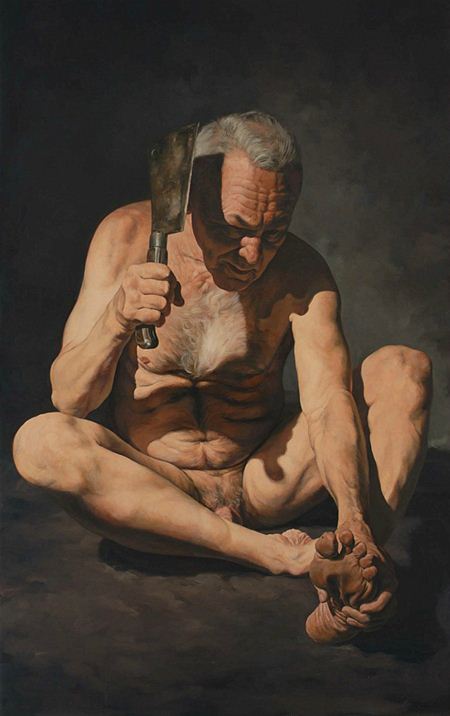
(Via/more).
Privacy/Homesick (Books Acquired, Some Time Last Week, Both Bearing an Eye)
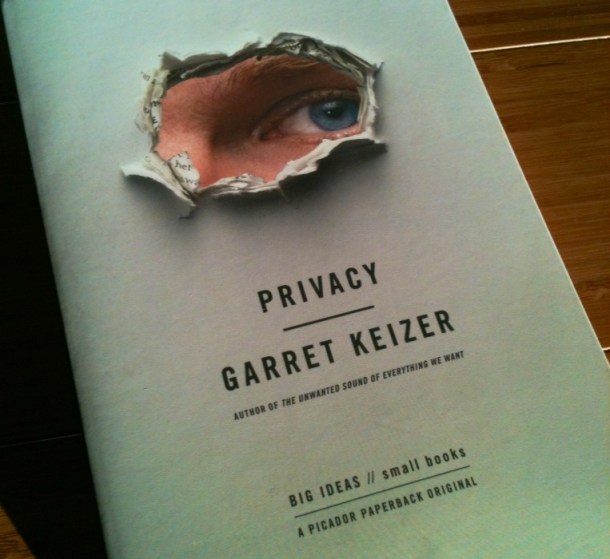
Maybe you saw Garret Keizer on Colbert, or maybe you’ve read his stuff at Harper’s; anyway, his new little book Privacy seems pretty good. I’ve enjoyed all the titles in Picador’s BIG IDEAS // small books so far, and a scan over Privacy suggests another intriguing entry. Full review down the line.
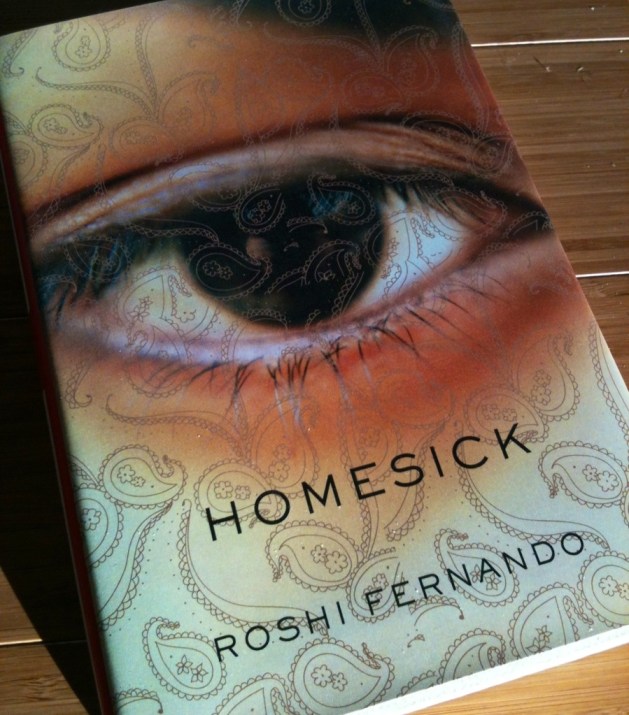
Roshi Fernando’s Homesick came out a few years ago in the UK; it’s now getting the deluxe treatment from Knopf. Their blurb:
In this stunningly assured debut work of fiction, Roshi Fernando weaves together the lives of an extended Sri Lankan family.
At Victor and Nandini’s home in southeast London, the New Year’s Eve celebration is under way. Everyone is gathered around—clinking glasses of arrack and whisky, eating freshly fried poppadoms, listening to baila music—waiting to ring in 1983. Upstairs, The Godfather is playing on repeat for a bedroom filled with teenagers drunk on pilfered wine. And in the middle of it all is sixteen-year-old Preethi, tipsy on youth and friendship and covert cigarettes, desperate to belong.
But what does that mean, to belong? As Preethi moves through her life—befriending the local outcast, revealing her brother’s deepest secret, struggling with her own unhappiness and through a souring marriage—this desire for acceptance remains the one constant, both for her and for everyone she knows.Homesick moves back and forth in time, between London and Sri Lanka, circling the people in Preethi’s world: her brother Rohan; her friends Nil, Clare, Deirdre, and Lolly; her aunty Gertie; and terrible cousin Kumar. Together, they are bound by this shared need to fit in somewhere, this rootless desire for a place to call home.
Gorgeously drawn, told with wit and pathos, this poignant narrative blends love with loss, politics with pop culture, tradition with youthful rebellion. Homesick is rich with insight and a kaleidoscopic view of contemporary immigrant life that introduces us to the work of Roshi Fernando, a remarkable new talent.
I usually sift through these books acquired books before I post, but I haven’t had time to do it thus far with Homesick, so I can’t really comment on the prose. The cover has an eye on it, so it’s here, in this post.
Green Summer — Edward Burne-Jones

“Among the Horses” — Roberto Bolaño
Among the Horses
I dreamed of a woman with no mouth, says the man in bed. I couldn’t help smiling. The piston forces the images up again. Look, he tells her, I know another story that’s just as sad. He’s a writer who lives on the edge of town. He makes a living working a riding school. He’s never asked for much, all he needs is a room and time to read. But one day he meets a girl who lives in another city and he falls in love. They decide to get married. The girl will come to live with him. The first problem arises: finding a place big enough for the two of them. The second problem is where to get the money to pay for it. Then one thing leads to another: a job with a steady income (at the stables he works on commission, plus room, board, and a small monthly stipend), getting his papers in order, registering with social security, etc. But for now, he needs money to get to the city where his fianceé lives. A friend suggests the possibility of writing articles for a magazine. He calculates that the first four would pay for the bus trip there and back and maybe a few days at a cheap hotel. He writes his girlfriend to tell her he’s coming. But he can’t finish a single article. He spends the evenings sitting outdoors at the bar of the riding school where he works, trying to write, but he can’t. Nothing comes out, as they say in common parlance. The man realizes that he’s finished. All he writes are short crime stories. The trip recedes from his future, is lost, and he remains listless, inert, going automatically about his work among the horses.
“Among the Horses” by Roberto Bolaño. Section 11 of his poem-novel Antwerp.
Visit to a Library — Pietro Longhi

“Hot Springs” — F. Scott Fitzgerald
Hot Springs:
In a Spring vacation hotel the rain is bad news indeed. The hundred French windows of the great galleries led the eye out to ink-and-water pines snivelling listlessly on to raw brown tennis courts, to desolate hills against soiled white sky. There was “nothing to do” for hotel and resort were one and the same and no indoor activity was promised on the bulletin board until the concert of the Princeton Glee Club Easter Monday. Women who had come to breakfast in riding clothes rushed to the hairdresser instead; at eleven the tap-k’tap of ping-pong balls was the only sound of life in the enormous half empty hotel.
The girl was one of a pair in white skirts and yellow sweaters who walked down the long gallery after breakfast. Her face reflected the discontent of the weather, reflected darkly and resentfully. Looking at her Deforrest Colman thought: “Bored and fierce,” and then as his eyes continued to follow her, “No, proud and impatient. Not that either, but what a face—vitality and hand cuffs—where’s this getting me—liver and bacon, Damon and Pythias, Laurel and Hardy.
A fragment from F. Scott Fitzgerald’s Notebooks.
A Bookstore — David Burliuk

Thomas Bernhard/Mary Douglas/Clarice Lispector (Books Acquired, 7.19.2012)
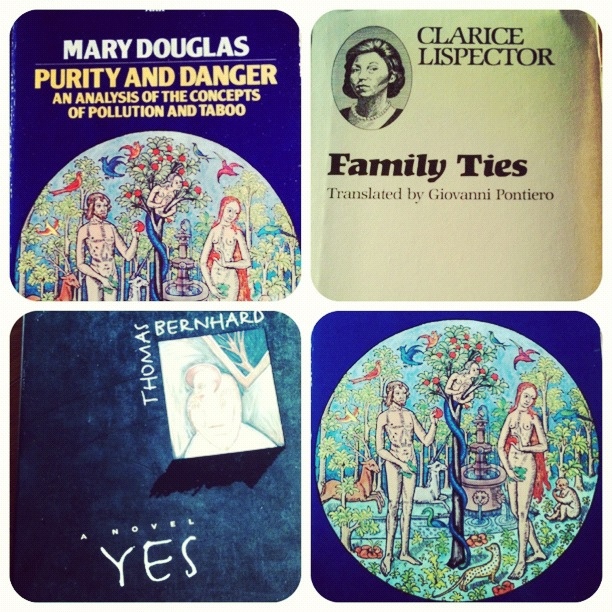
The same God so that he obtained of the Magus was by demons be pulled in pieces — Pieter Bruegel the Elder

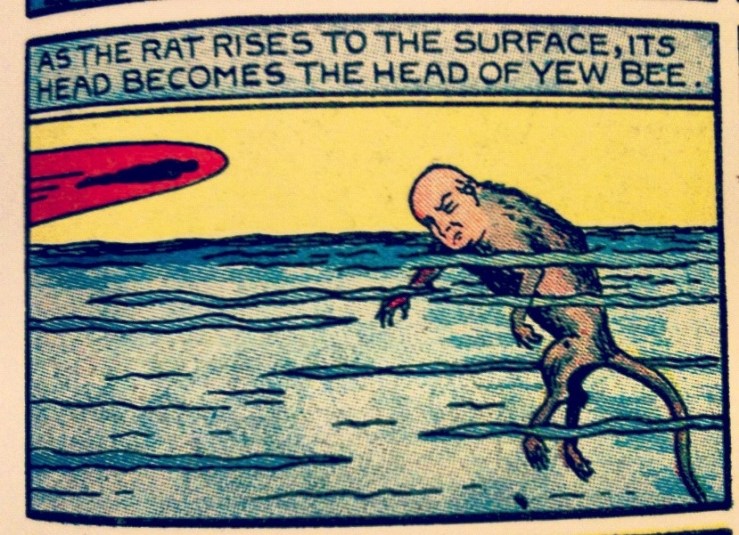
“As the Rat Rises to the Surface, Its Head Becomes the Head of Yew Bee” (Fletcher Hanks)
“A Very Short Story” — Ernest Hemingway
“A Very Short Story” by Ernest Hemingway:
One hot evening in Padua they carried him up onto the roof and he could look out over the top of the town. There were chimney swifts in the sky. After a while it got dark and the searchlights came out. The others went down and took the bottles with them. He and Luz could hear them below on the balcony. Luz sat on the bed. She was cool and fresh in the hot night.
Luz stayed on night duty for three months. They were glad to let her. When they operated on him she prepared him for the operating table; and they had a joke about friend or enema. He went under the anaesthetic holding tight on to himself so he would not blab about anything during the silly, talky time. After he got on crutches he used to take the temperatures so Luz would not have to get up from the bed. There were only a few patients, and they all knew about it. They all liked Luz. As he walked back along the halls he thought of Luz in his bed.
Before he went back to the front they went into the Duomo and prayed. It was dim and quiet, and there were other people praying. They wanted to get married, but there was not enough time for the banns, and neither of them had birth certificates. They felt as though they were married, but they wanted everyone to know about it, and to make it so they could not lose it.
Luz wrote him many letters that he never got until after the armistice. Fifteen came in a bunch to the front and he sorted them by the dates and read them all straight through. They were all about the hospital, and how much she loved him and how it was impossible to get along without him and how terrible it was missing him at night.
After the armistice they agreed he should go home to get a job so they might be married. Luz would not come home until he had a good job and could come to New York to meet her. It was understood he would not drink, and he did not want to see his friends or anyone in the States. Only to get a job and be married. On the train from Padua to Milan they quarreled about her not being willing to come home at once. When they had to say good-bye, in the station at Milan, they kissed good-bye, but were not finished with the quarrel. He felt sick about saying good-bye like that.
He went to America on a boat from Genoa. Luz went back to Pordonone to open a hospital. It was lonely and rainy there, and there was a battalion of arditi quartered in the town. Living in the muddy, rainy town in the winter, the major of the battalion made love to Luz, and she had never known Italians before, and finally wrote to the States that theirs had only been a boy and girl affair. She was sorry, and she knew he would probably not be able to understand, but might some day forgive her, and be grateful to her, and she expected, absolutely unexpectedly, to be married in the spring. She loved him as always, but she realized now it was only a boy and girl love. She hoped he would have a great career, and believed in him absolutely. She knew it was for the best.
The major did not marry her in the spring, or any other time. Luz never got an answer to the letter to Chicago about it. A short time after he contracted gonorrhea from a sales girl in a loop department store while riding in a taxicab through Lincoln Park.
Horse Attacked by Lion — George Stubbs

The Novel Reader — Vincent van Gogh

Slavoj Žižek Riffs on Marxism, The Avengers, Terry Gilliam’s Brazil; Suggests Orwell is Too Optimistic; Admits He Doesn’t Watch Half of the Films He Critiques; Advocates a Canadian Conquest of the U.S.
(Full interview audio here).
 Biblioklept