Read “Scholars of Sodom,” an Excerpt from Roberto Bolaño’s New Book The Secret of Evil

It’s 1972 and I can see V.S. Naipaul strolling through the streets of Buenos Aires. Well, sometimes he’s strolling, but sometimes, when he’s on his way to meetings or keeping appointments, his gait is quick and his eyes take in only what he needs to see in order to reach his destination with a minimum of bother, whether it’s a private dwelling or, more often, a restaurant or a café, since many of those who’ve agreed to meet him have chosen a public place, as if they were intimidated by this peculiar Englishman, or as if they’d been disconcerted by the author of Miguel Street and A House for Mr. Biswas when they met him in the flesh and had thought: Well, I didn’t think it would be like this, or: This isn’t the man I’d imagined, or: Nobody told me.

So there he is, Naipaul, and it seems that all he can notice are outward movements, but in fact he’s noticing inward movements too, although he interprets them in his own way, sometimes arbitrarily, and he’s moving through Buenos Aires in the year 1972 and writing as he moves or perhaps only wanting to write as his legs move through that strange city, and he’s still young, forty years old, but he already has a considerable body of work behind him, a body of work that doesn’t weigh him down or prevent him from moving briskly through Buenos Aires when he has an appointment to keep—the weight of the work, that’s something to which we shall have to return, the weight and the pride that he takes in his work, the weight and the responsibility, which don’t prevent his legs from moving nimbly or his hand from rising to hail a taxi, as he acts in character, like the man he is, a man who keeps his appointments punctually—but he is weighed down by the work when he goes strolling through Buenos Aires without appointments to exercise his British punctuality, without any pressing obligations, just walking along those strange avenues and streets, through that city in the southern hemisphere, so like the cities of the northern hemisphere, and yet nothing like them at all, a hole, a void that someone has suddenly inflated, a show that is strictly for local consumption; that’s when he feels the weight of the work, and it’s tiring to carry that weight as he walks, it exhausts him, it’s irritating and shameful.

Read the rest of the essay at NRYBFrom The Secret of Evil by Roberto Bolaño, translated by Chris Andrews, new from New Directions this month.

“I shall tell you a story about four little rabbits whose names were Flopsy, Mopsy, Cottontail and Peter” — Beatrix Potter Letter

‘Eastwood, Dunfield. Sept 4th ’93
My dear Noel, I don’t know what to write to you, so I shall tell you a story about four little rabbits whose names were – Flopsy, Mopsy, Cottontail and Peter. They lived with their mother in a sand bank under the root of a big fir tree.’

(Via/more).

“Holy Thursday” — William Blake

“Sex Crazed Love Goddesses” — Steve Martin

20120404-185250.jpg

(From Cruel Shoes).

The Opening of the Fifth Seal — El Greco

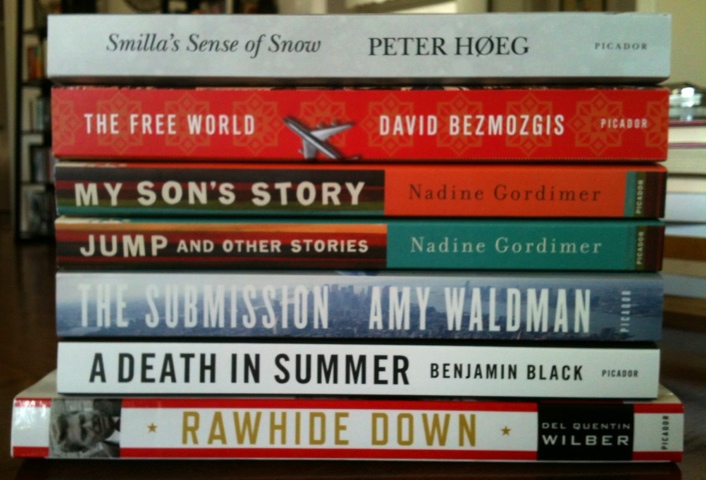
Books Acquired, 3.19.2012 — Or, Here’s What’s New From Picador

20120403-153037.jpg

New and newish titles from the good people at Picador. A few highlights:

20120403-153044.jpg

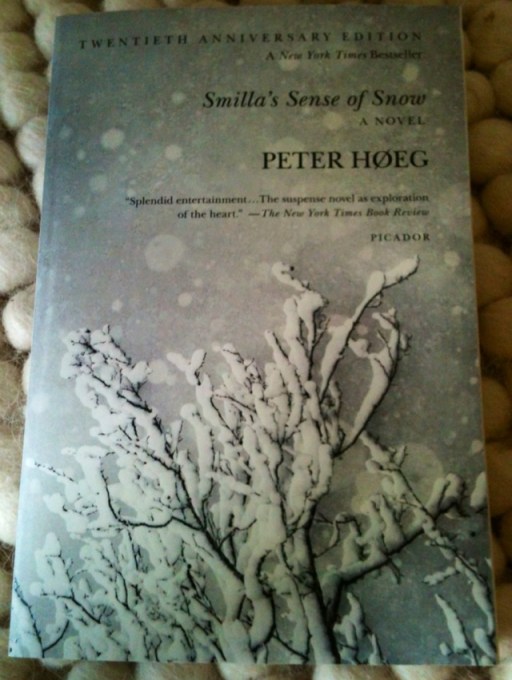
I read Peter Hoeg’s bestseller Smilla’s Sense of Snow over a decade ago; I recall reading it in a day or two, maybe as part of a long bus ride somewhere, and enjoying caustic Smilla’s murder investigation. It’s 20 years old now and getting the rerelease treatment. From Robert Nathan’s original 1993 review at The New York Times:

TRY this for an offer you could easily refuse. How would you like to be locked in a room for a couple of days with an irritable, depressed malcontent who also happens to be imperiously smart, bored and more than a little spoiled? Say no, and you will miss not only a splendid entertainment but also an odd and seductive meditation on the human condition. With “Smilla’s Sense of Snow,” his American debut following two previous books, the Danish novelist Peter Hoeg finds his own uncommon vein in narrative territory worked by writers as varied as Martin Cruz Smith and Graham Greene — the suspense novel as exploration of the heart. Mr. Hoeg’s heroine, Smilla Jaspersen, is the daughter of an Eskimo mother who was a nomadic native of Greenland and a wealthy Danish anesthesiologist father, parentage that endows her with the resilience of the frozen north and urban civilization’s existential malaise. One day just before Christmas, Smilla arrives at her Copenhagen apartment building to find a neighbor boy, 6-year-old Isaiah Christiansen, sprawled face down in the snow, dead after a fall from the roof of a nearby warehouse.

20120403-153052.jpg

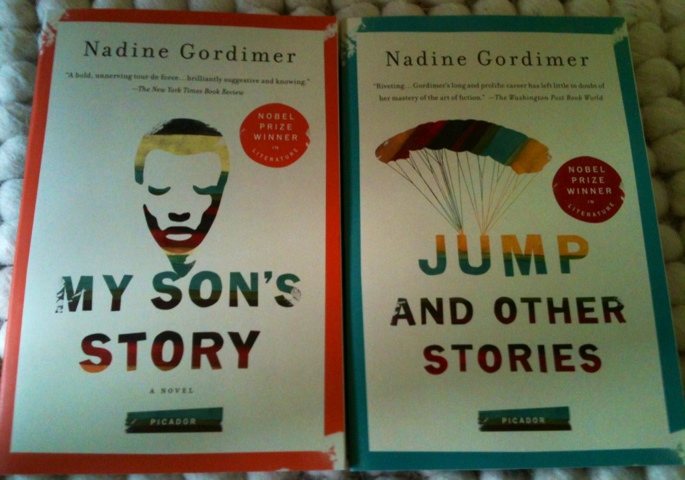
Love love love the covers for these pair by Nadine Gordimer—nice design work. I haven’t read Gordimer’s stuff — she’s a South African writer who won the Nobel in 1991 — so Jump and Other Stories seems like a good starting place. Here’s James Wood on Gordimer:

Gordimer’s talent is poetic and intellectual…Her best writing, sensuous, but aerated with deep intelligence, moving shrewdly between the serene claims of the poetic and the frantic compulsions of the political, makes her the lyrical analyst of an entire country

20120403-153103.jpg

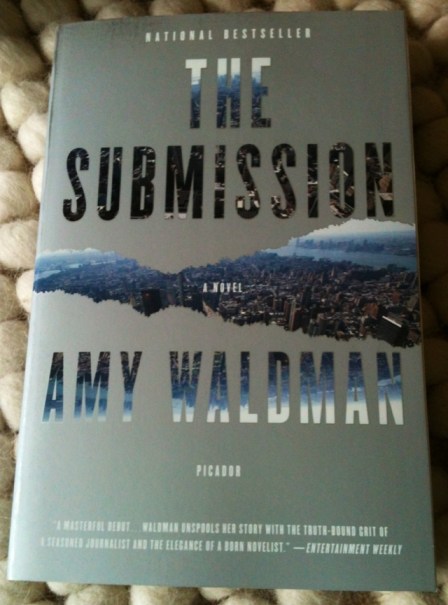
Amy Waldman’s The Submission is a 9/11 novel. Here’s Michiko Kakutani gushing in The New York Times:

A decade after 9/11, Amy Waldman’s nervy and absorbing new novel, “The Submission,” tackles the aftermath of such a terrorist attack head-on. The result reads as if the author had embraced Tom Wolfe’s famous call for a new social realism — for fiction writers to use their reporting skills to depict “this wild, bizarre, unpredictable, Hog-stomping baroque country of ours” — and in doing so, has come up with a story that has more verisimilitude, more political resonance and way more heart than Mr. Wolfe’s own 1987 best seller, “The Bonfire of the Vanities.”

20120403-153120.jpg

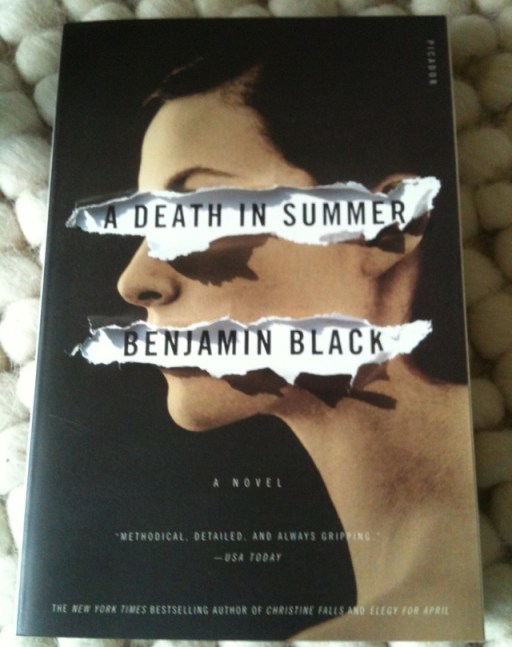
A Death in the Summer is new in trade paperback. It’s another in the Quirke crime series from Benjamin Black — pen name of writer John Banville. Jacket copy:

On a sweltering summer afternoon, newspaper tycoon Richard Jewell—known to his many enemies as Diamond Dick—is discovered with his head blown off by a shotgun blast. But is it suicide or murder? For help with the investigation, Detective Inspector Hackett calls in his old friend Quirke, who has unusual access to Dublin’s elite.

Jewell’s coolly elegant French wife, Françoise, seems less than shocked by her husband’s death. But Dannie, Jewell’s high-strung sister, is devastated, and Quirke is surprised to learn that in her grief she has turned to an unexpected friend: David Sinclair, Quirke’s ambitious assistant in the pathology lab at the Hospital of the Holy Family. Further, Sinclair has been seeing Quirke’s fractious daughter Phoebe, and an unlikely romance is blossoming between the two. As a record heat wave envelops the city and the secret deals underpinning Diamond Dick’s empire begin to be revealed, Quirke and Hackett find themselves caught up in a dark web of intrigue and violence that threatens to end in disaster.

Tightly plotted and gorgeously written, A Death in Summer proves to the brilliant but sometimes reckless Quirke that in a city where old money and the right bloodlines rule, he is by no means safe from mortal danger.

20120403-153135.jpg

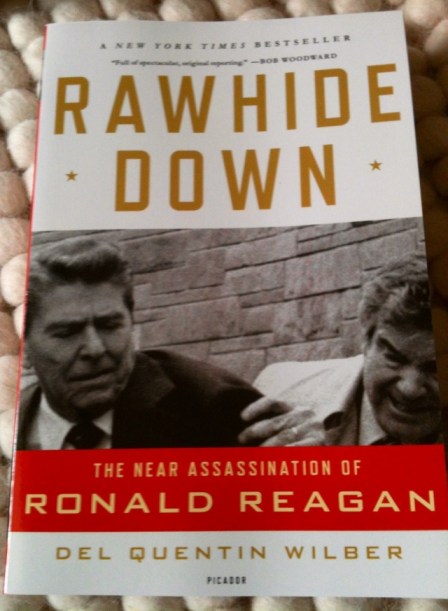
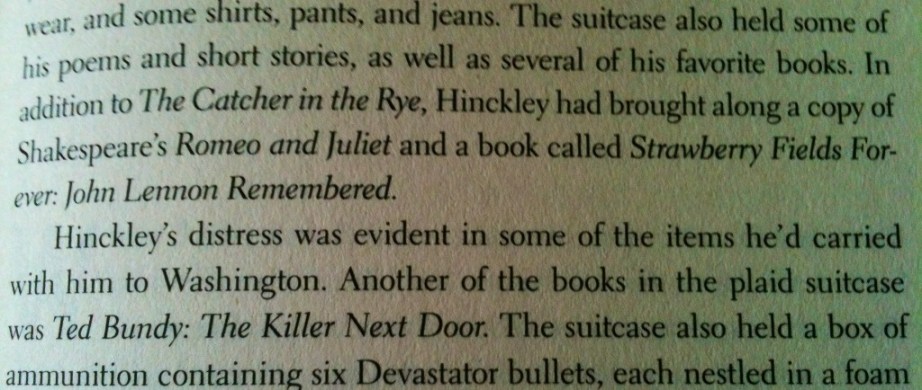
Del Quentin Wilber’s Rawhide Down: The Near Assassination of Ronald Reagan demanded more of my attention than I thought it would. It’s tightly paced book, telegraphed in sharp language—but most of all, the story of John Hinckley is just too bizarre. Here’s a sample of the would

20120403-153153.jpg

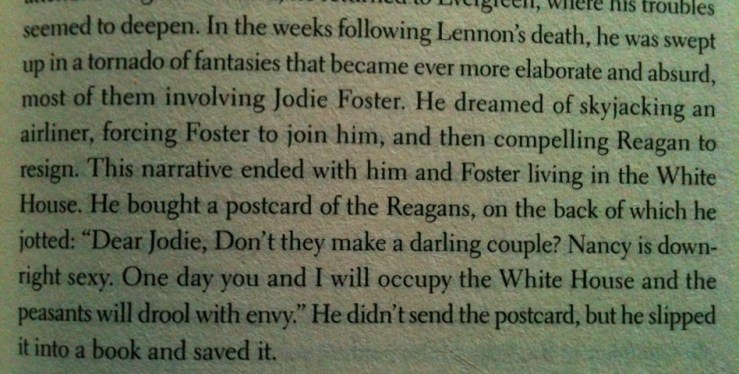
And if that’s not weird enough for you, check out Hinckley’s fantasy life:

20120403-153208.jpg

21 Citations on Pablo Picasso — David Markson

Pablo Picasso, Les Demoiselles d'Avignon, oil on canvas, 1907 (MoMA)

Painting is not done to decorate apartments –PICASSO

People speak of naturalism in opposition to modern painting.
Where and when has anyone ever seen a natural work of art?
Asked Picasso.

Depressed at the apparent lack of interest in one of his early still lifes, Matisse visited his dealer to retrieve it, only to learn that it had been purchased after all.
By Picasso.

The interrelationship of Picasso and Braque during Cubism:
Like being roped together on a mountain, Braque said.

The oddity that Velazquez and Picasso, surely two of the three greatest Spanish-born painters, each used his mother’s name rather than his father’s.

Among the many paintings in her Paris flat, Gertrude Stein had two exceptional Picassos.
If there were a fire, and I could save only one picture, it would be those two. Unquote.

The Bateau-Lavoir, the legendary former Montmartre piano factory broken up into artists’ studios, where Picasso contrived any number of his early masterpieces — while living with no running water and only one communal toilet.

The so-called anarchist artist who in 1988 smeared a large X in his own blood on a wall in the Museum of Modern Art — and in the process splattered an adjacent Picasso.

Picasso. Cézanne. Matisse. Braque. Bonnard. Renoir.
All of whom painted portraits of Ambroise Vollard.

Cartier-Bresson. Brassaï. Man Ray. Lee Miller. Robert Doisneau. Robert Capa. David Douglas Duncan. Cecil Beaton.
All of whom photographed Picasso.

Picasso’s play, Desire Caught by the Tail — which could be performed for the first time only privately, because of the Nazi occupation of Paris.
But avec Camus, Sartre, Michel Leiris, Raymond Queneau, Dora Maar, Pierre Reverdy, Simone de Beauvoir.

There is no such thing as abstract art, said Picasso.
You always have to start somewhere or other.

Gertrude Stein once delighted Picasso by reporting that a collector had been dumbfounded, years afterward, to hear that Picasso had given her her portrait as a gift, rather than asking payment.
Not understanding that that early in Picasso’s career, the difference had been next to negligible.

You never paint the Parthenon; you never paint a Louis XV armchair. You make pictures out of some little house in the Midi, a packet of tobacco, or an old chair.
Said Picasso.

Future generations will regard Bob Dylan with the awe reserved for Blake, Whitman, Picasso and the like.
Said an otherwise seemingly rational writer named Jonathan Lethem.

Picasso, avec laughter, after being asked if he had used models for Les Demoiselles d’Avignon:
Where would I have found them?

Picasso’s admiration for Charlie Chaplin.
Diego Rivera’s.
Stalin’s.

Kees van Dongen’s admission that there were occasions during his own early Montmartre years when he was forced to filch milk and/or bread from neighborhood doorsteps — with an accomplice named Picasso.

Picasso, in Paris during the Nazi occupation and learning that someone had accused him of having Jewish blood:
I wish I had.

A rejection of all that civilization has done.
Said the London Times of a first Post-Impressionist exhibition, in 1910 — which included Cézanne, van Gogh, Gauguin, Matisse, Picasso, others.

My old paintings no longer interest me. I’m much more curious about those I haven’t done yet.
Said Picasso, at seventy-nine.

From David Markson’s The Last Novel

Birdseed Anecdote — F. Scott Fitzgerald

Once there was a whole lot of bird seed around the room because an author had adopted a chicken. It was impossible to explain to anyone just why he had adopted the chicken but still more impossible to know why he had bought the bird seed for the chicken. The chicken was later broiled and the bird seed thrown out, but the question of whether the man was an author or a lunatic was still unsolved in the minds of the hotel servants who had to deal with the situation. The hotel servants didn’t understand it. They didn’t understand how months later the author could write a story about it but they all bought the magazine.

—F. Scott Fitzgerald, The Notebooks

Excursion into Philosophy — Edward Hopper

“My Precious!”

“Little or No Love” — Nietzsche on Good and Bad Books

158. Little or no Love. —Every good book is written for a particular reader and men of his stamp, and for that very reason is looked upon unfavourably by all other readers, by the vast majority. Its reputation accordingly rests on a narrow basis and must be built up by degrees.—The mediocre and bad book is mediocre and bad because it seeks to please, and does please, a great number.

—Friedrich Nietzsche, Human, All Too Human, Part II.

Stuart Kendall’s New Translation of Gilgamesh Restores Poetic Strangeness to an Ancient Epic

Somewhere in his big and often laborious book The Western Canon, Harold Bloom defines canonical literature as that which possesses a “strangeness, a mode of originality that either cannot be assimilated, or that so assimilates us that we cease to see it as strange.” Gilgamesh strikes me as exemplary of that second clause: It’s a foundational epic that has assimilated its readers such that we can no longer easily perceive its strangeness. In many of the prose translations we encounter, Gilgamesh becomes smoothed-out, a document in which we find universal symbols, characters, and themes, all ordered into a narrative scheme that resonates with our conceptualizations of story-telling. And while Gilgamesh and his wild-man companion Enkidu are clearly archetypal figures, the version of their story most of us read in our high school English class is overtly familiar, fitting too-neatly into a literary tradition with Homer, the Bible, and Shakespeare.

Stuart Kendall’s new translation of Gilgamesh reintroduces us to the strangeness of Gilgamesh, juxtaposing the epic’s irreconcilable eruptions against the archetypes it helped to originate. By using language reminiscent of Modernist poets like Ezra Pound and William Carlos Williams, Kendall’s version calls attention to the strange discontinuities of Gilgamesh, even as it paints for us a bold, concrete vision of action. Kendall’s Gilgamesh highlights the psychological dimensions of the epic, situating its heroes’ dramas of consciousness against a physical world that blends into metaphysical spaces.

Here’s a sample of Kendall’s precise language; the scene is from late in the narrative, after the death of Enkidu, as Gilgamesh searches for Utnapishtim—and immortality:

20120331-142406.jpg

The language here forces us to recontextualize, and thus perhaps understand anew, a scene so archetypal as to have become commonplace in even the most banal Hollywood adventure film (that is, the hero seeking admittance to a sacred space). Kendall’s language points to the narrative links between the physical and metaphysical worlds, an unstable opposition that frames the existential crisis at the heart of Gilgamesh.

I interviewed Kendall last month, where he posed the psychological stakes of Gilgamesh more aptly than I am able to:

As a drama of consciousness, then, Gilgamesh is a strange book. It is intensely physical in the sense of describing things in the world, in the same moment as it is highly symbolic. The characters are themselves symbolic and they travel through a symbolic landscape. They are recognizably human, though, and the tale is so moving, I think, because of the drama of consciousness grappling with these different registers of experience. Put a little differently, it is not hard to see that the characters are anything but fixed. They undergo changes large and small and they suffer those changes.

Elsewhere in our interview, Kendall remarks that,

The characters’ moods alternate between dream, denial and delirium through the book. For heroes, they spend a great deal of time in abject fear of the animate cosmos. This is a startling portrait for scientifically minded contemporary readers, confident in a stable view of subjects and objects in the world. Gilgamesh shakes that confidence.

Kendall’s translation highlights the radical instability of human experience, an instability that first-person consciousness often attempts to organize (or otherwise give meaning to) through narrative. As such, Kendall’s translation is often far more ambiguous than many of the textbook versions we might have read. In particular, his ending refuses to specifically point toward redemptive wisdom or reconciliation with death. In this version, Gilgamesh’s quest does not stabilize his identity and square his relationship with mortality; rather, we see strange and discontinuous responses to the (unresolved) problem of death.

Kendall’s translation is an excellent opportunity to rediscover a text many of us assume that we already know and have mastered. His introduction and end notes are enlightening, but it’s the poetry that will surely engage readers’ sustained attention: it’s by turns energetic and mystifying, filled with strange adventure, pathos, and even humor. Recommended.

Gilgamesh is new from Contra Mundum Press. Read my interview with Stuart Kendall.

Book Shelves #14, April 1, 2012

20120401-104052.jpg

Book shelves series #14, fourteenth Sunday of 2012.

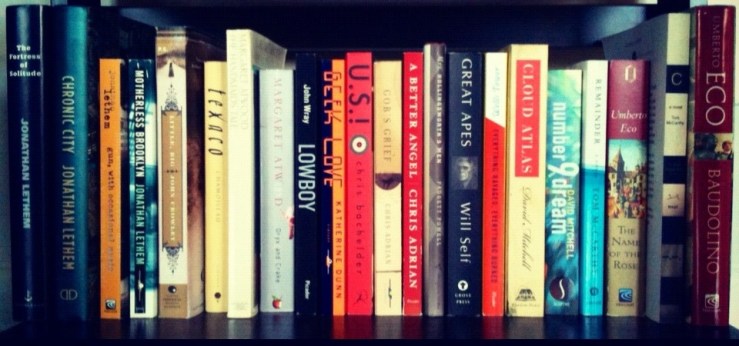
This is a strange shelf: it’s the bottom shelf of the ladder book shelf I’ve been photographing over the past few weeks, and it’s probably the least organized so far. There’s also a higher ratio of unread books on this shelf than in previous shelves. Anyway, left to right:

I was far more enthusiastic about Jonathan Lethem just a few years ago. I still think The Fortress of Solitude and Motherless Brooklyn hold up (they do in my memory, anyway), but Chronic City was awful (then why is it still on my shelf) and You Don’t Love Me Yet is one of the most pointless, silly, and gross books I’ve ever read.

I had good intentions to read John Crowley’s Little, Big and  Patrick Chamoiseau’s Texaco and John Wray’s Lowboy and Katherine Dunn’s Geek Love: I’m actually pretty sure I got all these novels around the same time. They must have been in a stack that eventually got shelved here during a reshelving.

I’ve read at least five or six more Margaret Atwood novels than the ones here, but have no idea where they are (likely a combination of cheap mass markets that I gave to friends or lost).

Chris Bachelder’s U.S.! is an underread gem. Chris Adrian: Again, I was more enthusiastic about his work a few years ago, but I think it holds up. Also, would the person who borrowed my first edition hardback of The Children’s Hospital please return it? Padgett Powell’s slim novel is not bad.

Will Self’s Great Apes holds the distinction of being the ickiest novel I’ve ever read. Horrifying stuff. I bought it at an airport—in Bangkok? LA? Houston? I really can’t remember—I was returning to the US from Thailand and had bought the cheapest possible plane ticket—one that would basically keep me en route for three days, sleeping on planes and in airports. Anyway, Self’s nightmare book is bound up in that experience: it’s a riff on Kafka; dude wakes up to find that he’s become a chimp. It’s just so gross on so many levels. (Maybe I should add that I find seeing chimps dressed as humans to be the acme of perversion).

The Wells Tower collection is gold.

David Mitchell’s Cloud Atlas is gold, but I never got past the first 20 pages of number9dream, which seemed to really bite from William Gibson. I loved both the Tom McCarthy books, particularly C. Eco’s The Name of the Rose is a bit overrated and Baudolino’s first half is not bad, but it just goes on and on and on . . .  but it’s funny.

“How Can I Be Silent?”

20120401-103621.jpg

(From Stuart Kendall’s Gilgamesh)

April Fools: Seven Literary Hoaxes

J.T. LeRoyJames FreyHerman Rosenblat, Margaret Seltzer . . . recent years have seen an explosion of memoirists lying, faking, or otherwise hoaxing the public—but this is hardly anything new. In honor of April Fool’s Day we present seven April Fools.

The Amber Witch — Johannes Wilhelm Meinhold (1844)

Meinhold pretended that The Amber Witch was the true story of a seventeenth-century minister’s daughter falsely accused of witchcraft. Meinhold claimed he found the minister’s manuscript in the refuse of an old church. When the book received critical attention, Meinhold admitted to the hoax, but audiences didn’t believe him at first.

“Geraint the Blue Bard” aka Iolo Morganwg aka Edward Williams (1747-1826)

Welshman Edward Williams was widely considered a leading antiquarian and expert on the antiquities of the British Isles. After his death, however, many of his manuscripts were revealed to have been forgeries, including those produced by “Geraint the Blue Bard,” supposedly a ninth-century composer. Oh well.

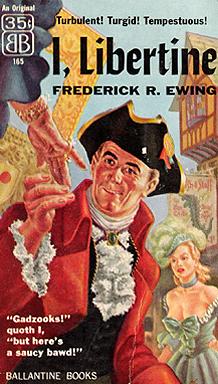
I, Libertine — Frederick R. Ewing  (1956)

Proto-shock jock Jean “Shep” Shepherd perpetrated I, Libertine as a purposeful hoax. He told his radio audience to demand the (non-existent) book by the (non-existent) author “Frederick R. Ewing” from their local booksellers, and even fabricated a basic plot for listeners to in turn relate (he even included the salacious detail that the book had been banned in Boston). Publisher Ballantine hired sci-fi scribe Theodore Sturgeon to write the book from Shepherd’s outline, and the book was published very soon after. All proceeds went to charity.

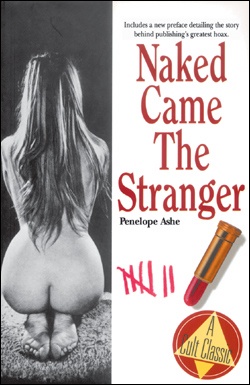
Naked Came the Stranger — Penelope Ashe (1969)

To prove that American culture was smutty and degraded, Newsday columnist Mike McGrady enlisted 24 of his fellow writers to write a smutty and degraded novel that they believed would top the bestseller list in spite of its lack of literary value. By the time “Penelope Ashe” had put out Naked Came the Stranger, the hoax had leaked, and it was unclear if this is what led to the book actually topping the New York Times bestseller list (for one slim week). The book later became the basis of a porno film.

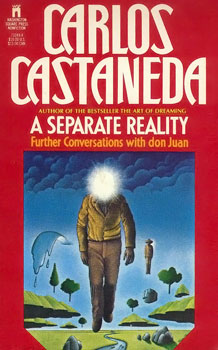
A Separate Reality — Carlos Castaneda (1971)

The debate around Castaneda’s series of “memoirs” in some ways gets to the heart of the problems of truth and invention, facts and authenticity, experience and memory. Castaneda claimed that he trained under Don Juan Matus, a Yaqui Indian sorcerer. Part of that training included taking massive amounts of psychotropic drugs like peyote as a means to “see” the energy of the universe. Don Juan Matus’s actual existence is questionable at best, but hey, when you’re doing large quantities of peyote, who knows what, like, truth is, man.

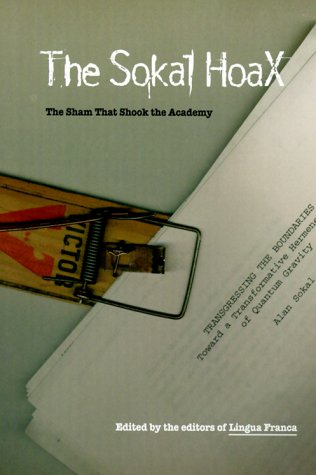
“Transgressing the Boundaries: Towards a Transformative Hermeneutics of Quantum Gravity”– Alan Sokal (1996)

Disgusted with a perceived slackness and ineptitude in modern academia, Dr. Alan Sokal published a paper full of nonsensical gibberish in Duke University’s cultural studies journal Social Text. The same day the essay was published, he announced the hoax in the journal Lingua Franca. Ouch. Biblioklept wrote a post about the incident a few years ago, if you’re interested.

The Songs of Bilitis — Pierre Louÿs (1894)

Louÿs claimed that the erotic poems he fabricated were the work of “Bilitis,” one of Sappho’s lovers; he even invented a biography of the woman, citing a fictional archaeologist named Herr G. Heim with discovering her tomb. (“Herr G. Heim” translates roughly to “Lord S. Ecret”). Despite the hoax, many critics consider it a work of literary merit, and it’s become something of a cult book among queer theory enthusiasts.

[Biblioklept originally published this post in 2010].

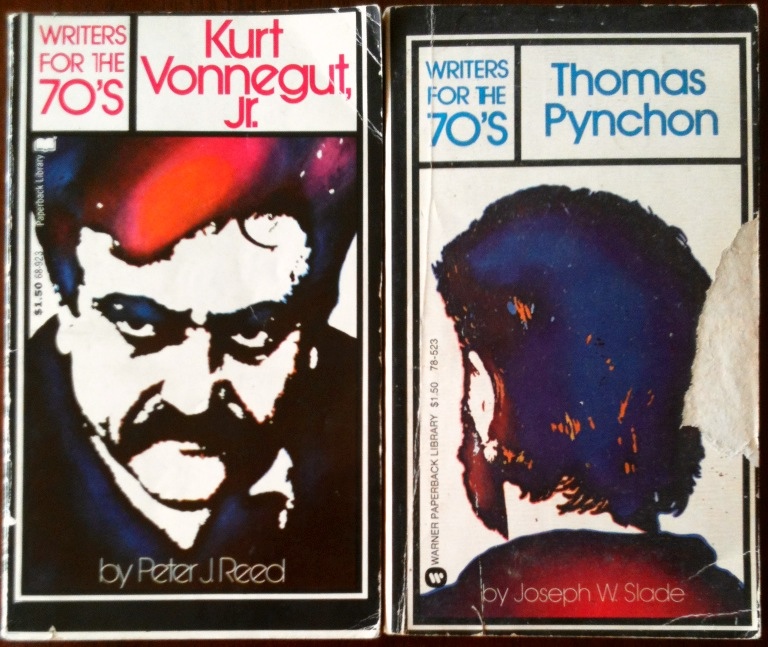
Pynchon/Vonnegut (Books Acquired, 3.28.2012)

20120330-194551.jpg

Saw these in my favorite used book shop and had to have them. Shabby copies of contemporary criticisms (i.e., old criticism) of Pynchon and Vonnegut. Love the covers.


The John Steinbeck Map of America

(Via/about).