War With the Newts — Karel Capek


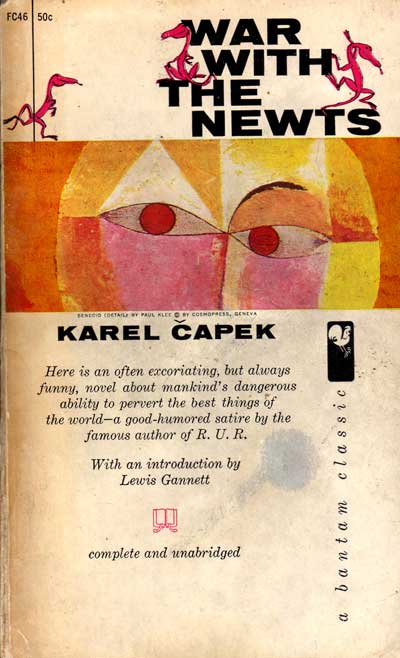
Even though the plot of War with the Newts may not shock audiences accustomed to its “human-invention-intended-for- good-becomes-in-the-end-not-so-good” story, readers shouldn’t neglect this often-overlooked science-fiction classic from 1937 by notable Czech writer and satirist Karel Capek.  Humans, motivated by a range of impulses: greed, curiosity, and sometimes even the best of intentions, have created an uncontrollable menace and brought about the end to their dominion over the planet.  Computers, robots, even monkeys have spelled doom for mankind, but Capek warned, in this short and sparkling book, that while masses of intelligent amphibians must be dealt with cautiously, true danger arises from our manipulation of the natural world, the unceasing capitalist drive to increase production by exploiting the weakest, and our inability to foresee the consequences of our actions.

The action begins when a drunk but benevolent sea captain discovers a new species of amphibians inhabiting the waters near an isolated island in the Pacific Ocean.  These docile creatures are able to breathe on land, walk on their hind legs, and communicate using rudimentary sounds and gestures.  The captain trains them to speak a pidgin English and dive for pearls before arming them so that they might fend off the sharks that prey on their young.  Once he receives generous financial backing from a Dutch conglomerate, he ships them to similar islands where pearl harvests have been been impossible or unproductive.  Eventually big business determines that the tireless and fecund newts are valuable for the expansion and development of economic activities near the coasts and under the seas and develop a global marketplace for trade in their labor and bodies.  Educated, well-equipped, and trained to use with the most advanced technologies, the newts produce the greatest expansion of wealth in the history of the world before taking it all for themselves, returning the continents to the bottom of the ocean while requiring a small cadre of humans, relocated to the mountains, to produce the steel and weapons required to support their new Atlantis.

Written as a history book, Capek brilliantly footnotes his narrative with carefully crafted primary sources: newspaper reports, academic studies, religious tracts, political manifestos and corporate minutes in order to illustrate human reaction to new, unsettling circumstance.  A nimble author blessed with the knowledge and skill to write comfortably about a wide variety of subjects, Capek captures both the progressive and cautious voices that shape human reaction to the slow advancement of a new and underestimated intelligence.  He shows that agreement against economic interest is impossible;  labor, for instance, bemoans loss of work to newt hordes while agriculture comes to rely on the millions of new mouths that have to be fed.  Scholars measure, analyze, and categorize; anonymous tract-writers urge an uneasy populace to take up arms against sea-dwelling usurpers while the young and fashionable flock to newt cults, giving themselves up to sexual licentiousness they relish the mysterious and taboo.

But though Capek capably documents trivialities, most of his accounts reflect the time in which he lived and wrote, between the two great European wars, situated between Stalin’s Russia and Hitler’s new Germany, at the height of colonial exploitation, not yet separated by a century from the horrors of the trans-Atlantic slave trade and the American Civil War.  In a report written by the “Salamander Syndicate,” the organization responsible for the organization and dissemination of the world trade in newts justifies the “humane” husbandry, categorization, and sale of newts according to their physical attributes.  Exemplary newts are invited to join committees and expound on their visions for a future shared with humans.  Echoes of American abolitionist thought appear in the debates waged in the media regarding the existence of newt art and culture, their assumed “soullessness,” and the minimal levels of education required for their lives as workers.

The newts, masters of human technology, eventually take over.  Humans, fleeing to higher ground,  are incapable of bringing the fight to the seas.   War with the Newts is an indictment not only of our ability to take without question unearned economic value, but also of our inability to halt the mechanisms by which we accrue those benefits once it becomes evident that the process of enrichment, by itself, is detrimental to the common good.  This is a very good book, a satire of the institutions that will fail when we need them the most, created by a writer whose demonstrated virtuosity deserves more attention.

“The Stench of Corpses” — William Vollmann Reviews William Vollmann

“The Stench of Corpses” is a self-review by William T. Vollmann of the poorly-received and rarely read book Argall, one of his “Seven Dreams” series (still incomplete). The piece originally ran in the October 7, 2001 edition of The Los Angeles Times, but I read it in Expelled from Eden, a Vollmann reader that I am very much enjoying.  There’s an immediate post-9/11 vibe running through Vollmann’s scathing review of Vollmann, culminating in his declaration that Argall is “positively un-American.”

“The Stench of Corpses”

A hundred years after William T. Vollmann was killed in a gun cleaning accident, I, William the Blind, received a commission to review the long novel “Argall,” which marks the midpoint of his uncompleted “Seven Dreams” series. According to Dombey’s “Easily Digested Biographies of Minor Authors,” which I just happen to have right here inside my reading pod, it was always Vollmann’s hope that the “Seven Dreams,” which were second in ambition only to his still-unpublished essay on violence, “Rising Up and Rising Down,” would “somehow, uh, mean something to people a hundred years from now.”

This desire is best understood as a form of wish compensation. Vollmann lived what can only be called a pathetic life. Isolated within and stubbornly estranged from millennial American society, he consoled himself with a sophomorically romantic belief that art, if protected in time capsules, can outlast Dark Ages. Let’s temporarily ignore the fact that Vollmann’s so-called art was never worth preserving, being infested by individualism, moral relativism and sexual depravity. More to the point, since stars, elephants and gods suffer death, how could even the greatest art be “immortal”? As we all know, the Liu-Mallinger Act of 2027, which made cranial stimulation devices compulsory for all inhabitants of the Global Trans-Industrial Zone, reduced the printed word to irrelevancy at last. Continue reading ““The Stench of Corpses” — William Vollmann Reviews William Vollmann”

The Scriptural Sperm Can No Longer Flow: Sade the Eunuch

The final section of Roland Barthes’ “Life of Sade,” a short biography of The Marquis de Sade. Translated from the French by Richard Miller.  Read the entire essay at Supervert.

22. Any detention is a system: a bitter struggle exists within this system, not to get free of it (this was beyond Sade’s power), but to break through its constraints. A prisoner for some twenty-five years of his life, Sade in prison had two fixations: outdoor exercise and writing, which governors and ministers were continually allowing and taking away from him like a rattle from a baby. The need and the desire for outdoor exercise are easily understood (although Sade always linked its privation to a symbolic theme, obesity). The repression, obviously, as anyone can see, of writing is as good as censoring the book; what is poignant here, however, is that writing is forbidden in its physical form; Sade was denied “any use of pencil, ink, pen, and paper.” Censored are hand, muscle, blood. Castration is circumscribed, the scriptural sperm can no longer flow; detention becomes retention; without exercise, without a pen, Sade becomes bloated, becomes a eunuch.

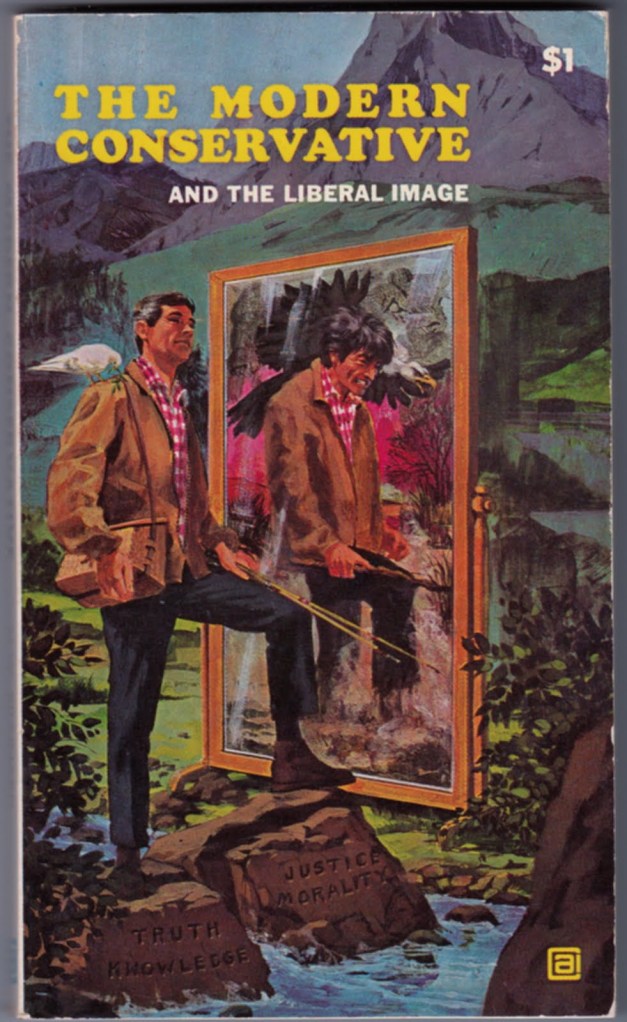
The Modern Conservative and the Liberal Image

This glorious cover from Maurice W. Brainard’s The Modern Conservative and the Liberal Image comes to us via DCB at Menthol Mountains; DCB’s original MM post has plenty of spiffy links, by the by. One of our favorite book covers since Donald (okay, that’s kind of an achronological “since,” but you get the drift, nay?).

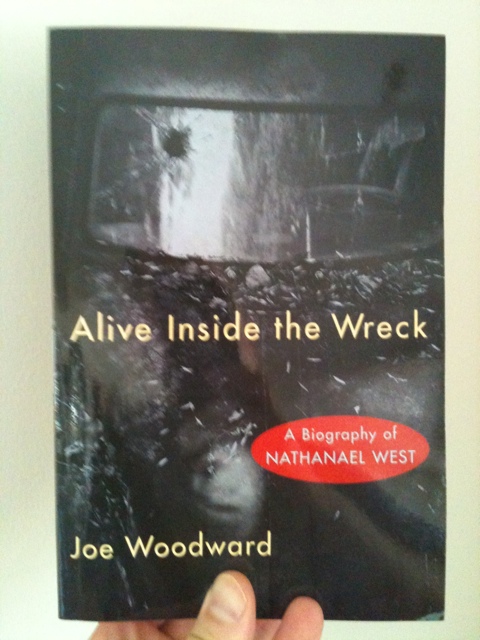
Book Acquired, 9.12.11 — Nathanael West Biography

20110912-050619.jpg

This one’s new from OR BooksJoe Woodward’s Alive Inside the Wreck: A Biography of Nathanael West. (Sorry for the extraordinarily amateurish photograph—the glossy cover spit back much light). I read the first three chapters this afternoon, and Woodward has a punchy, even terse style that I greatly appreciate in a literary biographer. It’s rare that the literary critic, “showing a little plumage,” to borrow a phrase from James Wood, knows when to remove himself from the text under discussion. Woodward’s writing here dispenses with any airy rhetoric, cutting sharply to bone in telegraphic sentences and short chapters.It’s the kind of  beginning that makes me want to keep reading. Here’s the publisher’s description—

From his name to his college transcript to his literary style, Nathanael West was self-invented. Born Nathan Weinstein, the author of the classics Miss Lonelyhearts (1933) and The Day of theLocust (1939) was an uncompromising artist obsessed with writing the perfect novel. He pursued his passion from New York to California, flirting dangerously with the bleak, faux-glamour of Hollywood as the country suffered through the grim realities of the Great Depression. At the center of a circle of vigorous young literary writers that included F. Scott Fitzgerald, Malcolm Cowley, William Carlos Williams, S. J. Perelman, and Dashiell Hammett, West rose to become one of the most original literary talents of the twentieth century—an accomplished yet regrettably underappreciated master of the short lyric novel.

In December of 1940, West — a notoriously bad driver — was racing back from a vacation in Mexico with his young bride of eight months when he crashed at full speed into another car. He was dead at 37. Just as he was finally starting to enjoy financial stability as a Hollywood screenwriter, he died in the California desert.

For this book, the first biography on West alone in over 40 years, Joe Woodward combed the archives at The Huntington Library and the John Hay Library at Brown University. He had access to personal letters, photographs, unpublished manuscripts and corrected typescripts as well as seldom-heard taped interviews with S. J. Perelman, Dalton Trumbo, Matthew Josephson and others.

Alive Inside the Wreck comes alive as it explores West’s struggle to survive both the writer’s life and the 1930s.


Old Man Sade, Seducer and Corrupter of the Young

From Roland Barthes’ “Life of Sade,” a short biography of The Marquis de Sade. Translated from the French by Richard Miller.  Read the entire essay at Supervert.

21. Corridor Philosophy: Imprisoned at Sainte-Pélagie (at sixty-three years of age), Sade, we are told, used “every means his imagination could suggest… to seduce and corrupt the young people (to slake his lubricity with young fools) who were imprisoned in Sainte-Pélagie owing to unfortunate circumstances and put by chance in the same corridor as himself.”

Candide — Voltaire

I liked pretty much all of the assigned reading in high school (okay, I hated every page of Tess of the D’Ubervilles). Some of the books I left behind, metaphorically at least (Lord of the Flies, The Catcher in the Rye), and some books bewildered me, but I returned to them later, perhaps better equipped (Billy Budd; Leaves of Grass). No book stuck with me quite as much as Candide, Voltaire’s scathing satire of the Enlightenment.

20110911-025457.jpg

I remember being unenthusiastic when my 10th grade English teacher assigned the book—it was the cover, I suppose (I stole the book and still have it), but the novel quickly absorbed all of my attention. I devoured it. It was (is) surreal and harsh and violent and funny, a prolonged attack on all of the bullshit that my 15 year old self seemed to perceive everywhere: baseless optimism, can-do spirit, and the guiding thesis that “all is for the best.” The novel gelled immediately with the Kurt Vonnegut books I was gobbling up, seemed to antecede the Beat lit I was flirting with. And while the tone of the book certainly held my attention, its structure, pacing, and plot enthralled me. I’d never read a book so willing to kill off major characters (repeatedly), to upset and displace its characters, to shift their fortunes so erratically and drastically. Not only did Voltaire repeatedly shake up the fortunes of Candide and his not-so-merry band—Pangloss, the ignorant philosopher; Cunegonde, Candide’s love interest and raison d’etre and her maid the Old Woman; Candide’s valet Cacambo; Martin, his cynical adviser—but the author seemed to play by Marvel Comics rules, bringing dead characters back to life willy nilly. While most of the novels I had been reading (both on my own and those assigned) relied on plot arcs, grand themes, and character development, Candide was (is) a bizarre series of one-damn-thing-happening-after-another. Each chapter was its own little saga, an adventure writ in miniature, with attendant rises and falls. I loved it.

I reread Candide this weekend for no real reason in particular. I’ve read it a few times since high school, but it was never assigned again—not in college, not in grad school—which may or may not be a shame. I don’t know. In any case, the book still rings my bell; indeed, for me it’s the gold standard of picaresque novels, a genre I’ve come to dearly love. Perhaps I reread it with the bad taste of John Barth’s The Sot-Weed Factor still in my mouth. As I worked my way through that bloated mess, I just kept thinking, “Okay, Voltaire did it 200 years earlier, much better and much shorter.”

Revisiting Candide for the first time in years, I find that the book is richer, meaner, and far more violent than I’d realized. Even as a callow youth, I couldn’t miss Voltaire’s attack on the Age of Reason, sustained over a slim 120 pages or so. Through the lens of more experience (both life and reading), I see that Voltaire’s project in Candide is not just to satirize the Enlightenment’s ideals of rationality and the promise of progress, but also to actively destabilize those ideals through the structure of the narrative itself. Voltaire offers us a genuine adventure narrative and punctures it repeatedly, allowing only the barest slivers of heroism—and those only come from his innocent (i.e. ignorant) title character. Candide is topsy-turvy, steeped in both irony and violence.

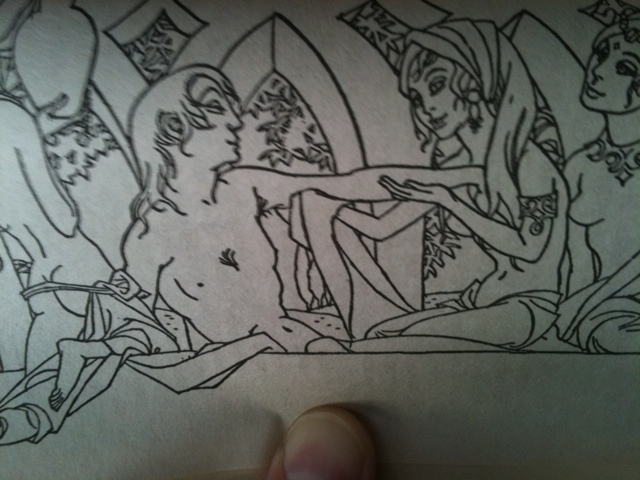
As a youth, the more surreal aspects of the violence appealed to me. (An auto-da-fé! Man on monkey murder! Earthquakes! Piracy! Cannibalizing buttocks!). The sexy illustrations in the edition I stole from my school helped intrigue me as well—

20110911-025719.jpg

The self who read the book this weekend still loves a narrative steeped in violence—I can’t help it—Blood Meridian, 2666, the Marquis de Sade, Denis Johnson, etc.—but I realize now that, despite its occasional cartoonish distortions, Candide is achingly aware of the wars of Europe and the genocide underway in the New World. Voltaire by turns attacks rape and slavery, serfdom and warfare, always with a curdling contempt for the powers that be.

But perhaps I’ve gone too long though without quoting from this marvelous book, so here’s a passage from the last chapter that perhaps gives summary to Candide and his troupe’s rambling adventures: by way of context (and, honestly spoiling nothing), Candide and his friends find themselves eking out a living in boredom (although not despair) and finding war still raging around them (no shortage of heads on spikes); Candide’s Cunegonde is no longer fair but “growing uglier everyday” (and shrewish to boot!), Pangloss no longer believes that “it is the best of all worlds” they live in, yet he still preaches this philosophy, Martin finds little solace in the confirmation of his cynicism and misanthropy, and the Old Woman is withering away to death. The group finds their only entertainment comes from disputing abstract questions—

But when they were not arguing, their boredom became so oppressive that one day the old woman was driven to say, “I’d like to know which is worse: to be raped a hundred times by Negro pirates, to have one buttock cut off, to run the guantlet in the Bulgar army, to be whipped and hanged in an auto-da-fé, to be dissected, to be a galley slave—in short, to suffer all the miseries we’ve all gone through—or stay here and do nothing.

“That’s a hard question,” said Candide.

It’s amazing that over 200 years ago Voltaire posits boredom as an existential dilemma equal to violence; indeed, as its opposite. (I should stop and give credit here to Lowell Blair’s marvelous translation, which sheds much of the finicky verbiage you might find in other editions in favor of a dry, snappy deadpan, characterized in Candide’s rejoinder above). The book’s longevity might easily be attributed to its prescience, for Voltaire’s uncanny ability to swiftly and expertly assassinate all the rhetorical and philosophical veils by which civilization hides its inclinations to predation and straight up evil. But it’s more than that. Pointing out that humanity is ugly and nasty and hypocritical is perhaps easy enough, but few writers can do this in a way that is as entertaining as what we find in Candide. Beyond that entertainment factor, Candide earns its famous conclusion: “We must cultivate our garden,” young (or not so young now) Candide avers, a simple, declarative statement, one that points to the book’s grand thesis: we must work to overcome poverty, ignorance, and, yes, boredom. I’m sure, gentle, well-read reader, that you’ve read Candide before, but I’d humbly suggest to read it again.

Citizen Sade

From Roland Barthes’ “Life of Sade,” a short biography of The Marquis de Sade. Translated from the French by Richard Miller.  Read the entire essay at Supervert.

20. A plurality of which Sade was well aware, since he laughs at it: in 1793, Citizen Sade was proposed as a juror in a common-law case (a matter of forged promissory notes): the dual hearing of the Sadian text (of which Sade’s life is a part): the apologist of crime and its judge are united in the same subject, as the Saussurian anagram is inscribed in a Vedic verse (but what remains of a subject that subjects itself with alacrity to a dual inscription?).

Books Acquired, 9.10.11

20110910-040358.jpg

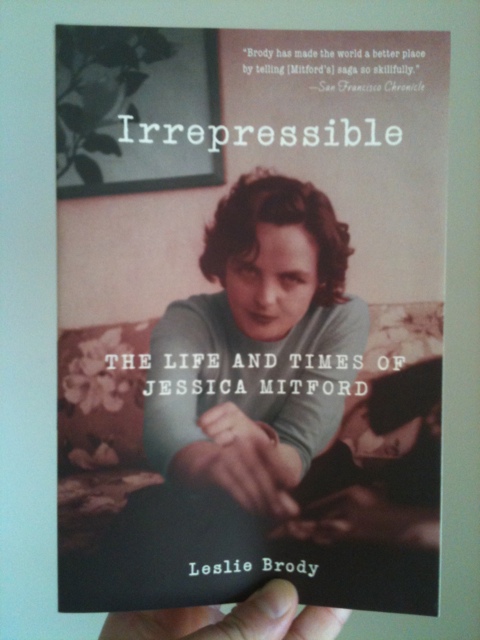
Two books in the mail today from Counterpoint Press, an expanding indie press with a broad but sharp catalog (including Soft Skull Press). The first is Irrepressible: The Life and Times of Jessica Mitford, a biography of the progressive upstart. From the press release—

Admirers and detractors use the same words to describe Jessica Mitford: subversive, mischief-maker, muckraker. J.K. Rowling calls Mitford her “most influential writer.” Those who knew her best simply called her “Decca.” Born into one of Britain’s most famous aristocratic families, Mitford eloped with Winston Churchill’s nephew to America as a teenager in 1939. A no-holds barred civil rights activist, outspoken communist, and feared journalist, Mitford rose to one of the New Deal’s most notorious bureaucrats. For her the personal was political. She coined the term “frenemies,”  and as a member of the American Communist Party, she made several, though not among the Cold War witch hunters. When she left the Communist Party in 1958 after fifteen years, she promised to be subversive whenever the opportunity arose. True to her word, late in life she hit her stride as a writer, publishing nine books before her death in 1996. With unrestricted access to the Mitford Family archives, Leslie Brody presents a moving, impeccably researched biography of one of the most influential women of the 20th century.

20110910-040407.jpg

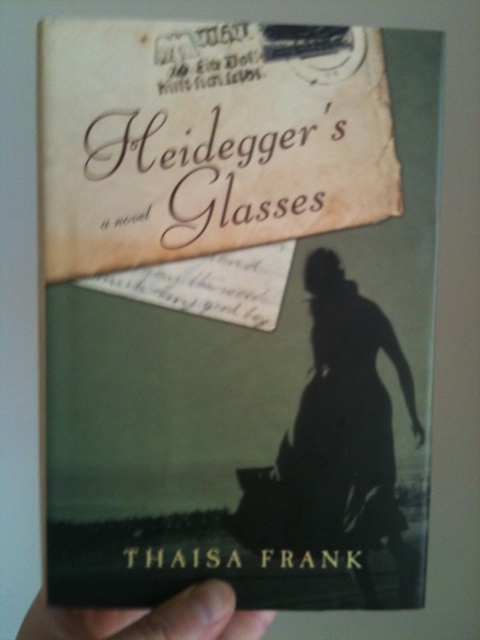
Heidegger’s Glasses is a novel by Thaisa Frank that seems promising. Description—

Magical and surreal, Heidegger’s Glasses offers a completely original vantage point on the Holocaust.  The story opens during the end of World War II in a failing Germany coming apart at the seams. The Third Reich’s strong reliance on the occult and the leading officials’ obsession with the astral plane has led to the formation of a secret Compound of Scribes–multilingual translators that have been spared from deportation to answer returned letters written to the dead in the concentration camps. Ellie Schacten, the mysterious heroine of the novel, supervises the Scribes, yet secretly uses the compound to hide a steadily growing number of refugees. When a letter arrives, written by eminent German philosopher Martin Heidegger to his friend and optometrist––a man who is now lost in the dying thralls of Auschwitz––a series of events unfold that turn the Reich’s attention to the compound and threaten Ellie’s operation and the lives of the Scribes.

Based on the real Third Reich procedure, Operation Mail, which forced concentration camp prisoners to send letters to loved ones extolling conditions in the camps, Heidegger’s Glasses explores a dark, absurd world in which fear and death are a constant companion, and yet, Frank’s characters show how that when stripped of their freedom and virtually all material possessions, the human spirit perseveres and thrives.

Sade’s Passion Was Theatrical, Not Erotic

From Roland Barthes’ “Life of Sade,” a short biography of The Marquis de Sade. Translated from the French by Richard Miller.  Read the entire essay at Supervert.

19. Throughout his life, the Marquis de Sade’s passion was not erotic (eroticism is very different from passion); it was theatrical: youthful liaisons with several young ladies of the Opéra, engaging the actor Bourdais to play for six months at La Coste, and in his torment, one idea: to have his plays performed; barely out of prison (1790), repeated requests to the actors of the Comédie Française; and finally, of course, theater at Charenton.

Sade Loved His Big Pillow

From Roland Barthes’ “Life of Sade,” a short biography of The Marquis de Sade. Translated from the French by Richard Miller.  Read the entire essay at Supervert.

18. Suddenly transferred from Vincennes to the Bastille, Sade made a great fuss because he had not been allowed to bring his big pillow, without which he was unable to sleep, since he slept with his head unusually high: “The barbarians!”.

It Is the Point One Is at that Makes a Thing Good or Bad, and Not the Thing Itself

From Roland Barthes’ “Life of Sade,” a short biography of The Marquis de Sade. Translated from the French by Richard Miller.  Read the entire essay at Supervert.

17. At Vincennes in 1783, the penitentiary administration forbade the prisoner’s receiving Rousseau’sConfessions. Sade comments: “They honor me in thinking that a deist author could be a bad book for me; I wish I were at that point… Understand, it is the point one is at that makes a thing good or bad, and not the thing itself… Start there, dear sirs, and by sending me the book I request, be sensible enough to understand that for died-in-the-wool bigots like yourselves, Rousseau can be a dangerous author, and that makes it an excellent book for me. For me, JeanJacques is what the Imitation of Christ is for you…” Censorship is abhorrent on two levels: because it is repressive, because it is stupid; so that we always have the contradictory urge to combat it and to teach it a lesson.

Book Acquired, 9.09.11 — Or, I Buy Yet Another William T. Vollmann Book Against My Better Judgment

20110909-044233.jpg

I like William T. Vollmann the persona probably more than I like William T. Vollmann the writer. That isn’t to say that I haven’t thought that the handful of books I’ve read by him were brilliant, strange, and engrossing—because they are—but I’ll admit that his methods, his back story, his sheer and absolute not-giving-a-fuckness is a major attraction. Voluminous Vollmann, unreadable Vollmann; smartypants Vollmann, fragile Vollmann. Vollmann, producer of travelogues, alternate histories, hagiographies for hookers; Vollmann, Ice Age chronicler; saga-slinging Vollmann. I can’t think of a writer who does more and says more and, because of his maximalist approach, will be largely unread, both for his career and for posterity—unless he concedes to edit. I think the irony is that, in wanting to give everything to his reader and wanting to preserve everything about his subjects—an act of love, compassion, empathy, what have you—in these grand, hopeless gestures, Vollmann paradoxically displays that intrinsic not-giving-a-fuckness. He needs an editor.

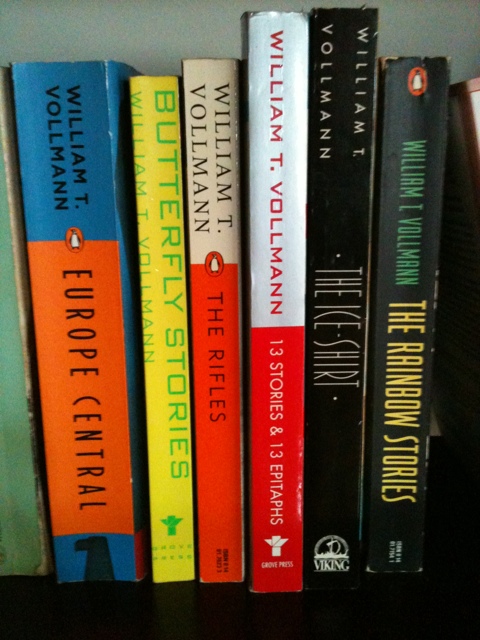
So, this afternoon, browsing at my favorite bookshop, a labyrinthine twisty thing, I ambled innocently past the ‘V’s of General Fiction, looking for a novel by Karel Capek in the sci-fi section, which abuts said ‘V’ aisle. Again, this was all innocence. I had no intention of picking up anything by Vollmann, despite the huge stack of his works there, used testaments to the futility of trying to read Vollmann perhaps—at least a dozen souls who said “fuck it” to Europe Central. Here are the Vollmann volumes (volmumes?) I possess—

20110909-044243.jpg

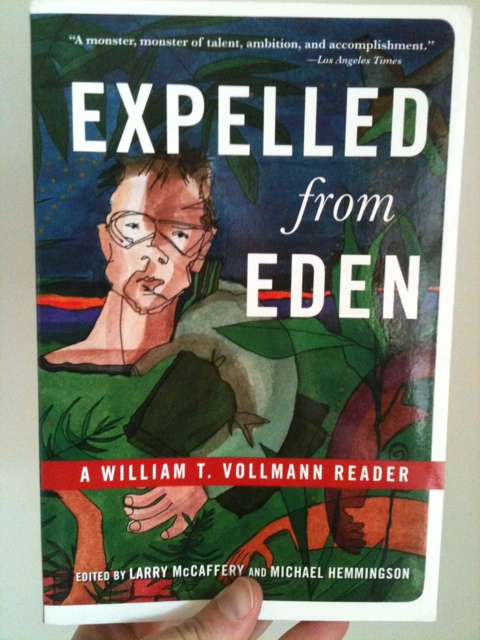
I’ve read Butterfly Stories, The Rifles, and The Ice-Shirt; I’ve read most of 13 Stories & 13 Epitaphs. I’ve read bits of The Rainbow Stories and mostly nothing of Europe Central, which migrated out of the “to read” stack a few years ago. So, yeah, I wasn’t looking for another Vollmann. But I’m too frequent a visitor at this particular labyrinthy, somewhat famous North Florida bookshop, so I noticed a “new” Vollmann in the stack, Expelled from Eden. And I started thumbing through it. Against my better judgment. 20 minutes later I was brainstorming reasons not to pick it up, but honestly, the credit in book trade I have with the store nails most economic arguments, and really, I’m thinking this is exactly what I wanted someone to do with Vollmann: edit that shit.

Larry McCaffrey and Michael Hemmingson have excised, chopped, moved around, and pulled from all over Vollmann’s massive world, putting together a book organized around Vollmann’s grand themes—travel writing; war; violence; prostitution; literature. There are lists, drawings, photographs. There is biography. I came home and read for an hour. I’m sure I’ll be sharing some citations down the road.

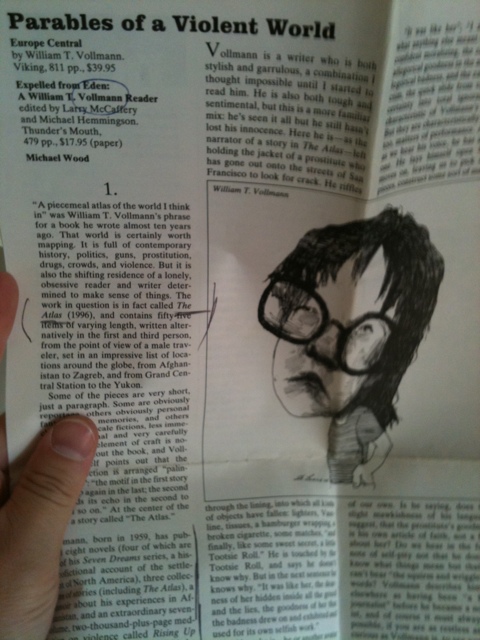
As a sort of bonus—and I always love to pick up a book where something is neatly tucked away—is an entire 2005 feature from The New York Review on Vollmann, focusing on Expelled from Eden and Europe Central.

20110909-044253.jpg

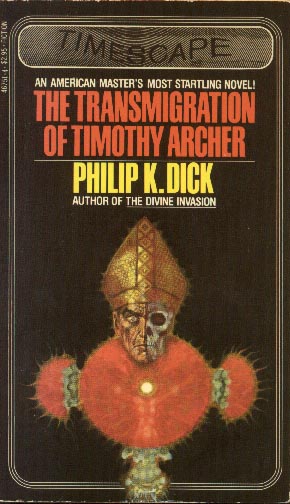
The Transmigration of Timothy Archer — Philip K. Dick

Suffering is the core of The Transmigration of Timothy Archer, a novel published just months after Philip Dick’s death in 1982. This is a book written by an author sure of his abilities, one who could confidently make this novel about big ideas turn on his characters’ struggles to control the trivialities of their day to day lives. While they attempt to make sense of the nature of God and unravel the mysteries of Christian teaching, they confront the questions that must have puzzled even Jesus’ own early advocates: is joy possible when good people are randomly confronted with confusion, pain, and death?  Dick tries to locate a mushy but viable middle ground in this sad, nimble, and touching novel.  Opening on the date of John Lennon’s assassination, Dick writes to commemorate the grinders, the survivors who manage to keep waking up, day after day, despite knowing that life often destroys those who dream too large.

The book is ostensibly based on the life and times of Timothy Archer, the iconoclastic American Episcopalian bishop of California in the 1960s whose unending search for truth led to his becoming friends with Robert Kennedy and Martin Luther King, Jr., advocating for the rights of women, homosexuals, and the transgendered, and time in the national spotlight.  The quest for knowledge led him also to adopt a number of intellectual positions that conflicted directly with his duties as a representative of the Episcopalian church — for example, he was brought to trial for heresy for openly questioning the existence of hell and the Holy Ghost.  The character of Bishop Archer was based almost entirely on the life of Bishop James Pike, Dick’s friend, who, like his fictional counterpart, died of exposure in Israel’s Dead Sea Desert searching for the sources of early Christian doctrine.  Bishop Archer is the bright flame in this book, the Gatsby who pulls in everyone he encounters — not because he’s influential and wealthy, but because his personality is that rare combination of knowledge and empathy, a true man of God who recognizes no difference between the important writer and the indigent cancer patient.  The actions of Bishop Archer form the arc of the book, and his deeds are a mirror to the other characters.  They struggle to shape their own individual visions for their lives because they must work in the shadow cast by a giant they love.

Angel Archer, the bishop’s daughter-in-law and the narrator of the novel, becomes one of Dick’s most realistically drawn characters.  She’s tough, articulate, and well-read.  While those around her succumb to suicidal impulses and mental illness she survives by searching her mind for poems and plays she’s read and committed to memory.  She finds uncomfortable parallels between books and her life.  She values her education and her self-identification as a “Berkeley intellectual” but makes light of her own pretension, telling us that she’s read all the long books but remembers nothing about them.  Do we become apathetic to our own experiences if we’ve read previously about something similar?  Angel fears ennui but describes her own artistic awakening as a ridiculous mixture of pleasure and pain — an agonizing night spent reading Dante’s Commedia while drinking a bottle of bourbon to dampen the pain of an abscessed tooth.  Aware that intellectual exercises and games both trivial and consequential have led to the deaths of her husband, the bishop, and his mistress, she still can’t escape her own self-made prison of words.  “The problem with introspection,” she states while contemplating her own death, “is that it has no end.”  When nobody is left, she soldiers on, dedicating herself, a fragile shell, to driving and working and walking and talking, a person “who records on a notepad the names of those who die.”

Like the narrator, this book reveals its depth rapidly, in spurts of astounding erudition and scholarship.  Dick writes masterfully about nuances of early Judaic law and the formation of Christian thought, illustrates the petty jealousy, kindness, and warmth that seems inherent to certain friendships between between intelligent, rival women, and indicts our perception and treatment of mental illness.  He quotes John Donne, Henry Vaughn, and discusses Virgil and Goethe without arrogance and without disturbing the flow of his story.  Like his best works — A Scanner Darkly, The Man in the High Castle, and Do Androids Dream of Electric Sheep?  — The Transmigration of Timothy Archer is fully drawn and completely real.  His best works seem to be filled with screwed up people trying to get by in a world that has been arbitrarily fucked up by war or technology or drug abuse.  This one is distinctly alive not because it’s set in an alternative world, but in sunny California that existed just three decades ago, close to the environs we currently abide.  A beautiful, moving coda from a man whose vision and prose changed and continues to challenge American writers.