
Category: Books
Three Books
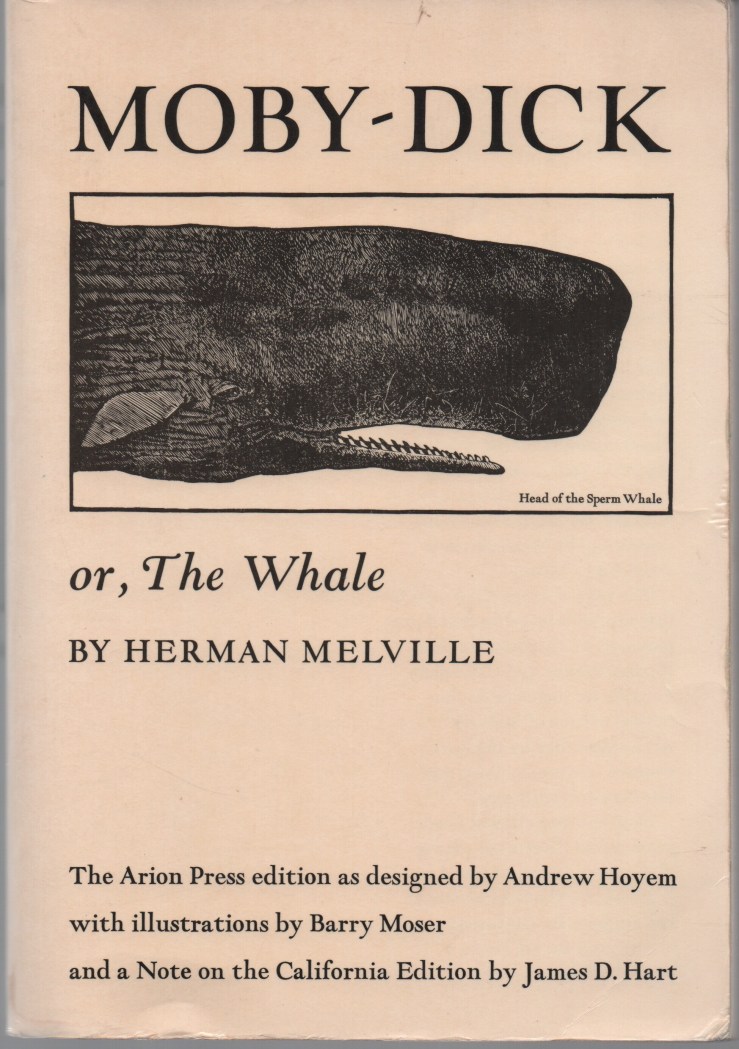
Moby-Dick by Herman Melville. First edition trade paperback by The University of California Press, based on the 1979 Arion Press edition. Cover illustration by Barry Moser. I have too many copies of Moby-Dick.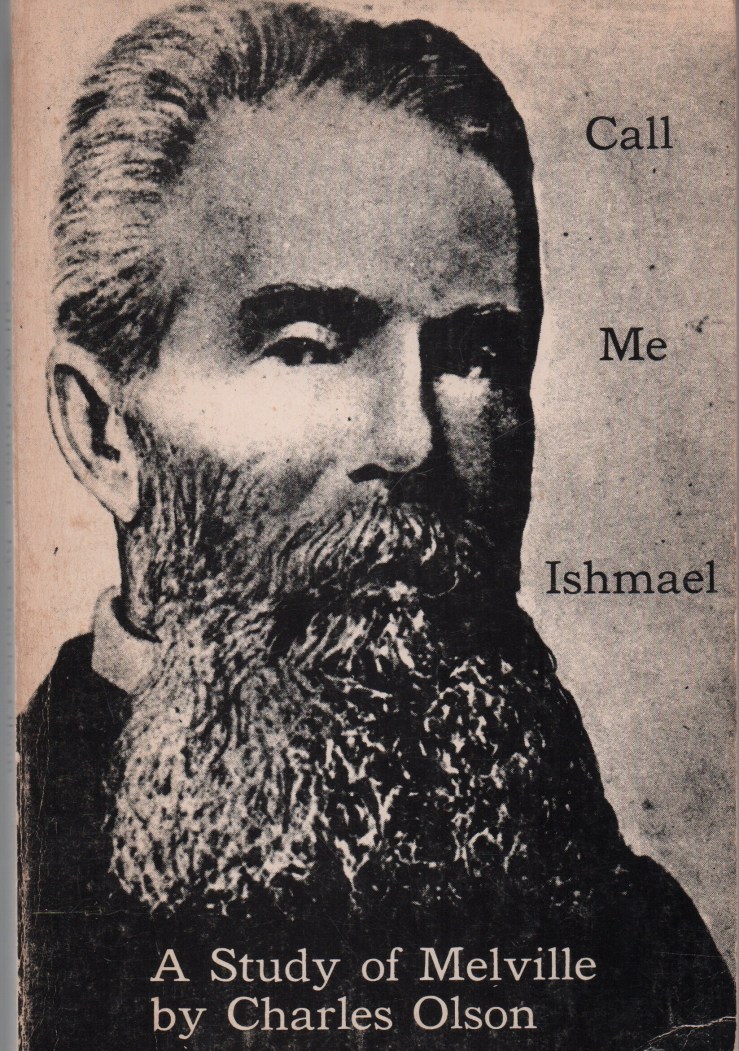
Call Me Ishmael by Charles Olson. 1971 trade paperback by City Lights Books. No designer credited. Call Me Ishmael is a perfect book.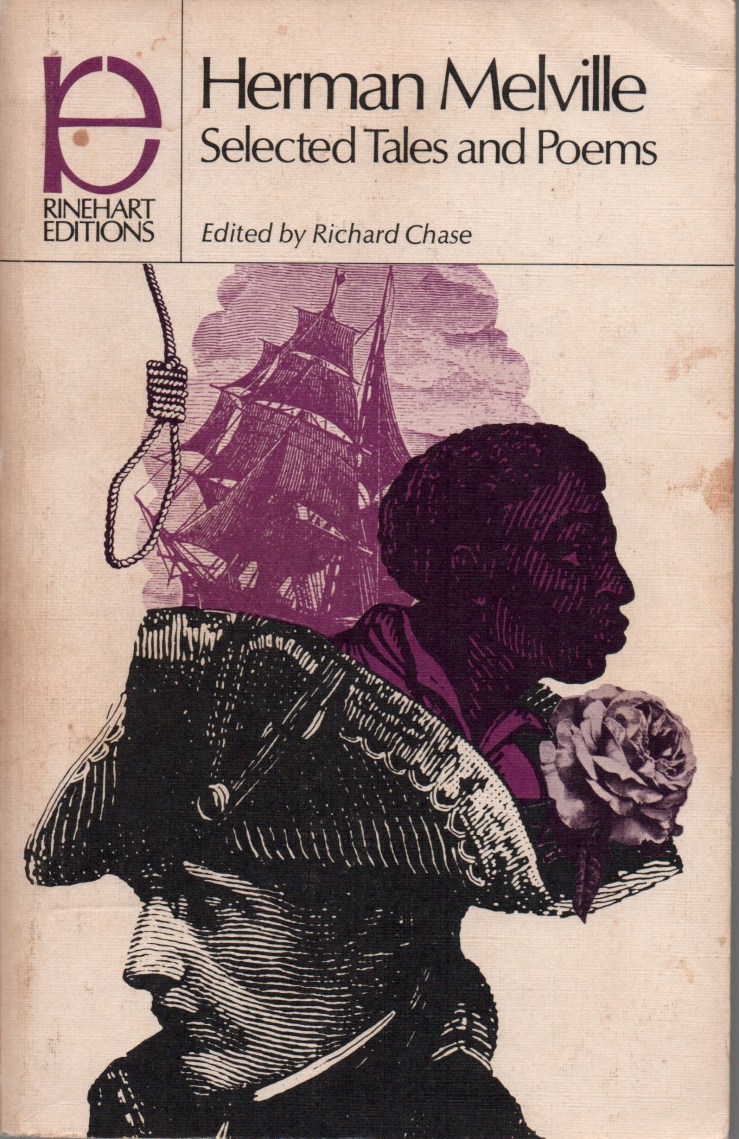
Selected Tales and Poems of Herman Melville (Richard Chase, editor). 1950 Rinehart Editions trade paperback by Holt, Rinehart and Winston. I’m a big fan of these midcentury Rinehart Editions paperbacks—they have an odd signature look to them.
No supernaturalism, only the occult continuation of infinite nature
Daydream, which is to thought as the nebula is to the star, borders on sleep, and is concerned with it as its frontier. An atmosphere inhabited by living transparencies: there’s a beginning of the unknown. But beyond it the Possible opens out, immense. Other beings, other facts, are there. No supernaturalism, only the occult continuation of infinite nature … Sleep is in contact with the Possible, which we also call the improbable. The world of the night is a world. Night, as night, is a universe … The dark things of the unknown world become neighbors of man, whether by true communication or by a visionary enlargement of the distances of the abyss … and the sleeper, not quite seeing, not quite unconscious, glimpses the strange animalities, weird vegetations, terrible or radiant pallors, ghosts, masks, figures, hydras, confusions, moonless moonlights, obscure unmakings of miracle, growths and vanishings within a murky depth, shapes floating in shadow, the whole mystery which we call Dreaming, and which is nothing other than the approach of an invisible reality. The dream is the aquarium of Night.
— VICTOR HUGO, LES TRAVAILLEURS DE LA MER
The Hugo citation comes from Ursula K. Le Guin’s 1971 novel The Lathe of Heaven—Le Guin uses it as a preface to the seventh chapter. It’s beautiful on its own; it also functions as a kind of poetic summary of The Lathe of Heaven.
Greg Graffin’s Population Wars (Book acquired some time in September, 2015)
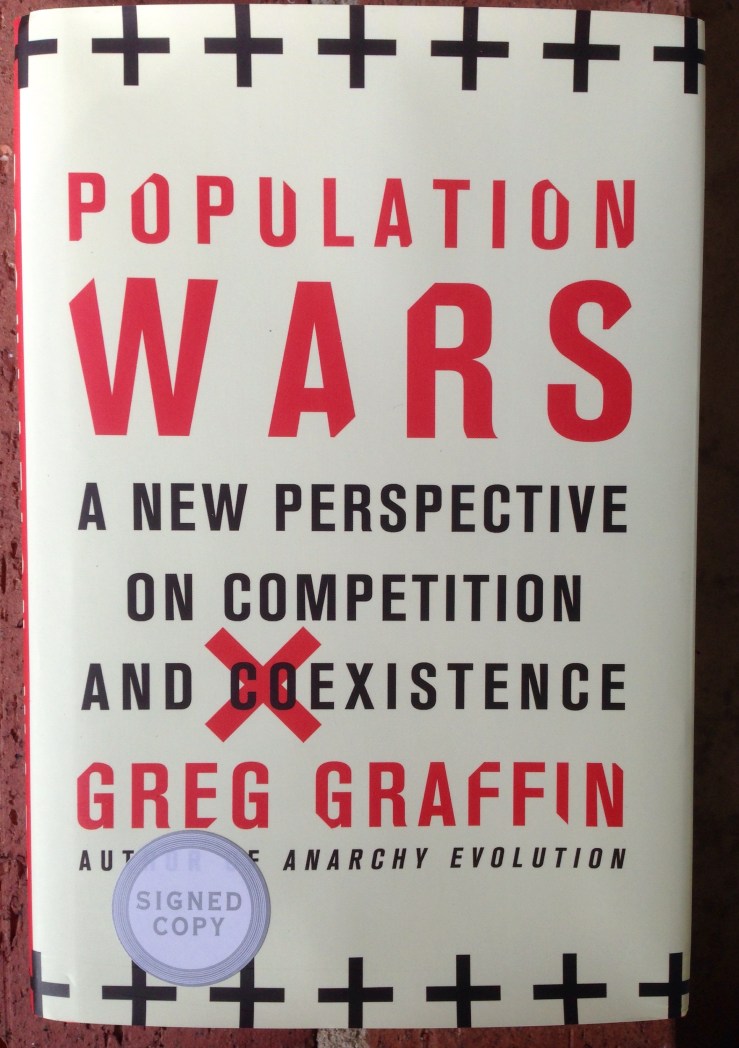
Greg Graffin is probably best known for his work as the leader of Bad Religion, a band he formed when he was 15. Graffin is also an academic and author. His latest book, Population Wars, makes a compelling argument for coexistence. It’s an accessible and persuasive read, rooted in biology and hope. (And of the three books I’ve read by indie rockers of yore this year, it’s easily the best). Publisher Thomas Dunne’s blurb:
From the very beginning, life on Earth has been defined by war. Today those first wars continue to be fought around and inside us, influencing our individual behavior and that of civilization as a whole. War between populations—whether between different species or between rival groups of humans—is seen as an inevitable part of the evolutionary process. The popular concept of survival of the fittest explains and often excuses these actions.
In Population Wars, Greg Graffin points to where the mainstream view of evolutionary theory has led us astray. That misunderstanding has allowed us to justify wars on every level, whether against bacterial colonies or human societies, even when other, less violent solutions may be available. Through tales of mass extinctions, developing immune systems, human warfare, the American industrial heartland, and our degrading modern environment, Graffin demonstrates how an oversimplified idea of war, with its victorious winners and vanquished losers, prevents us from responding to the real problems we face. Along the way, Graffin reveals a paradox: When we challenge conventional definitions of war, we are left with a new problem—how to define ourselves.
Population Wars is a paradigm-shifting book about why humans behave the way they do and the ancient history that explains that behavior. In reading it, you’ll see why we need to rethink the reasons for war, not only the human military kind but also Darwin’s “war of nature,” and find hope for a less violent future for mankind.

Three ideas from Nathaniel Hawthorne’s Note-Books
It seems a greater pity that an accomplished worker with the hand should perish prematurely, than a person of great intellect; because intellectual arts may be cultivated in the next world, but not physical ones.
To trace out the influence of a frightful and disgraceful crime in debasing and destroying a character naturally high and noble, the guilty person being alone conscious of the crime.
A man, virtuous in his general conduct, but committing habitually some monstrous crime,–as murder,–and doing this without the sense of guilt, but with a peaceful conscience,–habit, probably, reconciling him to it; but something (for instance, discovery) occurs to make him sensible of his enormity. His horror then.
From Nathaniel Hawthorne’s Passages from the American Note-Books.
Totally insane world (Ursula K. Le Guin)
“I am cracking,” he said. “You must see that. You’re a psychiatrist. Don’t you see that I’m going to pieces? Aliens from outer space attacking Earth! Look: if you ask me to dream again, what will you get? Maybe a totally insane world, the product of an insane mind. Monsters, ghosts, witches, dragons, transformations—all the stuff we carry around in us, all the horrors of childhood, the night fears, the nightmares. How can you keep all that from getting loose? I can’t stop it. I’m not in control!”
“Don’t worry about control! Freedom is what you’re working toward,” Haber said gustily. “Freedom! Your unconscious mind is not a sink of horror and depravity. That’s a Victorian notion, and a terrifically destructive one. It crippled most of the best minds of the nineteenth century, and hamstrung psychology all through the first half of the twentieth. Don’t be afraid of your unconscious mind! It’s not a black pit of nightmares. Nothing of the kind! It is the wellspring of health, imagination, creativity. What we call ‘evil’ is produced by civilization, its constraints and repressions, deforming the spontaneous, free self-expression of the personality. The aim of psychotherapy is precisely this, to remove those groundless fears and nightmares, to bring up what’s unconscious into the light of rational consciousness, examine it objectively, and find that there is nothing to fear.”
“But there is,” Orr said very softly.
From Ursula K. Le Guin’s 1971 novel The Lathe of Heaven.
A conversation about New American Stories, an anthology edited by Ben Marcus (Part 2)
Biblioklept contributor Ryan Chang and I continue our discussion of New American Stories, an anthology edited—or maybe “curated” is the right word, although I’m not sure—by Ben Marcus. Read the first part of our exchange here. In this exchange we discuss holes, white American violence, paranoia, stories by Clare Vaye Watkins, Robert Coover, Lydia Davis, and Tao Lin, and that “Wait! Why? How?” feeling that good fiction can produce.

Ryan Chang: What’d you think of the Claire Vaye Watkins story?
Edwin Turner: Yeah…so… “Diggings.” It’s taken me so long to get back to you about this one because I don’t really have anything intelligent to say about it. Which is really strange: I think I’ve told you that I’ve been obsessed with holes for a few years now, and the aesthetics of digging in particular. I’ve been compiling a bibliography on writings about holes, so I guess “Diggings” fits into that. And I like the general milieu and everything, the Western thing. And I appreciate Watkins lucid storytelling style. I do. But I found myself having to slog through it, and then the end, the sort of climax or whatever…I don’t know. No spoilers for the readers, but it didn’t ring my bell. Again, I’m not saying anything particularly interesting about it. I think my problem might be with the length of the story—to be clear, that’s my problem, not the story’s—but with a few notable exceptions (“Bartleby,” “The Metamorphosis”), superlong short stories don’t do it for me. I’d rather read a novella I guess.
I’m pretty sure “Diggings” is the longest selection in New American Stories. Lydia Davis’s “Men” is obviously the shortest in the book—it’s one of her better ultrashorts, and it’s already been widely anthologized via blogs and Twitter. I wish one of her longer pieces was included though–maybe something like “Marie Curie, So Honorable Woman.” But I’ve fallen into the stupid trap of What Would Ed Do?
Another short piece in the collection is Robert Coover’s “Going for a Beer,” which is a Perfect Short Story. Just perfect. It’s a perfect postmodern gesture without any gimmickry, a story about storytelling that’s actually a story. But maybe I only think it’s so perfect because I’ve read it so many times now and even used it in the classroom. Your thoughts?
RC: There are a few things I really like about Watkins’ “Diggings.” For one, I think the voice is what really carries this story, and the pretense of the subheadings. It certainly lends the story this epic-ness that, for the most part, it does well, but my resistance to this story comes from its place within the collection.
But first, I want to touch on the hole motif. There’s the easy reading of the kind of digging and the value invested in it. The tenuous promises of a new start, or a restart. The neutrality of money; that is, one’s self-worth is in direct proportion to one’s ownership. But Watkin’s story is a critique of that very American myth of manifest destiny. Was it ever good for anything? In this light, the story seems fine. A well-executed story with enough of the right moves to keep me going. I’m impressed by Watkins’ pacing, as well as how convincing this voice is. I don’t think we should forget that. Watkins’ inflection of that gruff, macho Westernly voice is what’s most convincing for me, and contributes to the irony that enables the critique of the American myth overall. Also, to end, I’m happy to see that the principle antagonists—besides the characters’ own desires—are the “Chinamen,” who are often footnoted or forgotten in the long history of white American violence.
But to be a little academic—that the collection ends with this critique of manifest destiny and (white) Americanness strikes me as counterproductive, or redundant, to the kind of politics this collection may (may!) be advocating: the flexibility of the American voice. I’m talking about Sayrafiezadeh’s story, and your point that the protagonist can’t listen, that no one can really listen. It’s redundant to me because that theme is shot through the entire collection. Did we really need it recapitulated again? And have it be our final punctuation mark on an otherwise strong and smart anthology? This is probably my own What Would Ryan Do? situation. The story reads like a watered-down version of the punch this collection attempts to make with “Diggings.” But we should remember that this is only one anthology compiled from one editor—whose own work we both really dig (God; no pun intended)—from a body of literature that would be impossible to completely anthologize. The best things about metaphors is that they fail to fully figure their abstract possibilities in text, fixing their content in time and place; instead, they point outside of themselves. That’s exactly what NAS does here: it says, the “American Story” is flexible, strange, and ever-moving. All its permutations cannot possibly be contained.
OK, but, I like that my response is going to end on a few considerations of Coover’s story, “Going For a Beer.” In an interview, Marcus says that it’s under Coover’s tutelage where he began to cut his storytelling teeth, and you can see a lot of resonance between, say, Marcus’s early work and Coover. But even now, the one thing they share—as well as Watkins—is a commitment to the strange.
You’re right to say that it’s a perfect example of a kind of postmodern fiction without any of the gimmickry, and a “Perfect Story” in this capacity. The way it calls attention to itself is, yeah, by foregrounding the artifice of storytelling through storytelling. But it’s not a “trick,” it’s a tweak: instead of one central conflict for the protagonist, we get a replication of several conflicts, they produce the next in the series. Our readerly expectations of conflict-resolution are turned upside down; Coover collapses the arc between readerly anticipation and pacing. Always, we’re like: “Wait! Why? How?” It hinges on when Coover makes the protagonist think—by merely thinking, the action happens, and we’re led into the next sentence of the story. In that light, it’s very Quixotic, and how the story calls attention to itself in that postmodern way. I could try to break this story down more to its components, but that’s not completely our purpose. But even if I did break this down some more, it wouldn’t suck out any of the magic of Coover’s story. Which is how, I think, Marcus understands language as a drug. The certain, indubitable and inevitable syntactical arrangement of words has this inexplicable effect on both us and the writer. The mystery is what keeps stories going.
ET: I got some of that “Wait! Why? How?” feeling from Tao Lin’s “Love Is a Thing on Sale for More Money Than There Exists,” although at a far more subtle level—maybe more like, wait–why?–huh?. Like Coover’s “Going for a Beer,” Lin’s story feels effortless—but a different kind of effortless. Coover’s tale is masterful and precise. There’s something a little tossed-off to Lin’s story; a riffing poetry which gives the story some of the energy it needs: “You, the botched clone of you, the Miami Dolphins, Cocoa Puffs, paper plates, a dwindling supply of clam juice. That was life.” Wait–why?–huh? “Love Is a Thing on Sale” (wait, do I need to name the whole name? Does it remind you of a Raymond Carver title?) — “Love Is a Thing on Sale for More Money Than There Exists” has almost no plot—it’s very Tao Linish. It also captures something of the post-millennial malaise and paranoia of the previous decade. Reading it I thought, “Ah, yes, that feeling”—like there was still a freshness to that exhaustion. We learn that our protagonist Garret “often suspected that The Future Was Now,” which of course it was. And now passed.
The hole pops up as a metaphor again, although I’m not sure what Lin’s doing with it besides the very, very obvious (“There’ere’s a hole in you/Gets emptier, ah-oh, each day” is a line from “Sigh (Hole),” the “radio hit that year”). The story seems best to me when it strays from its Barthelmesque absurdities into actual emotional contemplation, as when Garret, via Lin’s free indirect style, wonders about love and truth and being considerate—that love requires real attention, consideration, punctuality. (Garret is deeply flawed too, of course).
I was surprised at how much I enjoyed “Love Is a Thing on Sale,” especially because it frequently annoyed me, with its ultra-specific signifiers of capitalism (“KFC spork”!) juxtaposed with its leery vagueness (the protagonists “flew down to Florida” for a vacation. Florida, the fourth largest state in the US. Florida. Florida, which has an east coast but also a west coast. And where do they go in Florida? Fucking Red Lobster, man). One of my favorite moments of the story is actually one of these sparks of vagueness, of sheer impossibility, of how language is a drug that can compress banality into radical action: “A few minutes passed, and then Kristy got up, called the airline place, called a cab, and flew to New York. The next day, though, she flew back, and the rest of the week in Florida was very calm and sunny.” That passage is a piece of fantasy.
RC: Mm, yeah, there’s certainly a confidence in Coover’s story that isn’t in Lin’s, but it doesn’t mean his prose is any less precise. Part of the magic in Coover’s story is watching him handle the technique he’s devised and watching him perform it, amazed that we’re buying his gambit. Though we’re puzzled, we’re not in disbelief as to what’s happening. The absurdity of his narrator’s thought generating the action becomes self-reflexive because, again, it’s an ironic joke of how stories work. Someone thinks of something, and then it happens. Continue reading “A conversation about New American Stories, an anthology edited by Ben Marcus (Part 2)”
The gothic is an avant-garde genre
…the gothic is an avant-garde genre, perhaps the first avant-garde art in the modern sense of the term. A pursuit, half serious enterprise, half fashionable vice, of the intellectuals of the end of the 18th century, it remained highbrow enough to tempt the Shelleys and Byron, for instance, to try their hands at it. The popular success of Frankenstein, perpetuated still in movies, and known in its essence to children in the street, obscured the fact that it was launched as an advanced book; and that it belongs to a kind, one of whose functions was to shock the bourgeoisie into an awareness of what a chamber of horrors its own smugly regarded world really was. If some examples of the early gothic strike us now is comical, this is only in part the result of changing taste; such books were from the beginning intended to be, in part at least, a joke on the middle class reader who would inevitably find them too funny or not funny enough!
From Leslie Fiedler’s Love and Death in the American Novel (1960).
The polar ice kept melting and the sea kept rising (Ursula K. Le Guin)
He rode the Vancouver subway back into Portland. The trains were already jam-packed; he stood out of reach of strap or stanchion, supported solely by the equalizing pressure of bodies on all sides, occasionally lifted right off his feet and floating as the force of crowding (c) exceeded the force of gravity (g). A man next to him holding a newspaper had never been able to lower his arms, but stood with his face muffled in the sports section. The headline, “BIG A-l STRIKE NEAR AFGHAN BORDER,” and the subhead, “Threat of Afghan Intervention,” stared Orr eye to I for six stops. The newspaper holder fought his way off and was replaced by a couple of tomatoes on a green plastic plate, beneath which was an old lady in a green plastic coat, who stood on Orr’s left foot for three more stops.He struggled off at the East Broadway stop, and shoved along for four blocks through the ever-thickening off-work crowd to Willamette East Tower, a great, showy, shoddy shaft of concrete and glass competing with vegetable obstinacy for light and air with the jungle of similar buildings all around it. Very little light and air got down to street level; what there was was warm and full of fine rain. Rain was an old Portland tradition, but the warmth—70° F on the second of March—was modern, a result of air pollution. Urban and industrial effluvia had not been controlled soon enough to reverse the cumulative trends already at work in the mid-twentieth century; it would take several centuries for the CO2 to clear out of the air, if it ever did. New York was going to be one of the larger casualties of the Greenhouse Effect, as the polar ice kept melting and the sea kept rising; indeed all Boswash was imperiled. There were some compensations. San Francisco Bay was already on the rise, and would end up covering all the hundreds of square miles of landfill and garbage dumped into it since 1848. As for Portland, with eighty miles and the Coast Range between it and the sea, it was not threatened by rising water: only by falling water.
It had always rained in western Oregon, but now it rained ceaselessly, steadily, tepidly. It was like living in a downpour of warm soup, forever.
The New Cities—Umatilla, John Day, French Glen—were east of the Cascades, in what had been desert thirty years before. It was fiercely hot there still in summer, but it rained only 45 inches a year, compared with Portland’s 114 inches. Intensive farming was possible: the desert blossomed. French Glen now had a population of 7 million. Portland, with only 3 million and no growth potential, had been left far behind in the March of Progress. That was nothing new for Portland. And what difference did it make? Undernourishment, overcrowding, and pervading foulness of the environment were the norm. There was more scurvy, typhus, and hepatitis in the Old Cities, more gang violence, crime, and murder in the New Cities. The rats ran one and the Mafia ran the other. George Orr stayed in Portland because he had always lived there and because he had no reason to believe that life anywhere else would be better, or different.
From Ursula K. Le Guin’s 1971 novel The Lathe of Heaven.
Three Blurbs


Three Books

The Crack-Up by F. Scott Fitzgerald; edited by Edmund Wilson. A 1956 New Directions mass market paperback. No designer credited. The Crack-Up collects autobiographical pieces by Fitzgerald, along with letters and essays by some of Fitzgerald’s contemporaries and near-contemporaries—but the highlight is the inclusion of Fitzgerald’s note-books. (I shamelessly plundered them on this blog for years). Its cover is black and white and gray.
An Armful of Warm Girl by W.M. Spackman. 1981 trade paperback edition by Van Vactor & Goodheart. Cover design by Leslie Evans. A perfect little novella, with a perfect opening page. Its cover is black and white and gray.

Flee by Evan Dara. 2013 trade paperback edition by Aurora. Design by Todd Michael Bushman. Blogged about it here and here. Its cover is black and white and gray.
What will the creature made all of seadrift do on the dry sand of daylight; what will the mind do, each morning, waking? (Ursula K. Le Guin)
Current-borne, wave-flung, tugged hugely by the whole might of ocean, the jellyfish drifts in the tidal abyss. The light shines through it, and the dark enters it. Borne, flung, tugged from anywhere to anywhere, for in the deep sea there is no compass but nearer and farther, higher and lower, the jellyfish hangs and sways; pulses move slight and quick within it, as the vast diurnal pulses beat in the moon-driven sea. Hanging, swaying, pulsing, the most vulnerable and insubstantial creature, it has for its defense the violence and power of the whole ocean, to which it has entrusted its being, its going, and its will.
But here rise the stubborn continents. The shelves of gravel and the cliffs of rock break from water baldly into air, that dry, terrible outerspace of radiance and instability, where there is no support for life. And now, now the currents mislead and the waves betray, breaking their endless circle, to leap up in loud foam against rock and air, breaking…
What will the creature made all of seadrift do on the dry sand of daylight; what will the mind do, each morning, waking?
The first three paragraphs of Ursula K. Le Guin’s 1971 novel The Lathe of Heaven.
Voyage d’Hermès — Moebius

Interview with Richard Zenith

In July, I spoke to Richard Zenith in Lisbon about his work translating Fernando Pessoa, Carlos Drummond de Andrade, Sophia de Mello Breyner, and many other spectacular Portuguese-speaking poets. Read our conversation in the hot-off-the-press fall issue of Asymptote. (Available in English and Spanish!)
Almost no memory | A review of Kazuo Ishiguro’s The Buried Giant
In Kazuo Ishiguro’s 2015 novel The Buried Giant, a metaphysical mist engulfs sixth-century Britain, clouding the memories of all who inhabit the land. Saxons and Britons alike cannot recall their bellicose past. Against this mist, elderly Britons Axl and Beatrice seek their long-lost son. They meet a Saxon warrior who hunts an ancient she-dragon he’s vowed to slay. He’s aided by a youth, Edwin, who’s been exiled from his village after being bitten by a mythic creature. King Arthur’s aged nephew Sir Gawain lingers as a courtly protector, a figure from an already-bygone era; the mist seems to slowly rot his brain and his conscience, pushing him into paranoia and madness. There are Charonic ferrymen and awful ogres; there are mad monks and terrible pixies. A hellhound, a dragon, a poisoned goat. Rivers and mountains and crypts and villages. But most of all that mist.

Ishiguro makes the reader experience that mist. He obscures. The action that occurs—and yes, there’s action here, measured action (often measured in a literal sense)—the action that occurs in The Buried Giant is almost always oblique, shadowed, indistinct, but also very mechanical. The memory-mist renders the world treacherous, immediate, a dark, vague place that offers its travelers no purchase of reference. Deceptive.
Forgive me for quoting at such length, but I think a longish passage here shows how and what Ishiguro is doing. Almost all of our principals are here, underground—note their procession, their movement—a constant motif in the novel, movement, single file or side by side—and the presence of a light, illumination—also a motif. Note the variety of interpretations of not knowing, not seeing, note the simple horror:
They went on into the tunnel, Sir Gawain leading, Axl following with the flame, Beatrice holding his arm from behind, and Edwin now at the rear. There was no option but to go in single file, the passage remaining narrow, and the ceiling of dangling moss and sinewy roots grew lower and lower until even Beatrice had to stoop. Axl did his best to hold the candle high, but the breeze in the tunnel was now stronger, and he was often obliged to lower it and cover the flame with his other hand. Sir Gawain though never complained, and his shape going before them, sword raised over his shoulder, seemed never to vary. Then Beatrice let out an exclamation and tugged Axl’s arm.
“What is it, princess?”
“Oh, Axl, stop! My foot touched something then, but your candle moved too quickly.”
“What of it, princess? We have to move on.”
“Axl, I thought it a child! My foot touched it and I saw it before your light passed. Oh, I believe it’s a small child long dead!”
“There, princess, don’t distress yourself. Where was it you saw it?”
“Come, come, friends,” Sir Gawain said from the dark. “Many things in this place are best left unseen.”
Beatrice seemed not to hear the knight. “It was over here, Axl. Bring the flame this way. Down there, Axl, shine it down there, though I dread to see its poor face again!”
Despite his counsel, Sir Gawain had doubled back, and Edwin too was now at Beatrice’s side. Axl crouched forward and moved the candle here and there, revealing damp earth, tree roots and stones. Then the flame illuminated a large bat lying on its back as though peacefully asleep, wings stretched right out. Its fur looked wet and sticky. The pig-like face was hairless, and little puddles had formed in the cavities of the outspread wings. The creature might indeed have been sleeping but for what was on the front of its torso. As Axl brought the flame even closer, they all stared at the circular hole extending from just below the bat’s breast down to its belly, taking in parts of the ribcage to either side. The wound was peculiarly clean, as though someone had taken a bite from a crisp apple.
“What could have done work like this?” Axl asked.
He must have moved the candle too swiftly, for at that moment the flame guttered and went out.
Ishiguro gives us mystery, interpretation, and then an incomplete, ambiguous revelation. (This is the basic structure of the novel). Beatrice never relents in her belief that she’s stumbled over a dead child. Brimming with lost children and lost parents and orphans, The Buried Giant is a novel of erasures. But an erasure leaves a trace, a violent, visceral marking into the page’s blankness. Revelation through absence.
We would have no plot, not really, without some overcoming of blankness, and Axl in particular overcomes the mist in his quest. A backstory fleshes out, in watery strokes albeit. The Buried Giant, as far as fantasy epics go, is awfully indistinct. Or rather, Ishiguro offers only mechanical and immediate glimpses into this world, a Britain on the cusp of the Middle Ages. Through Axl’s consciousness (and conscience), we see the vital precision in hand-to-hand combat, for example. Its patience, its slowness, its dependence on muscle memory. Or perhaps (dare I say) more boringly, we feel the very real peril involved in walking in the wild dark as an elderly person. The thrills in The Buried Giant come not from its sword and sorcery costumes, but from its Kafkaesque edges and gaps. This is a novel about not knowing.
And it’s here that The Buried Giant is most successful—as an evocation of not knowing. Axl and Beatrice’s quest unfolds as a series of choices and consequences severed, for the most part, from the anchor of memory. There’s an episodic vibe to the novel, a sense that it’s making itself up as it goes along. (It’s not). The novel strongly reminded me of some of the old RPGs I’d play on a Commodore 64 as a kid. The graphics weren’t great and I had to use my imagination a lot. The games were sometimes frustrating and slow. But perhaps you want a more, uh, literary comparison? Something more recent too? The Buried Giant recalls Ishiguro’s short story “A Village after Dark” a lot more than, say, A Game of Thrones or The Lord of the Rings. It’s a fantasy novel, but one that feels etiolated, its vivid colors drained. More Gustave Doré than Gustave Moreau.
While a precise indistinctness (forgive the oxymoron) is part of The Buried Giant’s program, there’s nothing indistinct about its heroes’ love for each other. Axl and Beatrice, A & B—can I say I came to love them? Or if I didn’t quite love them, I was rooting for them, say? Rooting for their survival, but specifically their survival as a they, a shared survival. Ishiguro successfully communicates their intimacy, their romance, their love, a love threatened by both the natural world and the supernatural return of lost memory. Their relationship is the heart of the novel upon which Ishiguro fixes his themes of memory, justice, vengeance, and love. Ishiguro’s commentary on those themes ultimately may feel pessimistic to many readers, particularly in the novel’s conclusion.
Excepting the ones that we love and return to and obsess over, we retain little of the novels that we read. What memories remain are kernels—the outline of a plot, a strange lingering phrase or detail, a bright or bold character, a theme, an idea, an image. It’s the love between Axl and Beatrice that I’ll likely recall most strongly from the shadows of The Buried Giant. If we can’t remember, we can at least experience.
Interview with David Shook

Dear Biblioklepters,
I recently had the chance to interview the marvelous David Shook about the equally marvelous Like a New Sun, a book of contemporary indigenous Mexican poetry, which he edited and co-translated. You can read the interview over at Asymptote’s blog.
I first read about Asymptote here on Biblioklept a few years ago. I’m happy to share that I have joined their ranks as Interview Features Editor, and that this is my first interview with them. Check back often for more interviews with translators, poets, novelists, and more.
Shameless plug over! Thanks for reading.
-Ryan M.
Christopher Columbus in Prison — Thomas Eakins

 Biblioklept