Reading Chris Ware’s Building Stories / Two Short Loops

20121201-162412.jpg

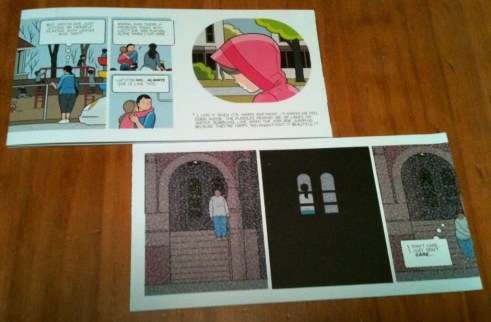
These two shorties in Chris Ware’s Building Stories showcase the novel’s thematic recursion, a recursion doubled in both its metastructure (14 pieces that the reader can read in any order) as well as the structure of many of the individual pieces. In the case of the two parts pictured above, we get Möbius strips that become richer with rereading. The strips seem to twin each other not just in their format, but also in their theme.

Both strips feature Lonely Girl, who perhaps emerges as the dominant protagonist of Building Stories. The one pictured at the top gives a voice to her daughter, a girl who seems to repeat some of her mother’s tendencies toward isolation and depression.

20121201-162435.jpg

Ware’s strength here (and always elsewhere) is the economy of storytelling: He packs entire short stories into just a few panels, coloring his narrative:

20121201-162443.jpg

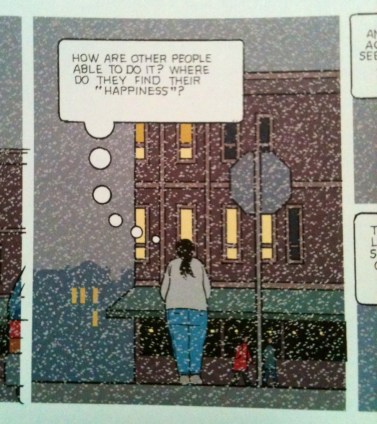
The second loop features a solitary Lonely Girl who trudges through the snowy night in a near-suicidal despair:

20121201-162451.jpg

Read recursively, the strip dooms Lonely Girl to an endless loop of despair—and it’s at moments like these that I’m happy there are other parts to Building Stories—some kind of existential “out” for our poor heroine.


Reading Chris Ware’s Building Stories / Big Four Panel Board Book

Continuing reading Chris Ware’s Building Stories; also, continuing the ad hoc naming of its “chapters”: let’s call this one the Big Four Paneled Board Book.

It’s big. Shown here in relation to a local brew (clearly the best way to illustrate scale):

20121116-170448.jpg

It’s difficult to describe how each chapter enriches the story of Building Stories. There’s something Borgesian about Ware’s novel—not in the sense that it’s something that Borges would have written—what I mean to suggest is it’s like something out of a Borges story—winding, maze-like, self-referential, but not solipsistic. Building Stories doesn’t come with a set of instructions, so the reader has to interact with it in a random way. What’s really thrilling and emotionally impactful is the way that each piece deepens the story and develops each character a little bit more.

In the forked path I’ve been following, Lonely Girl (this is the building’s name for her; we might also call her the Would-be Writer, The Diarist, or, perhaps, The Amputee) emerges as the central character, and she gets the lead story in the Big Four Panel Board book. She’s looking for a companion, so she places an ad:

20121116-170502.jpg

This tiny little square says so much: Ware wastes no space. Lonely Girl’s personal ad is in some ways a metonymy of Building Stories (and Ware’s oeuvre all together): it combines ironic, self-aware humor with a stark and devastating sense of loneliness.

Lonely Girl shows up as a character in the lives of her downstairs neighbors, the Sour Couple. The soda-swilling boyfriend wonders how she might have lost her leg. In some ways he serves as audience surrogate here—I doubt we’ll get the full story. (The boyfriend also entertains other fantasies about Lonely Girl’s body).

20121116-170509.jpg

Of course, the Lonely Landlady also gets her panel. We see more of her stunted life, her mother (and the building itself) a proverbial albatross around her neck. Ware uses the size and scope of the Big Book to optimum advantage; he knows that the book is so big (and his panels so small) that the reader simultaneously sees everything and comprehends nothing. Ware employs lines that crisscross from section to section, often running through narrative elements we’ve yet to engage, or sometimes tracing over what we’ve already seen. The effect is not disorienting, though—rather, Ware uses the visual space to show the ways in which his characters and narratives cross, abut, or fail to connect.

20121116-170524.jpg

The Big Book’s theme is in fact about cross-pollination, about the ways that different strands intersect, conmingle, blend (or fail to). It’s appropriate then when our old friend Branford the bee arrives:

20121116-170533.jpg

More to come.


Reading Chris Ware’s Building Stories / Untitled Wordless Loop

20121109-140907.jpg

Continuing this project:

I’ve thus far titled the pieces I’ve been reading of Chris Ware’s Building Stories in a rather ad hoc fashion, but this entry is a wordless affair.

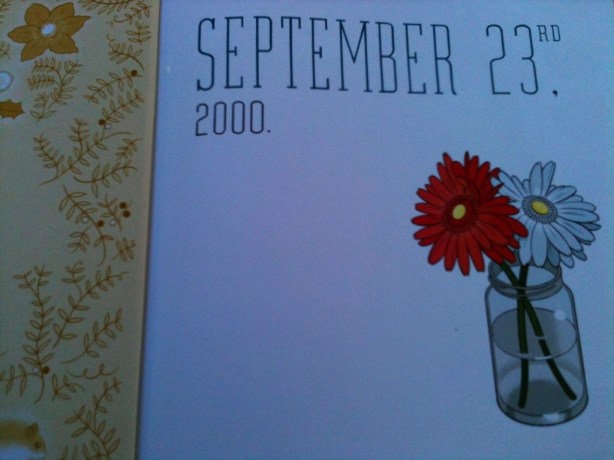
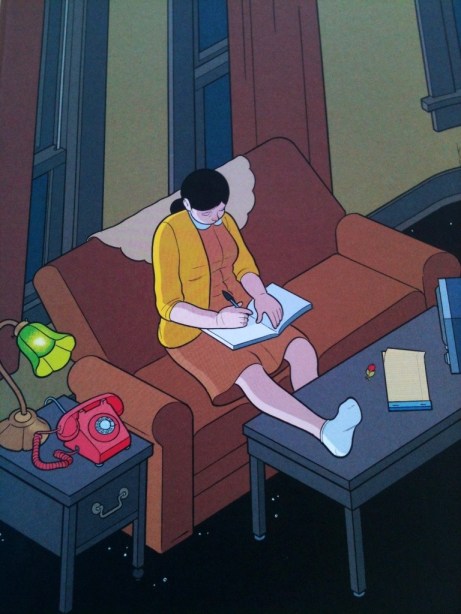
It continues the story of the “lonely girl,” the “cripple” who is the primary narrator of September 23rd, 2000.

Here, we see her raising her daughter in a series of wordless, precise panels that span roughly a decade.

Building Stories’s brilliance derives in large part from its precision and economy—Ware tells a story on every page, a chapter in every small panel:

20121109-140920.jpg

I’m a parent (my daughter is five, my son is two), and so much of this untitled piece struck me as utterly real and authentic—so true in the details.

There’s a moment when our mother looks up to see her daughter reading—silently, to herself—that is bittersweet, a kind of gentle heartbreak:

20121109-140926.jpg

There’s a fine line between the precise evocation of emotion and sentimental schlock, but Ware never comes close to treading it here—he’s always firmly on the side of the real.

And yet this doesn’t come at the expense of evocations of wonder, as we can see in the panels below:

20121109-140934.jpg

As I’ve suggested a few times already, Building Stories is a sort of  Möbius strip; this particular comic nearly literalizes this metaphor.

It begins with our mother drifting from sleep to waking memory, and ends thusly, a strange loop documenting how fast and how slow life changes.

Charles Burns Enriches His Wonderfully Weird Trilogy with The Hive

20121104-183159.jpg

In X’ed Out, Charles Burns created a rich and strangely layered world focusing on Doug, a confused and injured young man. In his parents’ suburban basement, Doug parcels out the last of his late father’s painkillers, slipping from haunted memories of his relationship with Sarah into fevered nightmares of abject horror and then into a wholly other world, a realm that recalls William Burroughs’s Interzone. In this alien world, Doug takes on the features of Nitnit (an inversion of Tintin), the alter-ego he adopts when performing spoken word cut-ups as the opening act for local punk rock bands. What made X’ed Out so compelling (apart from Burns’s thick, precise illustration, of course), was the sense that this Interzone was a reality equal to Doug’s own “real world” — that it was somehow more real than Doug’s dreams.
20121104-165518.jpg

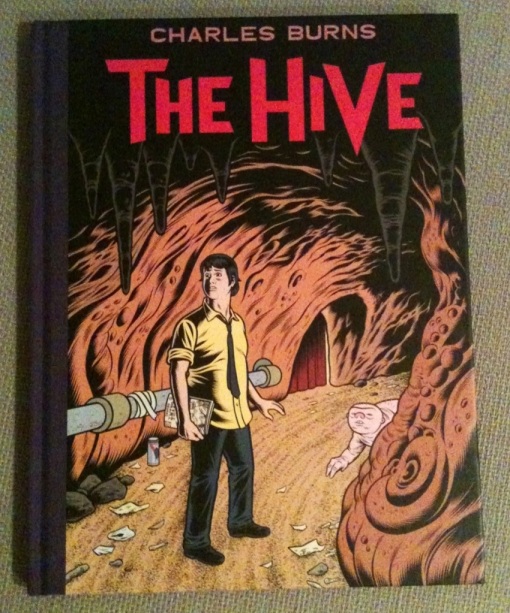
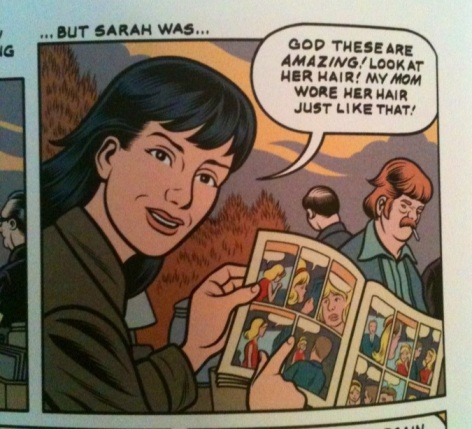
The Hive (part two of the proposed trilogy) deepens the richness and complexity of the world Burns has imagined. The title refers to a location in Interzone. Doug (or Nitnit) has found employment in The Hive as a kind of mail clerk or janitor. His primary role though is secret librarian, catering to the reading needs of the breeders of The Hive. One breeder seems to be a version of Doug’s ex-girlfriend; the other is a double of Sarah, who asks Doug/Nitnit to bring her romance comics—which he does—only he skips a few issues. These missing issues stand in for the information Doug (and Burns) withholds from the reader, the missing fragments that have been x’ed out.

20121104-165548.jpg

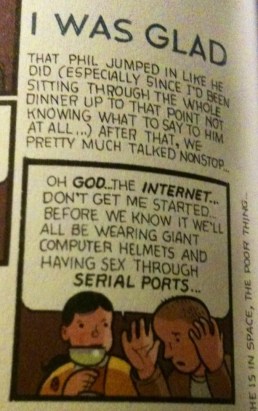
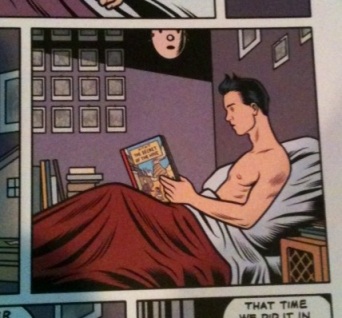
Burns uses romance comics as a framing or organizing device, a motif linking the disparate worlds of his narrative. In the “real world” — which is to say the world of Doug’s memory — we learn that he buys a stack of old romance comics for Sarah on their first date.
20121104-165537.jpg

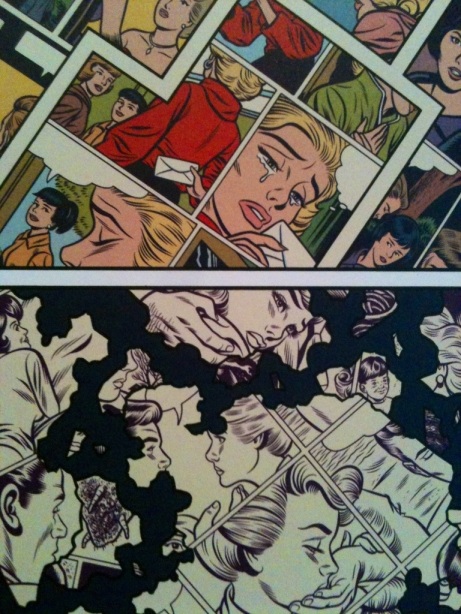
Throughout the narrative, Burns plays his characters against the extreme, often hysterical dramas of 1950s and ’60s romance comics; his strong lines and heavy inks readily recall the early works of Simon and Kirby, but more precise and careful—something closer to Roy Lichtenstein, only more sincere, more emotional.

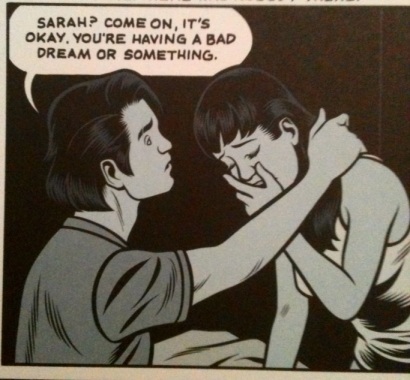
In The Hive, we learn more about Doug’s troubled relationship with Sarah, who has problems out the proverbial yingyang (not the least of which is a violent psychopathic ex-boyfriend).
20121104-165554.jpg

Burns weaves the story of Sarah and Doug’s relationship into the fallout of Doug’s father’s death—a death Doug was completely shuttered to, we realize. Doug’s drug-dreams dramatize the missing pieces of these narratives, and the Interzone set-pieces propel the mystery aspects of the narrative forward, as Doug’s alter-ego plumbs the detritus of his psychic fallout. Through the metatextual motif of reading-comic-books-as-detective-works, Burns explores themes of trauma, abjection, and distance. Images of pigs and cats, freaks and punks, portals and holes litter The Hive.
20121104-165603.jpg

Burns has always been a perfectionist of dark lines and strange visions, and his last full graphic novel Black Hole was a triumph of atmosphere and mood. With the first two entries of his trilogy, however, Burns has showed a significant maturation in storytelling, characterization, and dialogue. I often thought parts of Black Hole seemed forced or rushed (no doubt because Burns faced daunting production troubles during the decade he worked on the novel—including his original publisher Kitchen Sink folding). With X’ed Out and now The Hive we can see a more patient artist, working out an emotionally complex and compelling story in rich, symbolic layers.

I reread X’ed Out and then read The Hive in one greedy sitting; then I went through The Hive again, more slowly, more attendant to its details and nuances. We had to wait two years between X’ed Out and The Hive—and it was worth the two year wait. So if we must wait another two years—or more—for the final entry, Sugar Skull, so be it.

Reading Chris Ware’s Building Stories / September 23rd, 2000

20121101-205324.jpg

September 23rd, 2000 is one of the longer pieces in Chris Ware’s box set, Building Stories. Part of the joy and frustration of Building Stories is its free form—the possibility of reading one piece before another, of getting one tale or perspective before another. I started with Branford, which seems in retrospective a fairly neutral opening—it introduces many of the themes that develop in Building Stories but none of the major characters. I then read I just met, which introduces a couple suffering a sour relationship.

September introduces (to me, anyway), two major “new” (again, “new” to me; these characters appear central in other books and pamphlets of the collection and obliquely in others): The “lonely girl,” a would-be artist sporting a prosthetic leg, and the “old lady,” landlord of the building. Most of September takes the form of lonely girl’s diary entries.

20121101-205339.jpg

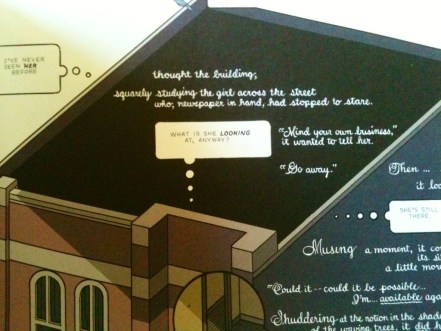
I noted two characters (again, new to me), but the building itself also gets a voice and prominent role in September; its thoughts and memories frame the narrative:

20121101-205351.jpg

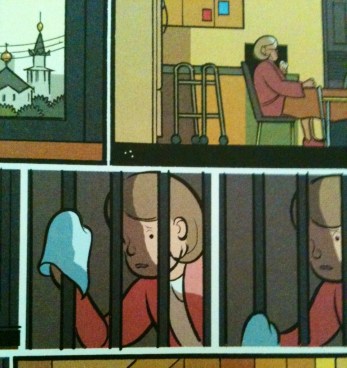
September frames the repetitions, the loops, the patterns that undoubtedly will resurface throughout Building Stories. We get access to the characters dreams, which seem to overlap and echo each other—and then repeat in real life, albeit in other forms. The landlady, recalling her youth, seems to echo the loneliness and despair of the lonely girl, as well as the pain of the woman in the sour relationship. We see that the building has in fact been a kind of prison for her, preventing her from forming real relationships:

20121101-205408.jpg

Other echoes are more subtle—a close up of a bee, for instance, either foreshadows or calls back to (or both, of course) Branford, the Best Bee in the World.

20121101-205429.jpg

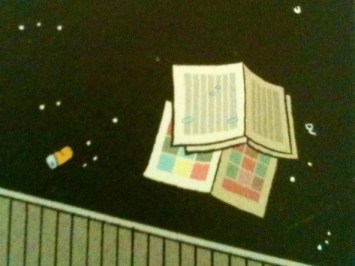
We can see the Branford episode again, here in the tiny detail of a soda can, a major setting for that episode. I was more fascinated by the newspaper though, particularly the colorful squares of a comics section, a reference Ware’s medium and perhaps a visual suggestion of Building Stories itself. The detail is tiny, but meaningful:

20121101-205421.jpg

In a later part of September, we see a direct reference to the end of I just met:

20121101-205436.jpg

I imagine that there were other references, call backs, and echoes in September that I won’t get until later.

The story—well, it’s beautiful, a perfect short story, self-contained but thematically resonant with the larger project. The ending is so damn sweet and perfect that it brought a little tear to my eye. And yet: Was that the ending? Of course not. The sense of rhetorical resolution—that is to say the so-called happy ending—will almost surely be punctured, deflated, or otherwise complicated by one of the next texts I read. More to come.