In Chapter 4 of F. Scott Fitzgerald’s The Great Gatsby, narrator Nick Carraway recounts the names of the rich, shallow, parasitic guests who attended Gatsby’s parties. Nick tells us the list comes from “an old time-table” of names he originally recorded in July 5th—significantly, the day after Independence Day: the day after the hopes and dreams of a new country. From the chapter—-
Once I wrote down on the empty spaces of a time-table the names of those who came to Gatsby’s house that summer. It is an old time-table now, disintegrating at its folds, and headed “This schedule in effect July 5th, 1922.” But I can still read the gray names, and they will give you a better impression than my generalities of those who accepted Gatsby’s hospitality and paid him the subtle tribute of knowing nothing whatever about him.
From East Egg, then, came the Chester Beckers and the Leeches, and a man named Bunsen, whom I knew at Yale, and Doctor Webster Civet, who was drowned last summer up in Maine. And the Hornbeams and the Willie Voltaires, and a whole clan named Blackbuck, who always gathered in a corner and flipped up their noses like goats at whosoever came near. And the Ismays and the Chrysties (or rather Hubert Auerbach and Mr. Chrystie’s wife), and Edgar Beaver, whose hair, they say, turned cotton-white one winter afternoon for no good reason at all.
Clarence Endive was from East Egg, as I remember. He came only once, in white knickerbockers, and had a fight with a bum named Etty in the garden. From farther out on the Island came the Cheadles and the O. R. P. Schraeders, and the Stonewall Jackson Abrams of Georgia, and the Fishguards and the Ripley Snells. Snell was there three days before he went to the penitentiary, so drunk out on the gravel drive that Mrs. Ulysses Swett’s automobile ran over his right hand. The Dancies came, too, and S. B. Whitebait, who was well over sixty, and Maurice A. Flink, and the Hammerheads, and Beluga the tobacco importer, and Beluga’s girls.
From West Egg came the Poles and the Mulreadys and Cecil Roebuck and Cecil Schoen and Gulick the state senator and Newton Orchid, who controlled Films Par Excellence, and Eckhaust and Clyde Cohen and Don S. Schwartze (the son) and Arthur McCarty, all connected with the movies in one way or another. And the Catlips and the Bembergs and G. Earl Muldoon, brother to that Muldoon who afterward strangled his wife. Da Fontano the promoter came there, and Ed Legros and James B. (“Rot-Gut.”) Ferret and the De Jongs and Ernest Lilly — they came to gamble, and when Ferret wandered into the garden it meant he was cleaned out and Associated Traction would have to fluctuate profitably next day.
A man named Klipspringer was there so often and so long that he became known as “the boarder.”— I doubt if he had any other home. Of theatrical people there were Gus Waize and Horace O’donavan and Lester Meyer and George Duckweed and Francis Bull. Also from New York were the Chromes and the Backhyssons and the Dennickers and Russel Betty and the Corrigans and the Kellehers and the Dewars and the Scullys and S. W. Belcher and the Smirkes and the young Quinns, divorced now, and Henry L. Palmetto, who killed himself by jumping in front of a subway train in Times Square.
Benny McClenahan arrived always with four girls. They were never quite the same ones in physical person, but they were so identical one with another that it inevitably seemed they had been there before. I have forgotten their names — Jaqueline, I think, or else Consuela, or Gloria or Judy or June, and their last names were either the melodious names of flowers and months or the sterner ones of the great American capitalists whose cousins, if pressed, they would confess themselves to be.
In addition to all these I can remember that Faustina O’brien came there at least once and the Baedeker girls and young Brewer, who had his nose shot off in the war, and Mr. Albrucksburger and Miss Haag, his fiancee, and Ardita Fitz-Peters and Mr. P. Jewett, once head of the American Legion, and Miss Claudia Hip, with a man reputed to be her chauffeur, and a prince of something, whom we called Duke, and whose name, if I ever knew it, I have forgotten.
All these people came to Gatsby’s house in the summer.
Reef joined Ruperta’s loose salon of neuræsthenics traveling hot spring to spring in search of eternal youth or fleeing the deadweight of time, finding enough impulsive or inattentive cardplayers to keep him in Havanas and $3.50-a-quart Champagne, and Ruperta surprised enough now and then with silver and lapis Indian trinkets and the odd bushel of flowers to keep her guessing, she having figured him for a white savage masquerading as an exquisite. Which did not prevent them from going round and round on average once a week, memorable uproars that sent everybody running for the periphery, uncertain as to what distance was safe. In between these dustups, Reef had long, desultory conversations with his penis, to the effect that there wasn’t much point missing Stray too much right now, was there, as it would only blunt the edge of desire, not only for Ruperta but whoever else, Yup Toy or whoever, might drift by over the course of their travels.
They finally parted company in New Orleans after a confused and repetitive headache of a night that began at the establishment of Monsieur Peychaud, where the Sazeracs, though said to’ve been invented there, were not a patch, it seemed to Reef, on those available at Bob Stockton’s bar in Denver, though those Absinthe Frappés were another matter. After taking on fuel, the party moved out into the French Quarter hunting for modes of intoxication “more exotic,” meaning, if you pushed it, some form of zombie powder. Ruperta tonight was in a narrow black bengaline costume with a Medici collar and cuffs of bastard chinchilla. Nothing on underneath except for stays and stockings, as Reef had had occasion to find out earlier, at their habitual lateafternoon rendezvous.
It had soon become apparent in this town that what you could see from the street was not only less than “the whole story” but in fact not even the picture on the cover. The real life of this place was secured deep inside the city blocks, behind ornate iron gates and up tiled passages that might as well’ve run for miles. You could hear faint strands of music, crazy stuff, banjos and bugling, trombone glissandi, pianos under the hands of whorehouse professors sounding like they came with keys between the keys. Voodoo? Voodoo was the least of it, Voodoo was just everywhere. Invisible sentinels were sure to let you know, the thickest of necks being susceptible here to monitory pricklings of the Invisible. The Forbidden. And meantime the smells of the local cuisine, cheurice sausages, gumbo, crawfish étouffé, and shrimp boiled in sassafras, proceeding from no place you could ever see, went on scrambling what was left of your good sense. Negroes could be observed at every hand, rollicking in the street. The so-called Italian Troubles, stemming from the alleged Mafia assassination of the chief of police here being yet fresh in the civic memory, children were apt to accost strangers, Italian or not, with, “Who killa da chief?” not to mention “Va fongoola your sister.”
Another passage from Thomas Pynchon’s novel Against the Day.
Luca Zombini liked to explain the business, at various times, to those of his children he deluded himself were eager to learn, even someday carry on, the act. “Those who sneer at us, and sneer at themselves for paying to let us fool them, what they never see is the yearning. If it was religious, a yearning after God—no one would dream of disrespecting that. But because this is a yearning only after miracle, only to contradict the given world, they hold it in contempt.
“Remember, God didn’t say, ‘I’m gonna make light now,’ he said, ‘Let there be light.’ His first act was to allow light in to what had been Nothing. Like God, you also have to always work with the light, make it do only what you want it to.”
He unrolled an expanse of absolute fluid blackness. “Magician-grade velvet, perfect absorber of light. Imported from Italy. Very expensive. Dyed, sheared, and brushed by hand many, many times. Finished with a secret method of applying platinum black. Factory inspections are merciless. Same as mirrors, only opposite. The perfect mirror must send back everything, same amount of light, same colors exactly—but perfect velvet must let nothing escape, must hold on to every last little drop of light that falls on it. Because if the smallest amount of light you can think of bounces off one single thread, the whole act—affondato, vero? It’s all about the light, you control the light, you control the effect, capisci?”
I think we get a fairly concise illustration of some of Against the Day’s major themes here: light, invisibility, perception, control, etc.
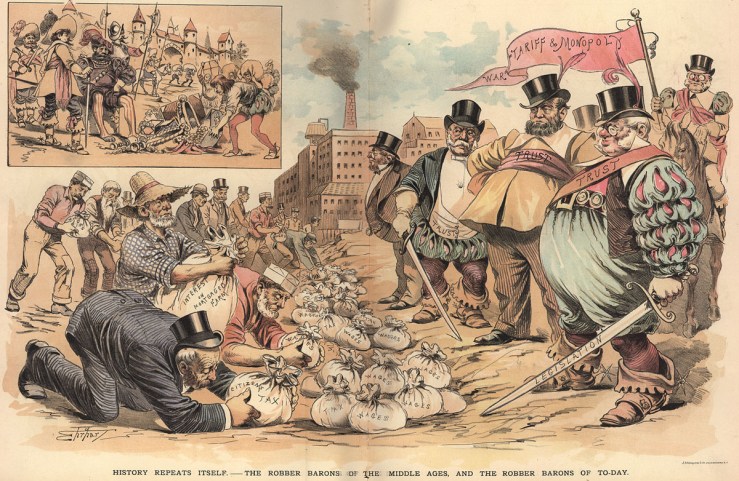
1. The passage I’ll be riffing on todayis hardly the funniest or most dazzling piece of writing I’ve encountered so far in Thomas Pynchon’s massive, shaggy novel Against the Day. However, I think this stretch of writing neatly and concisely illustrates the perspective (maybe world view is a better term; hell, we could even go with fancy-pants Weltanschauung here) of who I take to be the novel’s most prominent villain, ruthless robber baron Scarsdale Vibe.
More significantly, I think this passage illustrates the ways that Pynchon’s big novel analyzes American history and illuminates the contemporary American zeitgeist.
2. The block quote citations are continuous, although I’ll be interrupting. The passage starts at the very bottom of page 331 and goes through 334 in my hardback Penguin first edition.
3. Okay, so a bit of context:
Our scene is mostly a dialogue, or a monologue really, between Scarsdale Vibe and his Other, Foley Walker, who took Scarsdale’s place in the Civil War, took a bullet to the brain, and now, like so many of the characters in Against the Day, has special powers (he can hear voices that tell him how to invest (Scarsdale’s) money in the market).
Back at Pearl Street, the two Vibes were sitting over brandy and cigars.
“A tough one to figure, that kid,” Foley opined. “Sure hope we ain’t got another Red in the root cellar like his old man.”
The “kid” here is hero Kit Traverse, and his old man — the “Red in the root cellar” — is the recently-deceased-on-Scarsdale’s-orders Webb Traverse, the Kieselguhr Kid, enemy of the captains of industry.
Scarsdale is backing Kit in the hopes that he’ll become “the next Edison” — and not, significantly, the next Tesla.
5. (Tesla v. Edison—another set of doubles in the book.
Tesla, Serbian-American, mad magician, prophet of science, seer of the invisible, wants to provide free power for all is clearly allied (in Pynchon’s book, that is) with the unions, the Traverses, labor—the good guys.
His double, Edison: American-American, reputed idea-thief, dog-electrocuter; Edison, a hustler who sweated out idea after idea, perhaps gracelessly; Edison, whose methods and inventions could generate corporate profits.
Tesla remarked of Edison, after his death: “he had a veritable contempt for book learning and mathematical knowledge, trusting himself entirely to his inventor’s instinct and practical American sense”).
6. Note that Scarsdale wouldn’t hesitate to kill Kit:
“Our duty would be no less clear. There are hundreds of these abscesses suppurating in the body of our Republic,” an oratorical throb creeping into Scarsdale’s voice, “which must be removed, wherever they are found. No other option. The elder Traverse’s sins are documented—once they were brought to light, he was as good as lost. Should there be moral reservations, in a class war, about targeting one’s enemies? You have been in this game long enough to appreciate how mighty are the wings we shelter beneath. How immune we are kept to the efforts of these muckraking Reds to soil our names. Unless—Walker, have I missed something? you aren’t developing a soft spot.”
As Scarsdale’s was not the only voice Foley had to attend to, he erred, as usual, on the side of mollification. He held out his glowing Havana. “If you can find a soft spot, use it to put this out on.”
“What happened to us, Foley? We used to be such splendid fellows.”
“Passage of Time, but what’s a man to do?”
“Too easy. Doesn’t account for this strange fury I feel in my heart, this desire to kill off every damned socialist and so on leftward, without any more mercy than I’d show a deadly microbe.”
“Sounds reasonable to me. Not like that we haven’t bloodied up our hands already here.” Scarsdale gazed out his window at a cityscape once fair but with the years grown more and more infested with shortcomings. “I wanted so to believe. Even knowing my own seed was cursed, I wanted the eugenics argument to be faulty somehow. At the same time I coveted the bloodline of my enemy, which I fancied uncontaminated, I wanted that promise, promise unlimited.”
Foley pretended his narrowing of gaze was owing to cigarsmoke. “Mighty Christian attitude,” he commented at last, in a tone as level as he could make it.
Here we see Scarsdale’s hatred of organized labor, of anything that impedes on his profits, get tangled into the ideology that underwrites this conflict. He even cites the conflict as “a class war.” This class war interweaves into his personal life: he is usurping the coveted “bloodline of my enemy” by attempting to adopt Kit.
7. The scene then takes on a religious dimension, exploring a “Mighty Christian attitude”:
“Foley, I’m as impatient with religious talk as the next sinner. But what a burden it is to be told to love them, while knowing that they are the Antichrist itself, and that our only salvation is to deal with them as we ought.”
Pynchon’s villain here sounds like so many figures on the contemporary American Evangelical right, who repeatedly conflate their political/cultural enemies with “Antichrist” as a means to avoid the Jesusian imperative to love the Other.
8. Remember, wealthy Scarsdale—his father, really—was able to buy a deferment from the Civil War; Foley took his place:
It did not help Foley’s present mood that he had awakened that morning from a recurring nightmare of the Civil War. The engagement was confined to an area no bigger than an athletic field, though uncountable thousands of men had somehow been concentrated there. All was brown, gray, smoky, dark. A lengthy exchange of artillery had begun, from emplacements far beyond the shadowy edges of the little field. He had felt oppressed by the imminence of doom, of some suicidal commitment of infantry which no one would escape. A pile of explosives nearby, a tall, rickety wood crib of shells and other ammunition began to smolder, about to catch fire and blow up at any moment, a clear target for the cannonballs of the other side, which continued to come in, humming terribly, without pause. . . .
Foley has actually fought and been wounded and risked. He’s literally put skin in the game.
In contrast, Scarsdale Vibe was able to continue amassing and controlling wealth—just like other robber barons who bought deferments and then profited from the war (Andrew Carnegie, J.D. Rockefeller, and Jay Gould, just to name a few).
9. Note how Scarsdale, claiming “My civil war has yet to come,” pitches the conflict between capital and labor in terms of a holy war:
“I didn’t have my war then,” Scarsdale had been saying. “Just as well. I was too young to appreciate what was at stake anyway. My civil war was yet to come. And here we are in it now, in the thick, no end in sight. The Invasion of Chicago, the battles of Homestead, the Coeur d’Alene, the San Juans. These communards speak a garble of foreign tongues, their armies are the damnable labor syndicates, their artillery is dynamite, they assassinate our great men and bomb our cities, and their aim is to despoil us of our hard-won goods, to divide and subdivide among their hordes our lands and our houses, to pull us down, our lives, all we love, until they become as demeaned and soiled as their own. О Christ, Who hast told us to love them, what test of the spirit is this, what darkness hath been cast over our understanding, that we can no longer recognize the hand of the Evil One?
Note the xenophobia here, the fear that the dark Other with their “garble of foreign tongues” will try “to pull us down, our lives, all we love.” Good thing this poor rich captain of industry will fight for Real America!
10. Scarsdale, weary from carrying his White Man’s Burden:
“I am so tired, Foley, I have struggled too long in these thankless waters, I am as an unconvoyed vessel alone in a tempest that will not, will never abate. The future belongs to the Asiatic masses, the pan-Slavic brutes, even, God help us, the black seething spawn of Africa interminable. We cannot hold. Before these tides we must go under. Where is our Christ, our Lamb? the Promise?”
Seeing his distress, Foley meant only to comfort. “In our prayers—”
“Foley, spare me that, what we need to do is start killing them in significant numbers, for nothing else has worked. All this pretending—’equality,’ ‘negotiation’—it’s been such a cruel farce, cruel to both sides. When the Lord’s people are in danger, you know what he requires.”
“Smite.”
“Smite early and often.”
And there it is: The ideological veneer of demagoguery quickly gives way to the violent impulses seething underneath. Scarsdale’s Real America has no place for equality and negotiation. Just smiting.
11. And then quoth Foley:
“Hope there’s nobody listening in on this.”
I can’t help but read this as a joke, an echo (pre-echo?) of Nixonian paranoia. The direct recognition that there is a gap between intention at the core and the way that intention is represented (hidden) on the surface (in language, in gesture).
12. But Scarsdale is unafraid:
“God is listening. As to men, I have no shame about what must be done.” A queer tension had come into his features, as if he were trying to suppress a cry of delight.
“But you, Foley, you seem kind of—almost—nervous.” Foley considered briefly. “My nerves? Cast iron.” He relit his cigar, the matchflame unshaking. “Ready for anything.”
Scarsdale’s God is the god of the white man robber baron Real American capitalist, and “God is listening” not because he is omnipresent but because he is on Scarsdale’s side.
13. Foley doesn’t quite buy this resolve:
Aware of the Other Vibe’s growing reluctance to trust reports from out in the field, Foley, who usually was out there and thought he had a good grasp on things, at first resentful and after a while alarmed, had come to see little point these days in speaking up. The headquarters in Pearl Street seemed more and more like a moated castle and Scarsdale a ruler isolated in self resonant fantasy, a light to his eyes these days that was not the same as that old, straightforward acquisitive gleam. The gleam was gone, as if Scarsdale had accumulated all the money he cared to and was now moving on in his biography to other matters, to action in the great world he thought he understood but—even Foley could see—was failing, maybe fatally, even to ask the right questions about anymore.
Foley, who actually served in war, “who usually was out there,” can see that Scarsdale can only see what he wants to see—the Other Vibe lives in “a moated castle” as a “ruler isolated in self resonant fantasy,” blinded by the lights of his xenophobic ideology, which has moved beyond mere money to pursue some other greater power.
14. Foley, so far anyway, proves an important contrast, a balance even, to Scarsdale’s zealous evil. Through his eyes we can see the effects that isolation have taken on Scarsdale, who is becoming increasingly paranoid, anxious—crazy even. Scarsdale is completely divided from the men and women who create his wealth—he doesn’t understand (let alone empathize with) the average American—yet he sees himself as the God-appointed, self-created savior of America (an America with no place for equality or negotiation). The ways in which this passage diagnoses certain attitudes in contemporary American politics/big-business strikes me as so transparent that I won’t remark on them at further length. Pynchon’s novel documents the tail-end of the Gilded Age through the end of the Great War, showing us that the conflicts of the past are the conflicts of today—and tomorrow.
“Love Letter Written in a Burning Building” by Anne Sexton—
I am in a crate, the crate that was ours,
full of white shirts and salad greens,
the icebox knocking at our delectable knocks,
and I wore movies in my eyes,
and you wore eggs in your tunnel,
and we played sheets, sheets, sheets
all day, even in the bathtub like lunatics.
But today I set the bed afire
and smoke is filling the room,
it is getting hot enough for the walls to melt,
and the icebox, a gluey white tooth.
I have on a mask in order to write my last words,
and they are just for you, and I will place them
in the icebox saved for vodka and tomatoes,
and perhaps they will last.
The dog will not. Her spots will fall off.
The old letters will melt into a black bee.
The night gowns are already shredding
into paper, the yellow, the red, the purple.
The bed – well, the sheets have turned to gold –
hard, hard gold, and the mattress
is being kissed into a stone.
As for me, my dearest Foxxy,
my poems to you may or may not reach the icebox
and its hopeful eternity,
for isn’t yours enough?
The one where you name
my name right out in P.R.?
If my toes weren’t yielding to pitch
I’d tell the whole story –
not just the sheet story
but the belly-button story,
the pried-eyelid story,
the whiskey-sour-of-the-nipple story –
and shovel back our love where it belonged.
Despite my asbestos gloves,
the cough is filling me with black and a red powder seeps through my
veins,
our little crate goes down so publicly
and without meaning it, you see, meaning a solo act,
a cremation of the love,
but instead we seem to be going down right in the middle of a Russian
street,
the flames making the sound of
the horse being beaten and beaten,
the whip is adoring its human triumph
while the flies wait, blow by blow,
straight from United Fruit, Inc.






 Biblioklept