“May-Day” — Ralph Waldo Emerson

“May-Day” by Ralph Waldo Emerson

Daughter of Heaven and Earth, coy Spring,
With sudden passion languishing,
Maketh all things softly smile,
Painteth pictures mile on mile,
Holds a cup with cowslip-wreaths,
Whence a smokeless incense breathes.
Girls are peeling the sweet willow,
Poplar white, and Gilead-tree,
And troops of boys
Shouting with whoop and hilloa,
And hip, hip three times three.
The air is full of whistlings bland;
What was that I heard
Out of the hazy land?
Harp of the wind, or song of bird,
Or clapping of shepherd’s hands,
Or vagrant booming of the air,
Voice of a meteor lost in day?
Such tidings of the starry sphere
Can this elastic air convey.
Or haply ‘t was the cannonade
Of the pent and darkened lake,
Cooled by the pendent mountain’s shade,
Whose deeps, till beams of noonday break,
Afflicted moan, and latest hold
Even unto May the iceberg cold.
Was it a squirrel’s pettish bark,
Or clarionet of jay? or hark,
Where yon wedged line the Nestor leads,
Steering north with raucous cry
Through tracts and provinces of sky,
Every night alighting down
In new landscapes of romance,
Where darkling feed the clamorous clans
By lonely lakes to men unknown.
Come the tumult whence it will,
Voice of sport, or rush of wings,
It is a sound, it is a token
That the marble sleep is broken,
And a change has passed on things.
Continue reading ““May-Day” — Ralph Waldo Emerson”

Heavy Dreams (Sigizmund Krzhizhanovsky)

Quantin followed the procession for a few minutes out of morbid curiosity. The choice of narrower side streets, where it was easier to enlist the wall’s support, was probably deliberate, he thought, but then a long notice stuck to the stone exactly at eye level arrested his attention and, with it, his progress. The notice—in the manner of a proper, not overly pushy advertisement—listed the advantages ofso-called heavy dreams. Having come across the subject once before, Quantin read the fine print carefully, line by line: “The main advantage of the heavy industry of nightmares over the light industry of golden threads plunged into brain fibrils, over the production of so-called sweet dreams, is that in marketing our nightmares we can guarantee that they will come true, we can hand our customers ‘turnkey dreams.’ Sweet dreams cannot withstand reality, sleepy reveries wear out faster than socks; whereas a heavy dream, a simple but well-made nightmare, is easily assimilated by life. Where dreams unburdened by anything disappear like drops of water in the sand, dreams containing a certain harshness will, as they evaporate in the sun, leave a hard kernel on the roof of Plato’s famous cave: these dposits will collect and accrue, eventually forming a swordlike stalactite.

“Speaking in more modern terms,” the fine print went on, “our nightmares, weighing as they do on the brain, gradually form a sort of moral ceiling that is always about to come crashing down on one’s head: some of our customer’s call this ‘world history.’ But that’s not the point. The point is the durability, unwakeability, high depressiveness, and wide availability of our nightmares: mass-market products good for all eras and classes, nighttime and daytime, moonlight and sunlight, closed eyes and open.”

From Sigizmund Krzhizhanovsky’s short story “The Branch Line,” collected in NYRB’s Memories of the Future (translation by Joanne Turnbull).

Henry Miller/Georg Büchner (Books Acquired, 4.30.2013)

20130430-165618.jpg

Needing another book the same way I need another hole in the head, I nevertheless dropped by my local used bookstore to browse—the place is huge, and a day of grading term papers made me feel zapped and perhaps depressed. Anyway. Spotted a beautiful Penguin edition of Henry Miller’s The Colossus of Maroussi and had to have it. Here’s a passage some soul saw fit to dogear:

20130430-165623

I had never heard of Georg Büchner or his novella fragment Lenz, but it was shelved next to Blake Butler’s Scorch Atlas and both stood out because of their odd shapes.

20130430-165633.jpg

Here are the blurbs for Lenz, which more or less sold me:

20130430-165639.jpg

Finally, I did not buy yet another edition of Moby-Dick, despite this midcentury Rinheart cover—but I had to snap it to share:

20130430-165646.jpg


“I dreamt that the Earth was finished” — Roberto Bolaño

31. I dreamt that Earth was finished. And the only
human being to contemplate the end was Franz
Kafka. In heaven, the Titans were fighting to the
death. From a wrought-iron seat in Central Park,
Kafka was watching the world burn.

32. I dreamt I was dreaming and I came home
too late. In my bed I found Mário de Sá-Carneiro
sleeping with my first love. When I uncovered them
I found they were dead and, biting my lips till they
bled, I went back to the streets.

33. I dreamt that Anacreon was building his castle
on the top of a barren hill and then destroying it.

34. I dreamt I was a really old Latin American
detective. I lived in New York and Mark Twain
was hiring me to save the life of someone without
a face. “It’s going to be a damn tough case, Mr.
Twain,” I told him.

35. I dreamt I was falling in love with Alice Sheldon.
She didn’t want me. So I tried getting myself killed
on three continents. Years passed. Finally, when I
was really old, she appeared on the other end of the
promenade in New York and with signals (like the
ones they use on aircraft carriers to help the pilots
land) she told me she’d always loved me.

36. I dreamt I was 69ing with Anaïs Nin on an
enormous basaltic flagstone.

Read more short poems from Roberto Bolaño’s Tres (New Directions) in translation by Laura Healy.

Plagiarism

The first century Roman poet Martial used the Latin word plagiarius to complain that another poet had kidnapped his verses.

Plagiarius: kidnapper, seducer, plunderer, one who kidnaps the child or slave of another.

Anglicized by Johnson in 1601.

Plagiary, adjective. 1. Stealing men; kidnapping. 2. Practicing literary theft.

Based on the Indo-European root *-plak, “to weave” (seen for instance in Greek plekein, Bulgarian “плета” pleta, Latin plectere, all meaning “to weave”).

Listen Fates, who sit nearest of gods to the throne of Zeus, and weave with shuttles of adamant, inescapable devices for councels of every kind beyond counting.

Neith.

Frigg.

Brigantia.

If, while riding a horse overland, a man should come upon a woman spinning, then that is a very bad sign; he should turn around and take another way.

Wonderful, wonderful, yet again the sword of fate severs the head from the hydra of chance.

When shall we three meet again

In thunder, lightning, or in rain?

As we, or mother Dana, weave and unweave our bodies from day to day, their molecules shuttled to and fro, so does the artist weave and unweave his image.

In the 19th century there was a literary scandal when the leading Sterne scholar of the day discovered that many of the quintessentially Sternean passages of Tristram Shandy had been lifted from other authors.

Typically, a passage lamenting the lack of originality among contemporary writers was plagiarised from Burton’s Anatomy of Melancholy.

Now academics call the plagiarism “intertextuality.”

When the hurlyburly’s done,

When the battle’s lost and won.

Urðr.

Verðandi.

Skuld.

Olaudah Equiano was born in 1745 in Eboe, in what is now Nigeria. When he was about eleven, Equiano was kidnapped and sold to slave traders headed to the West Indies.

When our women are not employed with the men in tillage, their usual occupation is spinning and weaving cotton, which they afterwards dye, and make it into garments.

“I did so, sir, for my sins,” said I; “for it was by his means and the procurement of my uncle, that I was kidnapped within sight of this town, carried to sea, suffered shipwreck and a hundred other hardships, and stand before you to-day in this poor accoutrement.”

Persephone.

Europa.

Ganymede.

Plagiarism begins at home.

Nothing is said which has not been said before.

Originality: Judicious imitation.

Perhaps the efforts of the true poets, founders, religions, literatures, all ages, have been, and ever will be, our time and times to come, essentially the same—to bring people back from their present strayings and sickly abstractions, to the costless, average, divine, original concrete.

Hippolyta.

Helen.

Rapunzel.

I am against the prophets, saith the Lord, that steal My words every one from his neighbor.

Katherine Anne Porter on F. Scott Fitzgerald (She Wasn’t a Fan)

Katherine Anne Porter in her Paris Review interview:

PORTER

I’ve never belonged to any group or huddle of any kind. You cannot be an artist and work collectively. Even the fact that I went to Mexico when everybody else was going to Europe—I went to Mexico because I felt I had business there. And there I found friends and ideas that were sympathetic to me. That was my entire milieu. I don’t think anyone even knew I was a writer. I didn’t show my work to anybody or talk about it, because—well, no one was particularly interested in that. It was a time of revolution, and I was running with almost pure revolutionaries!

INTERVIEWER

And you think that was a more wholesome environment for a writer than, say, the milieu of the expatriated artist in Europe at the same time?

PORTER

Well, I know it was good for me. I would have been completely smothered—completely disgusted and revolted—by the goings-on in Europe. Even now when I think of the twenties and the legend that has grown up about them, I think it was a horrible time: shallow and trivial and silly. The remarkable thing is that anybody survived in such an atmosphere—in a place where they could call F. Scott Fitzgerald a great writer!

INTERVIEWER

You don’t agree?

PORTER

Of course I don’t agree. I couldn’t read him then and I can’t read him now. There was just one passage in a book called Tender Is the Night—I read that and thought, “Now I will read this again,” because I couldn’t be sure. Not only didn’t I like his writing, but I didn’t like the people he wrote about. I thought they weren’t worth thinking about, and I still think so. It seems to me that your human beings have to have some kind of meaning. I just can’t be interested in those perfectly stupid meaningless lives. And I don’t like the same thing going on now—the way the artist simply will not face up to the final reckoning of things.

The Scream (David Markson)

Capture

“Buds and Bird-voices” — Nathaniel Hawthorne

“Buds and Bird-voices” by Nathaniel Hawthorne

BALMY Spring—weeks later than we expected, and months later than we longed for her—comes at last to revive the moss on the roof and walls of our old mansion. She peeps brightly into my study window, inviting me to throw it open and create a summer atmosphere by the intermixture of her genial breath with the black and cheerless comfort of the stove. As the casement ascends, forth into infinite space fly the innumerable forms of thought or fancy that have kept me company in the retirement of this little chamber during the sluggish lapse of wintry weather—visions gay, grotesque and sad, pictures of real life tinted with nature’s homely gray and russet, scenes in dreamland bedizened with rainbow-hues which faded before they were well laid on. All these may vanish now, and leave me to mold a fresh existence out of sunshine. Brooding Meditation may flap her dusky wings and take her owl-like flight, blinking amid the cheerfulness of noontide. Such companions befit the season of frosted window-panes and crackling fires, when the blast howls through the black-ash trees of our avenue, and the drifting snowstorm chokes up the wood paths and fills the highway from stone wall to stone wall. In the spring and summer time all somber thoughts should follow the winter northward with the somber and thoughtful crows. The old paradisiacal economy of life is again in force: we live, not to think nor to labor, but for the simple end of being happy; nothing for the present hour is worthy of man’s infinite capacity save to imbibe the warm smile of heaven and sympathize with the reviving earth.

The present Spring comes onward with fleeter footsteps because Winter lingered so unconscionably long that with her best diligence she can hardly retrieve half the allotted period of her reign. It is but a fortnight since I stood on the brink of our swollen river and beheld the accumulated ice of four frozen months go down the stream. Except in streaks here and there upon the hillsides, the whole visible universe was then covered with deep snow the nethermost layer of which had been deposited by an early December storm. It was a sight to make the beholder torpid, in the impossibility of imagining how this vast white napkin was to be removed from the face of the corpse-like world in less time than had been required to spread it there. But who can estimate the power of gentle influences, whether amid material desolation or the moral winter of man’s heart? There have been no tempestuous rains—even no sultry days—but a constant breath of southern winds, with now a day of kindly sunshine, and now a no less kindly mist, or a soft descent of showers, in which a smile and a blessing seemed to have been steeped. The snow has vanished as if by magic; whatever heaps may be hidden in the woods and deep gorges of the hills, only two solitary specks remain in the landscape, and those I shall almost regret to miss when to-morrow I look for them in vain. Never before, methinks, has spring pressed so closely on the footsteps of retreating winter. Along the roadside the green blades of grass have sprouted on the very edge of the snowdrifts. The pastures and mowing fields have not yet assumed a general aspect of verdure, but neither have they the cheerless brown tint which they wear in later autumn, when vegetation has entirely ceased; there is now a faint shadow of life, gradually brightening into the warm reality. Some tracts in a happy exposure—as, for instance, yonder southwestern slope of an orchard, in front of that old red farmhouse beyond the river—such patches of land already wear a beautiful and tender green to which no future luxuriance can add a charm. It looks unreal—a prophecy, a hope, a transitory effect of some peculiar light, which will vanish with the slightest motion of the eye. But beauty is never a delusion; not these verdant tracts but the dark and barren landscape all around them is a shadow and a dream. Each moment wins some portion of the earth from death to life; a sudden gleam of verdure brightens along the sunny slope of a bank which an instant ago was brown and bare. You look again, and, behold an apparition of green grass!

The trees in our orchard and elsewhere are as yet naked, but already appear full of life and vegetable blood. It seems as if by one magic touch they might instantaneously burst into full foliage, and that the wind which now sighs through their naked branches might make sudden music amid innumerable leaves. The moss-grown willow tree which for forty years past has overshadowed these western windows will be among the first to put on its green attire. There are some objections to the willow: it is not a dry and cleanly tree, and impresses the beholder with an association of sliminess. No trees, I think, are perfectly agreeable as companions unless they have glossy leaves, dry bark, and a firm and hard texture of trunk and branches. But the willow is almost the earliest to gladden us with the promise and reality of beauty in its graceful and delicate foliage, and the last to scatter its yellow, yet scarcely-withered, leaves upon the ground. All through the winter, too, its yellow twigs give it a sunny aspect which is not without a cheering influence even in the grayest and gloomiest day. Beneath a clouded sky it faithfully remembers the sunshine. Our old house would lose a charm were the willow to be cut down, with its golden crown over the snow-covered roof, and its heap of summer verdure.

The lilac shrubs under my study windows are likewise almost in leaf; in two or three days more I may put forth my hand and pluck the topmost bough in its freshest green. These lilacs are very aged, and have lost the luxuriant foliage of their prime. The heart or the judgment or the moral sense or the taste is dissatisfied with their present aspect. Old age is not venerable when it embodies itself in lilacs, rose-bushes, or any other ornamental shrubs; it seems as if such plants, as they grow only for beauty, ought to flourish only in immortal youth—or, at least, to die before their sad decrepitude. Trees of beauty are trees of paradise, and therefore not subject to decay by their original nature, though they have lost that precious birthright by being transplanted to an earthly soil. There is a kind of ludicrous unfitness in the idea of a time-stricken and grandfatherly lilac-bush. The analogy holds good in human life. Persons who can only be graceful and ornamental—who can give the world nothing but flowers—should die young, and never be seen with gray hair and wrinkles, any more than the flower-shrubs with mossy bark and blighted foliage, like the lilacs under my window. Not that beauty is worthy of less than immortality. No; the beautiful should live forever, and thence, perhaps, the sense of impropriety when we see it triumphed over by time. Apple trees, on the other hand, grow old without reproach. Let them live as long as they may, and contort themselves into whatever perversity of shape they please, and deck their withered limbs with a springtime gaudiness of pink-blossoms, still they are respectable, even if they afford us only an apple or two in a season. Those few apples—or, at all events, the remembrance of apples in bygone years—are the atonement which utilitarianism inexorably demands for the privilege of lengthened life. Human flower shrubs, if they will grow old on earth, should, besides their lovely blossoms, bear some kind of fruit that will satisfy earthly appetites, else neither man nor the decorum of nature will deem it fit that the moss should gather on them.

One of the first things that strikes the attention when the white sheet of winter is withdrawn is the neglect and disarray that lay hidden beneath it. Nature is not cleanly, according to our prejudices. The beauty of preceding years, now transformed to brown and blighted deformity, obstructs the brightening loveliness of the present hour. Our avenue is strewn with the whole crop of autumn’s withered leaves. There are quantities of decayed branches which one tempest after another has flung down, black and rotten, and one or two with the ruin of a bird’s nest clinging to them. In the garden are the dried bean-vines, the brown stalks of the asparagus-bed, and melancholy old cabbages which were frozen into the soil before their unthrifty cultivator could find time to gather them. How invariable throughout all the forms of life do we find these intermingled memorials of death! On the soil of thought and in the garden of the heart, as well as in the sensual world, lie withered leaves—the ideas and feelings that we have done with. There is no wind strong enough to sweep them away; infinite space will not garner them from our sight. What mean they? Why may we not be permitted to live and enjoy as if this were the first life and our own the primal enjoyment, instead of treading always on these dry bones and mouldering relics from the aged accumulation of which springs all that now appears so young and new? Sweet must have been the spring-time of Eden, when no earlier year had strewn its decay upon the virgin turf, and no former experience had ripened into summer and faded into autumn in the hearts of its inhabitants! That was a world worth living in.—Oh, thou murmurer, it is out of the very wantonness of such a life that thou feignest these idle lamentations. There is no decay. Each human soul is the first created inhabitant of its own Eden.—We dwell in an old moss-covered mansion and tread in the worn footprints of the past and have a gray clergyman’s ghost for our daily and nightly inmate, yet all these outward circumstances are made less than visionary by the renewing power of the spirit. Should the spirit ever lose this power—should the withered leaves and the rotten branches and the moss-covered house and the ghost of the gray past ever become its realities, and the verdure and the freshness merely its faint dream—then let it pray to be released from earth. It will need the air of heaven to revive its pristine energies.

What an unlooked for flight was this from our shadowy avenue of black-ash and balm-of-gilead trees into the infinite! Now we have our feet again upon the turf. Nowhere does the grass spring up so industriously as in this homely yard, along the base of the stone wall and in the sheltered nooks of the buildings, and especially around the southern door-step—a locality which seems particularly favorable to its growth, for it is already tall enough to bend over and wave in the wind. I observe that several weeds—and, most frequently, a plant that stains the fingers with its yellow juice—have survived and retained their freshness and sap throughout the winter. One knows not how they have deserved such an exception from the common lot of their race. They are now the patriarchs of the departed year, and may preach mortality to the present generation of flowers and weeds.

Among the delights of spring, how is it possible to forget the birds? Even the crows were welcome, as the sable harbingers of a brighter and livelier race. They visited us before the snow was off, but seem mostly to have betaken themselves to remote depths of the woods, which they haunt all summer long. Many a time shall I disturb them there, and feel as if I had intruded among a company of silent worshipers as they sit in Sabbath stillness among the treetops. Their voices, when they speak, are in admirable accordance with the tranquil solitude of a summer afternoon, and, resounding so far above the head, their loud clamor increases the religious quiet of the scene instead of breaking it. A crow, however, has no real pretensions to religion, in spite of his gravity of mien and black attire; he is certainly a thief, and probably an infidel. The gulls are far more respectable, in a moral point of view. These denizens of sea-beaten rocks and haunters of the lonely beach come up our inland river at this season, and soar high overhead, flapping their broad wings in the upper sunshine. They are among the most picturesque of birds, because they so float and rest upon the air as to become almost stationary parts of the landscape. The imagination has time to grow acquainted with them; they have not flitted away in a moment. You go up among the clouds and greet these lofty-flighted gulls, and repose confidently with them upon the sustaining atmosphere. Ducks have their haunts along the solitary places of the river, and alight in flocks upon the broad bosom of the overflowed meadows. Their flight is too rapid and determined for the eye to catch enjoyment from it, although it never fails to stir up the heart with the sportsman’s ineradicable instinct. They have now gone farther northward, but will visit us again in autumn.

The smaller birds—the little songsters of the woods, and those that haunt man’s dwellings and claim human friendship by building their nests under the sheltering eaves or among the orchard trees—these require a touch more delicate and a gentler heart than mine to do them justice. Their outburst of melody is like a brook let loose from wintry chains. We need not deem it a too high and solemn word to call it a hymn of praise to the Creator, since Nature, who pictures the reviving year in so many sights of beauty, has expressed the sentiment of renewed life in no other sound save the notes of these blessed birds. Their music, however, just now seems to be incidental, and not the result of a set purpose. They are discussing the economy of life and love and the site and architecture of their summer residences, and have no time to sit on a twig and pour forth solemn hymns or overtures, operas, symphonies and waltzes. Anxious questions are asked, grave subjects are settled in quick and animated debate, and only by occasional accident, as from pure ecstasy, does a rich warble roll its tiny waves of golden sound through the atmosphere. Their little bodies are as busy as their voices; they are in a constant flutter and restlessness. Even when two or three retreat to a tree-top to hold council, they wag their tails and heads all the time with the irrepressible activity of their nature, which perhaps renders their brief span of life in reality as long as the patriarchal age of sluggish man. The blackbirds—three species of which consort together—are the noisiest of all our feathered citizens. Great companies of them—more than the famous “four-and-twenty” whom Mother Goose has immortalized—congregate in contiguous tree-tops and vociferate with all the clamor and confusion of a turbulent political meeting. Politics, certainly, must be the occasion of such tumultuous debates, but still, unlike all other politicians, they instill melody into their individual utterances and produce harmony as a general effect. Of all bird-voices, none are more sweet and cheerful to my ear than those of swallows in the dim, sun-streaked interior of a lofty barn; they address the heart with even a closer sympathy than Robin Redbreast. But, indeed, all these winged people that dwell in the vicinity of homesteads seem to partake of human nature and possess the germ, if not the development, of immortal souls. We hear them saying their melodious prayers at morning’s blush and eventide. A little while ago, in the deep of night, there came the lively thrill of a bird’s note from a neighboring tree—a real song such as greets the purple dawn or mingles with the yellow sunshine. What could the little bird mean by pouring it forth at midnight? Probably the music gushed out of the midst of a dream in which he fancied himself in paradise with his mate, but suddenly awoke on a cold, leafless bough with a New England mist penetrating through his feathers. That was a sad exchange of imagination for reality.

Insects are among the earliest births of spring. Multitudes, of I know not what species, appeared long ago on the surface of the snow. Clouds of them almost too minute for sight hover in a beam of sunshine, and vanish as if annihilated when they pass into the shade. A mosquito has already been heard to sound the small horror of his bugle-horn. Wasps infest the sunny windows of the house. A bee entered one of the chambers with a prophecy of flowers. Rare butterflies came before the snow was off, flaunting in the chill breeze, and looking forlorn and all astray in spite of the magnificence of their dark velvet cloaks with golden borders.

The fields and wood-paths have as yet few charms to entice the wanderer. In a walk the other day I found no violets nor anemones, nor anything in the likeness of a flower. It was worth while, however, to ascend our opposite hill for the sake of gaining a general idea of the advance of spring, which I had hitherto been studying in its minute developments. The river lay round me in a semi-circle, overflowing all the meadows which give it its Indian name, and offering a noble breadth to sparkle in the sunbeams. Along the hither shore a row of trees stood up to their knees in water, and afar off, on the surface of the stream, tufts of bushes thrust up their heads, as it were, to breathe. The most striking objects were great solitary trees here and there with a mile-wide waste of water all around them. The curtailment of the trunk by its immersion in the river quite destroys the fair proportions of the tree, and thus makes us sensible of a regularity and propriety in the usual forms of nature. The flood of the present season, though it never amounts to a freshet on our quiet stream, has encroached farther upon the land than any previous one for at least a score of years. It has overflowed stone fences, and even rendered a portion of the highway navigable for boats. The waters, however, are now gradually subsiding; islands become annexed to the mainland, and other islands emerge like new creations from the watery waste. The scene supplies an admirable image of the receding of the Nile—except that there is no deposit of black slime—or of Noah’s flood, only that there is a freshness and novelty in these recovered portions of the continent which give the impression of a world just made rather than of one so polluted that a deluge had been requisite to purify it. These upspringing islands are the greenest spots in the landscape; the first gleam of sunlight suffices to cover them with verdure.

Thank Providence for spring! The earth—and man himself, by sympathy with his birthplace—would be far other than we find them if life toiled wearily onward without this periodical infusion of the primal spirit. Will the world ever be so decayed that spring may not renew its greenness? Can man be so dismally age-stricken that no faintest sunshine of his youth may revisit him once a year? It is impossible. The moss on our time-worn mansion brightens into beauty, the good old pastor who once dwelt here renewed his prime, regained his boyhood, in the genial breezes of his ninetieth spring. Alas for the worn and heavy soul if, whether in youth or age, it have outlived its privilege of springtime sprightliness! From such a soul the world must hope no reformation of its evil—no sympathy with the lofty faith and gallant struggles of those who contend in its behalf. Summer works in the present and thinks not of the future; autumn is a rich conservative; winter has utterly lost its faith, and clings tremulously to the remembrance of what has been; but spring, with its outgushing life, is the true type of the movement.
“A Happy Wanderer” — Joseph Conrad

“A Happy Wanderer” by Joseph Conrad

Converts are interesting people.  Most of us, if you will pardon me for betraying the universal secret, have, at some time or other, discovered in ourselves a readiness to stray far, ever so far, on the wrong road.  And what did we do in our pride and our cowardice?  Casting fearful glances and waiting for a dark moment, we buried our discovery discreetly, and kept on in the old direction, on that old, beaten track we have not had courage enough to leave, and which we perceive now more clearly than before to be but the arid way of the grave.

The convert, the man capable of grace (I am speaking here in a secular sense), is not discreet.  His pride is of another kind; he jumps gladly off the track—the touch of grace is mostly sudden—and facing about in a new direction may even attain the illusion of having turned his back on Death itself.

Some converts have, indeed, earned immortality by their exquisite indiscretion.  The most illustrious example of a convert, that Flower of chivalry, Don Quixote de la Mancha, remains for all the world the only genuine immortal hidalgo.  The delectable Knight of Spain became converted, as you know, from the ways of a small country squire to an imperative faith in a tender and sublime mission.  Forthwith he was beaten with sticks and in due course shut up in a wooden cage by the Barber and the Priest, the fit ministers of a justly shocked social order.  I do not know if it has occurred to anybody yet to shut up Mr. Luffmann in a wooden cage.I do not raise the point because I wish him any harm.  Quite the contrary.  I am a humane person.  Let him take it as the highest praise—but I must say that he richly deserves that sort of attention. Continue reading ““A Happy Wanderer” — Joseph Conrad”

“Gifts” — Ralph Waldo Emerson

“Gifts” by Ralph Waldo Emerson

“Gifts of one who loved me,—
Twas high time they came;
When he ceased to love me,
Time they stopped for shame.”

IT is said that the world is in a state of bankruptcy, that the world owes the world more than the world can pay, and ought to go into chancery, and be sold. I do not think this general insolvency, which involves in some sort all the population, to be the reason of the difficulty experienced at Christmas and New Year, and other times, in bestowing gifts; since it is always so pleasant to be generous, though very vexatious to pay debts. But the impediment lies in the choosing. If, at any time, it comes into my head that a present is due from me to somebody, I am puzzled what to give until the opportunity is gone. Flowers and fruits are always fit presents; flowers, because they are a proud assertion that a ray of beauty outvalues all the utilities of the world. These gay natures contrast with the somewhat stern countenance of ordinary nature; they are like music heard out of a workhouse. Nature does not cocker us: we are children, not pets: she is not fond: everything is dealt to us without fear or favor, after severe universal laws. Yet these delicate flowers look like the frolic and interference of love and beauty. Men used to tell us that we love flattery, even though we are not deceived by it, because it shows that we are of importance enough to be courted. Something like that pleasure the flowers give us: what am I to whom these sweet hints are addressed? Fruits are acceptable gifts because they are the flower of commodities, and admit of fantastic values being attached to them. If a man should send to me to come a hundred miles to visit him, and should set before me a basket of fine summer fruit, I should think there was some proportion between the labor and the reward. Continue reading ““Gifts” — Ralph Waldo Emerson”

Julio Cortázar: For me, literature is a form of play

From his Paris Review interview, Julio Cortázar:

For me, literature is a form of play. But I’ve always added that there are two forms of play: football, for example, which is basically a game, and then games that are very profound and serious. When children play, though they’re amusing themselves, they take it very seriously. It’s important. It’s just as serious for them now as love will be ten years from now. I remember when I was little and my parents used to say, “Okay, you’ve played enough, come take a bath now.” I found that completely idiotic, because, for me, the bath was a silly matter. It had no importance whatsoever, while playing with my friends was something serious. Literature is like that—it’s a game, but it’s a game one can put one’s life into. One can do everything for that game.

Poeta y Vago — Roberto Bolaño’s Business Card (And Drafts, Maps, and Diagrams)

rbbc

Lovely passel of images of Roberto Bolaño documents at Las obras de Roberto Bolaño by Maria Serrano, who attended BOLAÑO ARCHIVE. 1977-2003, an exhibition of Bolaño’s personal effects. Along with Bolaño’s card, Maria photographed pages of Bolaño’s journals, showing several drafts of Tinajero’s poem in The Savage Detectives and other diagrams. There’s also what appears to be a map of Santa Teresa Bolaño sketched. Very cool stuff. Thanks to Matt Bucher for sharing.

Memories of Breece D’J Pancake

Read “Complicated Manners: Memories of Breece D’J Pancake” by Marion Field (in Oxford American). Excerpt:

The night before he died, Breece went to the movies with his girlfriend, Emily. They saw The Deer Hunter.

The next morning was Palm Sunday, and Emily went to church while Breece stayed home with a cold. He went later, to a 3 p.m. Mass, and stopped by Emily’s place to let her know he’d pick her up Monday morning so she could ride with him to an out-of-town job interview.

After Mass, he went home and drank a few beers.

Around 6 p.m., a neighbor’s girlfriend was startled by the dark shadow of a man she did not expect or recognize when she walked into her boyfriend’s home with a sack of groceries. She screamed and dropped the bag and Breece rose from a chair in the unlit kitchen. According to the complainant’s report to the sheriff’s office, “Mr. Pancake cornered her and explained that he had a drinking problem and had a tendency to wander around.”

In the half-hour between the moments the woman dropped her groceries and the police arrived, Breece’s landlady, Mrs. Meade, knocked on his door and told him that police were on their way to question him.

He called out from his room that he was sorry, and as the sirens neared, he walked outside with the only gun he hadn’t gifted off, a Savage Arms over/under shotgun, serial number B366615, sat down in a plastic folding chair beneath an apple tree, propped the gun on the ground with the muzzle in his mouth, and pulled the trigger.


John Barth on Italo Calvino and Jorge Luis Borges

The paralleli of the achievements of Borges and Calvino are mostly obvious, the relevant anti-parallelino doubt likewise. To begin with, both writers, for all their great sophistication of mind, wrote in a clear, straightforward, unmannered, nonbaroque, but rigorously scrupulous style. ”. . . crystalline, sober, and airy . . . without the least congestion” is how Calvino himself describes Borges’s style (in the second of his Six Memos for the Next Millennium, the Norton lectures that Calvino died before he could deliver), and of course those adjectives describe his own as well, as do the titles of all six of his Norton lectures: “Lightness” (Leggerezza) and deftness of touch; “Quickness” (Rapidita) in the senses both of economy of means and of velocity in narrative profluence; “Exactitude” (Esatezza) both of formal design and of verbal expression; “Visibility” (Visibilita) in the senses both of striking detail and of vivid imagery, even (perhaps especially) in the mode of fantasy; “Multiplicity” (Molteplicita) in the senses both of an ars combinatoria and of addressing the infinite interconnectedness of things, whether in expansive, incompletable works such as Gadda’s Via Merulana and Robert Musil’s Man Without Qualities or in vertiginous short stories like Borges’s “Garden of Forking Paths”—all cited in Calvino’s lecture on multiplicity; and “Consistency” in the sense that in their style, their formal concerns, and their other preoccupations we readily recognize the Borgesian and the Calvinoesque. So appealing a case does Calvino make for these particular half-dozen literary values, it’s important to remember that they aren’t the only ones; indeed, that their contraries have also something to be said for them. Calvino acknowledges as much in the “Quickness” lecture: ”. . . each value or virtue I chose as the subject for my lectures,” he writes, “does not exclude its opposite. Implicit in my tribute to lightness was my respect for weight, and so this apology for quickness does not presume to deny the pleasures of lingering,” etc. We literary lingerers—some might say malingerers—breathe a protracted sigh of relief.

Read the rest of John Barth’s essay The Parallels!”.


“Two Friends” — Guy de Maupassant

“Two Friends” — Guy de Maupassant

Besieged Paris was in the throes of famine. Even the sparrows on the roofs and the rats in the sewers were growing scarce. People were eating anything they could get.

As Monsieur Morissot, watchmaker by profession and idler for the nonce, was strolling along the boulevard one bright January morning, his hands in his trousers pockets and stomach empty, he suddenly came face to face with an acquaintance—Monsieur Sauvage, a fishing chum.

Before the war broke out Morissot had been in the habit, every Sunday morning, of setting forth with a bamboo rod in his hand and a tin box on his back. He took the Argenteuil train, got out at Colombes, and walked thence to the Ile Marante. The moment he arrived at this place of his dreams he began fishing, and fished till nightfall.

Every Sunday he met in this very spot Monsieur Sauvage, a stout, jolly, little man, a draper in the Rue Notre Dame de Lorette, and also an ardent fisherman. They often spent half the day side by side, rod in hand and feet dangling over the water, and a warm friendship had sprung up between the two.

Some days they did not speak; at other times they chatted; but they understood each other perfectly without the aid of words, having similar tastes and feelings.

In the spring, about ten o’clock in the morning, when the early sun caused a light mist to float on the water and gently warmed the backs of the two enthusiastic anglers, Morissot would occasionally remark to his neighbor:

“My, but it’s pleasant here.”

To which the other would reply:

“I can’t imagine anything better!”

And these few words sufficed to make them understand and appreciate each other.

In the autumn, toward the close of day, when the setting sun shed a blood-red glow over the western sky, and the reflection of the crimson clouds tinged the whole river with red, brought a glow to the faces of the two friends, and gilded the trees, whose leaves were already turning at the first chill touch of winter, Monsieur Sauvage would sometimes smile at Morissot, and say:

“What a glorious spectacle!”

And Morissot would answer, without taking his eyes from his float:

“This is much better than the boulevard, isn’t it?”

As soon as they recognized each other they shook hands cordially, affected at the thought of meeting under such changed circumstances.

Monsieur Sauvage, with a sigh, murmured:

“These are sad times!”

Morissot shook his head mournfully.

“And such weather! This is the first fine day of the year.”

The sky was, in fact, of a bright, cloudless blue.

They walked along, side by side, reflective and sad.

“And to think of the fishing!” said Morissot. “What good times we used to have!”

“When shall we be able to fish again?” asked Monsieur Sauvage.

They entered a small cafe and took an absinthe together, then resumed their walk along the pavement.

Morissot stopped suddenly.

“Shall we have another absinthe?” he said.

“If you like,” agreed Monsieur Sauvage.

And they entered another wine shop. Continue reading ““Two Friends” — Guy de Maupassant”

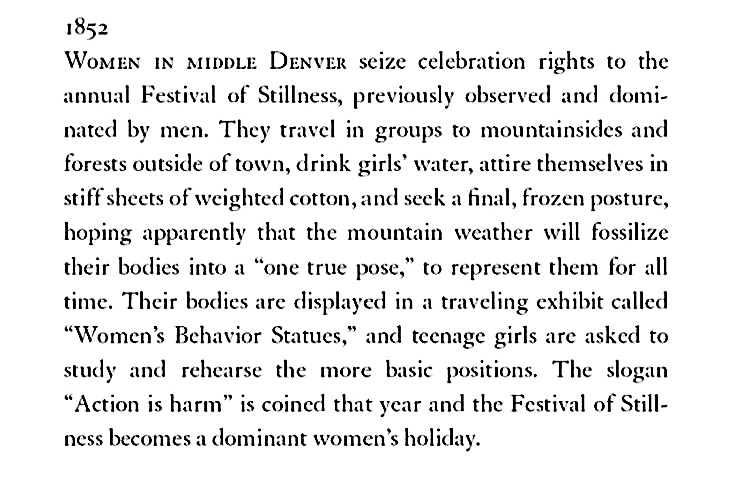
“1852” — Ben Marcus

Capture

“The Princess with the Lily-white Feet” — Ludmila Petrushevskaya

“The Princess with the Lily-white Feet” by Ludmila Petrushevskaya

Once upon a time there lived a Youngest Princess, and everybody loved her. She had tiny little hands like rose petals, and her tiny white feet were like lily petals. On the one hand, this was pretty, but on the other hand, the Youngest Princess was almost too delicate and sensitive – she’d cry at the slightest provocation. She wasn’t exactly reprimanded for it, but the family certainly didn’t condone such behaviour, either. “You can’t let yourself fall apart like that!” her Mama, Papa, Grandma, and King-granddaddy used to say. “You have to keep yourself in hand. You’re a big girl now.”

This would only hurt her feelings even more, and the Youngest Princess would take to crying again.

Nevertheless, there came a time when a Prince came to woo the Princess, which is the way it’s meant to be.

The Prince was tall, handsome, and gentle. “A fine pair!” everybody in the kingdom agreed.

The Prince and the Princess went on lots of walks, they danced together, and the Princess – and for her this was totally unheard of – wove flower garlands on the meadow for the Prince and for herself, garlands of cornflowers every bit as blue as the Prince’s eyes.

The Prince and the Princess were betrothed, which is the way it was meant to be – that is, they were declared fiancé and fiancée. Then the Prince rode back to his own kingdom.

The Youngest Princess stayed home and started crying. Everyone disapproved of such behaviour; they even called the doctor. The doctor talked a bit with the Princess and unexpectedly prescribed not sedatives, which is the way it’s meant to be, but pain pills. Because it turned out that the Youngest Princess had overexerted herself with all that dancing and walking and chafed her tender little hands and feet till they were sore and bleeding.

Time passed, the wedding grew near, but the bride kept crying, sitting in bed and favouring her bandaged hands and feet. She couldn’t walk or hold a cup of tea in her hands: she was fed by her old nurse, who held her cup for her, too.

The doctor, however, optimistically predicted that everything would heal up before the wedding, and said the Youngest Princess was simply too delicate and too sensitive, a crybaby with no self-discipline, and that was the fruit of her improper upbringing in the family, but as soon as the Prince returned she would get up and dance and move her hands just the way she used to. “It’s all psychological,” said the doctor, and kept feeding the Princess pain pills.

Then the old nurse gathered together some photos of the Youngest Princess and set off to see a sorcerer. She brought back an enigmatic answer: “He who loves, carries in his arms.”

This phrase soon became legendary with absolutely everybody who had loved the Princess so much since she was a baby, when she used to smile blissfully, showing her first four tiny teeth and the two little dimples in her cheeks, when her little ringlets were like golden silk, and her little eyes like forget-me-nots. Continue reading ““The Princess with the Lily-white Feet” — Ludmila Petrushevskaya”