Memories of Breece D’J Pancake

Read “Complicated Manners: Memories of Breece D’J Pancake” by Marion Field (in Oxford American). Excerpt:

The night before he died, Breece went to the movies with his girlfriend, Emily. They saw The Deer Hunter.

The next morning was Palm Sunday, and Emily went to church while Breece stayed home with a cold. He went later, to a 3 p.m. Mass, and stopped by Emily’s place to let her know he’d pick her up Monday morning so she could ride with him to an out-of-town job interview.

After Mass, he went home and drank a few beers.

Around 6 p.m., a neighbor’s girlfriend was startled by the dark shadow of a man she did not expect or recognize when she walked into her boyfriend’s home with a sack of groceries. She screamed and dropped the bag and Breece rose from a chair in the unlit kitchen. According to the complainant’s report to the sheriff’s office, “Mr. Pancake cornered her and explained that he had a drinking problem and had a tendency to wander around.”

In the half-hour between the moments the woman dropped her groceries and the police arrived, Breece’s landlady, Mrs. Meade, knocked on his door and told him that police were on their way to question him.

He called out from his room that he was sorry, and as the sirens neared, he walked outside with the only gun he hadn’t gifted off, a Savage Arms over/under shotgun, serial number B366615, sat down in a plastic folding chair beneath an apple tree, propped the gun on the ground with the muzzle in his mouth, and pulled the trigger.


John Barth on Italo Calvino and Jorge Luis Borges

The paralleli of the achievements of Borges and Calvino are mostly obvious, the relevant anti-parallelino doubt likewise. To begin with, both writers, for all their great sophistication of mind, wrote in a clear, straightforward, unmannered, nonbaroque, but rigorously scrupulous style. ”. . . crystalline, sober, and airy . . . without the least congestion” is how Calvino himself describes Borges’s style (in the second of his Six Memos for the Next Millennium, the Norton lectures that Calvino died before he could deliver), and of course those adjectives describe his own as well, as do the titles of all six of his Norton lectures: “Lightness” (Leggerezza) and deftness of touch; “Quickness” (Rapidita) in the senses both of economy of means and of velocity in narrative profluence; “Exactitude” (Esatezza) both of formal design and of verbal expression; “Visibility” (Visibilita) in the senses both of striking detail and of vivid imagery, even (perhaps especially) in the mode of fantasy; “Multiplicity” (Molteplicita) in the senses both of an ars combinatoria and of addressing the infinite interconnectedness of things, whether in expansive, incompletable works such as Gadda’s Via Merulana and Robert Musil’s Man Without Qualities or in vertiginous short stories like Borges’s “Garden of Forking Paths”—all cited in Calvino’s lecture on multiplicity; and “Consistency” in the sense that in their style, their formal concerns, and their other preoccupations we readily recognize the Borgesian and the Calvinoesque. So appealing a case does Calvino make for these particular half-dozen literary values, it’s important to remember that they aren’t the only ones; indeed, that their contraries have also something to be said for them. Calvino acknowledges as much in the “Quickness” lecture: ”. . . each value or virtue I chose as the subject for my lectures,” he writes, “does not exclude its opposite. Implicit in my tribute to lightness was my respect for weight, and so this apology for quickness does not presume to deny the pleasures of lingering,” etc. We literary lingerers—some might say malingerers—breathe a protracted sigh of relief.

Read the rest of John Barth’s essay “The Parallels!”.


“Two Friends” — Guy de Maupassant

“Two Friends” — Guy de Maupassant

Besieged Paris was in the throes of famine. Even the sparrows on the roofs and the rats in the sewers were growing scarce. People were eating anything they could get.

As Monsieur Morissot, watchmaker by profession and idler for the nonce, was strolling along the boulevard one bright January morning, his hands in his trousers pockets and stomach empty, he suddenly came face to face with an acquaintance—Monsieur Sauvage, a fishing chum.

Before the war broke out Morissot had been in the habit, every Sunday morning, of setting forth with a bamboo rod in his hand and a tin box on his back. He took the Argenteuil train, got out at Colombes, and walked thence to the Ile Marante. The moment he arrived at this place of his dreams he began fishing, and fished till nightfall.

Every Sunday he met in this very spot Monsieur Sauvage, a stout, jolly, little man, a draper in the Rue Notre Dame de Lorette, and also an ardent fisherman. They often spent half the day side by side, rod in hand and feet dangling over the water, and a warm friendship had sprung up between the two.

Some days they did not speak; at other times they chatted; but they understood each other perfectly without the aid of words, having similar tastes and feelings.

In the spring, about ten o’clock in the morning, when the early sun caused a light mist to float on the water and gently warmed the backs of the two enthusiastic anglers, Morissot would occasionally remark to his neighbor:

“My, but it’s pleasant here.”

To which the other would reply:

“I can’t imagine anything better!”

And these few words sufficed to make them understand and appreciate each other.

In the autumn, toward the close of day, when the setting sun shed a blood-red glow over the western sky, and the reflection of the crimson clouds tinged the whole river with red, brought a glow to the faces of the two friends, and gilded the trees, whose leaves were already turning at the first chill touch of winter, Monsieur Sauvage would sometimes smile at Morissot, and say:

“What a glorious spectacle!”

And Morissot would answer, without taking his eyes from his float:

“This is much better than the boulevard, isn’t it?”

As soon as they recognized each other they shook hands cordially, affected at the thought of meeting under such changed circumstances.

Monsieur Sauvage, with a sigh, murmured:

“These are sad times!”

Morissot shook his head mournfully.

“And such weather! This is the first fine day of the year.”

The sky was, in fact, of a bright, cloudless blue.

They walked along, side by side, reflective and sad.

“And to think of the fishing!” said Morissot. “What good times we used to have!”

“When shall we be able to fish again?” asked Monsieur Sauvage.

They entered a small cafe and took an absinthe together, then resumed their walk along the pavement.

Morissot stopped suddenly.

“Shall we have another absinthe?” he said.

“If you like,” agreed Monsieur Sauvage.

And they entered another wine shop. Continue reading ““Two Friends” — Guy de Maupassant” →
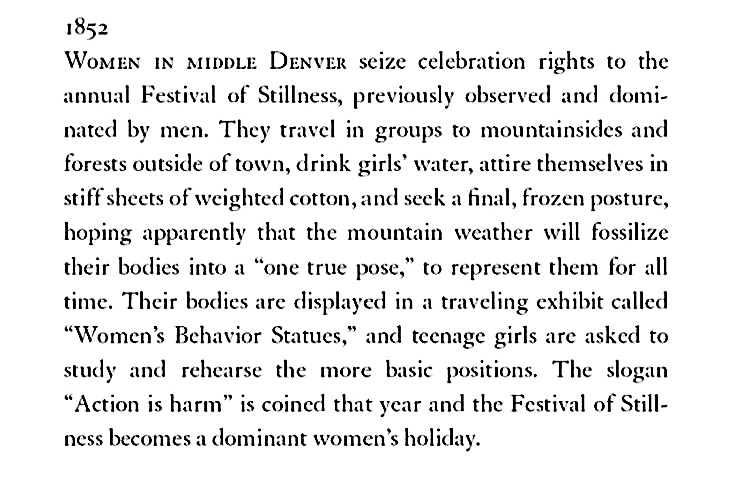
“1852” — Ben Marcus

Capture

“The Princess with the Lily-white Feet” — Ludmila Petrushevskaya

“The Princess with the Lily-white Feet” by Ludmila Petrushevskaya

Once upon a time there lived a Youngest Princess, and everybody loved her. She had tiny little hands like rose petals, and her tiny white feet were like lily petals. On the one hand, this was pretty, but on the other hand, the Youngest Princess was almost too delicate and sensitive – she’d cry at the slightest provocation. She wasn’t exactly reprimanded for it, but the family certainly didn’t condone such behaviour, either. “You can’t let yourself fall apart like that!” her Mama, Papa, Grandma, and King-granddaddy used to say. “You have to keep yourself in hand. You’re a big girl now.”

This would only hurt her feelings even more, and the Youngest Princess would take to crying again.

Nevertheless, there came a time when a Prince came to woo the Princess, which is the way it’s meant to be.

The Prince was tall, handsome, and gentle. “A fine pair!” everybody in the kingdom agreed.

The Prince and the Princess went on lots of walks, they danced together, and the Princess – and for her this was totally unheard of – wove flower garlands on the meadow for the Prince and for herself, garlands of cornflowers every bit as blue as the Prince’s eyes.

The Prince and the Princess were betrothed, which is the way it was meant to be – that is, they were declared fiancé and fiancée. Then the Prince rode back to his own kingdom.

The Youngest Princess stayed home and started crying. Everyone disapproved of such behaviour; they even called the doctor. The doctor talked a bit with the Princess and unexpectedly prescribed not sedatives, which is the way it’s meant to be, but pain pills. Because it turned out that the Youngest Princess had overexerted herself with all that dancing and walking and chafed her tender little hands and feet till they were sore and bleeding.

Time passed, the wedding grew near, but the bride kept crying, sitting in bed and favouring her bandaged hands and feet. She couldn’t walk or hold a cup of tea in her hands: she was fed by her old nurse, who held her cup for her, too.

The doctor, however, optimistically predicted that everything would heal up before the wedding, and said the Youngest Princess was simply too delicate and too sensitive, a crybaby with no self-discipline, and that was the fruit of her improper upbringing in the family, but as soon as the Prince returned she would get up and dance and move her hands just the way she used to. “It’s all psychological,” said the doctor, and kept feeding the Princess pain pills.

Then the old nurse gathered together some photos of the Youngest Princess and set off to see a sorcerer. She brought back an enigmatic answer: “He who loves, carries in his arms.”

This phrase soon became legendary with absolutely everybody who had loved the Princess so much since she was a baby, when she used to smile blissfully, showing her first four tiny teeth and the two little dimples in her cheeks, when her little ringlets were like golden silk, and her little eyes like forget-me-nots. Continue reading ““The Princess with the Lily-white Feet” — Ludmila Petrushevskaya” →

“Just mix up a mixture of theolologicophilolological” — Stephen Dedalus on Shakespeare

From Stephen Dedalus’s strange thesis on Shakespeare in episode 9 of James Joyce’s Ulysses–

— And the sense of property, Stephen said. He drew Shylock out of his own long pocket. The son of a maltjobber and moneylender he was himself a cornjobber and moneylender, with ten tods of corn hoarded in the famine riots. His borrowers are no doubt those divers of worship mentioned by Chettle Falstaff who reported his uprightness of dealing. He sued a fellowplayer for the price of a few bags of malt and exacted his pound of flesh in interest for every money lent. How else could Aubrey’s ostler and callboy get rich quick? All events brought grist to his mill. Shylock chimes with the jewbaiting that followed the hanging and quartering of the queen’s leech Lopez, his jew’s heart being plucked forth while the sheeny was yet alive: Hamlet and Macbeth with the coming to the throne of a Scotch philosophaster with a turn for witchroasting. The lost armada is his jeer in Love’s Labour Lost. His pageants, the histories, sail fullbellied on a tide of Mafeking enthusiasm. Warwickshire jesuits are tried and we have a porter’s theory of equivocation. The Sea Venture comes home from Bermudas and the play Renan admired is written with Patsy Caliban, our American cousin. The sugared sonnets follow Sidney’s. As for fay Elizabeth, otherwise carrotty Bess, the gross virgin who inspired The Merry Wives of Windsor, let some meinherr from Almany grope his life long for deephid meanings in the depths of the buckbasket.

I think you’re getting on very nicely. Just mix up a mixture of theolologicophilolological. Mingo, minxi, mictum, mingere.

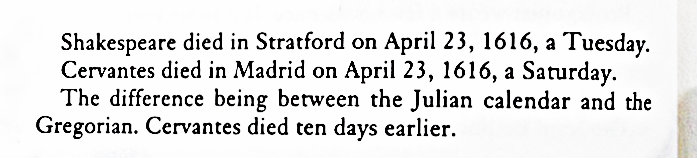
April 23, 1616 (David Markson)

dm


Spectrum Appearance of Banquo — Gustave Doré

Cordelia’s Portion — Ford Madox Brown

“The Bottle Imp” — Robert Louis Stevenson

“The Bottle Imp” by Robert Louis Stevenson

There was a man of the Island of Hawaii, whom I shall call Keawe; for the truth is, he still lives, and his name must be kept secret; but the place of his birth was not far from Honaunau, where the bones of Keawe the Great lie hidden in a cave.  This man was poor, brave, and active; he could read and write like a schoolmaster; he was a first-rate mariner besides, sailed for some time in the island steamers, and steered a whaleboat on the Hamakua coast.  At length it came in Keawe’s mind to have a sight of the great world and foreign cities, and he shipped on a vessel bound to San Francisco.

This is a fine town, with a fine harbour, and rich people uncountable; and, in particular, there is one hill which is covered with palaces.  Upon this hill Keawe was one day taking a walk with his pocket full of money, viewing the great houses upon either hand with pleasure, “What fine houses these are!” he was thinking, “and how happy must those people be who dwell in them, and take no care for the morrow!”  The thought was in his mind when he came abreast of a house that was smaller than some others, but all finished and beautified like a toy; the steps of that house shone like silver, and the borders of the garden bloomed like garlands, and the windows were bright like diamond; and Keawe stopped and wondered at the excellence of all he saw.  So stopping, he was aware of a man that looked forth upon him through a window so clear that Keawe could see him as you see a fish in a pool upon the reef.  The man was elderly, with a bald head and a black beard; and his face was heavy with sorrow, and he bitterly sighed.  And the truth of it is, that as Keawe looked in upon the man, and the man looked out upon Keawe, each envied the other.

All of a sudden, the man smiled and nodded, and beckoned Keawe to enter, and met him at the door of the house.

“This is a fine house of mine,” said the man, and bitterly sighed.  “Would you not care to view the chambers?”

So he led Keawe all over it, from the cellar to the roof, and there was nothing there that was not perfect of its kind, and Keawe was astonished.

“Truly,” said Keawe, “this is a beautiful house; if I lived in the like of it, I should be laughing all day long.  How comes it, then, that you should be sighing?”

“There is no reason,” said the man, “why you should not have a house in all points similar to this, and finer, if you wish.  You have some money, I suppose?”

“I have fifty dollars,” said Keawe; “but a house like this will cost more than fifty dollars.”

The man made a computation.  “I am sorry you have no more,” said he, “for it may raise you trouble in the future; but it shall be yours at fifty dollars.”

“The house?” asked Keawe. Continue reading ““The Bottle Imp” — Robert Louis Stevenson” →

Tim O’Brien Documentary

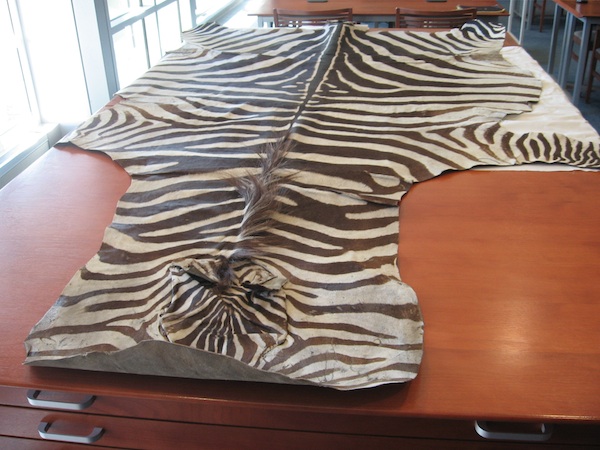
William Gaddis’s Zebra Skin

zebraskin

From Matthew Erickson’s article “Mysterious Skin: The Realia of William Gaddis” at The Paris Review. From the article:

What the researcher, or even the dilettante, might want to know is how an author’s material surroundings and posthumous personal effects might distill and leak into their work. Most often, the realia from a literary archive are the typical objects that we would associate with the physical act of writing, such as it is: fountain pens, stationery, reading glasses, ashtrays. Essentially, these objects are to dead authors what the items in Hard Rock Cafe display cases are to dead rock stars: memorabilia. Hendrix’s famous acid-soaked headband or Faulkner’s famous tin of beloved pipe tobacco, take your pick. This fact makes an author’s nonwriterly objects stand out and seem more significant, more imbued with potential coded meaning. Indeed, zebras and their skins do make appearances within Gaddis’s fiction, so the poor beast in the special collections isn’t entirely irrelevant when considering his corpus. A rolled-up zebra skin appears midway through Carpenter’s Gothic (“He’d kicked aside a cobwebbed roll of canvas, the black on white, or was it white on black roll of a hide …”), sporadically emerging from the silent background and into the incessant stream of dialog that makes up the majority of the text. In JR, the downtrodden composer Edward Bast is commissioned to write a score of “zebra music” for a documentary being made by the big-game hunter and stockbroker Crawley, in a lobbying effort to convince Congress to introduce various African species, zebras included, into the U.S. National Parks system…

“Sing to It” — Amy Hempel

“Sing to It”  by Amy Hempel

At the end, he said, No Metaphors! Nothing is like anything else.

Except he said to me before he said that, Make your hands a hammock for me. So there was one.

He said, Not even the rain—he quoted the poet—not even the rain has such small hands. So there was another.

At the end, I wanted to comfort him. But what I said was, Sing to it. The Arabian proverb: When danger approaches, sing to it.

Except I said to him before I said that, No metaphors! No one is like anyone else. And he said, Please.

So—at the end, I made my hands a hammock for him.

My arms the trees.

How I love the dying words (Henry Miller)

milleraquinas

“Yellow Coal” — Sigizmund Krzhizhanovsky

“Yellow Coal” by Sigizmund Krzhizhanovsky

1
The economic barometer at Harvard University had continually pointed to bad weather. But even its exact readings could not have predicted such a swift deepening of the crisis. Wars and the elements had turned the earth into a waster of its energies. Oil wells were running dry. The energy-producing effect of black, white and brown coal was diminishing yearly. An unprecedented drought had swaddled the sere earth in what felt like a dozen equators. Crops burned to their roots. Forests caught fire in the infernal heat. The selvas of South America and the jungles of India blazed with smoky flames. Agrarian countries were ravaged first. True, forests reduced to ashes had given place to ashy boles of factory smoke. But their days too were numbered. Fuellessness was threatening machines with motionlessness. Even glacier snow-caps, melted by the perennial summer, could not provide an adequate supply of waterpower; the beds of shrinking rivers lay exposed, and soon the turbine-generators would stop.

The earth had a fever. Flogged mercilessly by the sun’s yellow whips, it whirled round like a dervish dancing his last furious dance.

If nations had ignored political strictures and come to each other’s aid, salvation might have been theirs. But adversity only exacerbated ideas of jingoism, and soon all the New and Old World Reichs, Staats, Republics and Lands — like the fish on the desiccated bottoms of erstwhile lakes — were covered with a viscous sheath, swathed in borders like the filaments of cocoons, and raising customs duties to astronomical levels.

The one agency of an international sort was the Commission for the Access of New and Original Energies: CANOE. To the person who discovered a new energy source, a motive power as yet unknown on earth, CANOE promised a seven-figure sum.

2
Professor Leker was too busy to notice people. Blinkered by diagrams, thoughts, and pages from books, his eyes had no time to reflect faces. A frosted screen before the window shielded him from the street; the black case of an automobile, window curtains drawn, did likewise. Until a few years ago Leker had taught, then gradually given it up to devote himself full-time to his research into quantum theory, ionization, and the vicariate of the senses.

Thus Professor Leker’s twenty-minute stroll, his first in ten years, was pure accident. Leker set out in the company of his thoughts, without noticing places or faces. But the very first crossroad threw him into a quandary. The scientist was obliged to lift his head and gaze about to get his bearings. And here, for the first time, the street grated against his pupils.

A dingily bilious sun suffused the air through a tent of black clouds. Spitefully elbowing elbows, passers-by rushed along the pavement. People converged in the doorways of shops, tried to pummel their way through and stuck fast, faces flushed with rage and exertion, teeth bared.

The steps floating along the tram tracks were jammed with passengers: chests tried to climb up on backs; but the backs, flicking spiteful shoulder blades, would not budge; hands all in a tangle gripped the vertical handrails with rapacious vigour — like flocks of carrion crows fighting over prey.

The tram passed by, and behind it, as behind a curtain drawn back, a new scene unfolded across the street: two fist-shaking men were verbally assaulting each other; a circle of gloating pupils instantly formed round them and circling the circle another circle and another; while above the melee of shoulders raised sticks hovered.

Looking about him, Leker walked on. Suddenly his knee knocked into an outstretched hand. Protruding from dirty rags, the hand was demanding a donation. Leker dug in his pockets: he had no money on him. The open palm continued to wait. Leker again searched himself: nothing except a notepad. Without taking his gaze off the beggar, he stepped aside: the cripple’s eyes, half blind with pus, oozed with slime and an insatiable, impotent spite.

With greater and greater misgivings, Professor Leker scrutinized the street, gnashing with steel rims and humming with anxious human swarms. The people changed, yet remained the same: jaws clenched, foreheads butting the air, elbows endlessly elbowing their way. The famous physiologist first raised his eyebrows in astonishment, then knit them together the better to contain the thought fluttering behind them. Leker slowed his step and opened his notepad, searching for the exact words. Suddenly the stab of someone’s elbow deep in his ribs sent him staggering sideways: he hit his back against a post and dropped his slips of paper. Yet even the pain could not stop Leker smiling: his thought, tightly tied with associative threads, had been flung to the bottom of his brain. Continue reading ““Yellow Coal” — Sigizmund Krzhizhanovsky” →

Another paradox (David Foster Wallace)

This is another paradox, that many of the most important impressions and thoughts in a person’s life are ones that flash through your head so fast that fast isn’t even the right word, they seem totally different from or outside of the regular sequential clock time we all live by, and they have so little relation to the sort of linear, one-word-after-another-word English we all communicate with each other with that it could easily take a whole lifetime just to spell out the contents of one split-second’s flash of thoughts and connections, etc. — and yet we all seem to go around trying to use English (or whatever language our native country happens to use, it goes without saying) to try to convey to other people what we’re thinking and to find out what they’re thinking, when in fact deep down everybody knows it’s a charade and they’re just going through the motions. What goes on inside is just too fast and huge and all interconnected for words to do more than barely sketch the outlines of at most one tiny little part of it at any given instant. The internal head-speed or whatever of these ideas, memories, realizations, emotions and so on is even faster, by the way — exponentially faster, unimaginably faster — when you’re dying, meaning during that vanishingly tiny nanosecond between when you technically die and when the next thing happens, so that in reality the cliché about people’s whole life flashing before their eyes as they’re dying isn’t all that far off — although the whole life here isn’t really a sequential thing where first you’re born and then you’re in the crib and then you’re up at the plate in Legion ball, etc., which it turns out that that’s what people usually mean when they say ‘my whole life,’ meaning a discrete, chronological series of moments that they add up and call their lifetime. It’s not really like that. The best way I can think of to try to say it is that it all happens at once, but that at once doesn’t really mean a finite moment of sequential time the way we think of time while we’re alive, plus that what turns out to be the meaning of the term my life isn’t even close to what we think we’re talking about when we say ‘my life.’ Words and chronological time create all these total misunderstandings of what’s really going on at the most basic level. And yet at the same time English is all we have to try to understand it and try to form anything larger or more meaningful and true with anybody else, which is yet another paradox.

From David Foster Wallace’s short story “Good Old Neon,” collected in Oblivion.

I read “Good Old Neon” first back when Oblivion came out in hardback. It was good then, but it seemed more poignant and deeper after Wallace’s suicide. I reread it again last night, and I’m convinced it’s his finest discrete piece, and rivals some of the strongest sections of Infinite Jest and The Pale King. Anyway, I encourage doubters to check it out if they haven’t read it.

I’ll close by suggesting that in some way I think the story works through an idea from Ludwig Wittgenstein:

Death is not an event in life: we do not live to experience death. If we take eternity to mean not infinite temporal duration but timelessness, then eternal life belongs to those who live in the present. Our life has no end in the way in which our visual field has no limits. (Tractatus Logico-Philosophicus, 6.4311).

“The Hounds of Fate” — Saki

“The Hounds of Fate” — Saki

In the fading light of a close dull autumn afternoon Martin Stoner plodded his way along muddy lanes and rut-seamed cart tracks that led he knew not exactly whither. Somewhere in front of him, he fancied, lay the sea, and towards the sea his footsteps seemed persistently turning; why he was struggling wearily forward to that goal he could scarcely have explained, unless he was possessed by the same instinct that turns a hard-pressed stag cliffward in its last extremity. In his case the hounds of Fate were certainly pressing him with unrelenting insistence; hunger, fatigue, and despairing hopelessness had numbed his brain, and he could scarcely summon sufficient energy to wonder what underlying impulse was driving him onward. Stoner was one of those unfortunate individuals who seem to have tried everything; a natural slothfulness and improvidence had always intervened to blight any chance of even moderate success, and now he was at the end of his tether, and there was nothing more to try. Desperation had not awakened in him any dormant reserve of energy; on the contrary, a mental torpor grew up round the crisis of his fortunes. With the clothes he stood up in, a halfpenny in his pocket, and no single friend or acquaintance to turn to, with no prospect either of a bed for the night or a meal for the morrow, Martin Stoner trudged stolidly forward, between moist hedgerows and beneath dripping trees, his mind almost a blank, except that he was subconsciously aware that somewhere in front of him lay the sea. Another consciousness obtruded itself now and then—the knowledge that he was miserably hungry. Presently he came to a halt by an open gateway that led into a spacious and rather neglected farm-garden; there was little sign of life about, and the farm-house at the further end of the garden looked chill and inhospitable. A drizzling rain, however, was setting in, and Stoner thought that here perhaps he might obtain a few minutes’ shelter and buy a glass of milk with his last remaining coin. He turned slowly and wearily into the garden and followed a narrow, flagged path up to a side door. Before he had time to knock the door opened and a bent, withered-looking old man stood aside in the doorway as though to let him pass in.

“Could I come in out of the rain?” Stoner began, but the old man interrupted him.

“Come in, Master Tom. I knew you would come back one of these days.”

Stoner lurched across the threshold and stood staring uncomprehendingly at the other. Continue reading ““The Hounds of Fate” — Saki” →