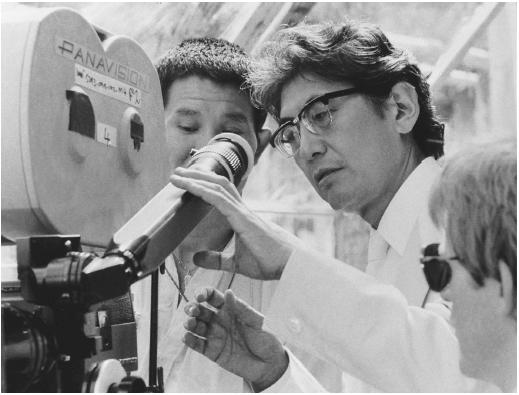
RIP Japanese filmmaker Nagisa Oshima, 1932-2013

Critic/contrarian Armond White has released his 2012 “Better Than” list, where he uses one film to pick on another. Great stuff, even if you disagree. A few samples:
Sacrifice > The Master
Chen Kaige finds the roots of culture in patriarchal responsibility; P.T. Anderson loses culture’s meaning in anti-religious hysteria and high-art folly. Chen also featured superior acting by competing father figures You Ge and Xuegi Wang.Holy Motors > Cosmopolis
Leos Carax’s dreamy limousine kineticism shamed Cronenberg’s oft-entrancing limousine stage drama. Carax parked and bloomed. Cronenberg parked then harangued.Dark Horse > The Turin Horse
Todd Solondz’s modern soap opera steadily, comically bored into our self-deceptions, while Bela Tarr’s highbrow jape steadily bored us.The Lady > Lincoln
Luc Besson’s bio-pic examined Aung San Suu Kyi’s marital and political commitment, while Spielberg’s unholy marriage to Tony Kushner pushed the cult of personality. Aphorisms vs. Propaganda.Ghost Rider: Spirit of Vengeance, Taken 2 > Zero Dark Thirty
Neveldine-Taylor and Olivier Megaton revealed the post-9/11 zeitgeist in genre tropes, while Bigelow reduced the zeitgeist to an enigmatic comic strip, a “mission accomplished” delusion.A Thousand Words > Argo
Brian Robbins and Eddie Murphy dared the most personal Hollywood critique since Clifford Odets’ The Big Knife; Ben Affleck trivialized Hollywood accountability.
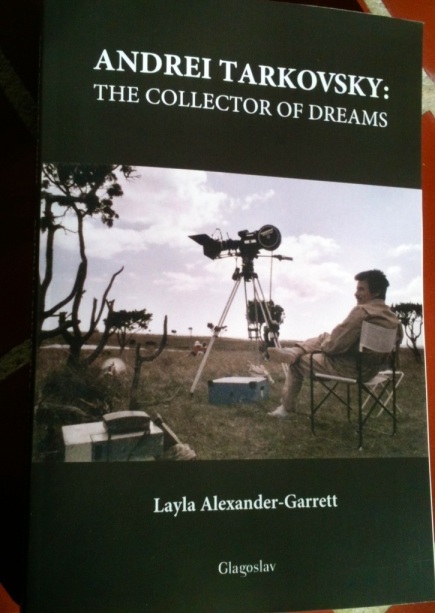
Layla Alexander-Garrett’s memoir Andrei Tarkovsky: The Collector of Dreams is new from Glagoslav. Their blurb:
The Sacrifice is Andrei Tarkovsky’s final masterpiece. The film was shot in Sweden, during the summer of 1985, while Tarkovsky was in exile; it turned out to be his final testament. Day after day, while the film was being made, Layla Alexander-Garrett – Tarkovsky’s on-site interpreter – kept a diary which forms the basis of her award-winning book Andrei Tarkovsky: The Collector Of Dreams. In this book the great director is portrayed as a real, living person: tormented, happy, inexhaustibly kind but at times harsh, unrelenting, conscience-stricken and artistically unfulfilled.
I’ve been riffling through it over the past few days. Alexander-Garrett describes her time with Tarkovsky in vivid detail—there’s a concrete richness to the book, and the author doesn’t try to psychoanalyze or interpret or otherwise interpose herself between the reader and the subject. More to come.
(I wrote about the film here).
 Biblioklept