Musician, writer, and filmmaker Paul Festa contacted me a few months ago to point out that I’d used a still of Harold Bloom from his film Apparition of the Eternal Church without crediting him. It was the nicest possible email in the world, and after a few pleasant exchanges, he sent me a copy of Apparition along with his new film, The Glitter Emergency. Both films are marked by humor, pathos, and a deep love for music. Paul was kind enough to talk with me about his work over a series of emails. For more info, check out his website.
Biblioklept: Your new film The Glitter Emergency is about a girl with a peg leg who dreams about being a ballerina. There’s a humor in the film that highlights some of the dramatic absurdity to the premise, but there’s also a lot of pathos there. How did the idea for the film come about?
Paul Festa: The germ of the plot itself came from an act Matthew Simmons had me accompany on violin many years ago, when his drag persona Peggy L’Eggs came out onstage as a one-legged ballerina on a rollerskate. But what precipitated the making of the film last year was a profound career crisis that came between the death of an extremely important and beloved mentor and my 40th birthday. I’d worked seriously – feverishly – to become a violinist, but a repetitive strain injury curtailed my musical career. Then I put all that energy and commitment into becoming a writer, but I didn’t achieve any success until almost by accident I became a filmmaker with my experimental documentary Apparition of the Eternal Church, a no-budget personal project that went on to screen throughout the US and Europe and win prizes and get very well reviewed. So at the age of 39 I found my energies and time divided between music, fiction and film, and none of the above had coalesced into a sustainable career and I still didn’t know, squarely into my middle age, what I was going to be when I grew up.
I spent December of 2009 and much of January lying awake through the night listening to my heart beat and it was in that period of grief for my mentor, and panic about my life, that I came up with the idea for this film that would be a comedic metaphor for my experience as an injured artist who finds his way back to his art through supernatural intervention. In the peg-leg ballerina’s case, it’s the vial of Enchanted Glitter; in my own case, it’s film, which enabled me to resume my life as a professional musician. And in both cases, it’s an enchantment much like Dumbo’s feather, a suspension of our self-doubt more than any external magical agent that permits us to do extraordinary things with our lives.
Biblioklept: The Glitter Emergency — at least most of it — is stylized as an early silent film: black and white, placards for dialog and titles, even the jumpiness of an old reel-to-reel machine is replicated. Was this form always part of the project? What prompted your decision to shoot the film this way?
PF: The silent-film aesthetic was there from the get-go, and for several reasons. First of all, the whole project is a star vehicle for Peggy L’Eggs, and as a film presence she was born sixty years too late — she’s Clara Bow and Lillian Gish and Stan Laurel all rolled into one. Second, the convention of silent film, with dialogue represented in intertitles, works perfectly with what I do at the intersection of music and film. In the usual relationship, music is there to serve film, to color it emotionally as soundtrack. What I do is the other way around – I’m using film to illuminate or dramatize music. And so the music has to play uninterrupted, and intertitles work perfectly. When you think of it, it happens in both my films – the last third of Apparition of the Eternal Church consists of silent images of the interview subjects, and text titles, and organ music accompanying.
I don’t have any formal education in film, but when I was a kid my father used to take me to the Avenue Theater out on San Bruno Avenue in San Francisco, where every Friday night they would show a silent film and an early talkie, the silent accompanied on the theater’s Wurlitzer by an old guy named Bob Vaughn who had accompanied these films when they first came out in the 20s. So the look and feel are second nature for me, as they are for my co-director Kevin Clarke, who came up with a lot of the signature silent-film flourishes in Glitter.
Biblioklept: You bring up your first film, Apparition of the Eternal Church, which again is obviously very much about music. The film begins by having a number of people listening to the music of Messiaen on headphones and reacting to it, discussing it, emoting to it, puzzling over it — but the music is withheld from the audience for quite some time. I found it very, very frustrating! Was this by design? What’s the story behind Apparition?
PF: I would never intentionally frustrate an audience, though I might withhold satisfaction for a half hour as Apparition does. The reason for the structure of that film is again to serve the music, to preserve our ability to hear it whole and to some extent on its own terms. I had filmmakers advise me that the film could only work if I dosed out the music in parcels, letting the audience hear it piece by piece, fading it in and out throughout the interviews. I never seriously considered this option – as the playwright Karen Hartman observes early in the film, you don’t talk over Messiaen! It’s not background music. So that is an experience – a trial – I reserved for the interview subjects and spared the audience. And I spared the music from being chopped up and presented piecemeal, which would have rendered it meaningless for the following reason: the piece is composed of two sonic pyramids, one short and preliminary, the next reaching up to what Messiaen understands to be God. If you present a pyramid in pieces, you have a pile of stones and they don’t do anything, much less ascend to heaven.
So my options were to play the music first, before the interviews, to play it after, or not to play it at all. I tend to think the option I chose results in the least frustration – but everyone experiences the film, and the music, differently.
Biblioklept: For the record, I don’t think the frustration is negative at all — the withholding primes anticipation to a level that passes, I don’t know, an itch, I suppose. I wanted to hear what your subjects were hearing. Speaking of the subjects, how did you get people involved in the film? There’s such a wide range of interviewees there, from Harold Bloom to Squeaky Blonde. How long did it all come together?
PF: The subject of frustration in Messiaen is interesting, because some people – including much more sophisticated musicians than I – find a disturbing lack of direction or resolution in his music. It’s static to them – it floats, an object in space that gets bigger or smaller as its relation to you changes, but beyond the change in that spatial relationship it’s not doing anything and it drives you bonkers. And I think that frustration is a species of the torture that eternity threatens, the emptiness of life without end. For theological reasons Messiaen can’t intend that dark gloss on eternal life, and it’s pretty far from my experience of the music, but plenty of people experience it. Hence John Rogers’s observation that despite what the composer intends to portray, “this is what hell is like.”
I interviewed 115 people for Apparition, and 31 are in the film — some of them for just one or two clips. The first interview was with the harpsichord virtuoso and early music guru Albert Fuller, who had taught me chamber music when I was a student at Juilliard in the early 90s, and who taught me in large part by putting on music and talking through it, describing what he heard in “the theater of his imagination,” as he called it. Albert’s interview was so great — so wide ranging ad surprising, starting in laughter and ending in tears — that I felt I needed to keep going. I interviewed pretty much everyone I could get to put on the headphones and sign a release – anyone who walked into my apartment. Several of my English mentors are in the film – I took Bloom’s Shakespeare seminar at Yale, and Rogers’s Milton and Spencer courses, and several classes with Wayne Koestenbaum. Michael Warner, who now heads the Yale English department, I met along with several other cast members in the woods of Tennessee at a gathering of the Radical Faeries. I spent most of three years collecting the interviews, a pace I recommend to anyone doing a project like this.
Biblioklept: You’ll be presenting both movies later this month (in Santa Cruz) with live musical accompaniment. Have you done that before? What can audiences hope to see and hear?
PF: Both Apparition of the Eternal Church and The Glitter Emergency are blessed with having had numerous screenings with live musical accompaniment. Apparition has screened accompanied by some great church organs in the US and Europe, including St. Bartholomew’s Church in New York and Grace Cathedral here in San Francisco. I’ve accompanied Glitter on violin at every public screening since we premiered the rough cut in May of last year. And while the two films have screened before as a double bill, this is the first time both will screen together with live music. In addition to the films and music, the audience should expect a robust discussion afterward. The screening is sponsored by UCSC, where both films screened last year to a terrific film history class where I got some of the most intelligent questions and commentary of any post-screening Q&A.
Biblioklept: Have you ever stolen a book?
PF: I’ve stolen a lot of books, most significantly Virginia Woolf’s Orlando and Thomas di Cantimpre’s Life of Christina Mirabilis. I’ve been boiling them down with some Bible and Franzen and a pinch of Milton and dimly remembered Steinbeck and any year now am expecting it to yield my first novel, Heaven Descending, a sort of bildungsroman amid a world of Hollywood lowlives and Radical Faerie medical marijuana farmers that sparkles with magical realism and catastrophic drug busts. In the fall I had seven weeks at Yaddo in which I laid the foundation for the fourth draft but work on two new films has prevented me from making any progress since New Year’s. Next year is a big year for the project; it turns 10.
The Glitter Emergency will have its Midwest premiere at the Chicago International Movies & Music Festival on Thursday, April 14, at 7:30 p.m., at the Wicker Park Art Center, launching a program that features Kenneth Anger’s two masterpieces, Lucifer Rising and Scorpio Rising – all with live musical accompaniment.
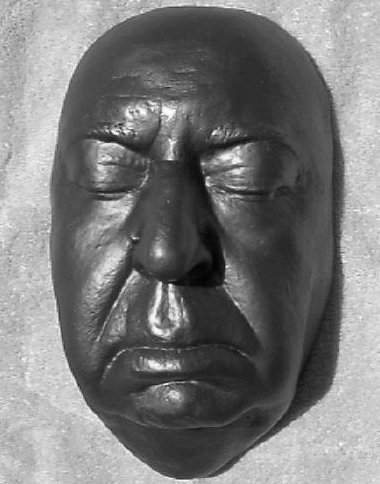
Alfred Hitchcock apparently didn’t care for eggs over easy. Or probably eggs at all. I love a runny yolk over some grits or hash browns.
I’m frightened of eggs, worse than frightened, they revolt me. That white round thing without any holes … have you ever seen anything more revolting than an egg yolk breaking and spilling its yellow liquid? Blood is jolly, red. But egg yolk is yellow, revolting. I’ve never tasted it.
From his 1997 interview with Charlie Rose (which Jesus yeah I know you’ve seen before, but hey, it’s worth reading this anecdote from the transcript), David Foster Wallace describes seeing David Lynch’s Blue Velvet—
The screen gets all fuzzy now as the viewer’s invited to imagine this. Coming out of an avant garde tradition, I get to this grad school and at the grad school, turns out all the teachers are realists. They’re not at all interested in post-modern avant garde stuff. Now, there’s an interesting delusion going on here — so they don’t like my stuff. I believe that it’s not because my stuff isn’t good, but because they just don’t happen to like this kind of esthetic.
In fact, known to them but unknown to me, the stuff was bad, was indeed bad. So in the middle of all this, hating the teachers, but hating them for exactly the wrong reason — this was spring of 1986 — I remember — I remember who I went to see the movie with — “Blue Velvet” comes out. “Blue Velvet” comes out.
“Blue Velvet” is a type of surrealism — it may have some — it may have debts. There’s a debt to Hitchcock somewhere. But it is an entirely new and original kind of surrealism. It no more comes out of a previous tradition or the post-modern thing. It is completely David Lynch. And I don’t know how well you or your viewers would remember the film, but there are some very odd — there’s a moment when a guy named “the yellow man” is shot in an apartment and then Jeffrey, the main character, runs into the apartment and the guy’s dead, but he’s still standing there. And there’s no explanation. You know, he’s just standing there. And it is — it’s almost classically French — Francophilistically surreal, and yet it seems absolutely true and absolutely appropriate.
And there was this — I know I’m taking a long time to answer your question. There was this way in which I all of a sudden realized that the point of being post-modern or being avant garde or whatever wasn’t to follow in a certain kind of tradition, that all that stuff is B.S. imposed by critics and camp followers afterwards, that what the really great artists do — and it sounds very trite to say it out loud, but what the really great artists do is they’re entirely themselves. They’re entirely themselves. They’ve got their own vision, their own way of fracturing reality, and that if it’s authentic and true, you will feel it in your nerve endings. And this is what “Blue Velvet” did for me.
I’m not suggesting it would do it for any other viewer, but I — Lynch very much helped snap me out of a kind of adolescent delusion that I was in about what sort of avant garde art could be. And it’s very odd because film and books are very different media. But I remember — I remember going with two poets and one other student fiction writer to go see this and then all of us going to the coffee shop afterwards and just, you know, slapping ourselves on the forehead. And it was this truly epiphantic experience.
Malick also tells us that “Badlands” features his one and only appearance as an actor. “This actor was supposed to show up at 9:30 in the morning for a small scene. We waited, the hours passed, and he didn’t show up. In the end we couldn’t afford to keep waiting, so I put on the cowboy’s hat and performed the part myself.”
“I prefer working behind the camera,” he added with a smile.


 Biblioklept